PSMA Organic Chemistry (PT 2)
 Call Kai
 Learn
Learn Practice Test
 Spaced Repetition
 Match
Match Flashcards
 Knowt Play
1/109

There's no tags or description
Looks like no tags are added yet.
Name | Mastery | Learn | Test | Matching | Spaced | Call with Kai | Chat |
|---|
No analytics yet
Send a link to your students to track their progress
110 Terms
isomers
these are compounds with the same molecular formula and same molecular weight but different structural formula, this differ in physical and chemical properties
Structural isomers
Constitutional isomers
Stereoisomerism
2 types of isomers
chain isomers
positional isomers
functional isomers
3 types of structural isomers:
chain isomers
Same molecular formula, but different arrangements of the carbon ‘skeleton’.
The positions of the carbon atoms can be rearranged to give ‘branched’ carbon chains coming off the main chain.
The name of the molecule changes to reflect this, but the molecular formula is still the same.
n-butane
2-methylpropane
example of chain isomers:
positional isomers
same molecule formula; same functional group, but its position in the molecule changes.
the name of the molecule changes to reflect the new position of the functional group
but-1-ene
but-2-ene
example of positional isomers:
functional isomers
same molecular formula but the atoms are rearranged to give different functional group.
the name of the molecule changes to reflect the new functional group.
ethanol
methoymethane
example of functional isomers:
constitutional isomers / structural
same atoms but linked together differently
same MF different connectivity
dimethyl ether C2H6O
ethanol C2H6O
example of constitutional isomers:
stereoisomerism
positioning the different functional groups in their site of action
optical isomer
geometric isomers
conformational isomers
three main groups of stereoisomerism:
Optical Isomer
Enantiomer - D and L forms
Diastereomer ex. Epimers
Conformational Isomers
Boat and Chair
optical isomer
ENANTIOMER - D and L forms
DIASTEROMER - ex. epimers
contain at least one asymmetric, or chiral carbon atom
each asymmetric carbon atom can exist in one of two non-superimposable isometric forms
chiral center or stereogenic center
differ by the placement of different substituents around one or more atoms in a molecule
different arrangements of these substituents can be impossible to superimpose.
chiral
carbons that have four non-identical substituents around it (chiral center or stereogenic center)
chiral

non-chiral

non-chiral

chiral

enantiomers
diasteriomers
2 types of stereoisomers:
Enantiomers
are mirror images of each other and non-superimposable
Diasteromers
are not mirror images of each other and non-superimposable
D-erythrose
D-threose
example of diastereomers:
Epimers
isomers differing as a result of variations in configuration of the -OH and -H on carbon atoms 2,3 and 4 of glucose are known as this
D-Galactose
D-Glucose
D-Mannose
examples of epimers:
Sinister
What does the “S” in (S)-enantiomer mean?
Rectus
What does the “R” in (R)-enantiomer mean?
clockwise
rotation of (+) dextrorotatory
counter clockwise
rotation of (-) levorotatory
geometric isomers
Cis and Trans
commonly exhibited by alkenes, the presence of two different substituents on both carbon atoms at either end of the double bond.
two different non-superimposable isomers due to the restricted rotation of the bond.
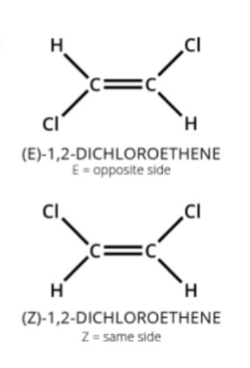
(E)- 1,2-Dichloroethene
(Z)- 1,2-Dichloroethene
E- opposite side (left)
Z- same side(right)
example of geometric isomers:
For morning sickness
(R)-thalidomide
Teratogenic
(S)-thalidomide
bioisosteres
groups that are spatially and electronically equivalent and, thus, interchangeable without significantly altering the molecules’ physicochemical properties.
enhance desired biological or physical properties
increased potency
decreased side-effects
increase duration of action
purpose of bioisosteres
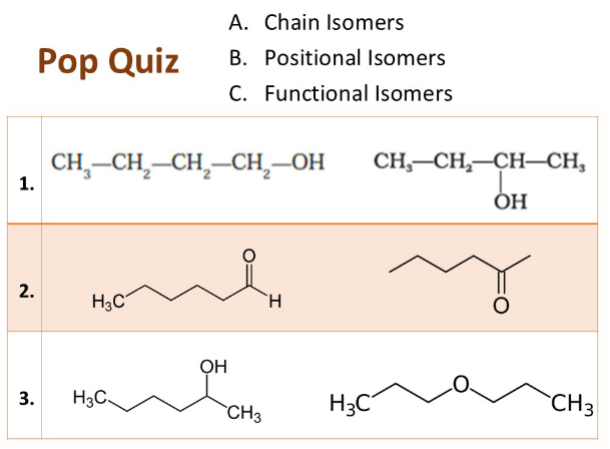
1. B. Positional Isomers
2. C. Functional Isomers
3. C. Functional Isomers
hydrocarbons
chemical compounds composed only of hydrogen and carbon atoms
alicyclic hydrocarbons
this group includes saturated and unsaturated cyclic hydrocarbons which resemble with the aliphatic hydrocarbons in properties.
pyridine
pyrimidine
purine
furan
imidazole
example of “Heterocyclic” in Alicyclic hydrocarbons
Aliphatic hydrocarbons
hydrocarbon compounds joined together in straight chains, branched chains or non-aromatic rings
alkanes
paraffins
sp3 hybrid
suffix ane
alkenes
olefins
sp2 hybrid
suffix - ene
alkynes
acetylenes
sp hybrid
suffix - yne
cyclic
prefix - cyclo
Aromatic Hydrocarbons
carbocylic compounds containing conjugated double bonds
Benzene
Simplest aromatic hydrocarbon
August Kekule (1865)
benzene ring as a flat molecule, having alternating single and double bonds between carbon atoms
p orbital overlap
Kathleen Lonsdale (1929)
used x-ray crystallography to show carbon-carbon bonds in a benzene ring are the same length.
delocalised electrons
Fluorobenzene
Chlorobenzene
Bromobenzene
Iodobenzene
Examples of “Halogen-Containing” Benzene Derivatives
Toluene
Cumene
Ethylbenzene
Styrene
Ortho-xylene
Meta-xylene
Para-xylene
Examples of “Hydrocarbon Derivatives” Benzene Derivatives
Phenol
Benzoic acid
Benzaldehyde
Acetophenone
Methyl benzoate
Anisole
Examples of “Oxygen-containing” Benzene Derivatives
Aniline
Nitrobenzene
Benzonitrile
Benzamide
Examples of “Nitrogen-containing” Benzene Derivatives
Benzenesulfonic Acid
Examples of “Sulfur-containing” Benzene Derivatives
Naphthalene
Anthracene
Examples of “Polyaromatics” Benzene Derivatives
aromatic compounds
it can form three disubstituted compounds namely 1,2 (ortho-) 1,3 (meta-) and 1,4 (para-) derivatives.
hydrocarbon derivatives
one or more hydrogen atoms in the molecules is replaced by certain group of atoms
Hydroxy Derivatives - Compounds containing a hydroxyl group (-OH), such as alcohols and phenols)
Ethers - Compounds featuring an oxygen atom connected to two alkyl or aryl groups (R-O-R’)
Carbonyl Compounds (Molecules containing a carbon double-bonded to an oxygen (C=O) primarily aldehydes and ketones.
Carboxylic Acids Compounds containing a carboxyl group (-COOH)
Amides - Derivatives of carboxylic acids where the -OH group is replaced by an amine derivative (-C(=O)NH2, -C(=O)NHR, or -C(=O)NR2)
Esters - Derivatives of carboxylic acids where the hydrogen of the carboxyl group is replaced by an alkyl group (-COOR)
Nitrogen Containing Compound - A broad class containing nitrogen atoms, such as amines (-NH2), nitriles (-CN), or nitro compounds (-NO2)
Alkyl Halides - (Haloalkanes): Hydrocarbons where one or more hydrogen atoms are replaced by a halogen (F, Cl, Br or I)
8 Functional Groups
carbonyl compounds
aldehydes
ketones
carboxylic acids
monocarboxylic acids
dicarboxylic acids
nitrogen containing compounds
amine
nitriles/cyanides
-ane
saturated (all C-C bonds)
-ene
unsaturated: one C=C
-diene
unsaturated: two C=C
-yne
unsaturated: one C≡C
-diyne
unsaturated: two C≡C
-enyne
unsaturated: one C=C and C≡C
-COOH
-oic acid
-carboxylic acid (NOT part)
carboxy-
representation of Carboxylic acid
-COOR
alkyl -oate
alkyl -carboxylate (NOT part)
alkoxycarbonyl-
representation of Ester
-COX
-oyl halide
-carbonyl halide (NOT part)
halocarbonyl-
representation of Acid halide
-CONH2
-amide
-carboxamide (NOT part)
carbamoyl-
representation of Acid amide
-CN
-nitrile
-carbonitrile (NOT part)
cyano-
representation of Nitrile
-CHO
-al
-carbaldehyde (NOT part)
oxo-
representation of Aldehyde
-CO-
-one
oxo-
representation of Ketone
-OH
-ol
-hydroxy
representation of Alcohol
-SH
-thiol
mercapto
representation of Thiol
-NH2
-amine
amino-
representation of Amine
=NH
-imine
imino-
representation of Imine
C=C
-ene
representation of Alkene
C☰C
-yne
representation of Alkyne
alcohols
with hydroxy (-OH) functional group
prefix - hydroxy
suffix - ol
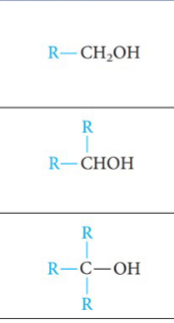
R-OH
primary
secondary
tertiary
according to the number of alkyl groups attached to the hydroxyl-bearing carbon
monohydric
dihydric
trihydric
according to the number of hydroxyl groups

methanol
“wood alcohol”
ethanol
“grain alcohol”
phenol
“carbolic acid”
Phenols
With hydroxyl (-OH) functional group attached to a carbon atom that is a part of an aromatic ring, Ar-OH
Catechol
Resorcinol
Quinol
Pyrogallol
Hydroxyquinol
Phloroglucinol
examples of Phenols:
Ethers
Alkoxy-substituted alkanes
R-O-R
Formed by the bimolecular dehydration of alcohols with sulfuric acid
methyl alcohol → dimethyl ether
ethyl alcohol → diethyl ether
examples of Ethers:
Aldehydes
Contains at least 1 hydrogen atom attached to the carbonyl carbon
RC=OH
Formed by oxidation of primary alcohols
Prefix – oxo
• Suffix – al
Methanal (Formaldehyde)
Ethanal (Acetaldehyde)
Propanal (Propionaldehyde)
examples of Aldehydes:
Ketones
Contains two carbon groups bonded to the carbonyl carbon
RC=OR
Formed by oxidation of secondary alcohols
Prefix – oxo
Suffix – one
Propanone (Acetone)
2-butanone (Ethyl methyl ketone)
3-pentanone (Diethylketone)
examples of Ketones:
Carboxylic Acids
Produced by oxidation of aldehydes
Contains the carboxyl functional group
RC=OOH
Suffix – oic acid
formic acid (methanoic acid)
acetic acid (ethanoic acid)
propionic acid (propanoic acid)
butyric acid (butanoic acid)
valeric acid (pentanoic acid)
caproic acid (hexanoic acid)
enanthic acid (heptanoic acid)
caprylic acid (octanoic acid)
pelargonic acid (nonanoic acid)
capric acid (decanoic acid)
Oxalic acid (ethanedioic acid)
malonic acid (propanedioic acid)
succinic acid (butanedioic acid)
glutaric acid (pentanedioic acid)
adipic acid (hexanedioic acid)
pimelic acid (heptanedioic acid)
examples of Carboxylic Acids:
Amides
Formed by the reactions of organic acids with ammonia or with amides
the least reactive of the common carboxylic acid derivatives
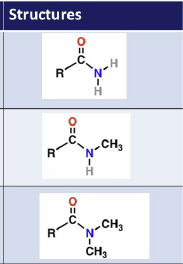
RC=ONH2
Suffix – amide
Primary amide
Secondary amide
Tertiary amide
Esters
Formed by the reactions of acids and alcohols with acid catalysts
derived from acids by replacing the -OH group by an -OR group and have the general formula RCOOR
Alkyl alkanoate, RC=OOR
Suffix – oate