Lecture 5: Computational models of speech production
 Studied by 0 people
 Call Kai
 Learn
Learn Practice Test
 Spaced Repetition
 Match
Match Flashcards
 Knowt Play
1/46

There's no tags or description
Looks like no tags are added yet.
Name | Mastery | Learn | Test | Matching | Spaced |
|---|
No study sessions yet.
47 Terms
methods to teach speech production
timing of speech onset, hesitations and pauses
tip-of-the-tongue state
speech errors
timing of speech onset, hesitations and pauses
-word representation in the lexicon compete for activation due to spreading activation
tip of the tongue state
-unable to retrieve the word you want
-can access syntactic elements of words but cannot retrieve phonemes to express the word
-shows the sentence is planned, syntax in place but struggle to retrieve sounds → specific levels of processing to produce speech
speech errors
-specific levels of processing are required to plan and articulate an utterance
-speech errors are systematic and tend to occur within specific processes:
semantic processing
syntactic and morphemic processing
articulation
semantic substitution errors
-correct word is replaced by one of similar meaning
-substituted and correct words belong to the same part of speech
-suggests speakers plan the grammatical structure of their next utterance before finding the precise words to insert into it
morpheme exchange errors
-involve inflections or suffixes being attached to the wrong word
subject-verb agreement errors
-singular verbs are mistakenly used with plural subjects or vice versa
Fromkin (speech errors)
-documented thousands of speech errors and defined them
-allows us to make inferences about cognition supporting speech
speech errors and processes
-speech errors tend to occur within the following processes rather than crossing boundaries between them:
conceptualisation - semantic blend errors → semantic processing
formulation - syntactic and morpheme exchange → syntactic and morphemic processing
articulation - word and phoneme exchange → form processing (articulation)
model of utterance generation (Fromkin)
meaning is generated
syntactic structure is generated and associated with semantic features
position of intonation/stress is planned
lexicon look-up → finds words and generates phonological segments
morphemic constraints are added and phonemes selected for utterance
serial processing → each stage must happen before another and cannot exchange information between stages
accommodating word exchange errors (Fromkin’s model of utterance generation)
lexicon look-up search error → look up two words and put them in the wrong place or confuse one concept for another
morphemic constraints are added and phonemes selected for utterance
stages of speech production
semantic level → meaning of what is to be said
syntactic level → grammatical structure of the words in the planned utterance
morphological level → morphemes (basic unit of meaning)
phonological level → phonemes (basic units of sound)
neural networks
-nodes represent groups of neurons
-activation of nodes spreads activation across the network
spreading activation
-activation of a node (corresponding to a word or concept) in the brain causes some activation to spread to several related nodes or words
Dell - spreading activation theory
-nodes that correspond to words or concepts within a network vary in activation or energy
-when a node or word is activated, activation or energy spreads from it to other related nodes or words
-this spreading activation is facilitated at every level of the speech activation process
categorical rules (spreading activation theory)
-categorical rules at the semantic, syntactic, morphological and phonological levels of speech production
-impose constraints on acceptable categories of items and combinations of categories
-rules define categories appropriate at each level
lexicon (spreading activation theory)
-form of connectionist network
-nodes for concepts words, morphemes and phonemes
-when a node is activated it sends activated to all the nodes connected to it
-the concept with the greatest activation that fits the target category will be selected
insertion rules (spreading activation theory)
-select items for inclusion in the representation of the to-be-spoken sentence according to the following criterion:
the most activated node belonging to the appropriate syntactic category is selected
after selection the node’s activation level immediately reduces to zero to prevent it from being selected repeatedly
syntactic traffic cop (spreading activation theory)
-monitors what we intend to say and inhibits words outside the appropriate syntactical category
spreading activation - semantic level (spreading activation theory)
-word with most activation is the one most likely to be produced/said and most likely the one we tried to activate
-but all other words are still activated and competing for selection
-have to activate relevant concept for communication
-but have similar ideas that compete for representation → but some concepts are activated more than others
-all information at semantic and phonological levels are activated at the same time
-these other levels can impact the other levels
spreading activation - phonemic level (spreading activation theory)
-words that sound like the target word or have similar sounds in the word to the target word are activated
-this occurs at the same time as spreading activation in the syntactic level
-the word that sounds the most similar is activated the most and is selected
cascaded interactive model (spreading activation theory)
-information is active in parallel → likely going to be an order in which things happen but this will not be discrete
-all of information at semantic level and phonological level is active at once
-information can influence information below → semantic level can influence down to phonological level which can influence certain phonological words → this then activates back and up and activates words in the brain at the semantic level
predictions (spreading activation theory)
-processing items that overlap in semantics and/or phonology will result in higher error rates than processing items that do not overlap
mixed-error effect (spreading activation theory)
-incorrect spoken word is semantically and phonemically related to the correct word
-suggests semantic and phonological factors can both influence word selection at the same time
-consistent with the idea that various levels of processing interact flexibly
lexical bias effect (spreading activation theory)
-speech errors typically consist of actual words rather than non-words
-because it is easier for words than non-words to become activated because they have representations in the lexicon
Griffin - method (spreading activation theory)
-wanted to see if information cascaded and if spreading activation would influence ways in which we produce speech
-measured onset of speech
-participants had to read an incomplete sentence and then name a picture → did not have to complete the sentence
-sentence would prime them to think about a particular concept, which would either be a:
semantic competitor
semantic and phonological competitor
unrelated word → not phonologically or semantically related to anything → should have no issue naming picture
Griffin - semantic competitor (spreading activation theory)
-semantically related to the image they were presented with
-sentence: “the woman went to the convent to become a…”
-should activate the word ‘nun’
-then presented with a picture of a priest → semantically related to a nun
-priest and nun compete for activation so participant has to inhibit saying nun so they say priest
-takes longer to sort through these competing concepts
Griffin - semantic and phonological competitor (spreading activation theory)
-homophone - same sound but different meaning
-study uses ‘nun’ and ‘none’
-sentence: “i thought there would be some cookies left, but there were…”
-should activate the word ‘none’ - phonologically this sounds like ‘nun’ so this competitor is semantic and phonological which demonstrates the cascade and interaction between the two levels → resulting in an error/slower to name
Griffin - results (spreading activation theory)
-participants were more likely to mistakenly produce the semantic or phonological + semantic competitor than they were to produce an unrelated word
semantic competitor → errors 20% of the time → indicative of spreading activation
semantic and phonological competitor → 8.5% for cookies condition → significantly more than control condition → shows information is processed at conceptual level down to phonological level but then phonological level can influence conceptual level
Griffin - conclusions (spreading activation theory)
-shows semantically and phonologically related items are active at the same time and can be selected for output
-shows semantic and phonological similarity can result in speech errors suggesting that processing is fluid and interactive
speech errors in Dell’s model (spreading activation theory)
-errors may occur due to more than one concept receiving the same amount of activation
-words cascading back up from phonological level may result in articles being misplaced or blended together
-however, the parallel processing in the model would predict that we make far more speech errors than we actually do
Word-form Encoding by Activation and Verification - Levelt (WEAVER++)
-focus on processes involved in producing individual spoken words
-feedforward activation-spreading network → activation can only proceed forward through the network and not backwards
-processing proceeds from meaning to sound only → discrete model
three levels (WEAVER++ model)
-from highest to lowest:
nodes → representing lexical concepts, figuring out what concept want to communicate
nodes representing lemmas from the mental lexicon
nodes representing word forms in terms of morphemes and their phonemic segments
lemmas (WEAVER++ model)
-word representations that are specified syntactically and semantically but not phonologically
-a given lemma is generally selected because it is more activated than other lemmas
-lemma is selected before starting to work out the sound of the selected word
competitive process (WEAVER++ model)
-lexical selection depends on a competitive process based on the number of lexical units activated
-spreading activation happens at the semantic level
-speech production following lexical selection involved various processing states following each other in serial fashion
-there is a checking mechanism that prevents concepts from being activated if they are not being carried forward to the next level → done via inhibition (stops them being activated and so harder to access)
inhibition (WEAVER++ model)
-items that are semantically similar will inhibit processing
-so concepts are no longer relevantly accessible
-speech errors are avoided by means of a checking mechanism based on the speaker monitoring what they say
Wheeldon & Monsell - method (WEAVER++ model)
answer a question out loud
name a picture
-answer to the question was either semantically related to the picture or unrelated
-testing whether semantically related concepts are more difficult to access after they have been inhibited
Wheeldon & Monsell - results (WEAVER++ model)
-slower reaction times for semantically related items
-concepts that have been semantically related have been inhibited compared to items that are not semantically related and not inhibited
-semantically related items inhibit processing of each other → suggesting speech production processes are discrete
speech errors in Levelt’s model
-errors may occur if the wrong concept is selected and processed to the phonological level
-two concepts that are both viable options for the utterance could be selected and processed to the phonological level
tip of the tongue state and lemmas (WEAVER++ model)
-lemmas contain syntactic information
-tip of the tongue state speakers know the grammatic gender of the word and the semantic information of the word (like lemmas)
-but cannot access the phonological form of the word
-suggests evidence for the lemma and that it is a separate process from the phonological stage
Meyer & Damian - method (evidence for Levelt or Dell)
-participants instructed to say name of item in green and ignore item in red
-items were either phonologically related or not phonologically related
doll is green
dog is red
so say doll and ignore dog
-dog and doll are phonologically related → doll is target word
Meyer & Damian - prediction based on Dell model (phonologically related condition)
-access concept we want to activate - activate both dog and doll due to spreading activation
-process both of these to morpheme level which allows us to produce phonology for the word
-dog and doll share some phonemes so there is increased representation for these phonemes to be activated at the same time
-both words become readily active at phonological level at the same time
-both are readily accessible so should be able to produce both words fairly quickly
Meyer & Damian - prediction based on Dell model (phonologically unrelated condition)
-will process both phonologically unrelated words from conceptual level and both become active but separately
-no overlap in phonology so have two functional but separate and not overlapping representations
Meyer & Damian - prediction based on Levelt model (phonologically related condition)
-only process down to the level of the lemma
-will inhibit the one we are not interested in and will process down to the lemma level for doll
-then access morphology and phonology for doll
-no overlapping representations of phonemes for dog and doll
Meyer & Damian - prediction based on Levelt model (phonologically unrelated condition)
-exactly the same as the phonologically related condition
-will process down to the lemma level and access morphology and phonemes of doll
Meyer & Damian - semantic interference (evidence for Levelt or Dell)
-want to see if phonologically related words have a difference in how quick we are able to produce the target word
Dell predictions → words that are phonologically related have a higher level of activation so should be able to say these words quicker than if the words were phonologically unrelated
would not see this in Levelt’s model as this higher activation is inhibited
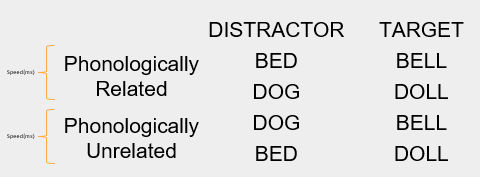
Meyer & Damian - results (evidence for Levelt or Dell)
-found that we can say phonologically related items much quicker
-both dog and doll are activated and this doubles the representation of shared phonemes so it is more accessible and a heightened representation
-allows us to access and produce target word more quickly compared to phonologically unrelated words
-shared phonological activation is not seen in Levelt model
-so this evidence supports Dell’s model