Bioavailability and First past metabolism
 Call Kai
 Learn
Learn Practice Test
 Spaced Repetition
 Match
Match Flashcards
 Knowt Play
1/15

There's no tags or description
Looks like no tags are added yet.
Name | Mastery | Learn | Test | Matching | Spaced | Call with Kai | Chat |
|---|
No analytics yet
Send a link to your students to track their progress
16 Terms
Routes of administration
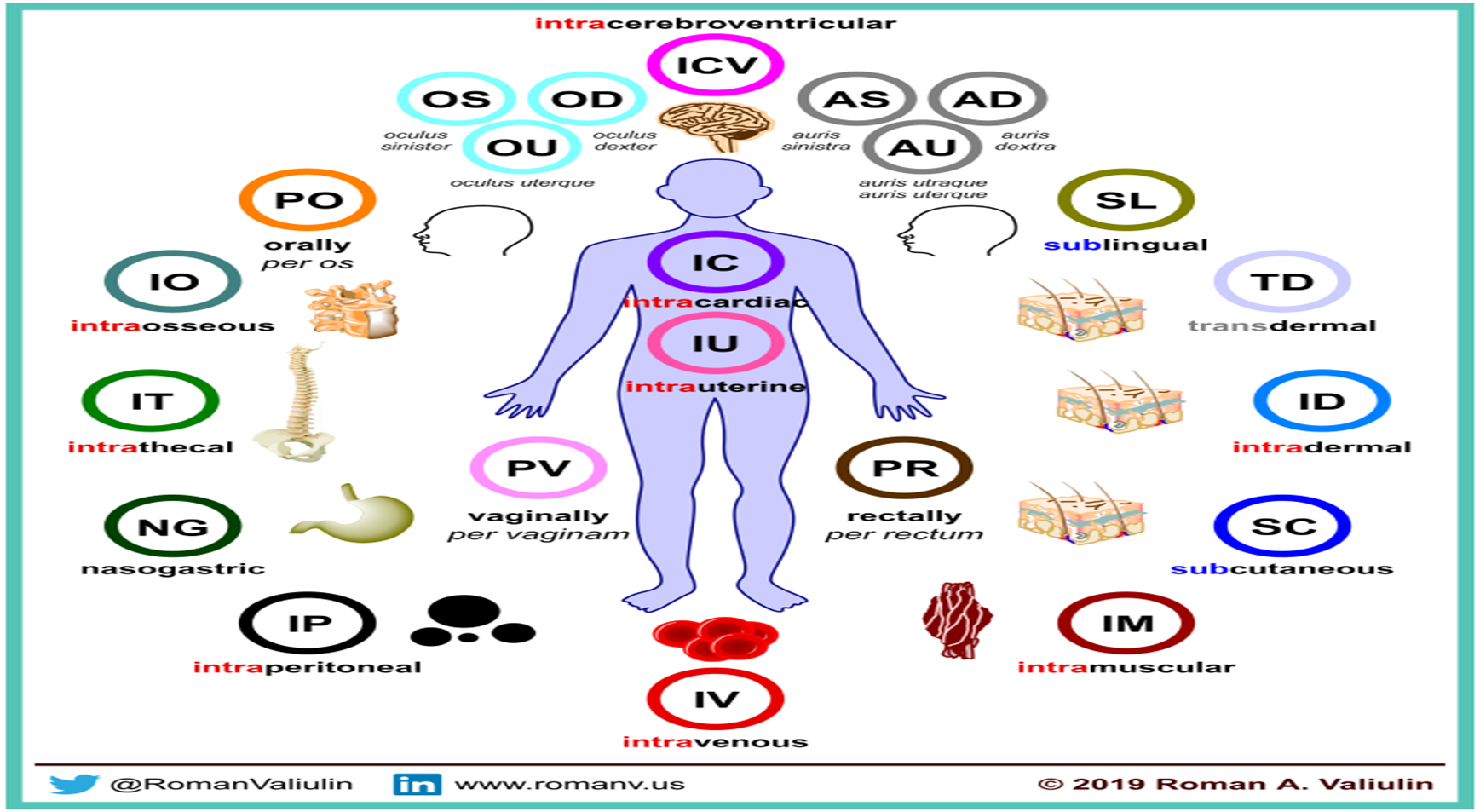
Enteral absorption
is absorption via the GI (gastrointestinal) tract/ small intestine for example oral, sublingual/buccal and rectal. You swallow it and it starts to work when it hits the stomach.
Parenteral absorption
It avoids the GI pathway to enter the systemic circulation (injections for example IM, IV, subcutaneous.). This method bypasses the gastrointestinal (GI) tract and the first-pass metabolism in the liver.
Topical
For example: epidermic, swabbing, installation
inhalation
For example: vaporization, gas inhalation and nebulization
Pros of oral administration
Easy, cheap and convenient; low infection risk; painless
Cons of oral administration
Exposed to GI tract; First Pass metabolism; Loss through vomiting
Pros of intravenous administration
Fast delivery to site; Avoids GI exposure; Avoid First Pass, increased bioavailability
Cons of intravenous administration
Infection risk; Pain/fear factor; administered by trained person
Bioavailability
Is the amount of the drug that reaches the systemic circulation after it is administered. Or the fraction (F) of an administered dose of drug that reaches the systemic circulation in its active form.
Oral medication and bioavailability
Oral medication has a low bioavailability due to the hostile environment in the stomach. A lot of the drugs are wasted/lost when it enters the stomach. This is why oral medication has regular dosing schedules. But its cost effective.
-Oral and other non IV routes bioavailability depends on:
-Absorption rate
-Drug formulations
-GI conditions
-First pass metabolism
Example in action- bioavailability
•If 100mf of a druf is given orally and 50mg reaches systemic circulation unchanged, its bioavailability is 50% (F = 0.5)
IV medication and bioavailability
IV medication has 100% bioavailability because is not affected or damaged by the stomach and it immediately enters the systemic circulation. It works very quickly but its not suitable for home etc.
-•Absorption phase is bypassed (drug enters the systemic circulation immediately)
First pass metabolism
Process where the concentration of an orally administered drug is significantly reduced before reaching the systemic circulation.
•Bioavailability - reduced, sometime dramatically.
•Higher oral doses - may be required to achieve same effect
First pass metabolism- process
When a drug is swallowed, it travels through the digestive system and is absorbed into the blood vessels of the small intestine. This blood is then collected in the hepatic portal vein and routed directly to the liver before being distributed to the rest of the body.
During this "first pass" through the liver and gut, enzymes (such as cytochrome P450 enzymes) metabolize the drug, often converting the active substance into inactive metabolites. As a result, only a fraction of the original dose reaches the bloodstream to exert a therapeutic effect.
in short terms:
Oral medication enters the stomach
It breaks down and enters the liver via the hepatic portal vein
The process destroys a lot of the drug, as much as 90% is lost
it then enters the systemic circulation. This explains why drug dosing is so variable
in regards to oral medication is when its absorbed in the GI tract and metabolised in the liver before entering the systematic circulation. This reduces its bioavailability of the drug.
Examples of FPM in action
-Propranolol – extensive hepatic metabolism, low oral bioavailability
-Glyceryl trinitrate (GTN) – almost completely metabolised orally – given sublingually
-Morphine – significant metabolism reduces oral potency