GCSE RS Paper 1 denominational beliefs (Christianity & Judaism)
 Call Kai
 Learn
Learn Practice Test
 Spaced Repetition
 Match
Match Flashcards
 Knowt Play
1/77

Earn XP
Description and Tags
first side is the belief, second side is the denomination
Name | Mastery | Learn | Test | Matching | Spaced | Call with Kai | Chat |
|---|
No analytics yet
Send a link to your students to track their progress
78 Terms
reconciliation is a sacrament
catholic
day of prayer for victims of human trafficking
salvation army
offer food banks, emergency assistance, employment support, debt advice
salvation army
CAFOD - fair trade initiatives (fair wages, good conditions)
catholic aid charity
relationships must only be loving, monogamous and committed
quaker
which 2 christian denominations have usually similar beliefs
catholic & orthodox
what christian denomination is usually more strict
evangelical
recognises the process of science in explaining creation & origins of life. the big bang happened but god was behind it
the earth is as old as scientists say (~4 bil years)
genesis as a metaphor - most important thing is the message
catholic
(christian) the soul is immediately judged on your actions when you die
protestant
(christian) when you die your soul waits until the day of judgement when the dead will be raised & return to god. everyone will come before god to be judged based on christian faith & behaviour. non christians & christians who haven’t repented for sins will go to hell
evangelical protestant
soul is immediately judged and go to heaven / purgatory / hell straight away. on the day of judgement jesus will come back to earth, raise the dead, and souls will be reunited with their bodies. god will judge everyone and souls in purgatory go to heaven
catholic
you’re saved by grace through faith working itself out in love. grace is god’s free gift but needs to be responded to with faith and work itself out in love (doing good deeds). faith without works is dead
catholic
salvation is continuous - you must continually go back to jesus & build a relationship with him through action. we’re saved by god but must apply ourselves & work at it
orthodox
liturgical worship x4
catholic, orthodox, anglican, cofe
non-liturgical worship x4
methodist, baptist, pentecostal, quaker
worship: hymns, lavish gold decorations, incense, crucifixes, congregation in pews, led by priest who performs rituals, set responses & repetitions from congregation
catholic
worship: icons, candles, priest carrying bible + with special dress, women covering heads, singing, hymns, chanting, incense, lavish decorations, worship with all senses
orthodox
worship: priest talking while modern style music plays, informal party-like atmosphere, congregation sings along to songs, charismatic worship eg speaking in tongues
pentecostal
worship: sitting in silence together in a circle where all face in, anybody is free to stand up and speak at any time, belief that holy spirit exists in everyone
quaker
infant baptism x2
orthodox, catholic
beleiver’s baptism x4
baptist, protestant, evangelical, pentecostal
different names for holy communion: mass, divine liturgy, lord’s supper
mass = catholic
divine liturgy = orthodox
lord’s supper = protestant
transubstantiation (bread & wine turn into jesus’ blood & body)
catholic
no transubstantiation (bread & wine represents jesus’ body & blood but aren’t actually it)
orthodox
divine liturgy: prayers, scripture readings, hymns, and processions culminating in the consecration and sharing of Holy Communion, followed by thanksgiving and dismissal
orthodox
christmas: advent preparations, special Masses and services celebrating Jesus’ birth, followed by feast days and a focus on peace at the start of the new year.
catholic
christmas: fasting, a midnight liturgy celebrating Jesus’ birth, followed by symbolic rituals like a cross procession and the blessing of water.
orthodox
easter: a series of services during Lent and Holy Week that reflect on Jesus’ death and resurrection, culminating in Easter celebrations, Holy Communion, and acts of charity.
catholic
easter: a period of fasting and preparation followed by Holy Week services that culminate in midnight celebrations of Jesus’ resurrection and joyful feasting on Easter Sunday.
orthodox
easter: traditions centre on deeply symbolic services and processions mourning Jesus’ death and celebrating his resurrection, culminating in midnight celebrations and joyful family gatherings.
eastern orthodox
provides widespread community support through services like homelessness aid, financial advice, food banks, and programs that bring people together and support families
salvation army
jews who emphasise the importance of following the laws & guidance of the Torah, and that it was given directly to Moses so should be followed as closely as possible
orthodox
jews who believe that the laws & guidance in the Torah was inspired by God but written by men, so can be interpreted according to the times
reform
Jews who are more committed to strictly following the laws and guidance in the Torah. They try to adhere to all of the Mitzvot, don’t believe in modernisation, and are often more segregated communities.
ultra-orthodox
(judaism) the creation story the literal truth and that it happened around 6000 years ago, and they reject the scientific research on evolution.
orthodox
(judaism) accept that evolution may be correct and that the universe is older, but that God still made everything happen. They still believe that God is the creator, but believe the Genesis story to be more of a metaphor.
reform
(judaism) resurrection when the messiah comes - righteous dead will be brought back to life, but the wicked dead won’t
orthodox
a future descendant of King David will become the Messiah, restoring Israel, upholding the Torah, and bringing peace and unity to the world.
orthodox
generally rejects a personal Messiah, instead teaching that a peaceful “messianic age” will be achieved through the collective efforts and ethical actions of humanity.
reform
(judaism) life is a gift from God, so euthanasia and assisted suicide are wrong, emphasising care, hope, and support through suffering instead.
orthodox
(judaism) in cases where life is being artificially prolonged without cure, such as through a ventilator, it may be acceptable to withdraw treatment to allow a natural and dignified death, especially to relieve severe suffering.
reform
emerged in 19th-century Germany as a movement led by rabbis like Abraham Geiger, aiming to modernise Jewish practice by adapting traditions, services, and laws to contemporary life. only believe in following moral mitzvot
reform
the Torah and all mitzvot remain divinely important and must be fully observed, rejecting modernisation of religious law and maintaining traditional Jewish practice in daily life. follow all mitzvot
orthodox
The Pittsburgh Platform teaches that Judaism is a modern, ethical religion rather than a national or ritual system, accepting scientific understanding and other faiths, and focusing on moral laws while rejecting many traditional practices like dietary laws, ritual purity, belief in bodily resurrection, and the expectation of a return to Israel.
reform
has the mechitza (partition separating men & women) in the synagogue
orthodox
men & women can sit together in the synagogue
reform
a raised gallery runs around the top of the synagogue, and this was where the women would pray, in order to be separate from the men.
orthodox
synagogue practice includes services in the local language, mixed seating for men and women, adapted prayers and modern wording about God, and continued emphasis on the covenant with God through the Siddur and worship.
reform
dietary rules are more lenient - choose for themselves what they do/don’t eat
reform
believe they are ‘stewards of the earth’ meaning that they have to protect the earth, and this includes Tikkun Olam (repairing the world) and Tzedakah (obligatory charity)
reform + orthodox
some choose not to follow some of the stricter shabbat rules e.g. not driving or not turning lights on. Shabbat is more about relaxing, reflecting, and connecting with family at the end of the week.
reform
The Tallit is the prayer shawl that is worn every morning (including shabbat) while doing prayers
The Tefillin is worn on weekday mornings (not shabbat because putting in on is classified as work in the torah). One is put on the head and one is wrapped on the arm in a specific way
orthodox
Yeshiva is a Jewish university which some jews will decide to go to
orthodox
Tikkun Olam is very important, and 10% of their earnings will go to charity
orthodox
Kashrut (food laws) are important, and kosher is kept very closely
orthodox
Prayer services are held entirely in Hebrew
orthodox
Shabbat laws are kept closely - no turning lights on, no cooking food, no driving, etc
orthodox
men have to try to go the synagogue three times a day, whereas women aren’t obligated to go at all, as stated by the time-bound laws that exist to accommodate a woman’s traditional domestic duties, which may not allow them to leave the home that many times a day.
orthodox
differences in the synagogue
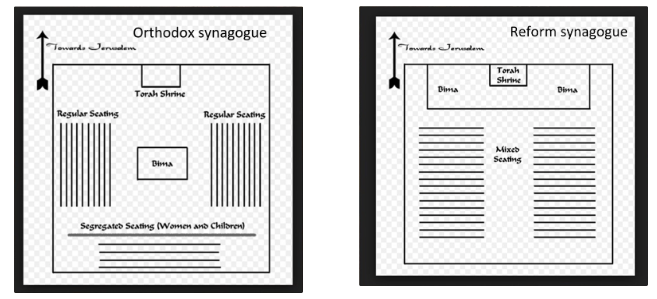
bimah in the middle of the congregation
orthodox
bimah at the front of the congregation
reform
only men rabbis
orthodox
women can be rabbis
reform
(judaism) some scripture in has been amended to accommodate their ideas
reform
it is believed this the torah was told to Moses on mount Sinai by God, so it is of divine origin, hence being considered the words of God.
orthodox
view the Mishnah as the Oral Torah, with almost equal importance to the Written Torah. Many study a page of the Talmud daily.
orthodox
see the talmud as divinely inspired, but not divinely authored - written by humans. The Talmud guides their lives, but does not dictate them.
reform
the ceremony of the redemption of the firstborn son (Pidyon Haben) symbolically “releases” a firstborn male from ancient priestly dedication by having parents give a small payment to a Kohein (priest) along with blessings and ritual questions and responses.
orthodox
families may not have a brit bat ceremony at all, or maybe just a small meal in celebration at home.
orthodox
Brit Bat is a naming service where baby girls are blessed in the synagogue, their Hebrew name is announced, and parents offer prayers for the child and mother, welcoming the child into the Jewish covenant.
reform
girls do the same as boys on their Bat Mitzvahs (read from the Torah and give a speech)
reform
girls might have a smaller ceremony (called Bat Chayil) where they recite a Hebrew passage called Eishet Chayil about their importance as Jewish women.
orthodox
When they date, they date one person at a time with the intention of marriage, but without any physical contact - not even holding hands
orthodox
has generally changed most marriage traditions to be more equal and modernised the ceremony
reform
marriage includes preparatory rituals like separation before the wedding, the Ufruf blessing in synagogue, and purification in the Mikveh, followed by a formal ceremony under the Chuppah with the signing of the Ketubah, exchange of a plain ring, sharing wine, veiling, symbolic circling, breaking a glass to remember the Temple’s destruction, and a final private seclusion (Yichud), all emphasising holiness, tradition, and community.
orthodox
adapted the ketubah (marriage contract) to be more equal & inclusive
reform
generally rejects kashrut, viewing dietary laws as non-binding and potentially restrictive, and instead prioritises moral laws that enhance spiritual life and ethical living.
reform
teaches that kashrut is fully binding as part of the unchanging Torah, requiring strict observance of dietary laws, which reinforce holiness, Jewish identity, and obedience to God as a central part of religious life.
orthodox