Lecture 2/9 How endorgonic reactions are favored
 Call Kai
 Learn
Learn Practice Test
 Spaced Repetition
 Match
Match Flashcards
 Knowt Play
1/3

There's no tags or description
Looks like no tags are added yet.
Name | Mastery | Learn | Test | Matching | Spaced | Call with Kai | Chat |
|---|
No analytics yet
Send a link to your students to track their progress
4 Terms

How can Exergonic reactions be used to favor endorgonic reactions (in the context of this image)?
If an Exergonic reaction’s Substrate is an Endergonic reaction’s Product, the exergonic reaction will keep the endorgonic reaction out of equillbrium because it keeps on using up it’s product, as it’s substrate
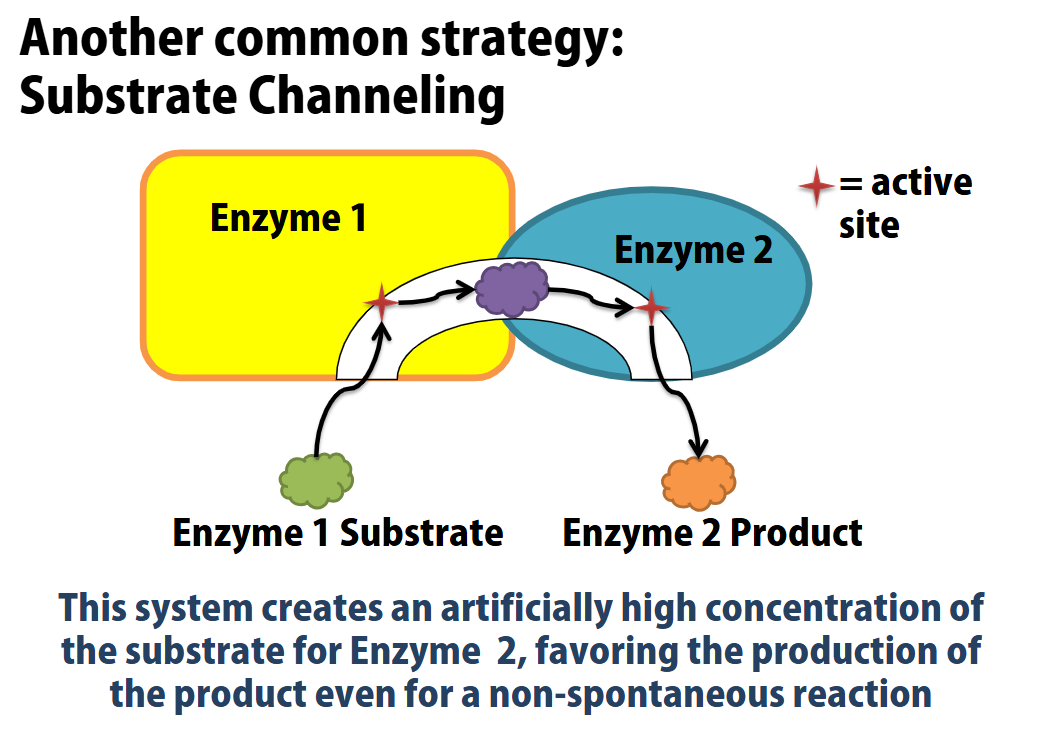
How can substrate channeling favor endorgonic reactions?
When two enzymes are linked together (i.e substrate channeling), assuming that the product of the first enzyme is used as the substrate of the 2nd, the 2nd enzyme would be creating a reaction more often (than if it wasn’t connected to the 1st enzyme), since it immediately has it’s reactants needed (rather than having to wait to find some free-floating reactants, if it were all alone ☹ ). If the second enzyme is used for an endorgonic reaction, this is how the endorgonic reaction could be favored.
In the context of ATP Hydrolysis, how can Energy Coupling be used to favor endorgonic reactions?
When the catabolic reaction of ATP Hydrolysis produces ADP and a phosphate group, the phosphate group can be added to an endorgonic reaction’s substrate creating a high energy intermediate that undergoes a catabolic reaction to create the original endorgonic reaction’s product. NOTE THAT the newly created product has more energy than the original reactant, but less energy than the high-energy intermediate.
HI