Cell: The Unit of Life
 Call Kai
 Learn
Learn Practice Test
 Spaced Repetition
 Match
Match Flashcards
 Knowt Play
1/11

Earn XP
Description and Tags
Vocabulary flashcards covering the introductory concepts of biology, the definition and discovery of cells, and types of organisms based on cell count.
Name | Mastery | Learn | Test | Matching | Spaced | Call with Kai | Chat |
|---|
No analytics yet
Send a link to your students to track their progress
12 Terms
Biotic (Animate)
A state of being living, characterized by the presence of at least one cell.
Abiotic (Inanimate)
A state of being non-living, characterized by the absence of a cell.
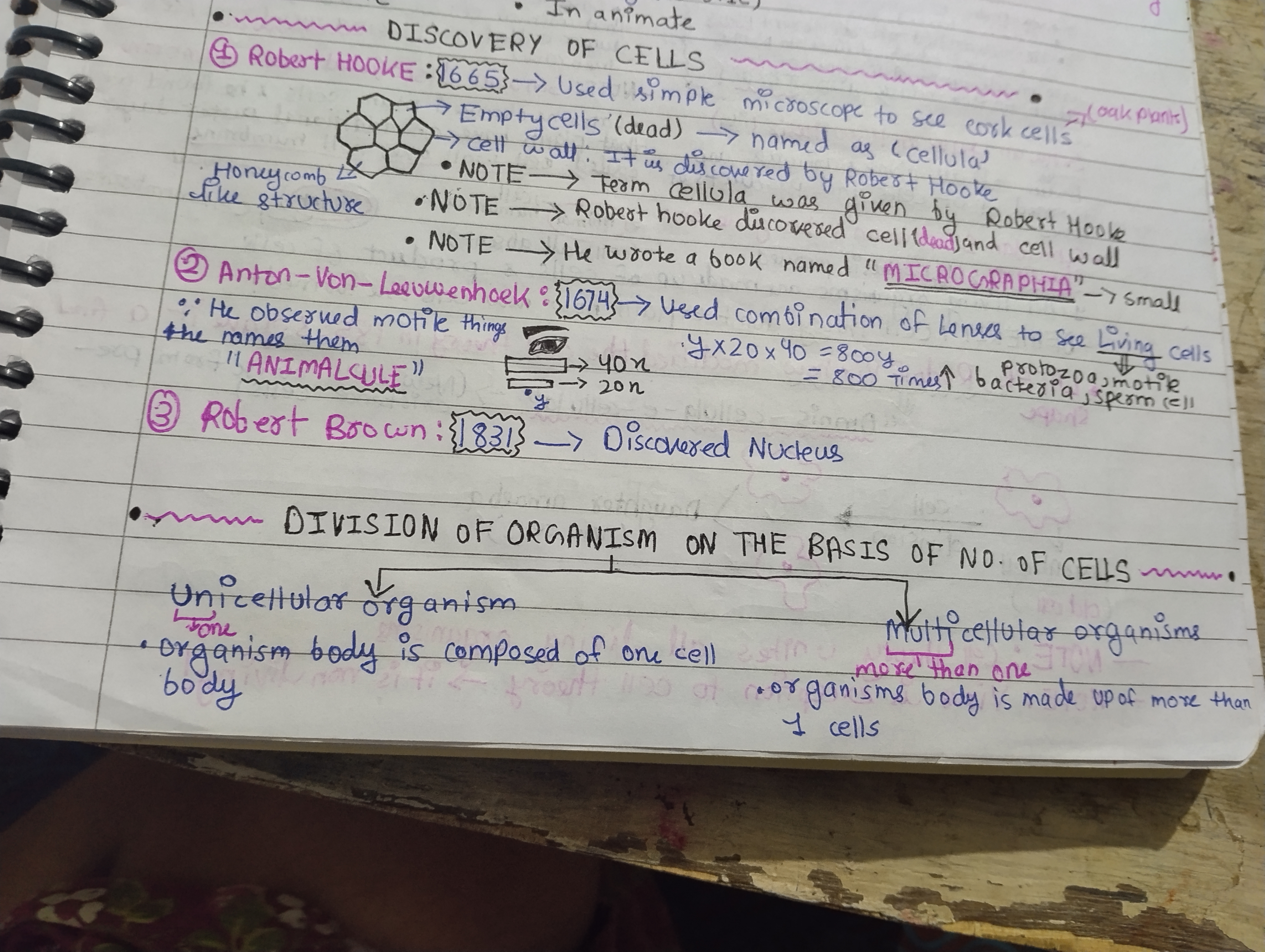
Robert Hooke
The scientist who in 1665 discovered dead cork cells and the cell wall using a simple microscope.
Cellula
The term given by Robert Hooke to the honeycomb-like structure of empty, dead cells he observed in cork.
MICROGRAPHIA
The book written by Robert Hooke.
Anton Von Leeuwenhoek
The scientist who in 1674 used a combination of lenses to see living cells, magnifying them up to 800 times.
ANIMALCULE
The name Anton Von Leeuwenhoek gave to the motile things (living cells) he observed, including protozoa, bacteria, and sperm cells.
Robert Brown
The scientist who discovered the Nucleus in 1831.
Unicellular organism
An organism whose body is composed of only one cell.
Multicellular organisms
Organisms whose bodies are made up of more than one cell.