CDC PART 1 NP5
 Call Kai
 Learn
Learn Practice Test
 Spaced Repetition
 Match
Match Flashcards
 Knowt Play
1/49

There's no tags or description
Looks like no tags are added yet.
Name | Mastery | Learn | Test | Matching | Spaced | Call with Kai | Chat |
|---|
No analytics yet
Send a link to your students to track their progress
50 Terms
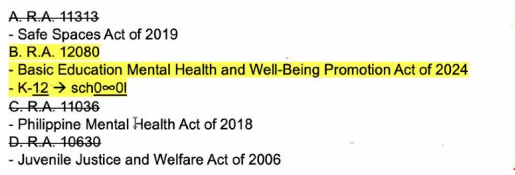
SITUATION: A newly registered nurse is not only expected to know the skills necessary in providing interventions in the different wards of the hospital, but must also be knowledgeable about the basic concepts and theories that encapsulate psychiatric nursing. Q1: An act that strengthens the promotion and delivery of mental health services in basic education by developing school-based mental health programs. As a school nurse, you know that this pertains to which legal document?
A. R.A. 11313
B. R.A. 12080
C. R.A. 11036
D. R.A. 10630
B. R.A. 12080
Q2: Neurotransmitters act as messengers in the nervous system which are essential in the conduct of normal psychologic processes. Which among the following neurotransmitters is responsible for major neurotoxic effects when present at high levels?
A. Glutamate
B. Neuropeptides
C. Dopamine
D. Norepinephrine
A. Glutamate
neurotoxic effects

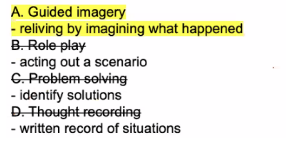
Q3: A client tells the therapist, "I felt completely shattered when my husband said he was leaving me. I keep thinking that if I had been a better spouse, he would not have chosen someone else. I blame myself for what happened." The therapist asks the client to recall that specific event and describe the thoughts and emotions she experienced during the interaction. What cognitive therapy technique is the therapist using?
A. Guided imagery
B. Role play
C. Problem solving
D. Thought-recording
A. Guided imagery
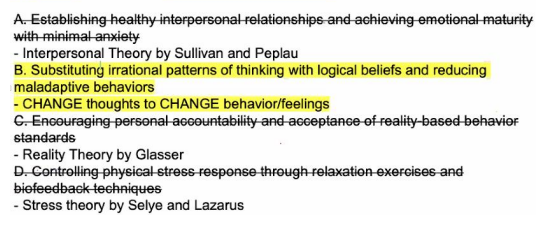
Q4: Which therapeutic outcome best reflects the principles of cognitive-behavioral approach developed by Aaron Beck and Albert Ellis?
A. Establishing healthy interpersonal relationships and achieving emotional maturity with minimal anxiety
B. Substituting irrational patterns of thinking with logical beliefs and reducing maladadaptive behaviors
C. Encouraging personal accountability and acceptance of reality-based behavior standards
D. Controlling physical stress response through relaxation exercises and biofeedback techniques
B. Substituting irrational patterns of thinking with logical beliefs and reducing maladadaptive behaviors
CB Approach
change way of thinking para mag bago behavior
Q5: A client is admitted to the emergency department after a motor vehicular crash. When asked by the nurse about the accident, the patient does not remember anything about it. The client is using which defense mechanism?
A. Undoing
B. Rationalization
C. Suppression
D. Repression
D. Repression
unconsciously forgetting

SITUATION: The psychiatric nurse must be at all times ready to provide adequate and efficient care care to patients regardless of different psychopathologies and must be capable of recalling etiologies and psychodynamics of different psychiatric conditions.
Q6: A 60-year-old male patient has presented signs and symptoms of dementia. When assessed by the nurse, it was revealed that the contributing factors to the patient's onset of dementia is linked to his type 2 diabetes mellitus, high cholesterol, and hypertension. Based on the given comorbidities, what type of dementia can it all cause?
A. Lewy Body Dementia
B. Alzheimer Disease
C. Vascular Dementia
D. Prion Disease
C. Vascular Dementia

Q7: A client with a history of substance use disorder is brought to the emergency department after suspected opioid overdose. Which of the following findings is the most expected effect of opioid toxicity?
A. Slowed respiration
B. Hyperactive bowel sounds
C. Dilated pupils
D. Increased lacrimation
A. Slowed respiration
rf respiratory depression

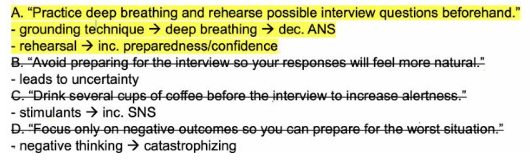
Q8: A client diagnosed with Generalized Anxiety Disorder tells the nurse, "I always get very nervous before a job interview and feel like I might fail." Which instruction should the nurse include in health teaching to help manage anxiety before an interview?
A. "Practice deep breathing and rehearse possible interview questions beforehand."
B. "Avoid preparing for the interview so your responses will feel more natural."
C. "Drink several cups of coffee before the interview to increase alertness."
D. "Focus only on negative outcomes so you can prepare for the worst situation."
A. "Practice deep breathing and rehearse possible interview questions beforehand."
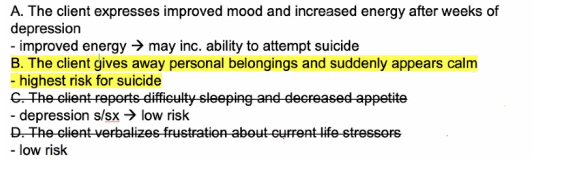
Q9: A nurse is assessing a client diagnosed with Major Depressive Disorder. Which finding should alert the nurse to the highest risk for suicide?
A. The client expresses improved mood and increased energy after weeks of depression
B. The client gives away personal belongings and suddenly appears calm
C. The client reports difficulty sleeping and decreased appetite
D. The client verbalizes frustration about current life stressors
B. The client gives away personal belongings and suddenly appears calm
natanggap na finalize na ang suicidal thoughts/ideals, pamigay na ang dating importanteng materials.
Q10: A client is brought to the emergency department with suspected acute intoxication of methamphetamine. The client is extremely agitated, shouting, and pacing around the room. Which nursing intervention is the priority?
A. Encourage the client to participate in group therapy to verbalize feelings
B. Place the client in a well-lit, high-traffic area for close observation
C. Reduce environment stimuli and maintain a calm, quiet setting
D. Confront the client about substance use to establish reality orientation
C. Reduce environment stimuli and maintain a calm, quiet setting
extreme agitation
decrease stimuli

SITUATION: One of the most important tools in the field of nursing is the nursing process. Thus, a competent psychiatric nurse should be able to perform correct patient assessment and provide accurate nursing diagnosis.
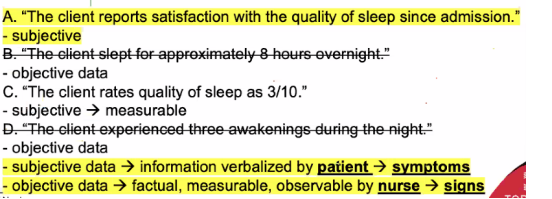
Q11: Which charting entry documents a subjective assessment of sleep patterns?
A. "The client reports satisfaction with the quality of sleep since admission."
B. "The client slept for approximately 8 hours overnight."
C. "The client rates quality of sleep as 3/10."
D. "The client experienced three awakenings during the night"
A. "The client reports satisfaction with the quality of sleep since admission."

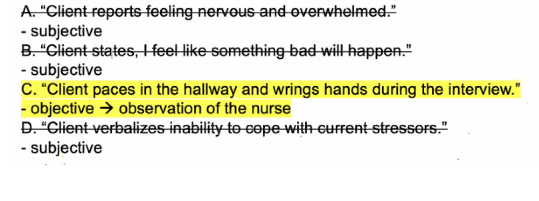
Q12: A psychiatric nurse is documenting assessment findings for a client experiencing anxiety. Which documentation reflects objective data?
A. "Client reports feeling nervous and overwhelmed."
B. "Client states, I feel like something bad will happen."
C. "Client paces in the hallway and wrings hands during the interview."
D. "Client verbalizes inability to cope with current stressors."
C. "Client paces in the hallway and wrings hands during the interview."
nakikita mo, senses mo
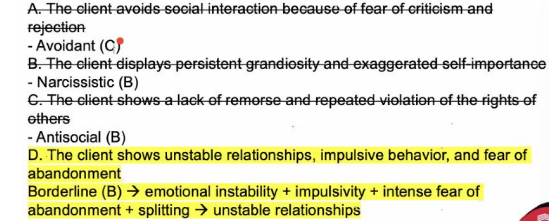
Q13: A nurse is assessing a client diagnosed with Borderline Personality Disorder. Which assessment finding is most characteristic of this disorder?
A. The client avoids social interaction because of fear of criticism and rejection
B. The client displays persistent grandiosity and exaggerated self-importance
C. The client shows a lack of remorse and repeated violation of the rights of others
D. The client shows unstable relationships, impulsive behavior, and fear of abandonment
D. The client shows unstable relationships, impulsive behavior, and fear of abandonment
“kapag iniwan moko magpapakamatay ako”
Q14: A client diagnosed with Anorexia Nervosa has a short-term goal that states, "The client will gain 2 pounds within 1 week." Which nursing diagnosis best corresponds to the problem being addressed by this goal?
A. Ineffective coping related to perceived loss of control over eating behaviors
B. Altered nutrition: less than body requirements related to decreased intake
C. Self-care deficit: feeding related to decreased energy levels
D. Anxiety related to persistent feelings of helplessness and low self-worth
B. Altered nutrition: less than body requirements related to decreased intake
anorexia = di nakaka kain ng maayos = altered nutri

Q15: A client diagnosed with Bipolar Disorder is admitted during a manic episode. The client has not slept for 4 days, is extremely talkative, frequently shifts from one topic to another, and is easily distracted during conversation. Which nursing diagnosis is most accurate?
A. Disturbed thought process related to flight of ideas as evidenced by distractibility and rapid topic shifting
B. Disturbed sensory perception related to rapid thought shifting as evidenced by inability to maintain attention during conversation
C. Ineffective coping related to impaired judgment as evidenced by decreased impulse control and hyperactivity
D. Disturbed thought process related to decreased need for sleep as evidenced by pressured speech and restlessness
B. Disturbed sensory perception related to rapid thought shifting as evidenced by inability to maintain attention during conversation
problem in cognition
cognitive disturbance

SITUATION: In the delivery of care, the nurse assigned in a psychiatric unit is expected to utilize his or her own knowledge, skills, and attitude in developing nursing care plans based on the client's needs and identified problems and at the same time select appropriate nursing interventions and implement them.
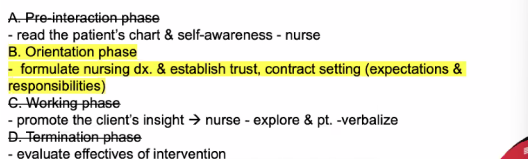
Q16: In a psychiatric unit, a client states, "I want to learn better ways to handle my sadness." This interaction is most likely to occur in which phase of the nurse-client relationship?
A. Pre-interaction phase
B. Orientation phase
C. Working phase
D. Termination phase
B. Orientation phase
set goals
set expectations
create envi establishes trust
Q17: A patient diagnosed with major depression has verbalized suicidal thoughts to the nurse. In line with the interventions on a suicidal client, what type of care must the physician order when the patient is expressing suicidal thoughts?
A. In-patient care
B. Outpatient care
C. Telehealth care
D. Community support care
A. In-patient care
ensure continuous monitoring, immediate intervention
structured controlled environment
rf injury for self and others
malupitang tutukan si pasyente

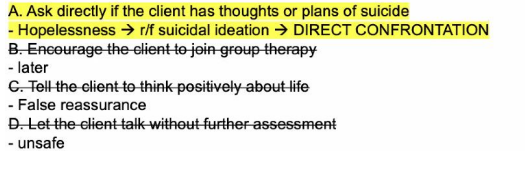
Q18: A client clinically diagnosed with depression states, "I don't think life is worth living anymore." What should the nurse do first?
A. Ask directly if the client has thoughts or plans of suicide
B. Encourage the client to join group therapy
C. Tell the client to think positively about life
D. Let the client talk without further assessment
A. Ask directly if the client has thoughts or plans of suicide
time of the essence
can cost life of client
Q19: A client diagnosed with Post-Traumatic Stress Disorder suddenly becomes tense, starts sweating, and reports feeling "like it is happening again" after hearing a loud noise in the unit. Which nursing intervention is most appropriate?
A. Encourage the client to describe the traumatic event in detail to process emotions
B. Ask the client to stay alone in the room until symptoms subside
C. Guide the client to identify objects in the room and focus on present reality
D. Confront the client about unrealistic thoughts to correct misinterpretation
C. Guide the client to identify objects in the room and focus on present reality
redirect to present
ibalik sa realidad

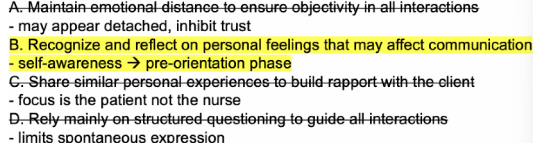
Q20: Which of the following is the most important action for the nurse to perform in establishing an effective nurse-client relationship?
A. Maintain emotional distance to ensure objectivity in all interactions
B. Recognize and reflect on personal feelings that may affect communication
C. Share similar personal experiences to build rapport with the client
D. Rely mainly on structured questioning to guide all interactions
B. Recognize and reflect on personal feelings that may affect communication
nurse client rs, most important action of nurse is self awareness
sila ang sasama sa ating mundo”
SITUATION: A nurse is assigned to clients in a psychiatric unit receiving various treatment modalities for mental health conditions. The nurse administers prescribed therapies, maintains safety, provides therapeutic communication, and monitors the clients' behavioral responses and progress toward established goals to determine the effectiveness of care.
Q21: The scientific structuring of the environment in order to effect behavioral changes and to improve the psychological health and functioning of the individual known as?
A. Behavioral therapy
B. Therapeutic community
C. Cognitive therapy
D. Gestalt therapy
B. Therapeutic community
AKA: MILLEU THERAPY

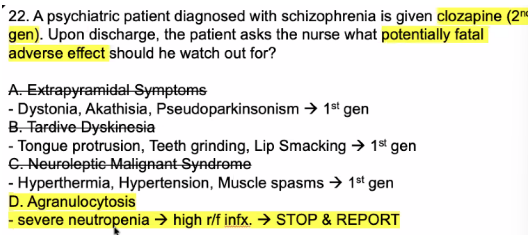
Q22: A psychiatric patient diagnosed with schizophrenia is given clozapine (2nd gen). Upon discharge, the patient asks the nurse what potentially fatal adverse effect should he watch out for?
A. Extrapyramidal Symptoms
B. Tardive Dyskinesia
C. Neuroleptic Malignant Syndrome
D. Agranulocytosis
D. Agranulocytosis
NMS? rare, if occur, fatal
agranulocytosis more common
Q23: A 17-year-old client diagnosed with Anorexia Nervosa is admitted to the psychiatric unit with severe weight loss. Which meal selection by the client indicates that teaching about nutritional rehabilitation has been effective?
A. Black coffee, plain lettuce salad, and diet gelatin
B. Grilled chicken, brown rice, steamed vegetables, and milk
C. Crackers and clear soup without added salt
D. Fresh fruits only with bottled water
B. Grilled chicken, brown rice, steamed vegetables, and milk
hi caloric, hi protein in anorexia

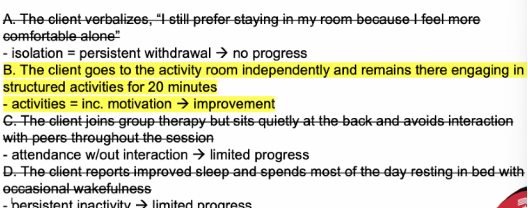
Q24: A client diagnosed with Major Depressive Disorder has been withdrawn and isolated since admission to the psychiatric unit. The nurse is evaluating the client's progress after several days of therapeutic communication and treatment. Which behavior best indicates improvement in the client's condition?
A. The client verbalizes, "I still prefer staying in my room because I feel more comfortable alone"
B. The client goes to the activity room independently and remains there engaging in structured activities for 20 minutes.
C. The client joins group therapy but sits quietly at the back and avoids interaction with peers throughout the session
D. The client reports improved sleep and spends most of the day resting in bed with occasional wakefulness
B. The client goes to the activity room independently and remains there engaging in structured activities for 20 minutes.
client demonstrated behavioral changes
improved social interaction
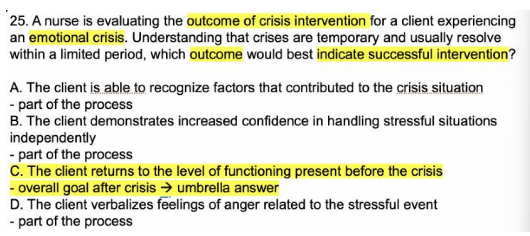
Q25: A nurse is evaluating the outcome of crisis intervention for a client experiencing an emotional crisis. Understanding that crises are temporary and usually resolve within a limited period, which outcome would best indicate successful intervention?
A. The client is able to recognize factors that contributed to the crisis situation
B. The client demonstrates increased confidence in handling stressful situations independently
C. The client returns to the level of functioning present before the crisis
D. The client verbalizes feelings of anger related to the stressful event
C. The client returns to the level of functioning present before the crisis
SITUATION: A nurse is assigned to provide care during an emergency and disaster situation involving multiple clients with varying degrees of injuries and urgent health needs. The nurse participates in triage, prioritization of care, implementation of emergency interventions, maintenance of safety, coordination with the healthcare team, and monitoring of clients' responses during the management of the incident.
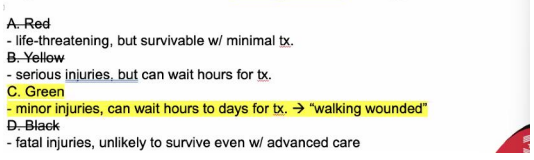
Q26: A mass casualty incident has occurred in a far-flung barangay. When the team arrived to sort patients, most of them were still able to walk despite their injuries. In triage, victims who are identified as "walking wounded" are tagged as what color?
A. Red
B. Yellow
C. Green
D. Black
C. Green
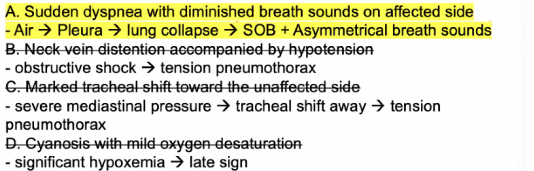
Q27: A client is admitted to the emergency department with crushing chest injuries sustained in a car accident. After assessing, the nurse determines a possible pneumothorax. Which of the following is an initial sign of pneumothorax?
A. Sudden dyspnea with diminished breath sounds on affected side
B. Neck vein distention accompanied by hypotension
C. Marked tracheal shift toward the unaffected side
D. Cyanosis with mild oxygen desaturation
A. Sudden dyspnea with diminished breath sounds on affected side
INITIAL
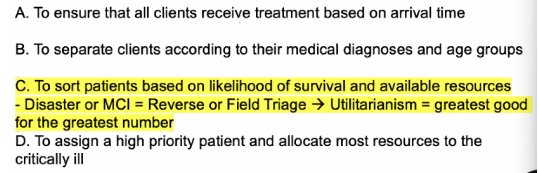
Q28: Following a major earthquake, multiple victims arrive simultaneously at the emergency treatment area. A nursing student asks the nurse about the main purpose of using colors in providing aid during a disaster. Which response by the nurse is most appropriate?
A. To ensure that all clients receive treatment based on arrival time
B. To separate clients according to their medical diagnoses and age groups
C. To sort patients based on likelihood of survival and available resources
D. To assign a high priority patient and allocate most resources to the critically ill
C. To sort patients based on likelihood of survival and available resources
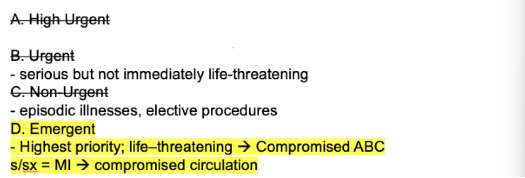
Q29: A 46-year-old client arrives at the emergency department complaining of left-sided chest pain accompanied by diaphoresis, and dizziness. Based on triage principles, how should the nurse classify this client?
A. High Urgent
B. Urgent
C. Non-Urgent
D. Emergent
D. Emergent
Q30: The nurse is the first person on the scene of a vehicle accident. The patient is in the shotgun seat unconscious. Which action should the nurse implement first?
A. Stabilize the patient's cervical spine
B. Do not move the patient from the accident
C. Ensure the patient has patent airway
D. Control any external bleeding
C. Ensure the patient has patent airway
(A)BC

SITUATION: When a nurse is assigned to care for clients experiencing acute biologic crises requiring immediate medical and nursing interventions, the nurse is expected to perform rapid assessment, prioritize care, implement appropriate emergency measures, administer prescribed treatments, maintain physiologic stability, and monitor the clients' responses throughout the course of management.
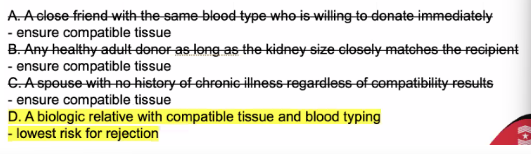
Q31: A client with end-stage renal failure asks the nurse about possible kidney donors for transplantation. Which individual would be considered the most appropriate potential donor?
A. A close friend with the same blood type who is willing to donate immediately
B. Any healthy adult donor as long as the kidney size closely matches the recipient
C. A spouse with no history of chronic illness regardless of compatibility results
D. A biologic relative with compatible tissue and blood typing
D. A biologic relative with compatible tissue and blood typing
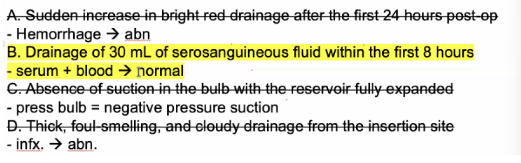
Q32: A client has just returned to the surgical unit after abdominal surgery with a Jackson-Pratt drain in place. The nurse is assessing the drainage system. Which finding should the nurse expect?
A. Sudden increase in bright red drainage after the first 24 hours post-op
B. Drainage of 30 mL of serosanguineous fluid within the first 8 hours
C. Absence of suction in the bulb with the reservoir fully expanded
D. Thick, foul-smelling, and cloudy drainage from the insertion site
B. Drainage of 30 mL of serosanguineous fluid within the first 8 hours
first drain
serosanguinous
body fluid + blood
Q33: A client diagnosed with Méniére's Disease asks the nurse about measures to reduce episodes of vertigo. Which instruction should the nurse include in the teaching plan?
A. "Increase your intake of high-sodium foods to maintain ear fluid balance"
B. "During vertigo episodes, lie still and avoid sudden head movements until symptoms subside"
C. "Perform rapid head-turning exercises daily to improve vestibular adaptation"
D. Avoid lying down and instead walk around to help reorient your balance"
B. "During vertigo episodes, lie still and avoid sudden head movements until symptoms subside"
higa
tayo/ lakad: rf falls/injuries

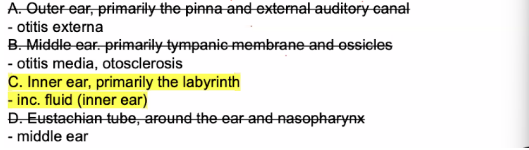
Q34: During a class discussion on Méniére's Disease, a student asks her professor about the anatomy of the disease process. The student knows that it is a problem somewhere in the ear. The professor has substantially provided correct information if he stated that the disease is a problem on what specific part of the ear?
A. Outer ear, primarily the pinna and external auditory canal
B. Middle ear, primarily tympanic membrane and ossicles
C. Inner ear, primarily the labyrinth
D. Eustachian tube, around the ear and nasopharynx
C. Inner ear, primarily the labyrinth
wanako kasabot sa explanation saka paspas
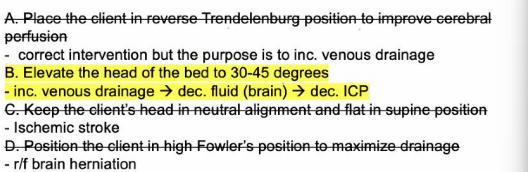
Q35: A client with traumatic brain injury is being assessed by the nurse. On assessment, the nurse has identified that the client has increased intracranial pressure of 20 mmHg. Which nursing intervention is most appropriate to help reduce ICP?
A. Place the client in reverse Trendelenburg position to improve cerebral perfusion
B. Elevate the head of the bed to 30-45 degrees
C. Keep the client's head in neutral alignment and flat in supine position
D. Position the client in high Fowler's position to maximize drainage
B. Elevate the head of the bed to 30-45 degrees
dec icp by gravity
D? high fowlers = 90deg
compression of blood vessels
dec blood to brain
SITUATION: The nurse assigned in the medical-surgical ward must possess the capability to render appropriate care in patients with either simple or complex necessities and disease conditions.
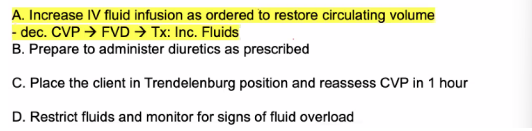
Q36: A client is admitted to the emergency department and is immediately inserted with a central venous catheter for monitoring. The central venous pressure (CVP) reading is 1 mmHg (N: 2-6). Based on this finding, which nursing action is most appropriate?
A. Increase IV fluid infusion as ordered to restore circulating volume
B. Prepare to administer diuretics as prescribed
C. Place the client in Trendelenburg position and reassess CVP in 1 hour
D. Restrict fluids and monitor for signs of fluid overload
A. Increase IV fluid infusion as ordered to restore circulating volume
CVP: 2-6
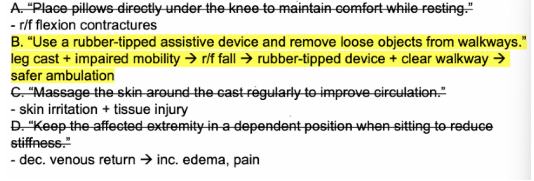
Q37: A client with a newly applied leg cast for a femoral fracture is being prepared for discharge. Which instruction by the nurse best promotes safety during recovery?
A. "Place pillows directly under the knee to maintain comfort while resting."
B. "Use a rubber-tipped assistive device and remove loose objects from walkways."
C. "Massage the skin around the cast regularly to improve circulation."
D. "Keep the affected extremity in a dependent position when sitting to reduce stiffness."
B. "Use a rubber-tipped assistive device and remove loose objects from walkways."
tanggalin lahat ng hazards
safety
Q38: An older adult client reports increasing difficulty understanding conversations, especially in crowded environments. The nurse explains that this age-related hearing change is most commonly associated with which physiologic alteration?
A. Degeneration of sensory hair cells within the inner ear
B. Obstruction of the external auditory canal by cerumen buildup
C. Decreased flexibility of the tympanic membrane in the middle ear
D. Weakening of the auditory ossicles responsible for sound conduction
A. Degeneration of sensory hair cells within the inner ear
older adult, degeneration

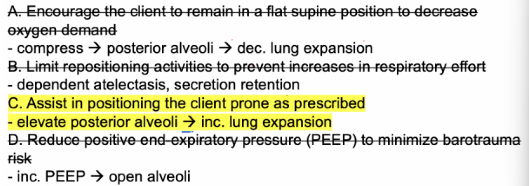
Q39: A client diagnosed with Acute Respiratory Distress Syndrome is experiencing worsening hypoxemia despite oxygen therapy. Which nursing intervention is most appropriate to improve oxygenation?
A. Encourage the client to remain in a flat supine position to decrease oxygen demand
B. Limit repositioning activities to prevent increases in respiratory effort
C. Assist in positioning the client prone as prescribed
D. Reduce positive end-expiratory pressure (PEEP) to minimize barotrauma risk
C. Assist in positioning the client prone as prescribed
hypoxia even 100% o2 delivered
improve o2 in ARDS
recruitment of collapsed alvoli units
ambot
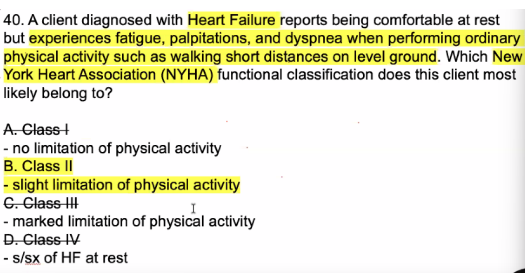
Q40: A client diagnosed with Heart Failure reports being comfortable at rest but experiences fatigue, palpitations, and dyspnea when performing ordinary physical activity such as walking short distances on level ground. Which New York Heart Association (NYHA) functional classification does this client most likely belong to?
A. Class I
B. Class II
C. Class III
D. Class IV
B. Class II
slight limitaiton rest is comfortable
A. Class I no limitation
C. Class III - marked limitation
D. Class IV - unable to carry out physical activity
SITUATION: The psychiatric nurse must be empowered in communicating effectively and therapeutically to patients. It is also a prerequisite that the nurse knows how to report and document client care accurately and comprehensively. Q41: A client with Major Depressive Disorder says, "Nothing will ever get better for me anymore." Which response by the nurse is most therapeutic? A. "You should be grateful because many people have bigger problems." B. "Tell me more about what makes you feel this way." C. "Everything will improve if you just stay positive." D. "You need to stop thinking negatively about yourself."
B. "Tell me more about what makes you feel this way."
theracom: exploring
Q42: A client with paranoid thoughts tells the nurse, "The staff members are secretly trying to poison my food." Which response by the nurse is most therapeutic? A. "That is not true. Nobody here wants to harm you." B. "Why would the staff want to poison you?" C. "I understand that you feel frightened, but I do not see any evidence that anyone is trying to harm you." D. "You are imagining things because of your illness."
C. "I understand that you feel frightened, but I do not see any evidence that anyone is trying to harm you."
presenting reality

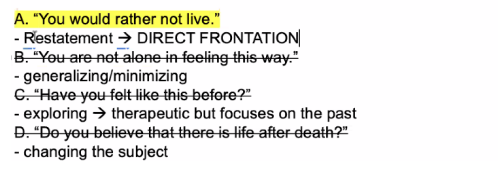
Q43: A client diagnosed with depression states to the nurse, "I want to die." Which is the nurse's most therapeutic response? A. "You would rather not live." B. "You are not alone in feeling this way." C. "Have you felt like this before?" D. "Do you believe that there is life after death?"
A. "You would rather not live."
restating → elaborate
C. is effective if u know reason, sa kalagitnaan ng conversation.
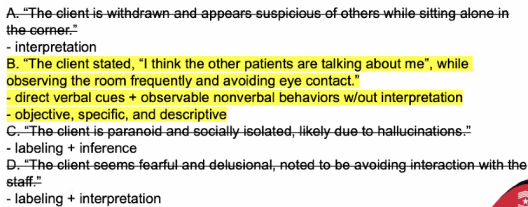
Q44: A nurse is documenting the assessment of a client diagnosed with Schizophrenia who is observed to be sitting alone in the corner of the day room, scanning the area whilst avoiding gaze from people passing by. Which chart entry is most appropriate?
A. "The client is withdrawn and appears suspicious of others while sitting alone in the corner."
B. "The client stated, "I think the other patients are talking about me", while observing the room frequently and avoiding eye contact." C. "The client is paranoid and socially isolated, likely due to hallucinations." D. "The client seems fearful and delusional, noted to be avoiding interaction with the staff"
B. "The client stated, "I think the other patients are talking about me", while observing the room frequently and avoiding eye contact."
completely stated
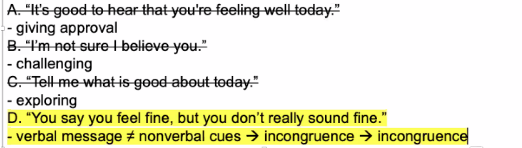
Q45: A patient states, "I feel okay today. It's actually a good day." While speaking, the nurse observes that the client avoids eye contact and speaks in a noticeably lower and decreasing tone. Which of the following is the most therapeutic response by the nurse? A. "It's good to hear that you're feeling well today." B. "I'm not sure I believe you." C. "Tell me what is good about today" D. "You say you feel fine, but you don't really sound fine."
D. "You say you feel fine, but you don't really sound fine."
explore, make observation
SITUATION: A nurse is a holistic professional who not only provides traditional and evidence-based care but is also well-versed in techno-intelligent care systems. As a holistic individual, the nurse must also be guided by management principles such as delegation and prioritization with the improvement of the quality of care in mind.
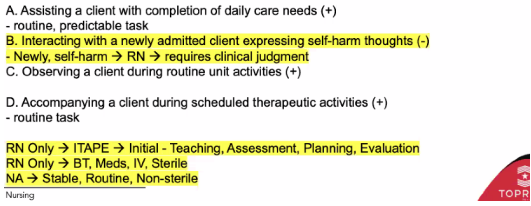
Q46: A registered nurse is assigning care responsibilities on an inpatient psychiatric unit. Which among the activities should the nurse not delegate to the assistive personnel? A. Assisting a client with completion of daily care needs B. Interacting with a newly admitted client expressing self-harm thoughts C. Observing a client during routine unit activities D. Accompanying a client during scheduled therapeutic activities
B. Interacting with a newly admitted client expressing self-harm thoughts
rf injury directed to self and others
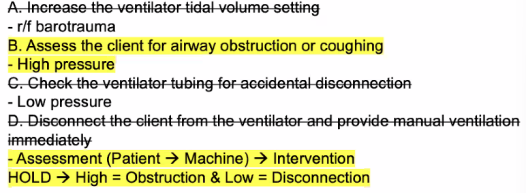
Q47: A client receiving mechanical ventilation suddenly triggers a high-pressure alarm. Which nursing action should the nurse perform first? A. Increase the ventilator tidal volume setting B. Assess the client for airway obstruction or coughing C. Check the ventilator tubing for accidental disconnection D. Disconnect the client from the ventilator and provide manual ventilation immediately
B. Assess the client for airway obstruction or coughing
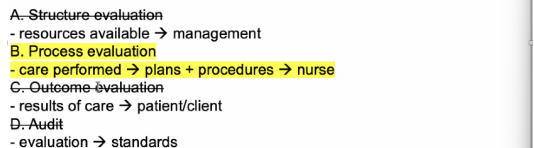
Q48: If the nurse planned to evaluate the length of time clients must wait for a nurse to respond to a client need reported over the intercom system on each shift, which process does this reflect? A. Structure evaluation B. Process evaluation C. Outcome evaluation D. Audit
B. Process evaluation
step by step procedure
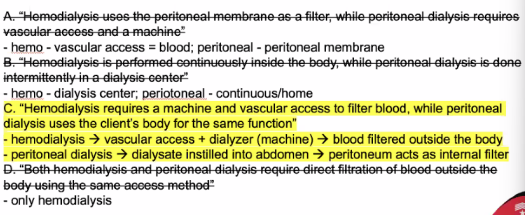
Q49: A client diagnosed with Chronic Kidney Disease is scheduled to begin renal replacement therapy. The nurse is explaining the differences between hemodialysis and peritoneal dialysis. Which statement by the nurse best reflects an accurate distinction between the two procedures? A. "Hemodialysis uses the peritoneal membrane as a filter, while peritoneal dialysis requires vascular access and a machine B. "Hemodialysis is performed continuously inside the body, while peritoneal dialysis is done intermittently in a dialysis center C. "Hemodialysis requires a machine and vascular access to filter blood, while peritoneal dialysis uses the client's body for the same function" D. "Both hemodialysis and peritoneal dialysis require direct filtration of blood outside the body using the same access method"
C. "Hemodialysis requires a machine and vascular access to filter blood, while peritoneal dialysis uses the client's body for the same function"
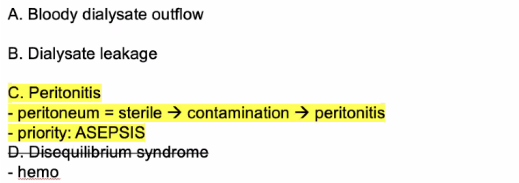
Q50: A client undergoing Peritoneal Dialysis is being monitored for complications. Which finding should the nurse recognize as the most common complication associated with this therapy? A. Bloody dialysate outflow B. Dialysate leakage C. Peritonitis D. Disequilibrium syndrome
C. Peritonitis