8/20 - Canine Cardiomyopathies
 Call Kai
 Learn
Learn Practice Test
 Spaced Repetition
 Match
Match Flashcards
 Knowt Play
1/18

There's no tags or description
Looks like no tags are added yet.
Name | Mastery | Learn | Test | Matching | Spaced | Call with Kai | Chat |
|---|
No analytics yet
Send a link to your students to track their progress
19 Terms
Acquired
Are valvular endocardiosis, bacterial endocarditis, dilated cardiomyopathy, myocarditis, pericardial disease, pulmonary hypertension, and arrythmias acquired or congenital canine cardiomyopathies?
Congenital
Are sub-aortic stenosis, patent ductus arteriosus, pulmonic stenosis, and septal defects acquired or congenital canine cardiomyopathies?
Endocardiosis
What condition in dogs is also called degenerative valve disease and refers to gradual changes to the valves, causing dysfunction? It is the most common cause for heart failure in dogs (75%), and affects the mitral and tricuspid valves, forming a holosystolic plateau murmur at the left apex, can cause a valve prolapse, and can involve MMVD. Sequelae include volume overload, endocardial fibrosis, CHF, left bronchial compression, chordae tendinae rupture, left atrial tears/rupture, and atrial fibrillation. It is degenerative, predisposed genetically in older small-breed dogs (shih tzu, dachshund, whippet, KCCS).
Endocarditis
What condition in dogs is an infective condition causing damage and inflammation to the heart valves? It is often aortic and mitral, and can be caused by B. henselae, E. coli, Staph, and Strep. Concurrent or recurrent infections can be associated with it, as well as either transient or persistent bacteremia. There will be systemic signs, and polyarthritis, TBE, and CHF can occur. Diagnosis is difficult and young large-breed dogs get it most commonly. Hyperkinetic or bounding pulses can be felt, plus fever, and radiography can help to diagnose. A “to and fro” aortic murmur can be heard.
Holosystolic Plateau
What type of murmur is present in dogs with mitral endocardiosis (MMVD) at the left apex?
Mitral
Which valve is most commonly affected by valvular endocardiosis in dogs?
Myxomatous
What type of degeneration is seen in cases of mitral valve endocardiosis in dogs, referring to nodular thickening, deformity, and weakening?
Respiratory
When managing client education in a valvular endocardiosis case, you should tell the client to monitor the patient’s what rate at rest? If this increases, then pulmonary edema may be progressing.
Respiratory
What type of disease (organ system) is most likely if a dog has a cough and clinical signs but normal NT-pro-BNP?
A
What stage of MVD is a patient at risk but with no clinical signs?
B1
Which stage of MVD is a dog with a murmur, no clinical signs, and no imaging abnormalities?
B2
Which stage of MVD is a dog with a murmur, no clinical signs, and either radiographic or echocardiographic changes?
C
Which stage of MVD is a dog with past or current clinical signs of heart failure and structural heart disease? Mitral valve repair can be done in this stage.
D
Which stage of MVD is a dog with end-stage refractory disease?
Repair
Can mitral valve repair or replacement surgery be done in dogs?
Transcatheter
What method of mitral valve repair is a new technique and less invasive than normal surgery, allowing edge-to-edge repair (TEER)? It also allows the valveclamp method to be used.
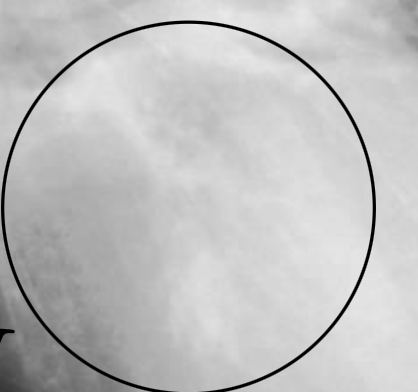
Aortic
What valve is shown here in this endocarditis radiograph?
Rapid
Will progression of endocarditis be rapid or slow? There can be embolization of septic thrombi and infection can proceed to the AV node. Valve insufficiency can occur.
Yes
Can endocarditis be treated with supportive care (CHF/arrhythmias) and antibiotics IV for at least 6-8 weeks?