Comprehensive Final - 1220 Tri-C (Not explained)
 Call Kai
 Learn
Learn Practice Test
 Spaced Repetition
 Match
Match Flashcards
 Knowt Play
1/420

Earn XP
Description and Tags
Name | Mastery | Learn | Test | Matching | Spaced | Call with Kai | Chat |
|---|
No analytics yet
Send a link to your students to track their progress
421 Terms
A nurse assesses several clients who have a history of respiratory disorders. Which client would the nurse assess first?
27-year-old client with a heart rate of 120 beats/min
A nurse cares for a client with arthritis who reports frequent asthma attacks. What action would the nurse take first?
Ask about the medications the client is currently taking.
After teaching a client who is prescribed a long-acting beta2 agonist medication, a nurse assesses the client's understanding. Which statement indicates that the client comprehends the teaching?
"I will take this medication every morning to help prevent an acute attack."
After teaching a client how to perform diaphragmatic breathing, the nurse assesses the client's understanding. Which action demonstrates that the client correctly understands the teaching?
The client places his or her hands on the abdomen.
A nurse cares for a client who has developed esophagitis after undergoing radiation therapy for lung cancer. Which diet selection would the nurse provide for this client?
Omelet, soft whole-wheat bread
After teaching a client who is prescribed salmeterol, the nurse assesses the client's understanding. Which statement by the client indicates a need for additional teaching?
"I will use the drug when I have an asthma attack."
A nurse cares for a client with chronic obstructive pulmonary disease (COPD). The client states that going out with friends is no longer enjoyable. How would the nurse respond?
"I'd like to hear about thoughts and feelings causing you to limit social activities."
A nurse is teaching a client who has cystic fibrosis (CF). Which statement would the nurse include in this client's teaching?
"Eat a well-balanced, nutritious diet."
While assessing a client who is 12 hours postoperative after a thoracotomy for lung cancer, a nurse notices that the chest tube is dislodged. Which action by the nurse is best?
Cover the insertion site with sterile gauze.
A nurse assesses a client who is prescribed fluticasone and notes oral lesions. What action would the nurse take?
a. Encourage oral rinsing after fluticasone administration.
A nurse cares for a client who is infected with Burkholderia cepacia. What action would the nurse take first when admitting this client to a pulmonary care unit?
Keep the client separated from other clients with cystic fibrosis.
A nurse cares for a client who had a chest tube placed 6 hours ago and refuses to take deep breaths because of the pain. What action would the nurse take?
Administer pain medication and encourage the client to take deep breaths.
The nurse is caring for a client who has cystic fibrosis (CF). The client asks for information about gene therapy. What response by the nurse is best?
"There is a good treatment for the most common genetic defect in CF."
A nurse cares for a client with a 40-year smoking history who is experiencing distended neck veins and dependent edema. Which physiologic process would the nurse correlate with this client's history and clinical signs and symptoms?
Increased pulmonary pressure creating a higher workload on the right side of the
heart
A nurse cares for a client with chronic obstructive pulmonary disease (COPD) who appears thin and disheveled. Which question would the nurse ask first?
"Do you experience shortness of breath with basic activities?"
A clinic nurse is reviewing care measures with a client who has asthma, Step 3. What statement by the client indicates the need to review the information?
"My inhaled corticosteroid must be taken regularly to work well."
A pulmonary nurse cares for clients who have chronic obstructive pulmonary disease (COPD). Which client would the nurse assess first?
A 52 year old in a tripod position using accessory muscles to breathe
A nurse cares for a client who has a pleural chest tube. What action would the nurse take to ensure safe use of this equipment?
Keep padded clamps at the bedside for use if the drainage system is interrupted.
A nurse cares for a client who tests positive for alpha1-antitrypsin (AAT) deficiency. The client asks, "What does this mean?" How would the nurse respond?
"Your risk for chronic obstructive pulmonary disease is higher, especially if you smoke."
A nurse cares for a client who has a family history of cystic fibrosis. The client asks, "Will my children have cystic fibrosis?" How would the nurse respond?
"Since you have a family history of cystic fibrosis, I would encourage you and
your partner to be tested."
A nurse administers medications to a client who has asthma. Which medication classification is paired correctly with its physiologic action?
Cholinergic antagonist—causes bronchodilation by inhibiting the parasympathetic
nervous system.
A nurse evaluates the following arterial blood gas and vital sign results for a client with chronic obstructive pulmonary disease (COPD): pH7.32 , PaCO2 62mmHg , Pa02 46mmHg , HCO3 28mEq
HR 110 bpm , RR 12 , BP 145/65 , O2 sat 76%
Arterial Blood Gas Results Vital Signs
What action would the nurse take first?
Initiate oxygenation therapy to increase saturation to 88% to 92%.
A nurse assesses a client with asthma and notes bilateral wheezing, decreased pulse oxygen saturation, and suprasternal retraction on inhalation. What actions by the nurse are best?
Administer oxygen and place client on an oximeter, Administer prescribed albuterol inhaler, Assess the client's lung sounds after administering the inhaler
A nurse assesses a client who has a mediastinal chest tube. Which symptoms require the nurse's immediate intervention?
Tracheal deviation, Sudden onset of shortness of breath, Drainage greater than 70 mL/hr, Disconnection at Y site
A nurse teaches a client who has chronic obstructive pulmonary disease. Which statements related to nutrition would the nurse include in this client's teaching?
"Avoid drinking fluids just before and during meals.", "Rest before meals if you have dyspnea.", "Have about six small meals a day.", "Use pursed-lip breathing during meals.", "Choose soft, high-calorie, high-protein foods."
A nurse assesses a client with chronic obstructive pulmonary disease. Which questions would the nurse ask to determine the client's activity tolerance?
"Do you have any difficulty sleeping?", "How long does it take to perform your morning routine?", "Have you lost any weight lately?", "How does your activity compare to this time last year?
A client, who has become increasingly dyspneic over a year, has been diagnosed with pulmonary fibrosis. What information would the nurse plan to include in teaching this client?
The need to avoid large crowds and people who are ill, Safety measures to take if home oxygen is needed, Information about appropriate use of the drug nintedanib, Measures to avoid fatigue during the day
A nurse plans care for a client who has chronic obstructive pulmonary disease and thick, tenacious secretions. Which interventions would the nurse include in this client's plan of care?
Ask the client to drink 2 L of fluids daily., Add humidity to the prescribed oxygen., Use a vibrating chest physiotherapy device., Administer the ordered mucolytic agent.
A nurse cares for a client who is prescribed an intravenous prostacyclin agent for pulmonary artery hypertension. What actions would the nurse take to ensure the client's safety while on this medication?
Keep an intravenous line dedicated strictly to the infusion, Ensure that there is always a backup drug cassette available, Use strict aseptic technique when using the drug delivery system.
A home health nurse evaluates a client who has chronic obstructive pulmonary disease. Which assessments would the nurse include in this client's evaluation?
Examination of mucous membranes and nail beds, Measurement of rate, depth, and rhythm of respirations, Determine the client's need and use of oxygen, Ability to perform activities of daily living
A nurse is teaching a client how to perform pursed-lip breathing. Which instructions would the nurse include in this teaching? (Select all that apply.)
"Use your abdominal muscles to squeeze air out of your lungs.", "Breath out slowly without puffing your cheeks.", "Exhale at least twice the amount of time it took to breathe in."
A nurse is assessing a client with lung cancer. What nonpulmonary signs and symptoms would the nurse be aware of?
Gynecomastia in male patients, Frequent shaking and sweating relieved by eating, "Moon" face and "buffalo" hump, General edema
The nurse is preparing to teach a community group about warning signs of lung cancer. What information does the nurse include?
Persistent coughing, Rusty or blood-tinged sputum, Dyspnea, Hoarseness
A nurse working in a geriatric clinic sees clients with "cold" symptoms and rhinitis. The primary health care provider (PHCP) often leaves a prescription for diphenhydramine. What action by the nurse is best?
Consult with the PHCP about the medication.
A nurse in a family practice clinic is preparing discharge instructions for a client reporting facial pain that is worse when bending over, tenderness across the cheeks, and postnasal discharge. What instruction will be most helpful?
"Try warm, moist heat packs on your face."
Which teaching point is most important for the client with a peritonsillar abscess?
Take all antibiotics as directed.
A client is in the family practice clinic reporting a severe "cold" that started 4 days ago. On examination, the nurse notes that the client also has a severe headache and muscle aches. What action by the nurse is best?
Teach the client to sneeze in the upper sleeve.
The charge nurse on a medical unit is preparing to admit several "clients" who have possible pandemic flu during a preparedness drill. What action by the nurse is best?
Inquire as to recent travel outside the United States.
A client admitted for pneumonia has been tachypneic for several days. When the nurse starts an IV to give fluids, the client questions this action, saying "I have been drinking tons of water. How am I dehydrated?" What response by the nurse is best?
"Breathing so quickly can be dehydrating."
An older adult is brought to the emergency department by a family member, who reports a moderate change in mental status and mild cough. The client is afebrile. The primary health care provider orders a chest x-ray. The family member questions why this is needed since the symptoms seem so vague. What response by the nurse is best?
"Older people often have vague symptoms, so an x-ray is essential."
A client has been diagnosed with tuberculosis (TB). What action by the nurse takes highest priority?
Educating the client on adherence to the treatment regimen
A client has been admitted for suspected inhalation anthrax infection. What question by the nurse is most important?
"What is your occupation?"
A charge nurse is rounding on several older clients on ventilators in the Intensive Care Unit whom the nurse identifies as being at high risk for ventilator-associated pneumonia. To reduce this risk, what activity would the nurse delegate to the assistive personnel (AP)?
Provide oral care every 4 hours.
The emergency department (ED) manager is reviewing client charts to determine how well the staff perform when treating clients with community-acquired pneumonia. What outcome demonstrates that goals for this client type have been met?
Antibiotics started before admission.
A nurse has educated a client on isoniazid. What statement by the client indicates that teaching has been effective?
"I will take this medication on an empty stomach."
A client has been taking isoniazid for tuberculosis for 3 weeks. What laboratory results need to be reported to the primary health care provider immediately?
Alanine aminotransferase (ALT): 180 U/L
A client seen in the emergency department reports fever, fatigue, and dry cough but no other upper respiratory symptoms. A chest x-ray reveals mediastinal widening. What action by the nurse is best?
Inform the client that oral antibiotics will be needed for 60 days.
A client has been hospitalized with tuberculosis (TB). The client's spouse is fearful of entering the room where the client is in isolation and refuses to visit. What action by the nurse is best?
Ask the spouse to explain the fear of visiting in further detail.
A client is being discharged on long-term therapy for tuberculosis (TB). What referral by the nurse is most appropriate?
Visiting nurses for directly observed therapy
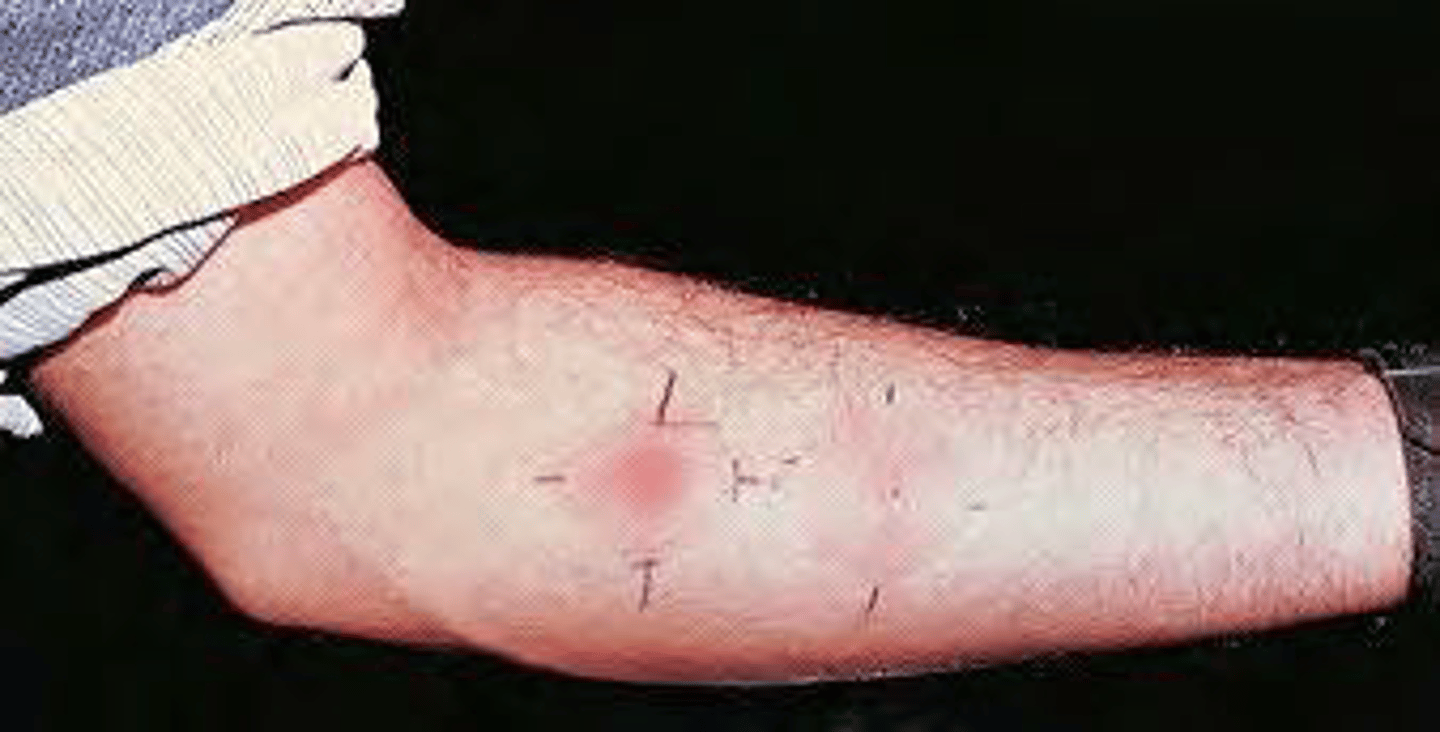
A client is admitted with suspected pneumonia from the emergency department. The client went to the primary health care provider a "few days ago" and shows the nurse the results of what the client calls "an allergy test," as shown below:
The reddened area is firm. What action by the nurse is best?
Immediately place the client on Airborne Precautions.
A nurse admits a client from the emergency department. Client data are listed below: History Physical Assessment Laboratory Values
What action by the nurse is the priority?
° 70 years of age
° History of diabetes
° On insulin twice a day
° Reports new onset dyspnea and productive cough
° Crackles and rhonchi heard throughout the lungs
° Dullness to percussion LLL
° Afebrile
° Oriented to person only
° WBC 5,200/mm3 (5.2 109/L)
° PaO2 on room air 85 mm Hg
Administer oxygen at 4 L per nasal cannula.
A nurse is providing pneumonia vaccinations in a community setting. Due to limited finances, the event organizers must limit giving the vaccination to priority groups. What clients would be considered a priority when administering the pneumonia vaccination? (Select all that apply.)
A 22-year-old client with asthma, Client with well-controlled diabetes, Healthy 72-year-old client, Client who is taking medication for hypertension
A hospital nurse is participating in a drill during which many "clients" with inhalation anthrax are being admitted. What drugs would the nurse anticipate administering?
Vancomycin, Ciprofloxacin, Doxycycline
A client in the emergency department is taking rifampin for tuberculosis. The client reports yellowing of the sclera and skin and bleeding after minor trauma. What laboratory results correlate to this condition?
International normalized ratio (INR): 6.3, Prothrombin time: 35 seconds
A client has been diagnosed with an empyema. What interventions would the nurse anticipate providing to this client?
Assisting with chest tube insertion, Facilitating pleural fluid sampling, Performing frequent respiratory assessment, Providing antipyretics as needed
The emergency department nurse is participating in a bioterrorism drill in which several "clients" are suspected to have inhalation anthrax. Which "clients" would the nurse see as the priorities?
Stridor, Oxygen saturation of 91%, Diaphoresis
A client is taking ethambutol for tuberculosis. What instructions does the nurse provide the client regarding this drug? (Select all that apply.)
Contact the primary health care provider if preexisting gout becomes worse. Report any changes in vision immediately to the health care provider. You will take this medication along with some others for 8 weeks. Take this medicine with a full glass of water.
The nurse is learning about endemic pulmonary diseases. Which diseases are matched with correct information?
Hanta virus: found in urine, droppings, and saliva of infected rodents. Histoplasmosis: sources include soil containing bird and bat droppings. Coccidioidomycosis: found in the southwest and far west of the United States.
A nurse answers a call light and finds a client anxious, short of breath, reporting chest pain, and has a blood pressure of 88/52 mm Hg. What action by the nurse takes priority?
Notify the Rapid Response Team.
A client is admitted with a pulmonary embolism (PE). The client is young, healthy, and active and has no known risk factors for PE. What action by the nurse is most appropriate?
Teach the client about factor V Leiden testing.
A client has a large pulmonary embolism and is started on oxygen. The nurse asks the charge nurse why the client's oxygen saturation has not significantly improved. What response by the nurse is best?
"The blood clot interferes with perfusion in the lungs."
A client is on intravenous heparin to treat a pulmonary embolism. The client's most recent partial thromboplastin time (PTT) was 25 seconds. What order would the nurse anticipate?
Increase the heparin rate.
A client is hospitalized with a second episode of pulmonary embolism (PE). Recent genetic testing reveals that the client has an alteration in the gene CYP2C19. What action by the nurse is best?
Prepare preoperative teaching for an inferior vena cava (IVC) filter.
A nurse is caring for four clients on intravenous heparin therapy. Which laboratory value possibly indicates that a serious side effect has occurred?
Platelet count: 82,000/L (82 109/L)
A client appears dyspneic, but the oxygen saturation is 97%. What action by the nurse is best?
Assess for other signs of hypoxia.
A nurse is assisting the primary health care provider (PHCP) who is intubating a client. The PHCP has been attempting to intubate for 40 seconds. What action by the nurse is best?
Interrupt the procedure to give oxygen.
An intubated client's oxygen saturation has dropped to 88%. What action by the nurse takes priority?
Listen to the client's lung sounds.
A client with acute respiratory failure is on a ventilator and is sedated. What care may the nurse delegate to the assistive personnel ?
Provide frequent oral care per protocol.
A nurse is caring for a client on mechanical ventilation. When double-checking the ventilator settings with the respiratory therapist, what would the nurse ensure?
The upper peak airway pressure limit alarm is on.
A nurse is caring for a client on mechanical ventilation and finds the client agitated and thrashing about. What action by the nurse is most appropriate?
Assess the cause of the agitation.
A nurse is preparing to admit a client on mechanical ventilation for acute respiratory failure from the emergency department. What action does the nurse take first?
Ensuring that there is a bag-valve-mask in the room
A client is on mechanical ventilation and the client's spouse wonders why ranitidine is needed since the client "only has lung problems." What response by the nurse is best?
"It will prevent ulcers from the stress of mechanical ventilation."
A client has been brought to the emergency department with a life-threatening chest injury. What action by the nurse takes priority?
Ensure a patent airway.
A client with ARDS is receiving minimal amounts of IV fluids. The new nurse notes the client is scheduled to receive a diuretic at this time. The nurse consults the Staff Development Nurse to determine the best course of action. What will the new nurse do?
Give the ordered diuretic as scheduled.
A nurse is assessing a client who is suspected of having ARDS. The nurse is confused that although the client appears dyspneic and the oxygen saturation is 88% on 6 L/min of oxygen, the client's lungs are clear. What explanation does the more senior nurse provide?
"Lung edema is in the interstitial tissues, not the airways."
A client in the emergency department has several broken ribs and reports severe pain. What care measure will best promote comfort?
Prepare to assist with intercostal nerve block.
A client has been diagnosed with a very large pulmonary embolism (PE) and has a dropping blood pressure. What medication would the nurse being most beneficial?
Alteplase
A client is brought to the emergency department after sustaining injuries in a severe car crash. The client's chest wall does not appear to be moving normally with respirations, oxygen saturation is 82%, and the client is cyanotic. What action does the nurse take first?
Prepare to assist with intubation.
A new nurse asks for an explanation of "refractory hypoxemia." What answer by the staff development nurse is best?
"It is hypoxemia that persists even with 100% oxygen administration."
A nurse is caring for a client on the medical stepdown unit. The following data are related to this client:
Shortness of breath for 20 minutes
Reports feeling frightened "Can't catch my breath"
pH: 7.32
PaCO2: 28 mm Hg PaO2: 78 mm Hg SaO2: 88%
Pulse: 120 beats/min Respiratory rate: 34 breaths/min
Blood pressure 158/92 mm Hg
Lungs have crackles
What action by the nurse is most appropriate?
Facilitate a STAT pulmonary angiography.
A nurse is caring for five clients. For which clients would the nurse assess a high risk for developing a pulmonary embolism (PE)?
Client with a new spinal cord injury on a rotating bed, Older client who is 1 day post-hip replacement surgery, Young obese client with a fractured femur
When working with women who are taking hormonal birth control, what health promotion measures does the nurse teach to prevent possible pulmonary embolism (PE)?
Exercise on a regular basis. Maintain a healthy weight. Stop smoking cigarettes.
A client with a new pulmonary embolism (PE) is anxious. What nursing actions are most appropriate?
Acknowledge the frightening nature of the illness. Delegate a back rub to the assistive personnel (AP). Give simple explanations of what is happening. Stay with the client and speak in a quiet, calm voice.
The nurse caring for mechanically ventilated clients uses best practices to prevent ventilator-associated pneumonia. What actions are included in this practice?
Adherence to proper hand hygiene, Administering antiulcer medication, Elevating the head of the bed, Providing oral care per protocol, Turning and positioning the client at least every 2 hours
A nurse is caring for a client in acute respiratory failure who is on mechanical ventilation. What actions will promote comfort in this client?
Allow visitors at the client's bedside. Ensure that the client can communicate if awake. Provide back and hand massages when turning. Turn the client every 2 hours or more.
The nurse caring for mechanically ventilated clients knows that older adults are at higher risk for weaning failure. What age-related changes contribute to this?
Chest wall stiffness, Decreased muscle strength, Less lung elasticity
A 100-kg client has developed ARDS and needs mechanical ventilation. Which of the following are potentially correct ventilator management choices?
Tidal volume: 600 mL, PEEP based on oxygen saturation, High-frequency oscillatory ventilation
A new nurse is working with a preceptor on a medical-surgical unit. The preceptor advises the new nurse that which is the priority when working as a professional nurse?
Ensuring client safety
A nurse is orienting a new client and family to the medical-surgical unit. What information does the nurse provide to best help the client promote his or her own safety?
Encourage the client and family to be active partners.
A nurse is caring for a postoperative client on the surgical unit. The client's blood pressure was 142/76 mm Hg 30 minutes ago, and now is 88/50 mm Hg. What action would the nurse take first?
Call the Rapid Response Team.
A nurse wishes to provide client-centered care in all interactions. Which action by the nurse best demonstrates this concept?
Assesses for cultural influences affecting health care.
A client is going to be admitted for a scheduled surgical procedure. Which action does the nurse explain is the most important thing the client can do to protect against errors?
Bring a list of all medications and what they are for.
Which action by the nurse working with a client best demonstrates respect for autonomy?
Asks if the client has questions before signing a consent.
A nurse asks a more seasoned colleague to explain best practices when communicating with a person from the lesbian, gay, bisexual, transgender, and questioning/queer (LGBTQ) community. What answer by the faculty is most accurate?
Don't make assumptions about his or her health needs.
A nurse is calling the on-call health care provider about a client who had a hysterectomy 2 days ago and has pain that is unrelieved by the prescribed opioid pain medication. Which statement comprises the background portion of the SBAR format for communication?
"This client has allergies to morphine and codeine."
A nurse working on a cardiac unit delegated taking vital signs to an experienced assistive personnel (AP). Four hours later, the nurse notes that the client's blood pressure taken by the AP was much higher than previous readings, and the client's mental status has changed. What action by the nurse would most likely have prevented this negative outcome?
Providing more appropriate supervision of the AP
A newly graduated nurse in the hospital states that because of being so new, participation in quality improvement (QI) projects is not wise. What response by the precepting nurse is best?
"Even being new, you can implement activities designed to improve care."
A nurse is talking with a co-worker who is moving to a new state and needs to find new employment there. What advice by the nurse is best?
Find a hospital that has achieved Magnet status.
A nurse manager wishes to ensure that the nurses on the unit are practicing at their highest levels of competency. Which areas would the manager assess to determine if the nursing staff demonstrate competency according to the Institute of Medicine (IOM) report Health Professions Education: A Bridge to Quality?
Collaborating with an interprofessional team. Implementing evidence-based care. Routinely using informatics in practice. Using quality improvement in client care
A nurse is interested in making interprofessional work a high priority. Which actions by the nurse best demonstrate this skill?
Consults with other disciplines on client care. Coordinates discharge planning for home safety. Participates in comprehensive client rounding. Routinely asks other disciplines about client progress. Delegate tasks to unlicensed personnel appropriately.