Test 2 (Cells and what they are made of)
 Call Kai
 Learn
Learn Practice Test
 Spaced Repetition
 Match
Match Flashcards
 Knowt Play
1/106

There's no tags or description
Looks like no tags are added yet.
Name | Mastery | Learn | Test | Matching | Spaced | Call with Kai | Chat |
|---|
No analytics yet
Send a link to your students to track their progress
107 Terms
Place the levels of biological organization in the correct order from smallest to largest.
Atoms
Molecule
Cell
Tissue
Organ
Body system
Organism
Population
Community
Ecosystem
Biosphere
Mitochondria
No pigments – opaque/yellow
Mitochondria
Forms ATP
Mitochondria
0.1-1 mM in size (very tiny)
Mitochondria
Use O2 and generate CO2
Mitochondria
Involved in cellular respiration
Mitochondria
Inner membrane forms cristae
Mitochondria
Bean-shaped
Chloroplasts
Involved in photosynthesis
Chloroplasts
Lens-shaped
Chloroplasts
Contains chlorophyll/green
Chloroplasts
1-2 mM in size (small)
Chloroplasts
Use CO2 and generate O2
Chloroplasts
Forms ATP and NADPH
Chloroplasts
Inner membrane forms thylakoid sacs
Both mitochondria and chloroplasts
Provide energy
Both mitochondria and chloroplasts
Contains enzymes and coenzymes
Both mitochondria and chloroplasts
Contains ribosomes
Both mitochondria and chloroplasts
Move freely in the cell
Both mitochondria and chloroplasts
Double membrane bounded organelles
Both mitochondria and chloroplasts
Contains both DNA and RNA
Prokaryotes only
May have a flagella for movement
Prokaryotes only
DNA is circular
Prokaryotes only
Extremely small (1-2 micrometers)
Prokaryotes only
Transcription and translation are NOT separated
Prokaryotes only
Genetic material is concentrated in a nucleoid region
Eukaryotes only
Extensive membrane bound organelles
Eukaryotes only
DNA organized into chromosomes
Eukaryotes only
DNA is contained in a nucleus
Eukaryotes only
Much larger than 1-2 micrometers
Eukaryotes only
Transcription occurs in the nucleus, translation in the cytoplasm
Both prokaryotes and eukaryotes
Contain DNA
Both prokaryotes and eukaryotes
Contain cytoplasm
Both prokaryotes and eukaryotes
Have a cell wall
Both prokaryotes and eukaryotes
Have a cell membrane
Both prokaryotes and eukaryotes
Have ribosomes
Which is true about phospholipids?
. They are amphipathic
. They make up the lipid bilayer of cellular membranes
. They have a polar head and non-polar tails
What causes the hydrophobic tails of lipids to assemble together?
van der Waals forces
True or False: The nuclear envelope is part of the endomembrane system
True
True or False: The smooth endoplasmic reticulum is responsible for the synthesis of
lipids
True or False: The organelle responsible for modifying newly synthesized proteins is the
Golgi apparatus

Lanel the chemical structure of the amino acid leucine by selecting the correct terms
a carbon
amino group carboxyl group
R group
A molecule of water
Electrons are more likely to be located near the oxygen atom
A molecule of water
the oxygen atom has a slight negative charge
a _________ can occur when a molecule has a hydrogen atom covalently linked to an electronegative atom, whereas _________ occurs between oppositely charged ions, and _________ occurs when atoms share electrons.
A hydrogen bond; an ionic bond; a covalent bond

The shown figure depicts two water molecules joined by three dotted lines. Each dotted line is numbers (1, 2, or 3). Select two numbers that indicate where a hydrogen bond would form between these two water molecules.
2 and 3
Water cohesion results from:
hydrogen bonds

Refer to the shown figure of a simplifies structure of a molecule. Indicate the total number of carbon and hydrogen atoms that this molecule contains by selecting the correct numbers
Total number of carbons: 5, Total number of hydrogens: 12
How many hydrogen atoms are present in a hydrocarbon chain of five carbons joined to each other by single covalent bonds?
12
Which type of fatty acid would be likely to have the lowest melting temperature?
short tails and low saturation
What was the molecules created in Stanley Miller’s experiment?
amino acids
Which molecules did Sutherland and colleagues demonstrate the synthesis of under conditions thought to resemble those of early Earth?
nucleotides
What are the four most common elements in organic molecules?
The four most common elements in organic molecules, in order of decreasing abundance by dry mass, are carbon, oxygen, hydrogen, and nitrogen
What features of carbon allow it to form diverse structures?
Take a close look at Fig. 2.2. How is glucose different from galactose?
Glucose and galactose differ only in the orientation of the -OH and -H groups attached to carbon 4.
What are the essential functions of proteins, nucleic acids, carbohydrates, and lipids?
Proteins act as catalysts to facilitate chemical reactions and also provide structural support of the cell. Nucleic acids encode and transmit genetic information carbohydrates provide a source of energy and make up the cell wall in bacteria, plant, and algae cells. Lipids store energy, act as signaling molecules, and make up the membranes of the cell.
How is diversity achieved in polymers? Use protein ss an example.
Diversity is achieved in polymers through numerous combinations of subunits. A protein, for example, is a polymer of amino acid subunits. As we discuss in Chapter 5, there are 20 different kinds of amino acids. Thus, any combination of subunits can be made, each resulting in a different protein. In this way, polymers are capable of displaying virtually limitless diversity.
What are the basic structure of amino acids, nucleotides, monosaccharides, and fatty acids? Sketch your answers

________ is the backbone of organic molecules.
Carbon
A ________ atom can form up to four covalent bonds with other atoms.
carbon
The geometry of these covalent bonds helps explain the ________ and ________ diversity of organic molecules.
structural, functional
Organic molecules include ______, _______, _______, and _______, each of which is built from simpler units.
proteins, nucleic acids, carbohydrates, and lipids
_________ are linked by covalent bonds to form proteins.
Amino acids
An ___________ consists of a carbon atom (the
α carbon) attached to a carboxyl group, an amino group, a hydrogen atom, and an R group or side chain.
amino acid
The _________ determines the properties of an amino acid.
side chain
nucleotides assemble to form ________, which store and transmit genetic information.
nucleic acids
__________ are composed of a 5-carbon sugar, a nitrogencontaining base, and a phosphate group.
Nucleotides
Nucleotides in ___ incorporate the sugar deoxyribose, and nucleotides in ___ incorporate the sugar ribose.
DNA, RNA
The bases are pyrimidines (_______, _______, and______) and purines (______ and ______) .
(cytosine, thymine, and uracil) and (guanine and adenine)
_______ are carbohydrates, molecules composed of C, H, and O atoms, usually in the ratio 1:2:1, and are a source of energy.
Sugars
_______________ assemble to form disaccharides or longer polymers called complex carbohydrates.
Monosaccharides
______ are hydrophobic
Lipids
_____________ store energy and are made up of glycerol and fatty acids
Triacylglycerols
__________ consist of a linear hydrocarbon chain of variable length with a carboxyl group at one end
Fatty acids
Fatty acids are either _______ (no carbon–carbon double bonds) or _______ one or more carbon–carbon double bonds)
saturated, unsaturated
The _____ packing of fatty acids in lipids is the result of van der Waals forces, a type of weak, noncovalent bond.
tight
Cell Theory
The cell is the fundamental unit of life
Structure of cell membranes
Cell membranes are composed of lipids, proteins, and carbohydrates
Membrane Transport
The cell membrane is a selective barrier that maintains homeostasis by controlling the movement of substances into and out of the cell.
The endomembrane system
The endomembrane system is an interconnected set of membranes in eukaryotes that defines spaces in the cell
Mitochondria and Chloroplasts
Mitochondria and chloroplasts are organelles that harness energy, and likely evolved from free-living prokaryotes.
What are the three basic tenets of the cell theory?
The cell theory states that all organisms are made up of cells, the cell is the fundamental unit of life, and cells come from preexisting cells.
What are the major differences between prokaryotic and eukaryotic cells? Compare their organization, degree of compartmentalization, and relative size
Prokaryotic cells lack a nucleus and extensive internal compartmentalization. Prokaryotic cells are small (usually 1-3 micrometers in diameter or smaller). Because of their small size, they have a large surface-area-to-volume ratio, which means they are able to absorb nutrients from the environment to meet their metabolic needs. Eukaryotic cells have a nucleus and specialized internal structures called organelles. They are 10 times larger in diameter and 1000 times larger in volume than a prokaryotic cell
Which of the answer choices is not considered to be a part of the endomembrane system?
Mitochondria
Most elements of the endomembrane system are connected by:
Vesicular trafficking
Consider a protein that will be released from the cell into the extracellular environment. Where would this protein be located in the endoplasmic reticulum?
in the lumen (inside) of the E.R.
Consider a protein that is targeted to be an integral membrane protein on the surface of a cell. It has a specific functional domain (domain X) facing the external environment of the cell. How will this protein be oriented in the E.R.
It will be embedded in the E.R. Membrane with domain X facing the lumen of the E.R.
Consider a protein that is targeted to be an integral membrane protein on the surface of a cell. It has a specific functional domain (domain Y) facing the cytoplasm of the cell. How will this protein be oriented in the Golgi?
It will be embedded in the Golgi membrane with domain Y facing the cytoplasm of the cell
Many cell functions involve communication between cells via molecular signals that must be sent from one cell to be received by a target cell. Suppose the signal to be sent is a small protein. Where would you expect to find the protein in the Golgi?
It would be in the lumen of the Golgi
The genetic material of a prokaryotic cell is located in its:
nucleoid
Which one of the answer choices is most closely related to Archaea?
eukaryotes
An amphipathic molecule is on that
contains both polar and nonpolar regions
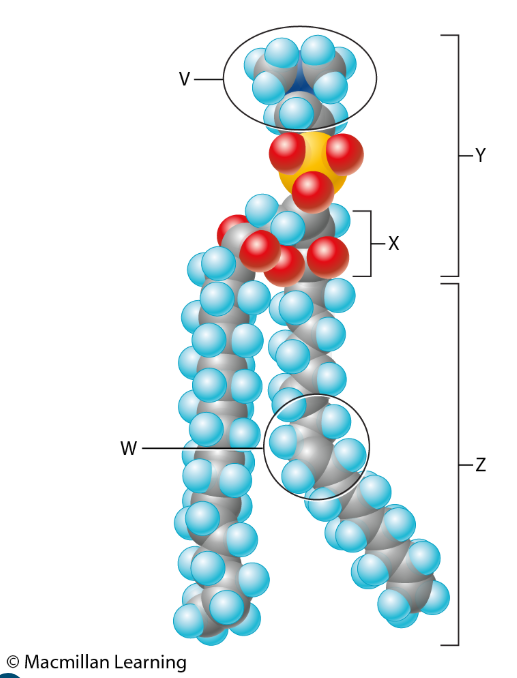
Which lettered part of the space-filling molecular model in the figure represents the hydrophobic portion?
Z
A nuclear pore is most similar to a:
channel protein
What is glycosylation?
the addition of sugars to lipids or proteins
Scientists use which of the answer choices as evidence that mitochondria and chloroplasts had prokaryotic origins?
Both contain their own circular DNA
Which of the answer choices is a pigment associated with chloroplasts and plays a role in energy harvesting?
chlorophyll
Identify all the cell type(s) that belong(s) to each of the listed cellular components in the answer bank. An example of a prokaryotic cell type is bacteria. Examples of eukaryotic cell types include both animal and plant cells.
*practice on paper

Prokaryotes absorb their nutrients from the environment. However, many prokaryotes have cell walls. What can you conclude from this information?
Cell walls are permeable, allowing nutrients to pass through
In order for phospholipids to form bilayers spontaneously in an aqueous environment, the pH should be:
approximately neutral