OT MH Practice Midterm
 Call Kai
 Learn
Learn Practice Test
 Spaced Repetition
 Match
Match Flashcards
 Knowt Play
1/424

There's no tags or description
Looks like no tags are added yet.
Name | Mastery | Learn | Test | Matching | Spaced | Call with Kai | Chat |
|---|
No analytics yet
Send a link to your students to track their progress
425 Terms
Schizophrenia
A psychotic disorder with 3 clusters of symptoms
psychotic/positive symptoms
Negative symptoms
Cognitive symptoms
Means “split mind”
DSM-5 Diagnostic Criteria of Schizophrenia
Two or more of the following symptoms (present for significant part of a month)
▪ Hallucinations
▪ Delusions
▪ Disorganized speech
▪ Disorganized or catatonic behavior
▪ Negative symptoms
o Condition persists for 6 months
o Impaired functioning At least one!
Psychosis
A disconnection from reality
Hallucinations
Delusions
Hallucinations
Distortion in perception
Auditory: Hearing sounds that aren’t real (voices, music, footsteps,commands)
o Visual: Seeing things that aren’t real (people, shapes, lights)
o Tactile: Feeling touch or movement that isn’t real (bugs crawling on skin, organs moving)
o Gustatory: Strange or unpleasant tastes (metallic)
o Olfactory: Experiencing smells that aren’t real
Delusions
Distortion in thought/false beliefs
Culturally situation
Persecutory: Paranoid beliefs (being targeted, followed, or threatened)
o Erotomanic: Unfounded beliefs about love (someone else is in love with them)
o Grandiose: Inflated sense of self (special powers, fame, God)
o Somatic: Something is wrong with the body (missing organs, being pregnant)
Thought Disorder
Disorganized thinking and speech
Tangential speech: Not following a clear train of thought
o Loose associations: Lack of connection between ideas, moving quickly between ideas
o Neologisms: Newly coined word that is meaningless to others
o Echolalia: Repetition of words or phrases said by others
o Magical thinking: More fleeting and flexible than delusions
o Concrete thinking: Difficulty with abstraction, takes things literally
Negative Symptoms: Scizophrenia
Alogia
Flat affect
Avolition
Asociality
Anhedonia
Alogia
Reduced amt of speech, impoverished content, limited spontaneity
Flat affect
Reduced intensity of emotional expression
Avolition
Difficulty initiating and carrying out goal directed behavior
Asociality
withdrawal or avoidance of social contact
Cognitive Impairment
NOT a diagnostic criteria but a core feature
Domains: processing speed, executive function, memory, sociaal cognition
Schizoaffective Disorder
Combination og psychotic + mood disorder
Must meet DSM-5 criteria for both schizophrenia AND depressive or manic episode
Mood disturbance must be present for majority of time of illness
Positive Experiences of Psychosis
Voices of encouragement
Identity and deeper meaning
Spirituality
Symptom or strength?
Etiology
Genetic Factors
Prenatal factors
Structural and functional neuroanatomical differences
Dopamine hypothesis
Environmental factors
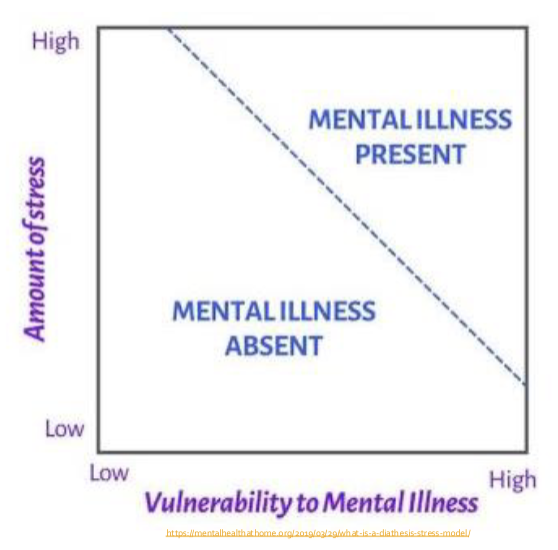
Diathesis Stress Model
Also called the stress vulnerability model
Suggests that schizophrenia results from
a biological predisposition to schizophrenia and
2. environmental stressors that triggers the onset of illness
Prevalence and Course
0.3-0.7% of population
Most commonly diagnosed in early 20s
The course and prognosis of schizophrenia is widely variable
o Symptoms
o Functioning
o Self-perceived wellbeing
Prodromal period
The period of time after the onset of symptoms but before diagnostic criteria
is met is called the prodromal period (can last for weeks or months)
o Early intervention during this period can reduce long-term disability and
impairment
o Oftentimes seen first through a change in cognition
Adaptive paranoia
Health suspicion that develops from experiences of racism and racial profiling
Impact on Occupational Performance: Cognitive Impairments
Information Processing
Executive Function
Social Cognition
Memory
Memory Cognitive Impairments: Schizophrenia
Short-term memory generally impacted less
o Difficulty with working memory (manipulating and processing information)
and episodic memory (remembering past events)
o Impairment in verbal fluency (retrieving verbal information)
Schizophrenia: Health and Wellness Impact
Associated with higher rates of morbidity and mortality
Life expectancy may be reduced by decades
Obesity
Smoking
Oral Health
Schizophrenia Medication: Antipsychotics
Most effective in reducing symptoms
1st Generation - Dopamine antagonists
2nd Generation - serotonin-dopamine antagonists
Side Effects: sedation, sun sensitivity, dry mouth, blurred vision, weight gain, orthostatic hypotension, movement disorders, clozaril (decreased WBC)
OT Intervention Approaches
Cognitive Remediation
Cognitive Adaptation
Social Skills Training
Permanent Supportive Housing
ADL and IADL training
Obsessive Compulsive Disorder
Involuntary and unwanted obsessions and compulsions that are distressing, consume more than 1 hr a day, and impair functioning
Common Themes: contamination, symmetry, forbidden thoughts, harm
May result in avoidant behaviors and/or habits and routines that interfere with daily functioning
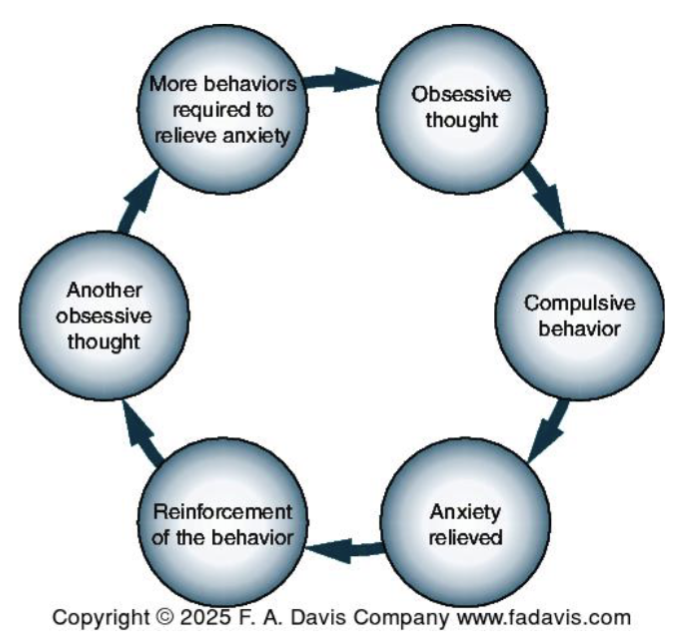
Cycle of Obsessive Thoughts and Compulsive Behaviors in OCD
Obsessive thought → compulsive behavior → anxiety relieved → reinforcement of the behavior → another obsessive thought → more behaviors required to relieve anxiety
Body Dysmorphic Disorder
Preoccupation with perceived flaws or defects in one’s physical appearance that are not apparent or significant to others
o Consumes 3-8 hours per day
Excessive, repetitive behaviors including seeking reassurance about appearance, compulsive skin picking, excessive lifting weights, using anabolic steroids, and having cosmetic surgical procedures
Can impact social participation
Hoarding Disorder
Persistent difficulty discarding or parting with possessions regardless of value resulting in an accumulation of clutter that interferes with functionality of the environment
o Collecting = systematic and organized
o Hoarding = disorganized, excessive clutter that interferes with ability to use living spaces
Trichotillomania
Repetitive pulling out of one’s own hair
Bald spots, thinning hair, skin issues
GI issues if ingested
Excoriation Disorder
Recurrent skin picking
Usually associated with anxiety or boredom, causes distress and/or embarrassment
Frequently co-occurs with anxiety and/or depression
More common in women
Etiology
Genetics:
Strong familial links
Close relatives of a person with OCD have a 5x higher chance of having OCD
Neuroanatomy:
Frontal cortex involvement
Brain differences in OCD can change over time
Neurochemical:
Involves multiple neurotransmitter systems (serotonin, dopamine, and glutamate)
Cognitive and Psychological:
Self perpetuating cycel of obsessions and compulsions
Environmental: NO specific environmental causes, BUT infections and stressful or traumatic life events may increase the risk
Prevalence: Obsessive Disorders
OCD has prevalence rate of 2-3%
Average age onset: 19-20 → almost always before 35
Females more commonly affected
Cultural beliefs, religious practices, and family roles should be considered when assessing/treating
Impact on Occupational Performance: Obsessive Disorders
Cognitive: executive functioning impairments
Psychosocial: decreased social and community participation, disrupted relationships due to → time spent engaged in obsessive thinking, compulsive acts interfering w task completion, avoiding situations that may trigger symptoms
Medication and Medical Treatment: Obsessive Disorders
SSRIs
ECT most effective for people w comorbid depressions
Repetitive transcranial electromagnetic stimulation (rTMS)
Deep Brain Stimulation (DBS)
OT Intervention Approaches: Obsessive Disorders
Cognitive Adaptation
Cognitive Behavioral
Community Clutter and Hoarding Toolkit
Motivational Interviewing
Cognitive Disabilities Model
Developed by Occupational Therapist Claudia Allen
▪ Referred to as the Allen Cognitive levels
▪ Identifies levels by remaining abilities
▪ Developed Allen Cognitive Lacing Screen (ACLS), Allen
Diagnostic Model (ADM) and Routine Task Inventory- Expanded (RTI-E)
▪ From this theory two other OTs have expanded work
▪ Kim Warchol- Best-Abilities Care Model
▪ Teepa Snow - the Positive Approach to Care
Theory of Retrogenesis
Developed by Barry Reisberg, M.D.
▪ Hypothesis that development occurs in reverse
▪ “First in-Last Out”
▪ Compares stages to developmental stages or ages
▪ Global Deterioration Scale (GDS) and Functional Assessment Staging Tool (FAST)
Person Centered Care Approach
Developed by Thomas Kitwood, Ph.D.
▪ Person as the focal point of caregiving
▪ Care is focused on
▪ Quality of life
▪ Well-being
▪ Dignity
Core Values include: Choice, Dignity, Respect, Purposeful living, Self-determination
ADRD and Cognition: Dementia
NOT a specific disease
▪ Overall term covering a wide range of specific medical
conditions
▪ General term for a loss of ‘thinking abilities’ severe enough to interfere with daily life
Classifications
Reversible
Major Depression
Stroke
Traumatic Brain Injury (TBI)
Normal pressure hydrocephalus
Medication side effects
Irreversible
Alzheimer’s Disease (AD)
Vascular Dementia (Multi-Infarct Dementia)
Lewy Body Dementia
Frontotemporal Dementia
Alzheimer’s Disease
Most common type of Dementia; accounts for 60-80%
▪ A progressive neurodegenerative disease
▪ No known cure
▪ Two abnormal structures
▪ Plaques-protein beta-amyloid build in the spaces
▪ Tangles- protein tau build in cells
Characterized by loss of function → loss of independence in daily life activities
Progression is in a continual slope
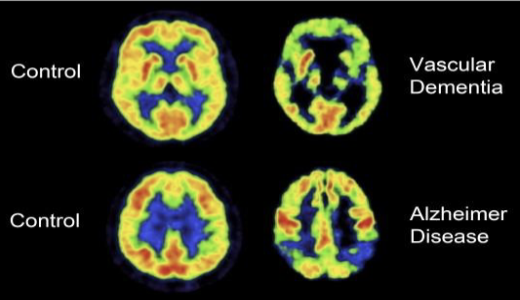
Vascular Dementia( Multi-infarct Dementia)
Commonly occurs with Alzheimer’s
Only around 5-10% occurs alone
More common in men
Causes blocked or reduced blood flow causing oxygen deprivation
Memory loss may or may not be a significant symptom
▪ Impaired planning and judgement, uncontrolled emotion, decreased attention span, impaired social skills and difficulty with word finding
▪ Progression is in a step pattern
Lewy Body Dementia
3rd most common cause of dementia
Deposits of alpha-synuclein proteins inside a neuron
Hallucinations, mostly visual
Trouble w visual info
Parkinsonian movement features
Confusion and alertness that varies significantly
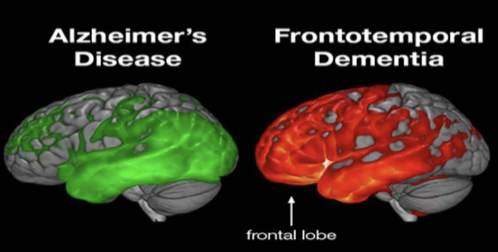
Frontotemporal Dementia (FTD)
Nerve cell damage in frontal and temporal lopes
Causes by 1. Tau and 2. TDP4-3
Used to be referred to as Pick’s disease
Frontotemporal Dementia
Behavior variant frontotemporal dementia (bvFTD)
Personality changes, conduct, judgement, empathy
50s and 60s, can be seen as early as 20s
Primary Progressive Aphasias (PPA)
speaking, writing comprehensions
Normally midlife
Disturbances of motor
Additional Types of Dementia
Korsakoff Syndrome: deficiency in thiamine (B-1)
▪ Most common cause is alcohol abuse
Parkinson’s Disease dementia:
▪ Early on tremors, shakiness, shuffling, stiff movements
▪ As brain changes spread often affect mental functions
Huntington’s Disease:
▪ Single defective gene on chromosome 4
▪ Uncontrolled movement of arms, legs, head, face,
▪ Decline in memory, concentration, judgement, ability to plan and organize
Mixed Dementia
Components of Function
Sensory
Emotional
Physical
Cognitive
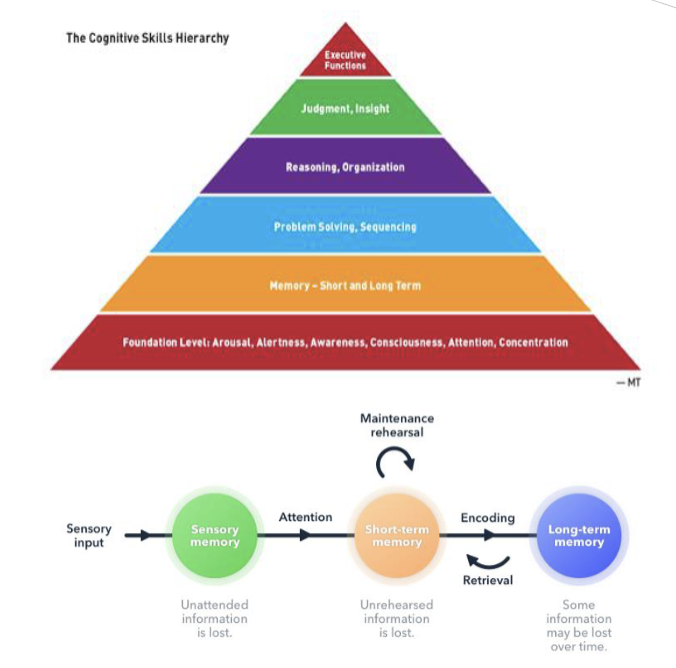
Cognitive Components
Memory
Attention
Problem Solving
Sequencing
4 Types of Memory
Short Term
Long Term
Procedural
Working
Working Memory
Considered an executive function
Retaining information for a brief period of time while then manipulating that information
▪ Helps the brain organize info for storage
Attention
The act of carefully thinking about, listening, to or watching someone or something
▪ Level of alertness: Selective, Divided, Switching, and Sustained
Problem Solving
Ability to recognize and problem and then formulate and implement solutions
▪ Components include:
▪ Recognizing problem
▪ Identify the source of the problem
▪ Devise a solution to the problem
▪ Carry out that solution to correct problem
▪ Assess effectiveness
Best Ability to Function
Comes from the Allen Cognitive Levels
▪ Each level is described by the remaining abilities
▪ These abilities are what provides us with the 'just right challenge'
▪ Matching task complexity with cognitive ability
▪ Is written in % of cognitive assistance
We can think it terms of developmental age
▪ We do not want to speak of a person as 'acting like a 2 year old"
▪ The intention is to help facilitate understanding of remaining abilities
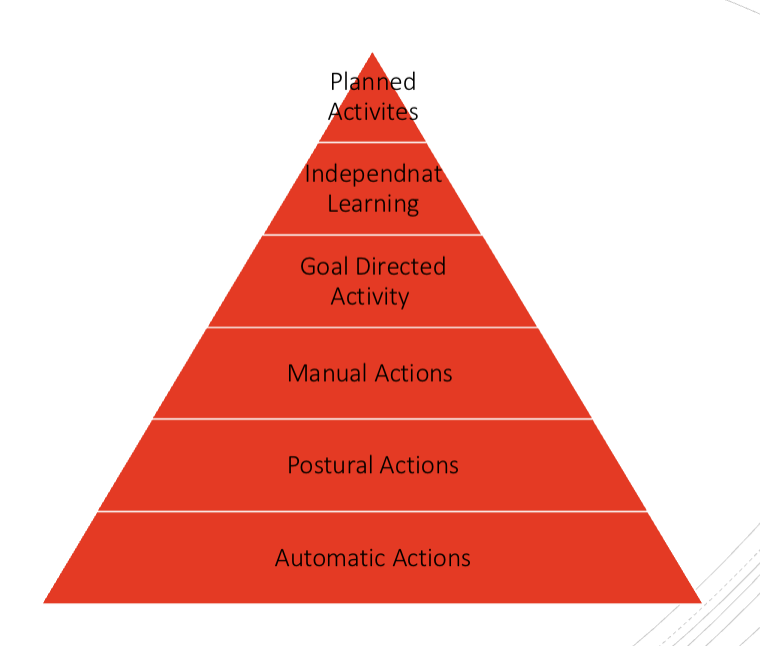
Allen Cognitive Levels
1 through 6, with 1 being the most severe
Level 1: Allen Cognitive Levels
Dementia Stage: End Stage, Severe
▪ Developmental Age: 0-12 months/infant
▪ BATF: Total Cognitive Assistance
▪ GDS: 7
Likely bed bound, mute, and requires total care
▪ Perceptual awareness 14" from face; monocular vision
▪ Can still feel love and experience relationships
▪ Primary remaining abilities
▪ Response to sensory stimuli
▪ Swallow
▪ Vocalize
▪ Partial ROM
Level 1 Care Approaches
Provide meaningful sensory stimuli
▪ Provide stimuli directly in front of person
▪ Gain person’s trust and agreement
▪ Promote movement
▪ Caregiver Knowledge
▪ Contractures
▪ Skin break down
▪ Aspiration
▪ Weight loss
Level 2: Allen Cognitive
Dementia Stage: Late stage
▪ Developmental Age: 12-18 months
▪ BATF: Maximum Cognitive Assistance
▪ GDS: 6-7
Gross motor movements
▪ Mobility
▪ Simple communication
▪ Possible self-feeding and drinking
▪ Perceptual awareness 23" from face; monocular field
Level 2 Care Approaches
Wait for a response
▪ Use verbal, visual, and tactile cues to gain attention and assist in processing directions
▪ Gain the person's trust and agreement
▪ Caregiver Knowledge
▪ Effective communication and engagement
▪ Hospice/ end stage complications
▪ Safety/fall prevention
▪ Promotion of movement
▪ Swallowing
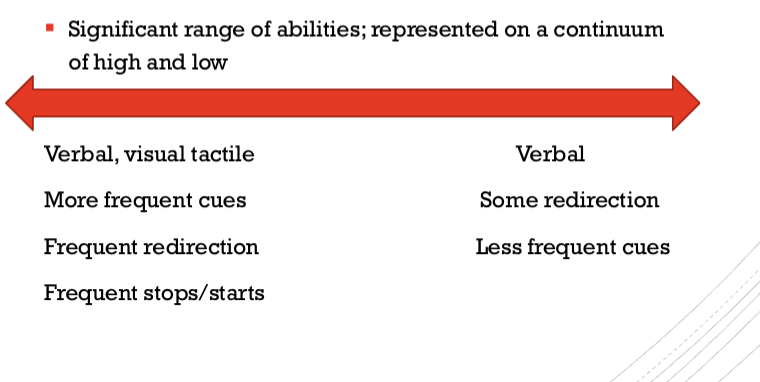
Level 3: Allen Cognitive
Dementia Stage: Middle stage
▪ Developmental Age: 8 months – 3 years
▪ BATF: Moderate Cognitive Assistance- except feeding
which is minimal
▪ GDS: 6
Uses hands to pick up and manipulate familiar objects
▪ Eye hand coordination
▪ Notices effects of actions on objects
▪ Follows one step directions with cues
▪ Perceptual awareness is to elbow/knees; binocular vision
▪ Significant range of abilities; represented on a continuum
of high and low
Level 3 Care Approaches
Use verbal, visual, and tactile cues to gain attention and assist in processing directions
▪ Break activity into one step parts and cue at each step
▪ Use familiar objects to access procedural memory
▪ Gain the person's trust and agreement
▪ Caregiver Knowledge
▪ Effective communication and engagement
▪ Knowing level of assist; avoiding excess disability
▪ Avoidance of behaviors
▪ Safety/fall prevention accommodations
Level 4 Care Approaches
Set out or make supplies visible
▪ Provide assist for problem solving
▪ Establish and maintain a daily routine
▪ Gain the person's trust and agreement
▪ Caregiver Knowledge
▪ Prevent excess disability by promoting use of abilities
▪ Promote effective communication
▪ Safe environment
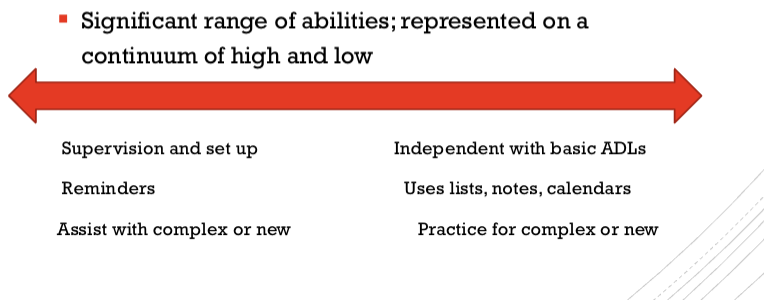
Level 4: Allen Cognitive
Dementia Stage: Early stage
▪ Developmental Age: 4 years – 10/12 years
▪ BATF: Minimum Cognitive Assistance- except feeding
which is supervision
▪ GDS: 4-5
Goal directed in simple, familiar activities
▪ Follows routines- very dependent on these
▪ Some new learning
▪ Some simple problem solving
▪ Perceptual awareness egocentric; binocular vision
Significant range of abilities; represented on continuum
Level 5: Allen Cognitive
Dementia Stage: Mild Cognitive Impairment
▪ Developmental Age: Teens to early 20s
▪ BATF: Independent to supervision depending on task
▪ GDS: 2-3
Follows simple written instructions
▪ Understands primary effects of actions; may not understand secondary
▪ Ability to learn through trial and error
▪ Beginning to have lapses in judgement, memory, attention, may show impulsivity
▪ Perceptual awareness beginning egocentric; tunnel vision
Level 5 Care Approaches
Compensatory strategies
▪ Gain the person's trust and agreement
Caregiver Knowledge
▪ Potential safety hazards
▪ Establish medication routine/compliance
▪ Walker training
Level 6: Allen Cognitive
Dementia Stage: No dementia
▪ Developmental Age: 25+ years
▪ BATF: Independent
▪ GDS: 1
The exchange of information
▪ 'Behavior' is communication
▪ Expressive
▪ Speech
▪ Body language
▪ Facial expression
▪ Receptive
▪ Comprehending message from other
Communication Approaches
Processing
speak in short sentences
wait for response
visuals
Memory
use nouns/avoid pronouns
avoid reality checks “remember?”
Attention
Make direct eye contact
begin with name
Behavior
trust and agreement
Communication Difficulty
Processing requests and directions → difficulties voicing desires and needs → resembling communication of infant
Behavior is Communication
Dementia causes people to act unpredictably
People with dementia communicate through behaviors
Recognize that behavior is communication and look for the trigger
Behavior Problems Arise from
1. Pain-number one cause
Fear
Inability to express unmet need
Loss of sense of self
Inappropriate expectations from a caregiver
Behavior Management Plan Questions
Who: Who was involved in incident
▪ What: What was the behavior
▪ Where: Where did incident occur? Is there a pattern?
▪ When:When did incident occur? Is there a pattern?
▪ Why: What happened prior?
▪ How: How did you respond? Was it effective?
Behavior Problems
Resists care
Physical and verbal aggression
Anxiety
Sundowning
Transfer Trauma
Sad mood or depression
Wandering
Minimize or Prevent
Come back later
▪ Use interests
▪ Gain trust and agreement
▪ Allow for as much control as possible
▪ Reduce stressors
▪ Check for pain
▪ Help to develop relationships
▪ Minimize time left alone
▪ Listen and support
▪ Anticipate unmet needs
▪ Engage in valued activities
▪ Challenging Behavior
Therapeutic Fibbing
Try other tactics first
▪ Distraction
▪ Respond to the emotion rather than the behaviorMix it up
▪ Don’t always resort to this technique - it doesn’t work with
everyone!Safety and well-being rule
▪ Only use when necessary to create safety, enhance QOL,
and ensure well-beingLet it be
▪ If the client is happy and not in danger, let them stay in
their personal realityIntuition
▪ Do what feels right
Montessori Method
Purpose
▪ Help persons with dementia be engaged by meaningful activity
▪ Teach loved ones new ways of connecting
Principles
▪ Sense of purpose and capture interest
▪ Activities that relate the the past
▪ Invite the person to participate
▪ Offer choices (no more than 2)
▪ Talk less, demonstrate more
▪ Match their speed
▪ Engagement is success
Sensory Engagement
Visual Engagement: bright colors, familiar objects to look at
Provide for Motor Movement: active movements throughout day, fidget toys, rocking chairs, air cushion
Activate senses for task preparation: smells of food or cooking before eating, smells of shower, relaxing music to calm or favorite music to alert
Cognitive Beliefs
Convictions held as true
Influence and influenced by occupational, personal, and environmental factors
OTPs can address cognitive beliefs to positively influence occupational participation and performance
Theoretical Assumption
1. Deeply held core beliefs influence our thoughts, emotions, behavior, and
physiological arousal
2. Beliefs and their dynamic interaction with behavior, emotions, physiological states, and the environment comprise human functioning
3. Beliefs are instrumental in how we perceive, appraise, and attach meaning to information from ourselves and the environment (our beliefs are our filter)
4. Beliefs that are true or held to be true often act as self-fulfilling prophecies
5. Beliefs develop from childhood through adulthood
6. Beliefs affect relationships, group affiliations, and society, and these social contexts also affect beliefs
Levels of Beliefs
Beliefs are on a continuum of overlapping levels
o Automatic thoughts- surface level, spontaneous, flexible, situational, arise
from core beliefs
o Assumptions/rules for living- intermediate assumptions, values, conditional rules, arise from core beliefs
o Core beliefs or schemas- deepest level; templates of absolutes about self, others, or the world; rigid; global
• Exist in a dynamic feedback loop where core beliefs generate intermediate and surface level thoughts, and intermediate and surface level thoughts reinforce core beliefs
Levels of Beliefs: Feedback Loop
Surface beliefs or automatic thoughts
Intermediate beliefs: values, attitudes, and rules for living
Core beliefs or schemas: about self, world, future
Depression: Cognitive Beliefs
Cognitive triad of negative beliefs
1. Self
2. The world or environment
3. The future
o May lead to a pessimistic world-view, self-deprecation, unpleasant feelings, maladaptive behaviors
Anxiety Disorders: Cognitive Beliefs
Beliefs tend to focus on threats and catastrophic interpretations of situations
o Intolerance of Uncertainty Model
o In OCD, distorted beliefs lead to inflated responsibility for negative events and need for control
o In PTSD, distorted beliefs center around self-blame
Eating Disorders: Cognitive Beliefs
Distorted beliefs about self and eating
Emphasis on appearance and eating habits on self worth
Substance Use Disorders: Cognitive Beliefs
Anticipatory beliefs - expectation of reward
Relief-oriented beliefs - using will alleviate discomfort
Facilitative beliefs - permissive in spite of potential consequences
Schizophrenia: Cognitive Beliefs
Defeatist beliefs
Self stigma
Cognitive Beliefs and Stigma
Stigma is rooted in personal and public beliefs
• Experiencing stigmatized beliefs from others and/or holding stigmatizing beliefs about oneself may hinder recovery
• Restructuring beliefs about mental illness to focus on hope and the ability to live a successful, meaningful life can support recovery
Cognitive Beliefs Assessment
Structured:
Pain Self Efficacy Questionnaire
Self Efficacy Gauge
Semi-Structured:
Socratic Questioning
Dysfunctional Thought Records
TIC-TOC
ABC
Pain Self Efficacy Questionnaire
Adults with chronic pain
10 item Likert scale survey measuring confidence in ability to perform daily tasks with pain
Self Efficacy Guage
For adults with occupational performance dysfunction
27 item Likert scale survey measuring confidence to perform occupational performance tasks
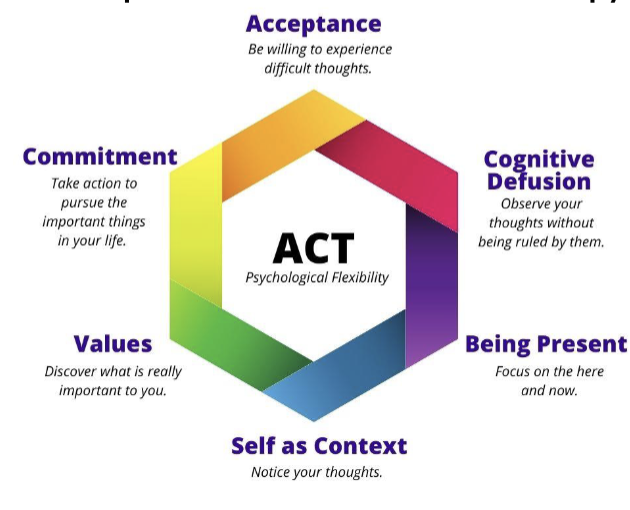
Acceptance and Commitment Therapy Practice Model
Acceptance: be willing to experience difficult thoughts
Cognitive Defusion: observe your thoughts without being ruled by them
Being Present: focus on the here and now
Self as Context: notice your thoughts
Values: discover what is really important to you
Commitment: take action to pursue the important things in your life
CBT Effectiveness
Reducing anxiety
Improving mood and reducing relapse rates in bipolar disorder
Decreasing symptoms of depression
Targeting underlying pathology associated with eating disorders
Substance use treatment, particularly when combined with motivational and skill building approaches
Addressing SOME aspects of functioning in schizophrenia
CBT and OT
When using CBT (or related approaches) in OT, we should consider the relationship between cognitive beliefs and occupational participation and performance
o How do beliefs shape our participation and performance?
o How do participation and performance shape our beliefs?
CBT: Cognitive Restructuring
Socratic Questioning
Guiding Discovery
TIC_TOC
Self-Talk and Affirmations
Thought Records
Coordinated Anxiety Learning and Management (CALM)
Ellis’s Rational Emotive Behavior Therapy (REBT)
TIC-TOC
focuses on identifying and reframing cognitions that interfere with tasks (Task-interfering Cognitions → Task-Oriented Cognitions)
o Identify task-interfering cognitions (TICs)
o Identify the associated though distortions
o Reframe to task-oriented cognition (TOCs)
Thought Records
Worksheet to organize and evaluate thoughts, beliefs, and emotional responses during distress
o May help to challenge cognitive distortions
Cognitive Distortions
All or nothing
Magnifying or minimizing
Catastrophizing or fortune-telling
Mental filter
Emotionalizing or emotional reasoning
Personalizing
Coordinated Anxiety Learning and Management (CALM)
Model for treating anxiety in primary care settings
8 week computer guided program w educational videos, opportunities to practice new skills, and homework
Ellis’s Rational Emotive Behavior Therapy (REBT_
Core tenet: irrational beliefs about how things “must” and “should” be for
people to be happy actually lead them to make themselves miserable
o Participants first identify, evaluate, and challenge irrational beliefs and then restructure and replace these beliefs using a graded approach
o ABC Model
▪ Activating event
▪ Irrational beliefs
▪ Emotional and behavioral consequences
CBT: Behavior/Learning Methods
Behavioral Experiments
Behavioral Activation and Activity Scheduling
Self-Monitoring
Behavioral Experiments
Collaborative strategy where client has opportunities to test thoughts, attitudes, beliefs, and behaviors
o Involves developing a hypothesis, predicting the outcome, engaging in the behavior, evaluating results, and revising beliefs and behaviors
Behavioral Activation and Activity Scheduling
Inactivity/avoidance may result from negative beliefs
o Behavioral activation aims to increase activity, counteract avoidance behavior, increase access to positive resources
o May include activity scheduling like making a list, chart, or calendar of activities to increase commitment and engagement