AP Pre-Calc: All Formulas For AP Exam
 Call Kai
 Learn
Learn Practice Test
 Spaced Repetition
 Match
Match Flashcards
 Knowt Play
1/73

There's no tags or description
Looks like no tags are added yet.
Name | Mastery | Learn | Test | Matching | Spaced | Call with Kai | Chat |
|---|
No analytics yet
Send a link to your students to track their progress
74 Terms
Union set
All elements in A or B (or both)

Intersection
All elements in A and B

(x + y)^3
x^3 + 3x^2y + 3xy^2 + y^3
(x - y)^3
x^3 - 3x^2y + 3xy^2 - y^3
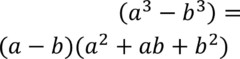
Sum of cubes
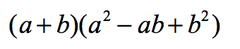
Difference of cubes
Simple interest formula
I = Prt
I = interest earned
P = principal amount
r = rate of interest
t = time
Work formula
W = rt
W = work
r = rate
t = time
Distance formula
d = rt
d = distance
r = rate
t = time
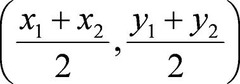
Midpoint formula
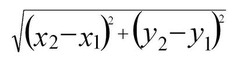
Distance formula
Equation of a circle

Vertical Line Test
Checks if a graph is a function
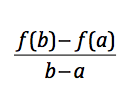
Average rate of change
Even function
f(-x) = f(x)
Odd function
f(-x) = -f(x)
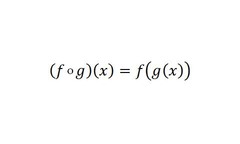
Composition of functions
One-to-one function
Every x value has a unique y value
Horizontal Line Test
Checks if a graph is one-to-one
Inverse of a function
f^-1(y) = x
Inverse function properties
f^-1(f(x)) = x
f(f^-1(x)) = x
Standard form of parabola
f(x) = a(x - h)^2 + k
If a > 0, parabola opens upwards
If a < 0, parabola opens downwards
Maximum or minimum value of a parabola
x = -b / 2a
Remainder Theorem
If the polynomial P(x) is divided by x - c, then the remainder is the value P(c)
Descartes' Rule Of Signs

Finding asymptotes of rational functions

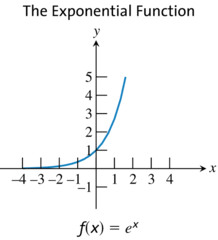
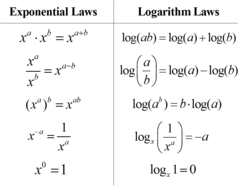
Exponential function
f(x) = a^x
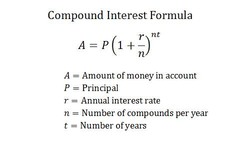
Compound interest formula
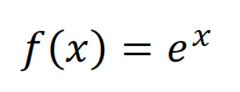
Natural exponential function
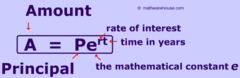
Continously compounded interest
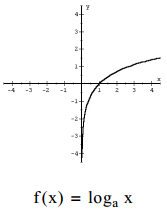
Logarithmic function
loga x = y
Natural logarithm
lnx = loge x

Laws of Logarithms
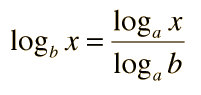
Change of Base formula
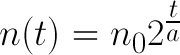
Exponential growth (doubling time)
n0 = initial time at t = 0
t = time
a = doubling time
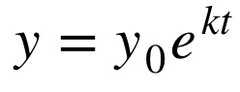
Exponential growth (relative growth rate)
y = population at time t
n0 = initial size of the population
k = relative rate of growth
t = time
Radioactive decay model
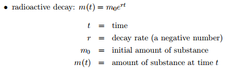
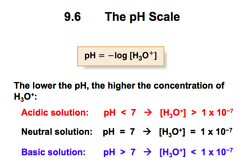
pH scale formula
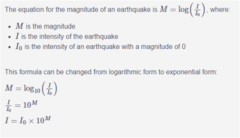
Richter scale formula
Decibel scale formula
I = intensity
I0 = reference intensity

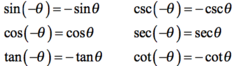
Even-odd properties of trigonometric functions
Pythagorean identities

Shifted sine and cosine curves
y = asink(x - b)
y = acosk(x - b)
Amplitude: |a|
Period: 2π / k
Tangent and cotangent curves
y = atankx
y = acotkx
Period: π / k
Cosecant and secant curves
y = acsckx
y = aseckx
Period: 2π / k
Domain and range of inverse trigonometric functions
Inverse sine:
Domain: [-1, 1]
Range: [-π / 2, π / 2]
Inverse cosine:
Domain: [-1, 1]
Range: [0, π]
Inverse tangent:
Domain: ℝ
Range: (-π / 2, π / 2)
Relationship between degrees and radians

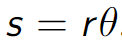
Length of circular arc
s = length
Θ = central angle (radians)
Area of circular sector

Linear and angular speed
Linear: v = s / t = rw
Angular: w = Θ / t
s = rΘ
t = time
1 revolution = 2π
Area of a triangle
A = 1/2absinΘ
Law of Sines
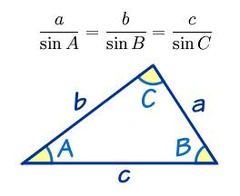
Ambiguous case for Law of Sines
SSA Triangle: can result in 0, 1, or 2 triangles
Law of Cosines

Heron's Formula

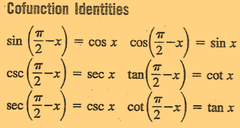
Cofunction identities
Addition and subtraction formulas

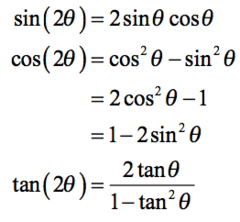
Double angle formulas
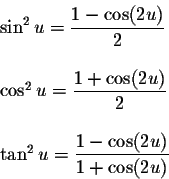
Formulas for lowering powers
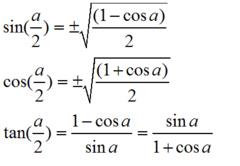
Half angle formulas
Relationship between polar and rectangular coordinates
x = rcosΘ
y = rsinΘ

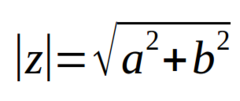
Modulus of complex numbers
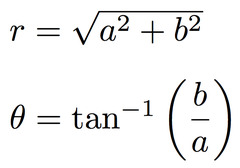
Polar form of complex numbers
z = r(sinΘ + isinΘ)
Multiplication and division of complex numbers
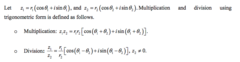
De Moivre's Theorem
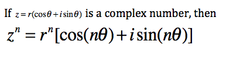
nth roots of complex numbers

Arithmetic Sequence

Partial sums of an arithmetic sequence
Sn = n/2[2a + (n - 1)d]
![<p>Sn = n/2[2a + (n - 1)d]</p>](https://assets.knowt.com/user-attachments/fdad3397-cad7-43d4-995c-85539e9e9e54.png)
Geometric Sequence

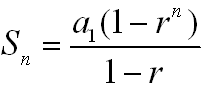
Partial sums of a geometric sequence
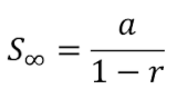
Sum of an infinite geometric sequence
If |r| < 1, series converges
If |r| >= 1, series diverges
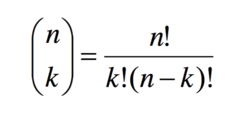
Binomial Coefficient
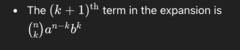
Term containing a^r in binomial expansion
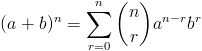
Finding nth term in binomial expansion