Somatosensory processing part 1
 Call Kai
 Learn
Learn Practice Test
 Spaced Repetition
 Match
Match Flashcards
 Knowt Play
1/44

Earn XP
Description and Tags
Sensory systems chapter 9
Name | Mastery | Learn | Test | Matching | Spaced | Call with Kai | Chat |
|---|
No analytics yet
Send a link to your students to track their progress
45 Terms
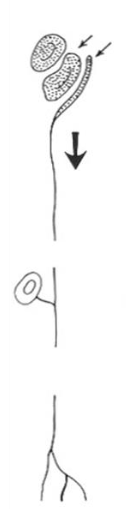
Sensory neuron?
Oxygen sensory neuron
transduction
convert information into neural signals
transmission
pass information on
inference
did something just happen?
4 qualities of information to encode
modality, intensity, duration, locatio4
5 factors that influence success or failure
fatigue, adaptation, sensitization, overlap/redundancy, damage/overload
All sensory fibers transmit nerve impulses in the form of
action potentials
activation of a sensory receptor causes a change in membrane potential called a
receptor potential

Sensory neuron?
taste

Sensory neuron?
smell

Sensory neuron?
Somatosensory
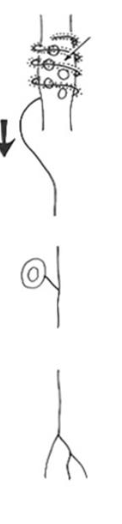
Sensory neuron?
muscle

Sensory neuron?
hearing
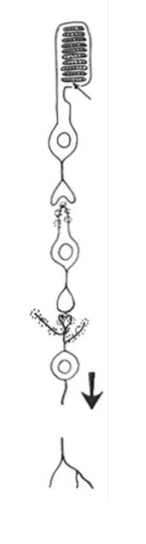
Sensory neuron?
vision
dorsal root ganglia are what kind of cells?
pseudo unipolar cellsnliu
An AP in a dorsal root ganglion may initiate
in the distal process in the periphery
An AP in a dorsal root ganglion may bypass
the cell body
An AP in a dorsal root ganglion may propagate
along the axon until reaching the synaptic terminal in the dorsal horn of the spinal cord
The distal section of the axon may either be a
bare nerve ending or encapsulated by a receptor structure od
dorsal root ganglia contain the
sensory neurons of the somatosensory system
sensory axons are classified according to their
diameter
the diameter of sensory axons governs their
myelination and conduction velocity
A alpha and A beta have what properties?
Myelinated, large diameter, muscle spindle proprioception, discriminative light touch
A delta properties
lightly myelinated, medium diameter, harmless temperature, itch, pain C
C fibers have what properties?
unmyelinated, small diameter, harmless temperature, itch, pain
sensory afferents differ in the size of their respective fields and reflect how
nerve endings branch
Ruffini ending
deep tension; slowly adapting
Meissner corpuscle
light touch; rapidly adapting
Merkel cells + afferents
sustained pressure; slowly adapting
Activation of mechxnosensitive nerve endings of the DRG transduces..
mechanical stimuli into AP to mediate the sense of touch
Sensory afferents differ in their responses to
sustained stimulation (degree of adaptation)
Slowly adapting afferents convey information about
spatial attributes such as size and shape
Rapidly adapting afferents convey information about
changes in ongoing stimulation (dynamic)
Dynamic adaptation change is encoded in
discrete bursts of AP
Pacinian corpuscle properties
vibration; large vague borders; fast adapting
Meissner’s corpuscle properties
touch; small sharp borders; fast adapting
Merkel’s discs properties
touch; small sharp borders; slow-adapting
Ruffini’s ending properties
stretch; large vague borders; slow-adapting
Deformation of the DRG by a mechanical stimulus does what
lowers the threshold needed to evoke an action potential
High threshold channels characterize
nociceptors (pain)
nociceptors are found predominantly in ___ and are activated by___
smaller DRG; higher pressures
Sensory neurons enter the spinal cord through the
dorsal roots
Each Dorsal root innervates a field of skin called
dermatome
Dermatomes are used to determine level of
lesion of spinal cord
Epidural blocks sensation through
several dermatomes