Econ 102 - CHAPTER 15: Entry, Exit, and Long-Run Profitability
 Studied by 0 people
 Call Kai
 Learn
Learn Practice Test
 Spaced Repetition
 Match
Match Flashcards
 Knowt Play
1/13

There's no tags or description
Looks like no tags are added yet.
Name | Mastery | Learn | Test | Matching | Spaced |
|---|
No study sessions yet.
14 Terms
Accounting profit
The total revenue a business receives, less its explicit financial costs.
Accounting profit = Total revenue – Explicit financial costs
Tracks literal money in/out (rent, wages, utilities, ingredients, etc.).
Used to answer: “Where did my money go?”
Economic Profit
The total revenue a business receives, less both explicit financial costs and the entrepreneur’s implicit opportunity costs.
Economic profit = Total revenue – Explicit financial costs – implicit cost (opportunity costs)
Implicit costs include:
Forgone wages (your next-best job)
Forgone interest (money you could’ve earned by investing your startup funds)
used to answer: “Is starting this business actually worth it?”
Average Revenue (AR)
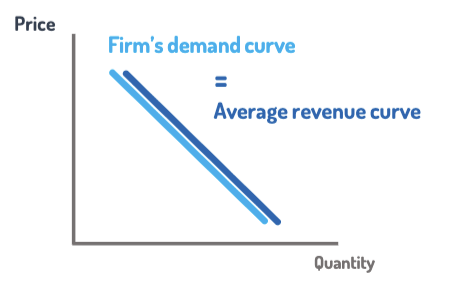
your revenue per unit, calculated as the total revenue divided by the quantity supplied
AR = TR / Q = Price
→ Your firm’s demand curve is also your average revenue curve
Average Cost (AC)
your cost per unit, calculated as your total costs (including fixed and variable costs) divided by the quantity produced
AC = Total cost / Quantity = (Fixed + Variable costs) / Q
Fixed costs: Do NOT change with output (rent, equipment, opportunity cost of owner’s time/money).
Variable costs: Change with output (ingredients, worker hours, electricity).
Why Average Cost Is U-Shaped
1. Spreading Fixed Costs (AC decreases early)
Fixed cost per unit falls as Q increases
(e.g., $6,000 rent → $6,000 per unit at Q=1, $3,000 at Q=2, $2,000 at Q=3)
2. Rising Variable Costs (AC increases later)
Due to:
Diminishing marginal product
Crowding
Coordination problems
Overtime
Higher marginal input costs
Profit Margin
Profit margin per unit = Price − Average Cost
or
PM = Average Revenue − Average Cost
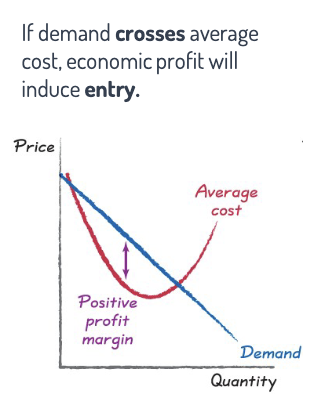
Profit occurs when the demand curve lies above the AC curve.
Visually, for any given quantity, your profit
margin per unit is the gap between your
firm’s demand curve and its average cost
curve.

Short-run analysis
deciding quantity given today’s market price
Long-run analysis
planning how much to invest for a business expansion; launch decisions.
Rational Rule for Entry
Enter if Price > Average Cost → positive economic profit.
Rational Rule for Exit
Exit if Price < Average Cost → negative economic profit.
Effect of Entry
When new competitors enter:
Your demand curve shifts left (fewer customers).
Your demand curve becomes flatter (more elastic) → less market power.
You charge a lower price and sell less quantity.
Effect of Exit
When competitors leave:
Your demand curve shifts right (more customers).
It becomes steeper → more market power.
You charge a higher price and sell more

Long-Run Dynamics
Positive economic profit → ENTRY → profits pushed down.
Negative economic profit → EXIT → profits pushed up.
Long-run outcome with free entry & exit:
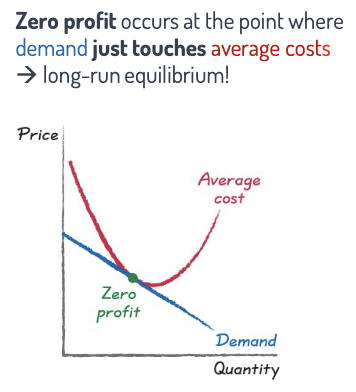
Economic profit = 0
In the Long Run…
Price = Average Cost
Demand touching AC → zero economic profit → entry and exit stop.
Price = AC
Economic profit = 0