unit 4 aos 2 theory for bio
 Call Kai
 Learn
Learn Practice Test
 Spaced Repetition
 Match
Match Flashcards
 Knowt Play
1/32

There's no tags or description
Looks like no tags are added yet.
Name | Mastery | Learn | Test | Matching | Spaced | Call with Kai | Chat |
|---|
No analytics yet
Send a link to your students to track their progress
33 Terms
Calculating Allele Frequencies:
Consider 10 sheep in a population: (Remember: homozygotes have two copies of each allele and heterozygotes only have one)
2 black: ww, 6 homozygous white: WW, 2 heterozygous white: Ww
Total alleles in this population of sheep = 2 x 10 = 20
Number of W = 2 x 6 + 2 = 14
Number of w = 2 x 2 + 2 = 6
Frequency of W= 14/20= 0.7= 70%
Frequency of w= 6/20= 0.3= 30%
If the frequency of only one allele is known, we can obtain the frequency of the second allele by subtracting one from the other:
Freq (W) = 1 – freq (w), Freq (w) = 1 – freq (W)
Freq of (w) is 0.6. What is the frequency of (W)? 0.4
Changing Allele Frequencies:
There are many ways that allele frequencies can change in a gene pool:
- New alleles can arise from mutations.
- Environmental selection pressures can favour some alleles over others, making those alleles more common.
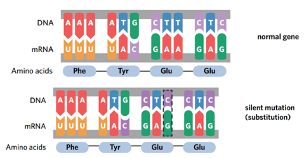
Point Mutations: Substitution and Silent:
new codon that codes for the same amino acid. Possible because genetic code is degenerate (redundant), meaning that more than one codon can specify the same amino acid. No effect on the organism (GAA became GAG) because instruction remains the same (both GAA and GAG code for the same amino acid). Mutation may occur in non-coding regions (introns) of DNA and will have no effect on the phenotype (differences in the number of short-tandem repeats (STRs) usually do not affect an individual’s traits).
Point Mutations: Substitution and Missense:
Result in an amino acid replacement. A protein is still produced, but its structure and function may be altered, depending on which amino acid is substituted and where it occurs in the protein. (Sickle-cell anaemia is caused by a missense mutation that replaces glutamic acid with valine in the β-globin protein).

Point Mutations: Substitution and Nonsense:
result in formation of a premature stop codon. Protein synthesis to stop early, producing a shortened (truncated) protein, usually non-function. Often have a major effect, particularly if the stop codon occurs early in the gene. (Some forms of β-thalassaemia are caused by nonsense mutations in the β-globin gene).

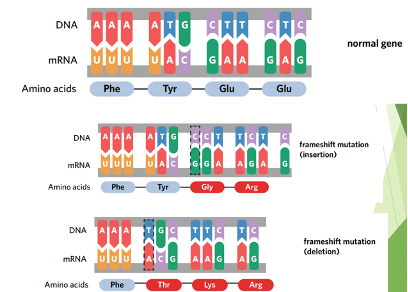
Point Mutations: Frameshift:
one or two nucleotides are inserted or deleted, shifting the reading frame and altering every codon from that point onwards. Often have significant effects on polypeptide because they change amino acid sequence from the point of the mutation onwards. As a result, protein is often non-functional or has greatly reduced function. May also create a premature stop codon, producing a shortened (truncated) protein. May be due to an insertion or deletion of a nucleotide base.
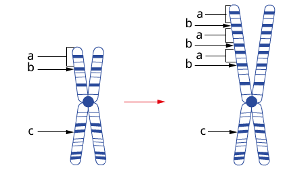
Block Mutations: Duplication:
Section of a chromosome is copied, resulting in multiple copies of the same genes being present on that chromosome. There can be thousands of repeats. Extra copies of genes can alter gene expression (the amount of gene product produced), which may be harmful, neutral or beneficial depending on the gene involved.
Block Mutations: Deletion:
section of a chromosome is removed, which may result in the loss of one or more genes. Missing genetic information can disrupt gene function and may affect growth, development and survival. The effects depend on the size of the deleted region and the genes affected. Large deletions are often severe and may be lethal.
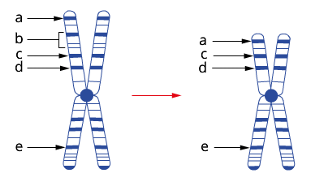
Block Mutations: Inversion:
Section of the chromosome breaks off, rotates 180° and reattaches to the same chromosome. The amount of DNA is unchanged; order of genes or DNA sequences is reversed. Can involve small sections of a chromosome or several genes. May disrupt gene function if the break occurs within an important gene or regulatory region.
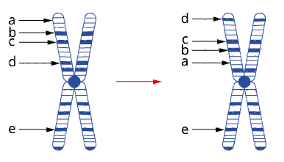
Block Mutations: Insertion:
Section of DNA is inserted into a chromosome, adding extra genetic material. May disrupt genes or alter gene expression depending on where the inserted DNA is located.
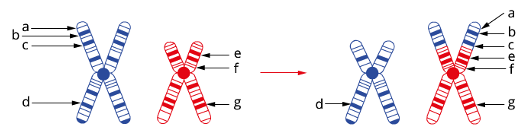
Block Mutations: Translocation:
Section of a chromosome breaks off and attaches to a different chromosome, or section of two chromosomes are exchanged. Often occurs between non-homologous chromosomes, where chromosome segments are swapped. Gene regulation or gene function is interrupted, and some forms of cancer can result.

Chromosomal Abnormalities:
Changes to the number of chromosomes or structure of whole chromosomes. Karyotypes can be used to detect chromosomal abnormalities by arranging stained and photographed chromosomes into pairs to analyse their number and structure. Two main forms of chromosomal abnormalities:
u Aneuploidy; an extra or missing chromosome.
u Polyploidy; having more than two full sets of chromosomes (i.e. more than diploid).
Example: Aneuploidy in Sex Chromosomes: Turner Syndrome:
Due to the absence of one of the sex chromosomes. Foetuses with only a Y chromosome do not survive to birth, but girls with only one X chromosomes usually survive. Sex organs don't mature at adolescence, sterility, short stature.

Variation in a Population:
Different phenotypes between individuals in a population can arise by: mutations, random mating creating different combinations of alleles, independent assortment and recombination during meiosis, differences in gene expression, different environmental factors.
Environmental Pressure:
Selection pressures are conditions that influence allele frequency in a population. They are environmental factors or artificial selection pressures brought about by humans. They remove unsuited individuals (with unsuited alleles/phenotypes). Selection pressures and mutations are the driving forces of evolution.
Pressures can be things such as: Over population, Changing environments (natural disasters or slow changes), Predators, Disease, Boundaries, Food shortages, Breeding competition, Selective breeding.
Survival Advantage:
Some phenotypes provide a survival advantage, phenotypes more likely to survive and reproduce in a particular environment. Individuals more likely to pass on their alleles to offspring, increasing frequency of those alleles in the pop over generations.
- A phenotype that contributes more to the future gene pool is said to have a higher fitness or higher adaptive value.
- A phenotype that contributes less to the next generation has lower fitness and may be selected against.

steps of natural selection (MEMORISE)
Variation – genetic differences exists between individuals in a population.
Selection pressure – environmental factors create conditions that affect survival and reproduction.
Survival advantage – some individuals have phenotypes that are better suited to the environmental conditions.
Survival / Reproduction – individuals with advantageous phenotypes are more likely to survive and reproduce, passing their alleles to offspring. These alleles make a greater contribution to the gene pool of the next generation.
Change in allele frequency – Over many generations, alleles associated with higher fitness become more common in the population, while less advantageous alleles may decrease in frequency.
Example:
Situation 1: In an environment where there is no pesticide, both the resistant and the sensitive phenotypes survive and reproduce equally. The allele frequencies would be expected to remain constant.
Situation 2: If the insect’s habitat is sprayed with pesticide, many of the sensitive insects will be killed. The resistant insects are now at a selective advantage and have a higher fitness level. Over time, the resistant insects will form most of the population.

The Effect of Natural Selection on Allele Frequencies:
Selection pressure determines which phenotypes make organisms ‘fitter’ and are represented in the next generation. Causes reduction in genetic diversity as only the individuals who are better suited to the environment survive/reproduce. Advantageous traits become more common, disadvantageous become less common. Large genetic variation in a population results in a higher change of the survival of the species (less likely to become extinct). Low genetic variation can lead to inbreeding and consequently lead to a high frequency of disadvantageous alleles. Larger populations are more likely to have a greater genetic variation.
Bottleneck Effect – Cheetahs:
Cheetahs severely affected. Experienced two major bottleneck effects, including one from 100 000 years ago and another 10 000–12 000 years ago after the last ice age. Large populations of cheetahs were lost, leading to the extinction of cheetahs from North America and Europe, leaving behind Asian and African populations of cheetahs. Due to these bottleneck events, the genetic diversity of the remaining cheetahs was also severely reduced, leading to significant inbreeding. Cheetahs are so inbred; they are nearly all genetically identical. Unfortunately, due to this reduction in genetic diversity and widespread inbreeding, if a new environmental selection pressure was to arise, then the population of cheetahs is unlikely to be able to adapt. This is because the ability of a population to adapt relies on genetic diversity, with the presence of advantageous alleles which can confer a selective advantage against the environmental selection pressure. Without the presence of advantageous alleles, the population of cheetahs is likely to go extinct.
Founder Effect Example – Amish Community:
make up only about 10 percent of the population in Geagua County in Ohio, but they're half of the special need’s cases. Three of the five Miller children, for example, have a mysterious crippling disease that has no name and no known cure. But for so many years, the Amish have had no names for these disorders. It was simply a mystery why half the headstones in Amish cemeteries were headstones of children. The genetic problems come down to something called the "founder effect" because the nearly 150,000 Amish in America can trace their roots back to a few hundred German Swiss settlers who brought the Amish and Mennonite faiths to the United States in the 18th century. Over generations of intermarriage, rare genetic flaws have shown up, flaws which most of us carry within our genetic makeup but which don't show up unless we marry someone else with the same rare genetic markers.
Selective Breeding (artificial selection)
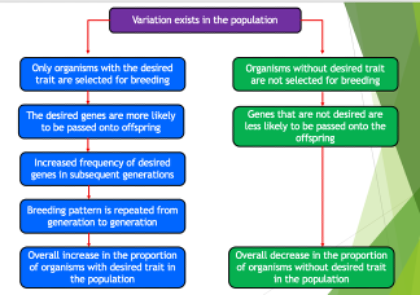
Humans choose individuals with desirable traits to reproduce. Individuals are chosen with desirable traits and are deliberately interbred to increase the allele frequency of those desired traits in the gene pool. Humans have manipulated allele frequencies in the gene pools of populations for thousands of years through deliberate selection of individuals. Allows extreme forms to reproduce while preventing others from reproducing.

Selective Breeding Summary:
Identify the desired trait.
Breed parents that show the desired trait.
Select offspring with the strongest form of the trait and breed them.
Repeat the process over multiple generations until the desired trait is consistently inherited.
Selective Breeding in Crops:
All modern crops and livestock were developed through selective breeding. It has led to improved agricultural crops and domestication of animals for food and other uses (including pets).
Why is Genetic Variation Important?
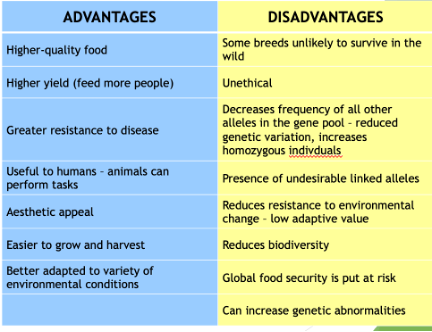
Selective breeding can reduce genetic variation in domesticated plants and animals. Populations may become monomorphic for may traits (individuals have little or no variation at certain gene loci). Low genetic variation increases vulnerability to diseases and environmental change (single disease could wipe out entire populations if no individuals have resistance). Loss of an important crop species could contribute to food shortages or mass starvation. Genetic variation should therefore be protected in wild populations, (through seed banks and food/genetic arks). Wild populations and traditional/primitive varieties often have greater genetic variation, making them more resilient to disease and environmental change.
Negative Effects of Selective Breeding
u Reduced genetic variation: Lower adaptive value present in alleles of population (small gene pools). Changing environmental conditions may wipe out entire populations. A disease or environmental change could wipe out an entire population.
u Reduced Biodiversity: Selectively bred species replace wild varieties reducing genetic variation in the species. Low genetic diversity in major crops can threaten global food security if a disease affects a widely grown variety. (Rice or maize crops would cause global starvation as there are few wild varieties to fall back on).
Increased chance of genetic abnormalities:Small gene pools and repeated interbreeding can increase the frequency of harmful alleles, increasing chance of homozygous recessive genetic disorders. Purebred dogs can be born with conditions such as dysplasia, deafness, heart/neurological conditions and increased likelihood of cancer.
Bacteria:
Prokaryotic, single-celled organisms with a singular circular chromosome, reproduce rapidly by binary fission (asexual reproduction, don’t need mare, clone). Random mutations can occur, spread quickly through a population. Mutations may alter surface antigens, making bacteria harder for the immune system to recognize. Mutations can give bacteria a selective advantage, increasing their survival and reproduction.
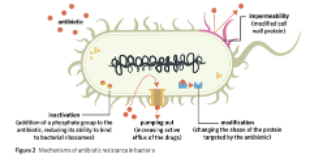
Bacteria can resist antibiotics in a variety of ways. They may:
Reduce intake of drug into the cell. Alter drug’s target so the antibiotic cannot bind effectively. Pump the drug out of the cell. Break down/deactivate antibiotic using enzymes
Causes and Consequences of Increasing Bacterial Resistance:

- Common bacterial infections = more difficult to treat.
- Resistant bacteria can continue reproducing in the body, making infections more severe and potentially life-threatening.
- Treatments that were once effective may no longer work.
- Increasingly difficult to treat with antibiotics are: Pneumonia, Tuberculosis (TB), Gonorrhoea (‘Super gonorrhea’ resistant to at least 6 antibiotics), Salmonella, Methicillin-resistant Staphylococcus aureus (MRSA) (resists common antibiotics available).
Viruses
Non-cellular pathogens that replicate inside host cells. Take over the host cell’s protein synthesis processes to reproduce and spread. Have antigens on their surface which allows the immune system to recognise them as non-self (foreign). Viruses mutate rapidly, which can change their surface antigens. Changes to antigens can help viruses evade immune response and many increase their virulence or resistance to antiviral treatments.
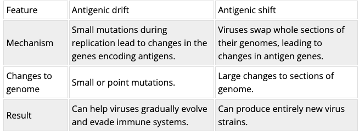
Viral surface antigens can change through: Antigenic drift, Antigenic shift.
Consequences of Antigenic Drift and Shift:
- Antigenic Drift: Produces small changes to viral surface antigens. Existing memory B cells may still recognize the virus. Can provide partial immunity, reducing the severity of the illness.
- Antigenic Shift: Produces major changes to viral surface antigens. The immune system may recognize the virus as new. Existing memory cells may not provide effective protection. A new immune response must be developed, increasing the risk of illness.
Challenges in Treating Viral Disease: Vaccination:
Require the virus to be identified and studies before can be developed. New viruses are problematic, development of vaccines takes time, during which time people can become ill and even die. If the new virus spreads rapidly, it can make people very ill and overwhelm health systems, especially if health professionals become infected. Influenza is particularly challenging because its surface antigens constantly change through antigenic drift and occasionally antigenic shift. Previous flu vaccines may become less effective as the virus changes. Influenza vaccines are updated and administered yearly.
Challenges in Treating Viral Disease: Viral medications:
Unlike bacterial infections, viral infections cannot be treated with antibiotics. Few effective antiviral medications exist because they often need to target specific viruses or viral process. Without effective antiviral, treatment focuses on managing symptoms and supporting the patient while their immune system fights the infection. Large outbreaks can place significant strain on healthcare systems due to the number of patients requiring care.
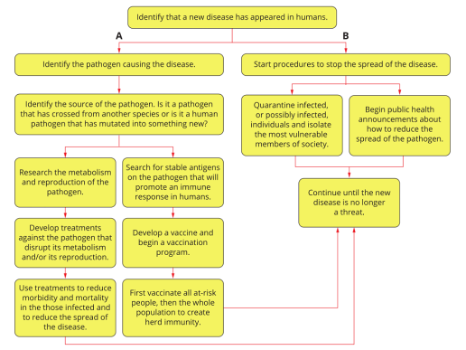
Dealing with an Emerging Disease Summary: