Genetics Final Lab Review
 Call Kai
 Learn
Learn Practice Test
 Spaced Repetition
 Match
Match Flashcards
 Knowt Play
1/20

There's no tags or description
Looks like no tags are added yet.
Name | Mastery | Learn | Test | Matching | Spaced | Call with Kai | Chat |
|---|
No analytics yet
Send a link to your students to track their progress
21 Terms
Genetic linkage leads to the formation of non-recombinant gametes which are …
Significantly more frequent than predicted by chance
Syntenic genes
Genes which are located on same chromosome
The percentage of people when producing gametes with crossing over is higher when …
Related genes are separated by a large distance
When crossing two AaBbCc, the expected phenotype ratio among the offspring is …
(3:1) x (3:1) x (3:1)
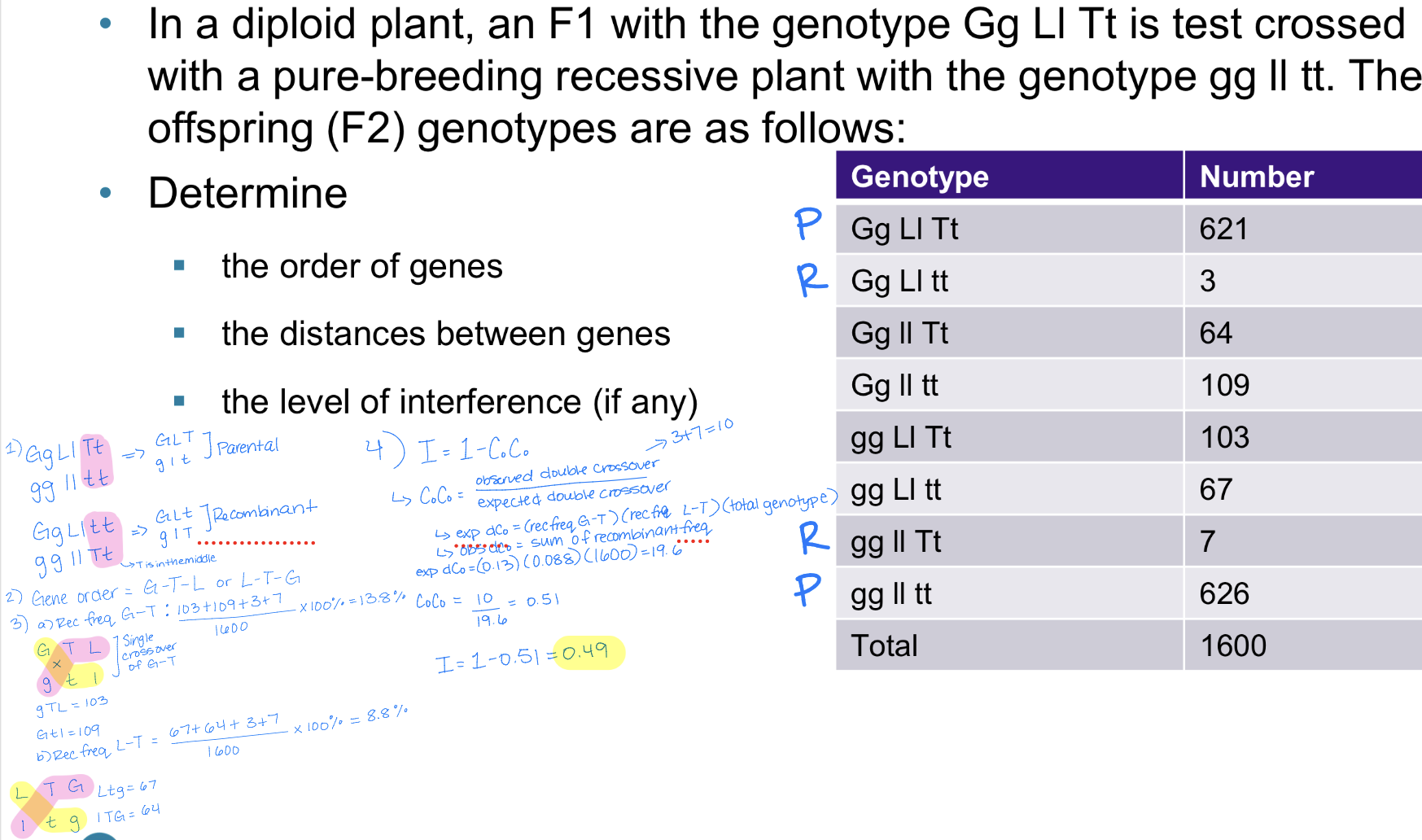
How to solve a 3 point cross/mapping problem (Definitely on Lab Final on Monday)
Identify if the observation #s deviate from the expected #s
Identify the parental allele combinations → biggest #s and the recombinant allele combinations → smallest #s
Identify which gene is in the middle by comparing the parental and recombinant allele combinations and seeing which allele changes → get 2 possible gene orders from this
Calculate the recombination frequencies for both possible gene orders by doing single crossovers and then using numbers associated with result from crossover into formula:
single crossover 1 # + single crossover 2 # + double crossover #s / total x 100%
Solve for interference (I=1-CoCo)
Find expected double crossover = (calculated rec freq/map distance G-T) (calculated rec freq/map distance L-T) (total)
Find observed double crossover = sum of recombinant freq
Divide observed double crossover / expected double crossover to get CoCo
Plug into eqn: I=1-CoCo
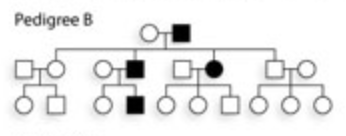
Autosomal dominant
Gene is on autosomes, and one copy is enough to show the trait.
Affects males and females equally
Appears in every generation
No carriers (heterozygotes are affected)
Affected parent → ~50% of children affected
Genotypes:
AA or Aa → affected
aa → normal
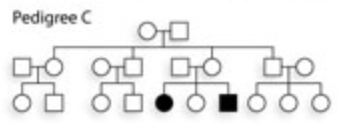
Autosomal recessive
Gene is on autosomes, and two copies needed to show the trait
Affects males and females equally
Can skip generations
Parents often unaffected carriers
More common with consanguinity
Genotypes:
AA → normal
Aa → carrier
aa → affected
Dihybrid cross phenotypic ratio (AaBb x AaBb)
9:3:3:1
Epistasis
Gene interactions in which an allele of one gene modifies or prevents expression of alleles of another gene
Test cross phenotypic ratio (AaBb x aabb)
1:1
Monohybrid cross phenotypic ratio (Aa x Aa)
3:1
Incomplete Dominance
Phenotype of both allele is partially expressed
Example of Polygenic Inheritance
Human eye colors are found on a spectrum that ranges from completely pigmented (dark brown eyes) to a complete lack of pigment (light blue eyes)
b/c multiple genes are involved in determining eye color
The eukaryotic cell cycle is divided into what two principal phase?
Interphase and M phase
If two recessive mutations are on the same gene, then crossing them …
Will not restore function → offspring stays mutant
If recessive mutations are on different genes …
Each parent provides a working copy of the other gene → offspring are normal
Interphase
A period prior to mitosis in which the cell undergoes a period of growth
During this phase, DNA is synthesized and cell organelles are produced
S phase
The phase of interphase where DNA is copied
The number of chromosomes _____ from G1 to G2
Do NOT change
Centromere
This is a specific region of DNA on a chromosome that holds two sister chromatids together. It acts as the physical foundation and anchor point for the chromosome.
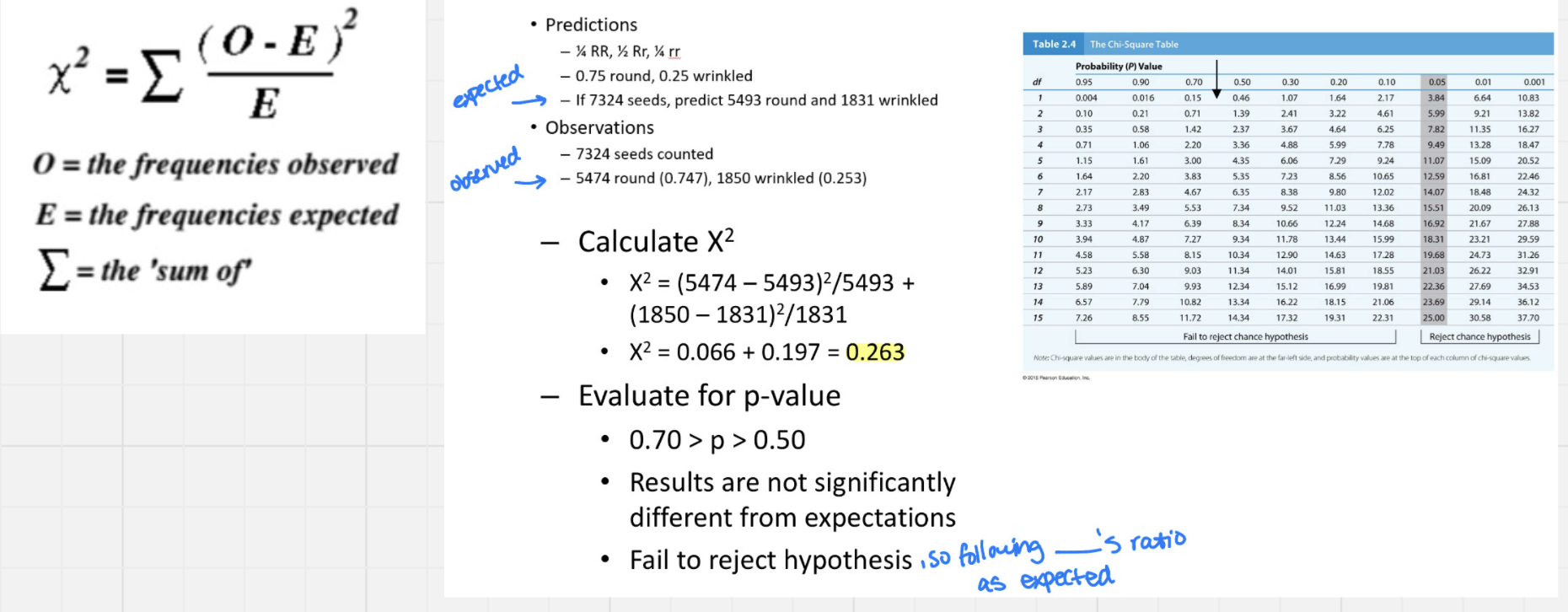
Steps to calculate X2 value for Chi-square analysi
1. Calculate the difference between the observed (O) and expected (E), then square it and divide by E
2. Sum for each outcome class
Then, find where X2 falls on a normal distribution to determine p-value
Need to also know degrees of freedom (df = n-1)
If fail to reject = they assort independently