Anatomy and Function of the Skin
 Call Kai
 Learn
Learn Practice Test
 Spaced Repetition
 Match
Match Flashcards
 Knowt Play
1/23

There's no tags or description
Looks like no tags are added yet.
Name | Mastery | Learn | Test | Matching | Spaced | Call with Kai | Chat |
|---|
No analytics yet
Send a link to your students to track their progress
24 Terms
functions of the skin
1) protection
2) fluid conservation
3) temperature regulation
4) sweat regulation
5) sensation
6) immune assist
7) mobility assist
8) gives physical appearance/identity
20 ft2
How large would the average human's skin be if you laid it out flat?
layers of the skin
EPIDERMIS
1) stratum corneum
2) stratum lucidum
3) stratum granulosum
4) stratum spinosum
5) stratum basal
DERMIS
1) papillary
2) reticular
SUBCUTANEOUS TISSUE

epidermis
outermost layer of skin
FUNCTION--> barrier/protection from water loss
COMPOSITION:
1) 90% keratinocytes
(strength)
2) melanocytes
(gives skin color)
3) Langerhans
(immunity)
AVASCULAR

free nerve endings, Merkel
What 2 sensory receptors can be found in the epidermis?
HINT: pain, light touch
corneum, lucidum, granulosum, spinosum, basale
List the epidermal layers from outermost to innermost.
(excluding the word stratum)
HINT: My corny lucid grandma left her spine in the basement.
stratum lucidum
Which layer of the epidermis is only found on the palms and soles?
HINT: layer #2
stratum granulosum
In which layer of the epidermis do free nerve endings terminate?
HINT: layer #3
stratum spinosum
In which layer of the epidermis are there a high concentration of Langerhans cells?
HINT: layer #4
stratum basale
In which layer of the epidermis are melanocytes, Merkel cells, and epidermal cell germination?
HINT: layer #5
basement membrane
layer of collagen below the stratum basale and immediately superior to the dermis
FUNCTION--> bond the two skin layers together
*rete ridges
sweat glands, hair follicles, sebaceous glands
What are the 3 epidermal appendages?
HINT: move through epidermal layers
sweat glands
EPIDERMAL APPENDAGE
1) apocrine
location: axilla and groin
function: possible sexual attraction
2) eccrine
location: all over body except lips and external genetalia
function: regulate body temperature excretion of water and electrolytes

hair follicle
EPIDERMAL APPENDAGE
dips deep into reticular dermis
FUNCTIONS
1) follicle-->
re-epithelialization
(stem cells migrate to wounds to initiate healing process)
2) shaft-->
thermoregulation, UV, protection, protection from foreign particles, sensation
3) arrector pili-->
thermoregulation and emotion

sebaceous glands
EPIDERMAL APPENDAGE
incorporated within each hair follicle
FUNCTION--> secrete sebum
1) MOISTURIZING
2) water resistance
3) acidic pH of skin
(4-6)
false (sebum)
True or False: Sweat helps to moisturize the skin.
dermis
innermost layer of skin
FUNCTION--> protect the deeper layers and support/nourish the epidermis
COMPOSITION:
1) fibroblasts
2) extracellular matrix
3) adipocytes
4) lymphocytes
VASCULAR
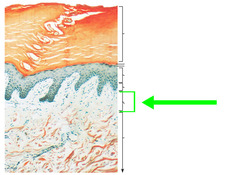
papillary dermis
DERMAL LAYER
LOCATION:
superficial dermal layer
*rete ridges*
COMPOSITION
cellular:
- ECM
- loose collagen
- elastin
extracellular:
- lymphatic capillaries
- blood capillaries
- Meissner's corpuscles
(movement)
reticular dermis
DERMAL LAYER
LOCATION:
deep dermal layer
*80% of thickness*
COMPOSITION
cellular:
- ECM
- dense collagen
- elastin bundles
extracellular:
- arterioles
- venules
- pre-collectors
- Ruffini endings (stretch)
- Pacinian corpuscles (vibration)

subcutaneous (hypodermis)
located deep to the dermis
FUNCTION--> thermoregulation and cushioning to deep vital structures
COMPOSITION:
1) adipose tissue
- acts as insulation
- stores calories, gives skin motility, provides the body shape
2) fascia
- bands of collagen
- stabilize underlying structures
skin aging effects
REDUCED:
- dermal blood flow
- production of elastin and collagen fibers
- subcutaneous fat
- (flattening of) rete ridges
- sensory structures
- presence of Langerhans cells
- (delayed) wound healing
*sweat and sebaceous gland atrophy
(affects thermoregulation & skin moisture)
thin transparent film
Skin tears are typically a DRY wound. Which type of bandage should be applied for healing?
papillary dermis
Where do the blood and lymphatic capillaries live?
flattening of rete ridges
Why are skin tears more common with age?