Legacy Tape Formats and Video Technology
 Call Kai
 Learn
Learn Practice Test
 Spaced Repetition
 Match
Match Flashcards
 Knowt Play
1/23

Earn XP
Description and Tags
Vocabulary flashcards covering legacy analogue and digital videotape formats, tape path wrap configurations, technical specifications, track layouts, and editing control equipment.
Name | Mastery | Learn | Test | Matching | Spaced | Call with Kai | Chat |
|---|
No analytics yet
Send a link to your students to track their progress
24 Terms
2 Inch Quadruplex Reel to Reel VTR
A videotape recorder format introduced by Ampex in 1956 using 2" wide video tape and four magnetic record/replay heads spinning width-wise across the tape to record PAL/NTSC composite signals.
Low-band Quadruplex
The first variety of 2" Quad tape introduced by Ampex.
High-band Quadruplex
A variant of 2" Quad tape that used a wider bandwidth for recording video to the tape, resulting in higher-resolution video.
Super High-band Quadruplex
A variant of 2" Quad tape that used a pilot tone for better stability.
Type C 1" Reel to Reel VTR
Broadcast recorders introduced in 1976 by Ampex and Sony, based on large audio reel-to-reel designs and recording high-quality PAL/NTSC composite signals.

Alpha Tape Path Wrap
An early tape path wrap configuration used in 1" broadcast reel-to-reel video recorders.

Omega Tape Path Wrap
A tape path wrap configuration used in later 1" broadcast reel-to-reel video recorders.
Quadruplex Scanning
A tape scanning system using 4 video heads to write and read video lines top to bottom across the tape width, while linear heads record audio, timecode, and control tracks along the length.

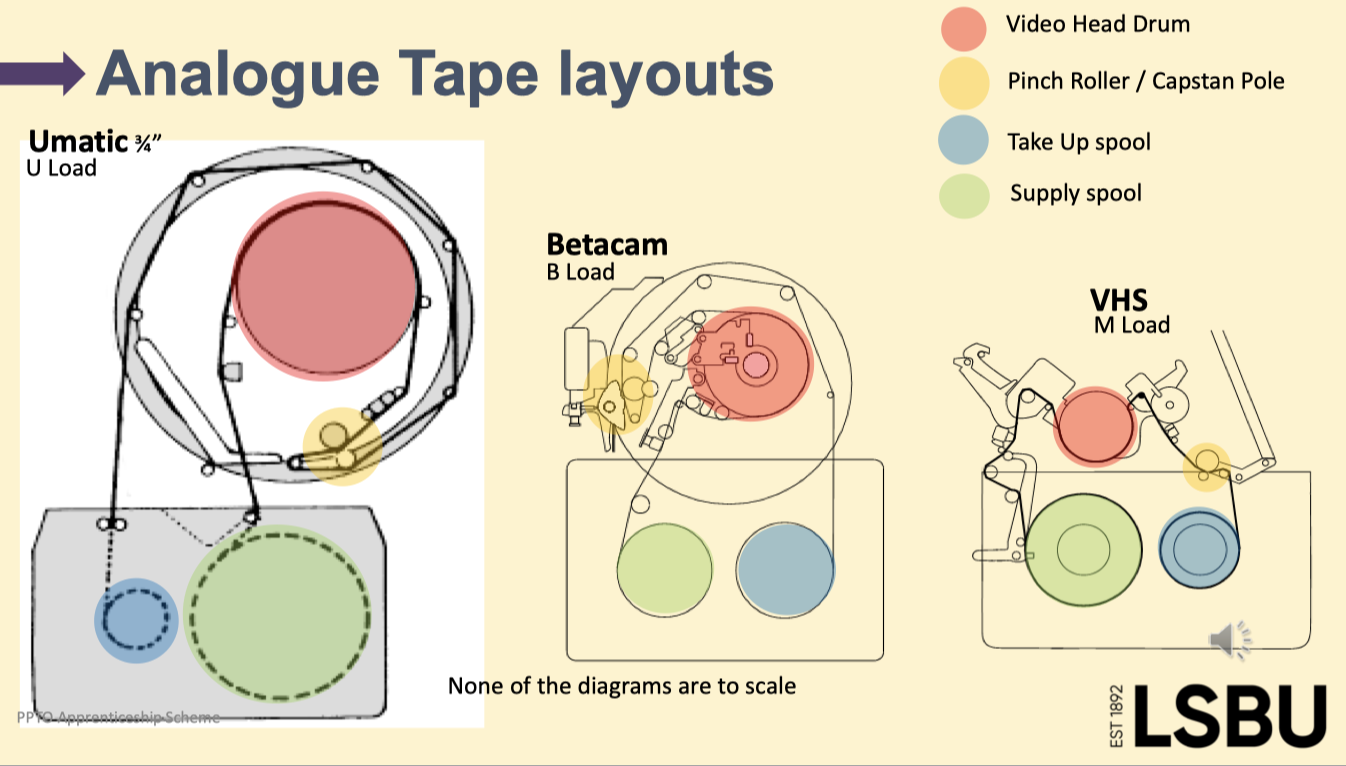
Analogue Tape Loading Layouts
The tape path loading configurations used in analogue cassette formats, including U Load (U-matic 43"), B Load (Betacam), and M Load (VHS).

Helical Scan Tracks on Tape
The physical tape layout on 21" and 43" videotapes, where video tracks are recorded diagonally across the tape between linear audio tracks and control tracks.
Betacam SP
An analogue component videotape format featuring a 12.5mm (21") tape width, 10.15cm/s tape speed, 574cm/s writing speed, 86μm video track width, and 5.5MHz luminance resolution.
VHS
A domestic analogue composite videotape format with a 12.5mm (21") tape width, 2.339cm/s tape speed, 483cm/s writing speed, 49μm video track width, and 2.3MHz luminance resolution.
U-matic 43"
An analogue composite tape format with a 19.05mm (43") tape width, 9.525cm/s tape speed, 854cm/s writing speed, and 830μm video track width.
Video 8
An 8mm analogue composite tape format featuring 2.4MHz luminance resolution and 1 FM (also stereo FM) audio track.
Hi 8
An 8mm analogue composite tape format featuring 3.85MHz luminance resolution, 1 FM audio track, and 2 PCM digital 8-bit audio tracks.
Betamax
A 21" analogue composite tape format featuring 3.5MHz luminance resolution and 2 longitudinal (+ 2 FM - Hi-Fi) audio tracks.
S-VHS
An improved 21" analogue composite tape format featuring 3.54MHz luminance resolution.

Sony RM-450
A two-machine edit controller designed to control one player and one recorder, serving as a staple in linear video editing setups like Betacam SP and U-matic.
BVW
Sony designation prefix for Broadcast specification Betacam and Betacam SP machinery.
PVW
Sony designation prefix for Professional specification Betacam SP machinery.
UVW
Sony designation prefix for Industrial specification Betacam SP machinery.
D1
The first digital video format produced, which uses 43" wide tape in large cassettes with uncompressed 8-bit quantised CCIR601 digitised component video.
Digital Tape Advantage
The absence of generation loss, allowing pictures to go through multi-generational post-production processes without image degradation, noise accumulation, or compounding analogue distortions.
Small Digital Formats
Highly compressed digital formats such as DVCPro, DVCAM, and Mini DV used in news cameras and pre-visualization to avoid analogue generation loss.