Era of good feeling
 View linked note
 Call Kai
 Learn
Learn Practice Test
 Spaced Repetition
 Match
Match Flashcards
 Knowt Play
1/105

There's no tags or description
Looks like no tags are added yet.
Name | Mastery | Learn | Test | Matching | Spaced | Call with Kai |
|---|
No analytics yet
Send a link to your students to track their progress
106 Terms
What nickname is given to the period of James Monroe’s administration?
The Era of Good Feelings.
Why was Monroe’s administration called the "Era of Good Feelings"?
Because political tension eased as the Federalist Party declined, creating a period of national unity.
What happened to the Federalist Party during Monroe’s administration?
The Federalist Party faded away, leaving the Democratic-Republicans as the dominant political force.
How did Monroe’s administration attempt to bridge political divides?
Monroe appointed former Federalists, such as Henry Clay, to his administration, promoting bipartisan cooperation.
What change in international relations helped Monroe focus on domestic issues?
The U.S. was no longer caught between European conflicts, allowing a focus on westward expansion and internal development.
What was the Cumberland Road, and why was it significant?
The Cumberland Road, also known as the National Road, was the first federally funded highway in the U.S.
How did the Cumberland Road impact westward expansion?
It facilitated travel and trade, connecting the East Coast with the western frontier.
Who pioneered the use of steamboats in the United States?
Robert Fulton.
What was the name of Robert Fulton’s notable steamboat?
The City of New Orleans.
How did steamboats like The City of New Orleans transform river travel?
They made transportation faster and more reliable for people and goods along American rivers.
What was the purpose of the Erie Canal?
To connect Lake Erie and the other Great Lakes with the Atlantic Coast for easier trade and migration.
What cities did the Erie Canal link in New York?
Albany, Rome, Syracuse, Rochester, and Buffalo.
How did the Erie Canal impact the economy of New York?
It significantly lowered shipping costs and made New York City a major trade hub.
How much did it cost to ship a ton of goods from Buffalo to New York City before the Erie Canal?
$100.
How much did it cost to ship a ton of goods after the Erie Canal was built?
$10.
What was a major consequence of the Erie Canal on migration?
It encouraged western migration and settlement, particularly in the Great Lakes and Upper Midwest.
How did the Erie Canal affect New Orleans’ economy?
It diverted trade to New York, weakening New Orleans’ role as a major port.
Who was a major supporter of the Erie Canal and oversaw its construction?
New York Governor DeWitt Clinton.
What nickname was given to the Erie Canal by some critics?
“Clinton’s Ditch.”
How was the Erie Canal funded after President Monroe’s veto of federal funding?
New York State legislature funded it through state funds, with tolls repaying the costs.
Name three major diplomatic achievements during the Era of Good Feelings.
The Rush-Bagot Treaty, Jackson’s actions in Florida, and the Adams-Onis Treaty.
What was the purpose of the Rush-Bagot Treaty?
To demilitarize the U.S.-Canada border along the Great Lakes.
What boundary did the Rush-Bagot Treaty establish?
The 49th parallel between the U.S. and Canada.
Who negotiated the Rush-Bagot Treaty on behalf of the U.S.?
John Quincy Adams, Monroe’s Secretary of State.
Why was Andrew Jackson sent to Florida in 1818?
To put down the Seminole tribes, who had absorbed many Creek Indians and were raiding U.S. territory.
What actions did Jackson take against British citizens in Florida?
He captured two British citizens, accused them of aiding the Seminoles, and executed them.
How did Jackson’s actions in Florida impact U.S.-Spanish relations?
His capture of Pensacola forced Spain to reconsider its hold on Florida, leading to the Adams-Onis Treaty.
What did the Adams-Onis Treaty accomplish?
It ceded Florida to the U.S. and established the southern border at the 42nd parallel.
How much did the U.S. pay Spain for Florida in the Adams-Onis Treaty?
$5 million.
What was the main purpose of the Monroe Doctrine?
To prevent European nations from interfering in the affairs of the Western Hemisphere.
What did President Monroe declare about European colonization in the Americas?
He declared that the Western Hemisphere was off-limits to further European colonization.
How did European nations initially react to the Monroe Doctrine?
They largely disregarded it and did not take it seriously.
Why did the Monroe Doctrine later become an important part of U.S. foreign policy?
As the U.S. gained strength, it could enforce the doctrine, making it a significant policy for protecting American interests.
What was the purpose of the Anglo-American Treaty of 1818?
To settle border disputes between the U.S. and the United Kingdom.
What was the primary boundary established by the Anglo-American Treaty of 1818?
The 49th parallel as the border between the U.S. and British Canada.
What arrangement did the treaty make regarding the Oregon Territory?
It allowed for joint occupation and settlement by both the U.S. and Britain.
What did the Land Act of 1820 change about purchasing public lands?
It ended the practice of buying land on credit, requiring buyers to pay the full amount upfront.
How did the Land Act of 1820 make land purchases more affordable?
Congress reduced the minimum price and minimum size of land tracts, encouraging more settlers to buy land.
What impact did the Land Act of 1820 have on western settlement?
It spurred increased settlement in the American West by making land more accessible to settlers.
How did the Land Act of 1820 affect land speculation?
It decreased land speculation, creating a more stable environment for settlers.
What was the Tallmadge Amendment, and who proposed it?
Proposed by James Tallmadge in 1819, it sought to admit Missouri as a free state, banning slavery there.
What was the outcome of the Tallmadge Amendment?
It passed in the House but failed in the Senate due to strong opposition from Southern states.
What compromise did Congress reach in 1820 regarding Missouri’s admission to the Union?
The Missouri Compromise allowed Missouri as a slave state, Maine as a free state, and banned slavery north of the 36˚30’ parallel in the Louisiana Territory.
Why was the Missouri Compromise significant?
It temporarily eased sectional tensions over slavery by balancing the number of slave and free states.
Who founded the African Methodist Episcopal (AME) Church, and when?
Reverend Richard Allen founded the AME Church in 1816.
Why was the AME Church founded?
To provide Black congregants a religious community free from racial discrimination and to advocate for civil rights.
What was the mission of the AME Church?
It aimed for social improvement, religious autonomy, and civil rights for African Americans.
How did the AME Church grow after the Civil War?
It expanded throughout the South and West, becoming the largest African-American Methodist denomination by 1906.
What was the Tariff of 1828, and why did Southerners oppose it?
The Tariff of 1828 imposed high duties on imports, which Southerners felt unfairly burdened them to protect northern industries.
How did John C. Calhoun respond to the Tariff of 1828?
Calhoun secretly wrote “The South Carolina Exposition,” calling for states to nullify the tariff.
What was the response to South Carolina’s threat to nullify the tariff?
Other states did not join in, leaving South Carolina isolated in its nullification threat.
How did the tariff issue affect Andrew Jackson’s stance?
Jackson, although from the South, took a strong stance to preserve the Union, leading to tensions with South Carolina.
How did Andrew Jackson’s supporters portray him in the 1828 election?
They presented him as the “People’s President,” a representative of the common man, against the “Corrupt Bargain” that had favored John Quincy Adams in 1824.
What allegations did Adams’ supporters make against Jackson in 1828?
They accused him of being an adulterer and attacked his wife, Rachel, calling her character into question.
What was the outcome of the 1828 election?
Andrew Jackson won decisively with support from the West and South, while Adams was favored by New England.
How did Jackson’s wife, Rachel, influence his presidency?
Rachel’s death shortly after the election, which Jackson blamed on the slander against her, left him bitter and affected his interactions with political rivals.
What was the spoils system, and how did Jackson implement it?
The spoils system rewarded political supporters with government positions; Jackson replaced many officials, favoring loyal followers over experienced ones.
How did Jackson’s use of the spoils system differ from previous presidents?
Jackson removed a significant number of officials to replace them with supporters, unlike prior administrations that retained many incumbents.
Who was Samuel Swartwout, and why was he significant in Jackson’s administration?
Swartwout, appointed as collector of customs in New York, fled to England after embezzling over a million dollars, marking the first major case of government embezzlement.
What was the Eaton Affair, and why did it become a scandal?
Secretary of War John Eaton’s marriage to Margaret “Peggy” O’Neale, who had a controversial reputation, led to social ostracism and conflicts within Jackson’s cabinet.
How did Jackson respond to the social rejection of Peggy Eaton?
Jackson defended her, seeing the attacks as similar to those made against his late wife, Rachel, but ultimately sent the Eatons back to Tennessee.
What was the political outcome of the Eaton Affair?
The affair deepened tensions between Jackson and his Vice President, John C. Calhoun, eventually leading to Calhoun’s resignation.
What was the Nullification Crisis, and what caused it?
The Nullification Crisis was a confrontation between South Carolina and the federal government over the “Tariff of Abominations,” which South Carolina sought to nullify.
How did Jackson respond to South Carolina’s threat to nullify the tariff?
Jackson obtained a force bill allowing him to use military action to enforce the tariff, threatening to hang any nullifiers.
What compromise was reached to end the Nullification Crisis?
Henry Clay proposed a compromise bill to gradually lower the tariff, which Congress passed along with the Force Bill to save face.
How did the Nullification Crisis affect the Union?
It temporarily eased tensions, but the concept of state rights and nullification foreshadowed future conflicts, particularly over slavery.
Why did Andrew Jackson oppose the Bank of the United States (BUS)?
Jackson saw the BUS as unconstitutional, monopolistic, and favoring the elite over common people.
What strategy did Henry Clay and Daniel Webster use regarding the BUS recharter?
They forced an early recharter vote in Congress, hoping Jackson’s veto would cost him political support.
How did Jackson respond to the BUS recharter bill?
Jackson vetoed it, condemning the bank as unconstitutional and aligning his support with the western states.
Who led the BUS and opposed Jackson’s policies?
Nicholas Biddle, the BUS president, who viewed the bank as stabilizing and economically vital.
What was the Indian Removal Act of 1830?
It enabled the federal government to negotiate land exchanges with Native American tribes, forcing them to relocate westward.
How many Native Americans were forced to relocate due to the Indian Removal Act?
Approximately 60,000 Native Americans were forced westward, many to present-day Oklahoma.
What hardships did the Native Americans face on the Trail of Tears?
They faced a 1,200-mile journey marked by illness, hunger, and exposure, leading to the deaths of over 4,000 Cherokee.
How did the U.S. Supreme Court respond to Indian removal in Worcester v. Georgia?
The Court ruled that states couldn’t regulate Native American lands, affirming Native American sovereignty.
How did Jackson respond to Worcester v. Georgia?
Jackson disregarded the ruling, asserting federal and executive power over the tribes’ land rights.
When was the Bureau of Indian Affairs established, and what was its role?
Established in 1836, it managed interactions between the U.S. government and Native American tribes.
Who were some of the prominent leaders of the Seminole Tribe during the Second Seminole War?
Osceola, Jumper, Alligator, Tiger Tail, and Micanopy were notable leaders.
What was the significance of the Second Seminole War?
It was the longest and most sustained Native American resistance in U.S. history, partly fueled by runaway slaves who fought alongside the Seminoles.
What was the result of the Second Seminole War?
The Seminoles were ultimately forced to relocate to Oklahoma, though some resisted and retreated into Florida’s Everglades.
How did Andrew Jackson view federal versus state authority?
Jackson was a strong advocate for federal authority, often prioritizing the Union over individual state actions, as seen in the Nullification Crisis.
What precedent did Jackson set by defying the Supreme Court’s ruling in Worcester v. Georgia?
Jackson demonstrated executive power over judicial decisions, asserting federal control over Native American policy.
How did Jackson’s presidency change the political power structure in the U.S.?
Jackson shifted power from the elite toward the common man, fostering a more democratic political landscape and establishing the "People’s President" model.
What nickname did Andrew Jackson earn from his troops, and why?
He was called “Old Hickory” because of his toughness and resilience as a military leader.
How did Jackson’s use of the veto differ from previous presidents?
Jackson used the veto more frequently, wielding it as a tool to challenge congressional decisions and emphasize executive power.
What treaty forced the Cherokee to cede their land, and what did they receive in return?
The Treaty of New Echota, which granted the Cherokee $5 million and land in Oklahoma in exchange for their ancestral land.
How did Principal Chief John Ross respond to the Treaty of New Echota?
He protested the treaty in a letter to Congress, highlighting that the majority of Cherokee opposed it.
What was the death toll for the Cherokee on the Trail of Tears?
Approximately 4,000 Cherokee died from disease, exposure, and hunger on the journey westward.
What was Cohens v. Virginia?
A landmark case by the U. S. Supreme Court notable for the Court's assertion of its power to review state supreme court decisions in criminal law matters.
What was Gibbons v. Ogden?
A landmark case by the U. S. Supreme Court holding that the power to regulate interstate commerce includes the power to regulate navigation.
What was Fletcher v. Peck?
A landmark case by the U. S. Supreme Court in which it first ruled that a state law was unconstitutional.
What was Dartmouth College v. Woodward?
A U.S. Supreme Court decision dealing with the application of the Contracts Clause of the Constitution to private corporations.
The Joint administration for the territory passed from Spain to The US in the Adam’s-Onis Treaty
Oregon
What did Carolina seek to do with the “Tarif Yoke”
Nullify
How did Jackson respond to the bill to recharter the National bank early?
He vetoed it
The US disavowed all claims to this territory in the Adam-Onis Treaty
Texas
The President of the Bank of the United States he became a critic of Jacksons
Nicholas Biddle
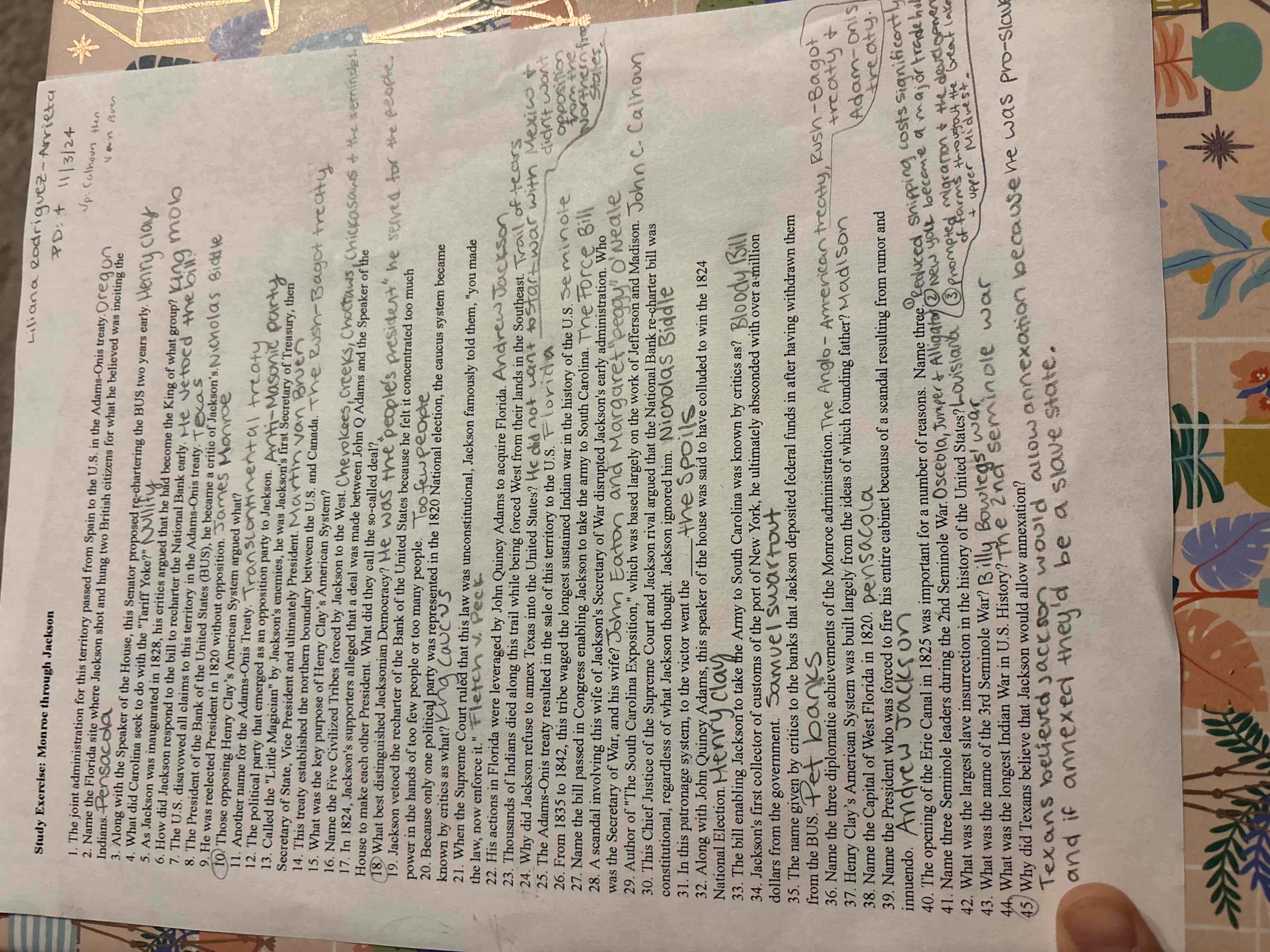
He was reelected as president in 1820 without opposition
James Monroe
Another name for the Adam-onis treaty
Transcontinental treaty
Called the “little magician by Jackson’s enemy he was Jackson’s first secretary of treasury, then secretary, state, vice president ultimately president
Martin van Bruen
Five civilized tribes
Cherokees, creeks, Choctaw, chickasaws and the Seminoles