Equine
 Call Kai
 Learn
Learn Practice Test
 Spaced Repetition
 Match
Match Flashcards
 Knowt Play
1/81

There's no tags or description
Looks like no tags are added yet.
Name | Mastery | Learn | Test | Matching | Spaced | Call with Kai | Chat |
|---|
No analytics yet
Send a link to your students to track their progress
82 Terms
Identify the 2 types of community housing for horses
Individual housing (traditional stabling, ‘American’ barns)
Group housing (crew yards)
Describe the advantages and disadvantages of grass-kept horses
Natural
Allows access to natural forage
Supports exercise and fitness
A break from routine
Enables horse-to-horse contact
Some horses do not cope well in stables
Describe the key requirements of housing horses
Stable should be a suitable size
Free access to water
Adequate ventilation and drainage
Bedding
Should be free from draughts or water damage
Describe the environmental impacts of keeping horses
Overgrazing and/or overstocking
High parasite burden (high faecal load)
Destruction of turf
Carcass disposal: cremation, abattoir, hunt kennels, burial
Disposal of waste bedding
Identify some good management practices of keeping horses
Fresh, clean water
Well-maintained fields (check daily for litter, poisonous plants, debris, etc)
Regular dropping removal
Appropriate and well-maintained fencing
Natural/artificial shelter
Appropriate stocking density
Recommended 1-1.5 acres per horse
Routine harrowing
Fertilising and ‘topping’ pastures
‘Resting’ paddocks
Identify some consequences of poor management practices of keeping horses
Reduced access to appropriate nutrition
Increased risk of injury and disease
Increased risk of endoparasites
Development of undesirable behaviour
Identify the advantages and disadvantages of using straw as bedding for horses
Advantages
Readily available (time of year may affect price)
Relatively cheap
Easy to use
Disadvantages
Can vary in quality
May contain high levels of dust and mould spores
Muckheap can be large and hard to keep tidy
Identify the advantages and disadvantages of using wood shavings as bedding for horses
Advantages
Low dust levels
Provide support for hooves
Easily stored
Disadvantages
Low quality shavings can be contaminated with sharp splinters and other dangerous waste
Quality varies greatly, particularly in dust content
Identify the advantages and disadvantages of using shredded wood fibre as bedding for horses
Advantages
Made from recycled white wood
Low dust levels
Absorbent
Less likely to move around- reducing injury
Consistently high quality, provides hoof support
Disadvantages
More expensive
Identify the advantages and disadvantages of using flex and hemp as bedding for horses
Advantages
Low dust content
Easily stored
Disadvantages
More expensive
Not suitable for horses that eat their bedding
Identify the advantages and disadvantages of using paper as bedding for horses
Advantages
Made from recycled papers
Low dust levels
Non-palatable
Easy to store
Disadvantages
Harder to muck
Large number of bales needed
When wet, becomes very soggy
Identify the advantages and disadvantages of using cardboard as bedding for horses
Advantages
Low dust content
Clumps when wet
Disadvantages
Difficult to separate from droppings
Leaves bare patches when horse gets up
Identify the advantages and disadvantages of using rubber matting as bedding for horses
Advantages
Provides excellent support for hooves
Provides better grip- reducing injury
Disadvantages
Initially expensive
Bedding material should be added on top
Mats must be cleaned regularly
What is the heart rate of a healthy horse?
28-44bpm
What is the respiratory rate of a healthy horse?
8-16bpm
What is the rectal temperature of a healthy horse?
37.5-38.5 degrees Celsius
What is the mucous membrane colour of a healthy horse?
Salmon pink
What is the gestation period of a healthy horse?
320-340 days
When is the sexual maturation of a healthy horse?
12-24 months
How would you describe:
A female horse under the age of 4
A female horse over the age of 4
An intact male horse under the age of 4
An intact male horse over the age of 4
A castrated male horse
Female (under 4)= Filly
Female (4+)= Mare
Uncastrated male (under 4)= Colt
Uncastrated male (4+)= Stallion
Castrated male (any age)= Gelding
What is the gestation and time of puberty in donkeys?
Gestation: 340-370 days
Puberty: 12-24 months
How would you describe:
A female donkey
A male donkey
The offspring of a male donkey and a female horse
The offspring of a female donkey and a male horse
Female donkey= Jenny
Male donkey= Jack
Jack + Mare= Mule
Stallion + Jenny= Hinny
Describe how preventative healthcare is managed in horses
Vaccination:
As a minimum, horses should be annually vaccinated against equine influenza and tetanus
Some vaccinations are compulsory for competitions
Describe the common equine diseases
Equine influenza: highly contagious viral disease affecting the respiratory tract
Tetanus: life-threatening bacterial disease caused by toxin from Clostridium tetani
‘Strangles’: respiratory disease caused by the bacteria Streptococcus equi
Equine herpes virus: contagious respiratory virus (some strains can cause neurological disease and abortion)
Describe how biosecurity is managed in horses
Minimises risk of disease introduction and prevents the spread of disease
Routine monitoring of health and keeping vaccinations up to date
Isolating new arrivals for a minimum of 21 days
Prevent direct contact and sharing of water sources off the yard
Ensure good hygiene: provide each horse with their own equipment
Clean and disinfect boots, outer clothing and equipment after visiting other yards/events
Describe how foot care is managed in horses
Should be seen to by a registered farrier every 4-8 weeks
Farriers work closely with vets when remedial shoeing is required
Describe how dental care is managed in horses
Teeth ‘grow’ continuously
Molars grind laterally: should be examined as a minimum every 12 months by a qualified veterinary surgeon or a registered equine dental technician (EDT)
Describe how worming is managed in horses
Wide range of equine endoparasites including: small and large roundworm, small redworm, tapeworms
Routine faecal worm egg counts every 8-12 weeks
Describe the nutritional requirements of horses
Lack of suitable diet can negatively impact physical/mental health
Evolved to eat a high-fibre diet:
Good quality forage must make up biggest part of the diet
This includes hay, haylage and grass
Primarily hind-gut fermenters:
Most digestion occurs via continual microbial fermentation
‘Trickle feeders’:
Designed to eat little but often
Should not be left without forage for more than 3-4 hours
Equine feedstuffs:
Forage: can be chaff (dried, chopped forage), grass, hay, haylage, root succulents and by-products (e.g sugar beet- never give when dry)
Hard feed/cereals/concentrates: fed if additional energy is needed, life-stage and exercise dependent, formulated to include essential vitamins and minerals
Describe how body condition scoring is used in horses
An objective method of assessing fat coverage in horses
Useful in determining if a horse is a healthy weight
Visual observation and hands-on palpation
2 different scales used:
5 point scale (3 areas assessed, added and divided by 3)
9 point scale (6 areas assessed, added and divided by 6)
Which areas are assessed on the 9-point BCS in horses?
Neck
Withers
Behind the shoulder
Ribs
Loins
Tailhead
Describe how weight tapes are used when assessing body condition in horses
Not 100% accurate, but convenient for owners
Easy to track if weight is fluctuating
Ensure horse is stood level
Place the tape over the lowest point of withers
Pass around the horse close to the elbow
Tape should be pulled snuggly around the body
Read off the weight estimate
Describe the 3 plants that are poisonous to horses
Ragwort
Can cause irreparable liver damage
Often fatal as late onset of clinical signs
Oak
Acorns contain tannic acid
Severe illness if large quantities are consumed
Sycamore
Can cause atypical myopathy (AM) or seasonal pasture myopathy (SPM)
Caused by the ingestion of the toxin Hypoglycin-A (HGA)
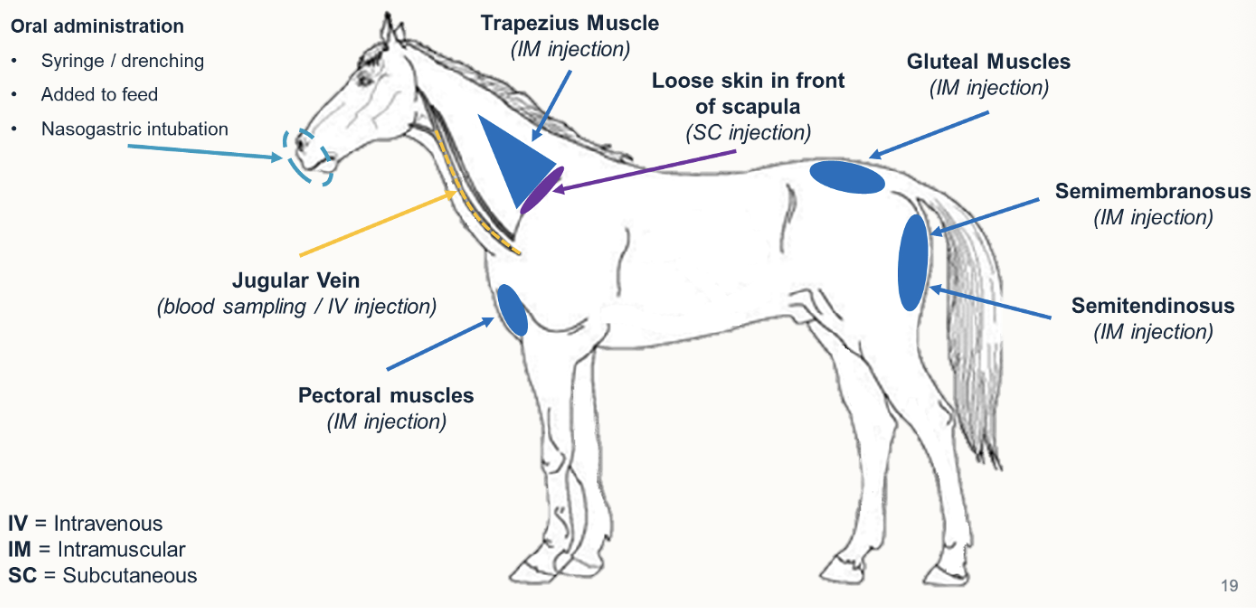
Draw a diagram of the injection sites on horses
List some common emergencies horses experience
Colic (abdominal issues)
Wounds
Severe lameness
Respiratory distress
Choke
Eye problems
Laminitis
Describe how horses are used in the equine industry
Food
Transport
Farming
Military
Haulage
Sport
Thoroughbred racing
Dressage
Describe the natural social structure of horses
Free-roaming, able to reproduce
Close contact with other horses
Seasonal changes in feed
Family ‘bands’
Harem/family: stable core of mares > 4 years old, one or more stallion, offspring
Mare and offspring: no stallion, usually together for 6 months
Bachelor: young males, older males no longer in harem/family
Describe the domesticated social structure of horses
Individually houses
Unstable herd hierarchy
Reduction in horse-to-horse contact
No natural ‘bands’
Often separated by age or gender
‘Herds’ created by humans
Reproduction, exercise and diet dictated by humans
How do horses use communication in social settings?
Prey animal: use fight or flight and mask pain to some extent
Primarily use body language to communicate- using facial expressions, ear position, head height, limb and tail movement
Occasionally use vocalisation (whinny, squeal, nicker, snort) to convey dominance, discipline, danger or separation
What are the types of abnormal behaviour you may see in horses?
Oral
‘Wind-sucking’: arching the neck and ‘gulping’ in air, no contact with surfaces
‘Crib-biting’: grasping a surface with teeth and pulling back, can be followed by a ‘gulp’ of air
Locomotive
‘Box walking’: constant, repetitive movement within stable
‘Weaving’: rocking the body and/or swinging the neck side to side
What are the common causes of abnormal behaviour in horses?
Inappropriate diet or feeding practices
Limited social contact
Locomotive restrictions due to inappropriate housing
Abrupt or inappropriate weaning methods
How can you prevent abnormal behaviour in horses?
Cribbing strap/collar
Ensure housing is sufficient
Application of aversive liquid
Ensure social contact is sufficient
Anti weaving bars
Ensure diet/feeding behaviour is sufficient
What is a ‘yearling‘?
A young horse between one and two years old
What is a ‘broodmare‘?
A female adult horse (mare) kept for breeding purposes
What is a ‘dam‘?
The mother of a racehorse
What is a ‘sire‘?
The father of a racehorse
Outline the evolutionary history of the horse
The horse we see today is the product of over 50 million years of evolution, which occurred across several continents
Changes in climate and geography, as well as interactions with other animal and plant species, influenced the adaptations that were successful in each generation
Hyracotherium
Mesohippus
Merychippus
Pliohippus
Equus
Describe the hyracotherium
Also known as the eohippus or ‘dawn horse’
Emerged over 52 million years ago, at roughly the size of a fox
Roamed the forest browsing on soft fruit and foliage
Key evolutionary traits:
Forelimbs: four toes ending in small, hoof-like appendages (vestigial fifth toe)
Hind limbs: three toes ending in small, hood-like appendages (vestigial first and fifth toe)
Teeth adapted for browsing
Describe the mesohippus
Emerged around 35 million years ago- when the climate became drier and the first grass species began to emerge: over time, forests declined to open flatlands containing various grasses and small shrubs
Key evolutionary traits:
Increase in body size
Both forelimbs and hind limbs had three toes ending in small, hoof-like appendages (vestigial first and fifth toe)
Legs were longer and more suited to running in open areas
Teeth began to adapt to a grazing diet
Describe the merychippus
Emerged around 23 million years ago- the largest equid to have existed at the time, and the first to have the distinctive head shape of the horse we see today
Key evolutionary traits:
Increase in body size
Single ‘hoof’ (third toe) on both forelimbs and hindlimbs- second and fourth toes present but smaller/not touching the ground
Teeth developed a higher crown in response to a predominantly grazing diet
Describe the pliohippus
Emerged around 15 million years ago- very similar in appearance to the horse we see today (long, slim limbs and suited to a grazing diet)
Key evolutionary traits:
Increase in body size
Lateral location of eyes
Single ‘hoof’ (third toe) on both forelimbs and hindlimbs- second and fourth toes now non-functional and barely visible
High-crowned teeth suited to grazing
When did equus emerge?
Emerged around 7 million years ago in the family equidae (along with seven other species)
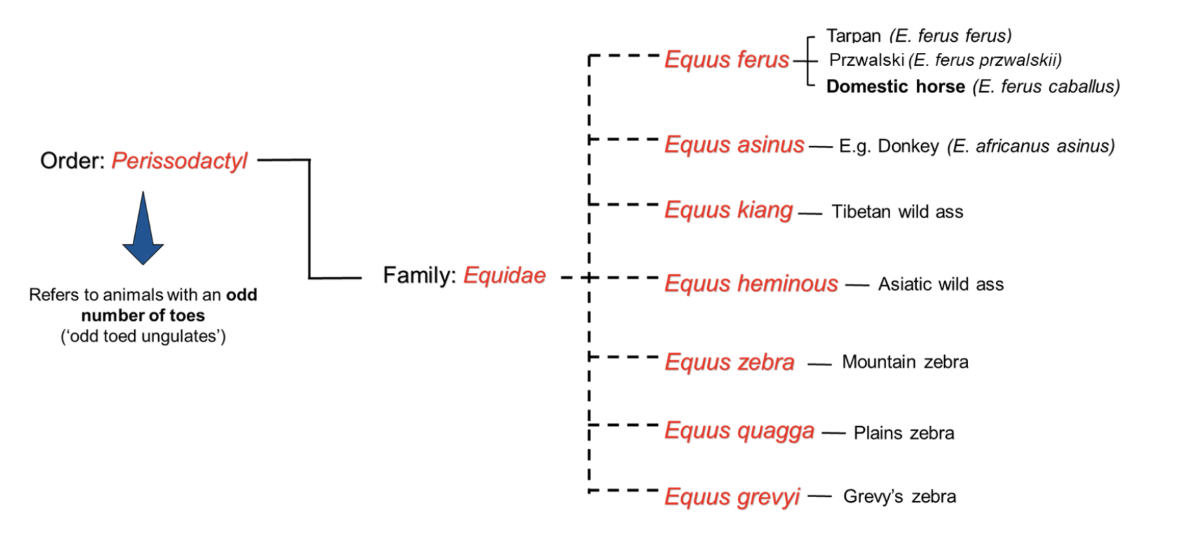
What is the kingdom, phylum, class, order and family of the domestic horse?
Kingdom: Animal
Phylum: Chordate
Class: Mammal
Order: Perissodactyl
Family: Equidae
Draw out the family ‘equidae’, including the order and relative genus
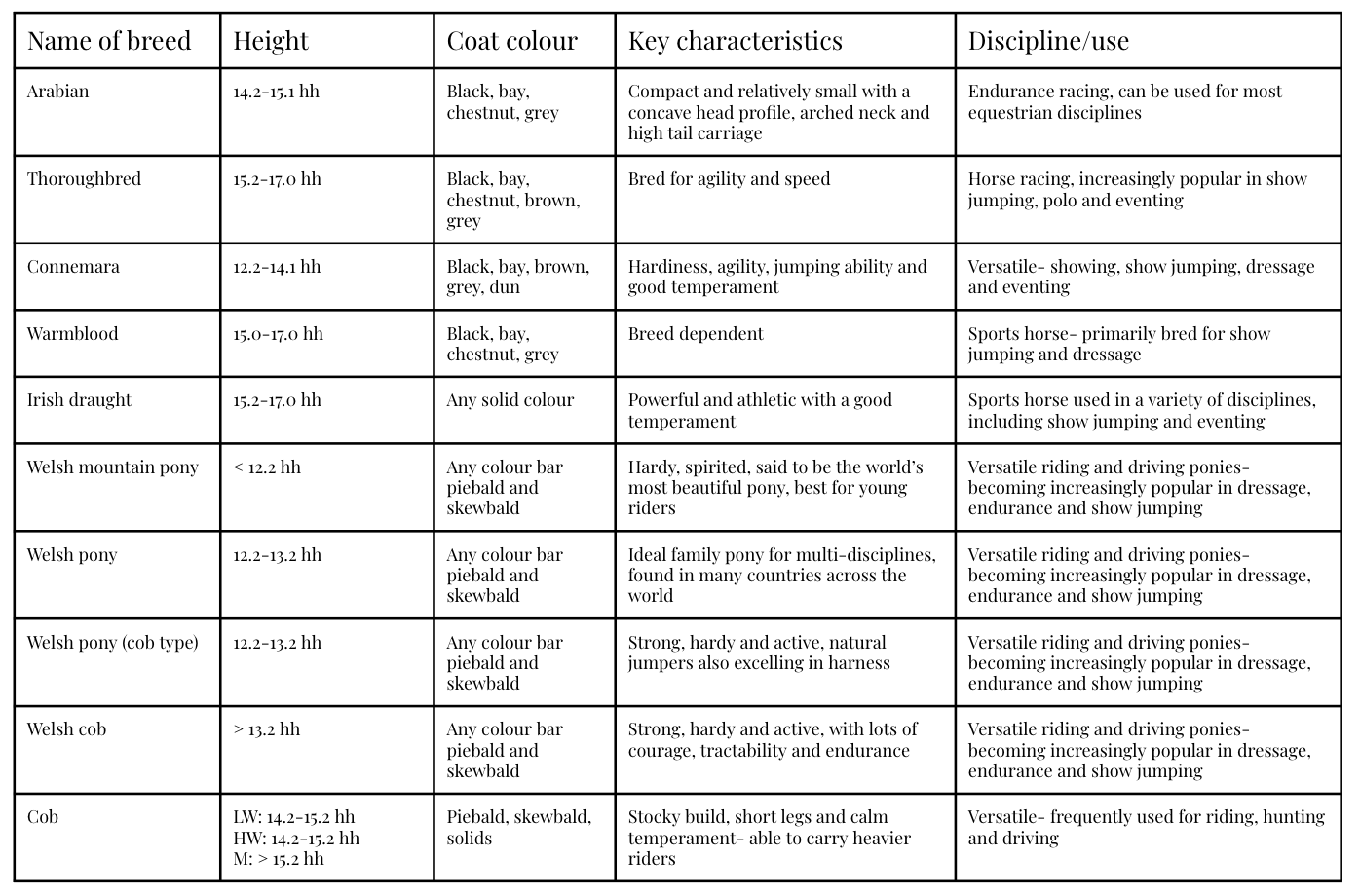
Give the height, coat colours, key characteristics and disciplines of:
Arabian horses
Thoroughbred horses
Connemara horses
Warmblood horses
Irish draught horses
Welsh mountain ponies
Welsh ponies
Welsh ponies (cob type)
Welsh cobs
Cobs
How should you safely approach a horse?
Approach a horse at their shoulder: they cannot see directly in-front or behind
Speak to them to let them know where you are
Always be calm, patient and quiet
Complete all practical activities on the ‘near (left) -side’ of the horse (leading, tacking up, putting on headcollars/rugs, picking out the feet, mounting or dismounting)
What are the signs of low arousal in horses?
Ears in a neutral position
Ears occasionally moving back and forth
Head level with withers
Resting a hind leg
Droopy bottom lip
What are the signs of high arousal in horses?
Ears flat against head
Ears alert
Head above level of withers
Constant limb movement
Whites of eyes showing
Tense neck muscles
What is lunging and when is it used?
A form of controlled exercise for horses
Involves the horse moving around a handler on a circle at the end of a ‘lunge line’
Can be used:
As an alternative form of exercise if the horse cannot be ridden
As a training aid to improve fitness, muscle definition and suppleness
To help identify lameness during a veterinary examination
Describe the two most common methods of restraint in horses
Head collar and lead rope- commonly used for most non-ridden activities
Bridle- used when a head collar does not provide adequate levels of restraint, and has the addition of a ‘bit’, but not as strong as a ‘Chifney’
Describe how and when ‘Chifey’s’ are used as restraint in horses
Applies pressure directly to the horse’s tongue and bars of the mouth, giving the handler more control
It is an in-hand bit, meaning it is used to handle horses on the ground only
Often used in veterinary practice when trotting up or examining horses which require a stronger form of restraint
Can be used with or without a head collar, with the lead rope attaching to the loop which sits below the horse’s chin
This method of restraint should be used with great care, as serious damage to the horse’s mouth can occur if misused
Describe how nose/neck twitches are used as restraint in horses
Neck and/or nose twitch- used to restrain horses for short periods of time ( <5 minutes)
Nose twitch- placing a ‘humane’/wooden device on the top lip and applying pressure
Neck twitch- grasping a fold of skin on the neck and twisting
Research suggests that the horse is immobilised due to: stimulation of nerve endings resulting in the release of endorphins, the horse reacting to the twitch as a painful stimuli, the horse becoming flooded with sensory information
A twitch should not be used on every horse, or for every veterinary procedure: ensure restraint methods are tailored to the individual horse/situation
Describe how chemicals are used as restraint in horses
Chemical- sedation, restraint for a longer time period (e.g when taking multiple radiographs)
Describe how holding one leg is used as restraint in horses
Holding one leg- restraint for a short time period (e.g distal limb nerve blocks)
Describe what equine boots are used for and the name different types
Protect the horse’s distal limb
There are various types- usage is often discipline dependent
Overreach boots
Brushing boots
Travel boots
Tendon boots: protect tendons on the palmer aspect of the fore legs from being struck by the hind feet when jumping
Fetlock boots: protects the medial aspect of the hind fetlocks from injury when jumping
How and why are tail bandages used for horses?
Commonly used to protect the tail from damage during transportation, or prior to competition
In veterinary practice, tail bandages are useful for keeping the tail clean and out of the way during procedures such as rectal examinations, pregnancy scans and artificial insemination
Must not be left on for more than 3 hours
Tail must be dry prior to applying the bandage to prevent rubs/sores
Equal pressure should be applied to the entire bandage
The bandage straps should be fastened using the same pressure as the rest of the bandage
How and why are rugs used for horses?
Used to provide extra warmth and protection during wet/cold weather
‘Stable’ rugs are used in the stable and keep the horse warm, but they are not waterproof
‘Turnout’ rugs are used in the field to protect the horse from the elements- they are waterproof
Describe how you would pick out the feet of the horse
Face the tail of the horse and place one hand supporting the fetlock to turn the hoof upwards and begin picking the feet
Run your hand down the caudal aspect of the leg when lifting the front foot
Run your hand down the medial aspect of the leg when lifting the hind foot
Clean out around the frog, the central sulcus and then the around the hoof wall- working from heel to toe
Describe how ‘friends, forage and freedom’ relates to the welfare legislation of horses
Freedom (to move and perform natural behaviour): daily turnout in a field, or access to a large school/yard. Stables should be large enough for them to move, lie down and get up comfortably- this can be encouraged by placing enrichment around the stable
Friends: horses need regular contact with their own species (social, herd-dwelling animal)- ideally kept in a herd to allow for social/physical interaction during turnout. They should be stabled with animals they are familiar with- where they can touch and see each other
Forage: hay, haylage and grass should be the basis of their diet- increased access shown to reduce many health issues. Horses shouldn’t be left for long periods of time without access to forage- and diets should be reviewed regularly to ensure key micronutrients are provided
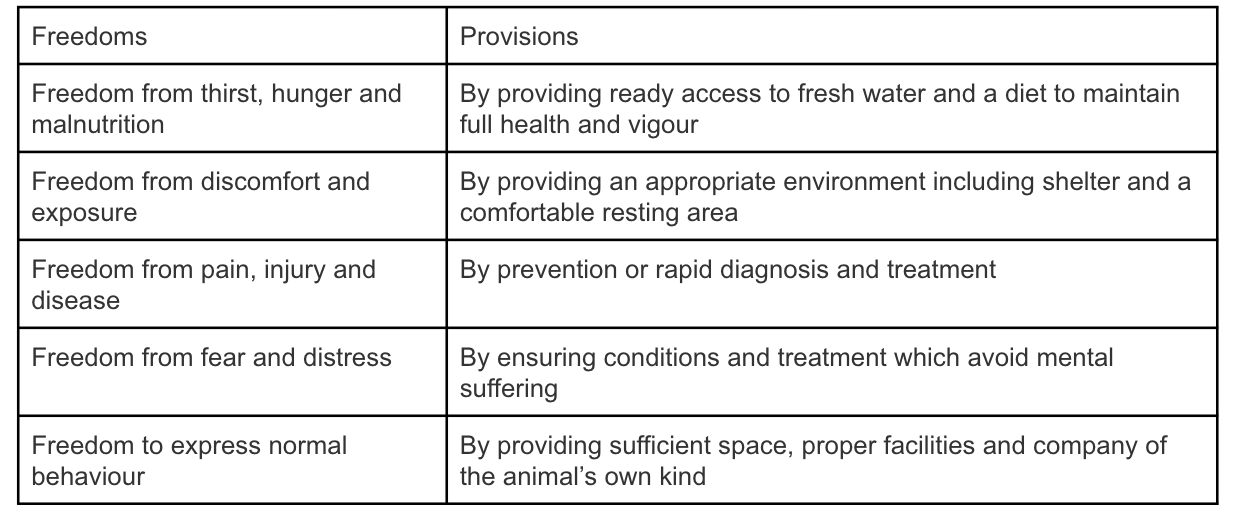
Name the five freedoms and their provisions
Describe the Veterinary Surgeons Act (1966) legislation around horses
Only qualified veterinary surgeons, registered with the RCVS, can perform acts of veterinary surgery in the UK
Veterinary surgeons may direct registered/student veterinary nurses employed at their practice to complete certain clinical procedures- including vaccinations, monitoring of anaesthesia and minor surgery
As a veterinary student, you will be required to undertake acts of veterinary surgery as part of your clinical training. To be able to do this, the Veterinary Surgeons (Practice by Students) (Amendment) Regulations 1993 was introduced to allow registered veterinary students to perform a range of clinical procedures- whilst under the under the direct supervision of a registered veterinary surgeon
Some aspects of a horse's care, e.g farriery or dentistry, can be performed by non-veterinary surgeons; however, the individual must be suitably qualified and registered. Category 1 and 2 equine dental procedures can be undertaken by Equine Dental Technicians (EDTs) who have trained and passed an examination approved by DEFRA. However, category 3 procedures, which involve vascular or innervated tissue, can only be performed by qualified veterinary surgeons
Describe the Farriers (Registration) Act 1975 and Farriers Registration (Amendment) Act 1977 legislation around horses
Only trained, and appropriately registered, farriers can perform acts of farriery in the UK
An act of farriery is described within the Act as being, "any work in connection with the preparation or treatment of the foot of a horse for the immediate reception of a shoe thereon, the fitting by nailing or otherwise of a shoe to the foot or the finishing off of such work to the foot”
Barefoot trimming (trimming a horse’s hoof but not applying a shoe) is not considered an act of farriery
All farriers in England, Scotland and Wales must be registered with the Farriers Registration Council (FRC)
The FRC is responsible for maintaining a register of farriers eligible to practise, regulating farriery education up to the point of registration, and regulating professional conduct
The Worshipful Company of Farriers (WCF) encourages continued professional development amongst qualified farriers, being the awarding body for the farrier qualifications of Diploma, Associate and Fellow
Describe the Equine Identification Regulations legislation around horses
All equids in the UK must have an equine passport and be microchipped as stated in these regulations:
The Equine Identification (England) Regulations 2018
The Equine Animal Identification (Scotland) Regulations 2019
The Equine Identification (Wales) Regulations 2019
The Equine Identification Regulations (Northern Ireland) 2019
Equine passport applications must be completed by a qualified veterinary surgeon before being sent to be registered with one of 81 UK passport issuing organisations
Horse owners must apply for an equine passport within 6 months of their horse’s birth
Passport applications submitted to UK PIOs are held on the central equine database (subsequently managed by the equine register)
As of October 2020, microchipping of all equines in England became compulsory: including equines born on or before 30 June 2009- those born after should already be microchipped as mandated by previous legislation
Describe the key organisations responsible in equine welfare
BHA: responsible for overall governance, administration and regulation of the British horseracing industry
Jockey club: aims to widen participation within the British horseracing industry to create a sustainable future for the sport
Wetherbys: all thoroughbred horses bred to race in Britain and Ireland must be registered. They also maintain the general stud book for thoroughbreds
Horserace betting levy board: non-departmental body which creates a statutory levy from horseracing bookmakers- these funds are applied to a wide range of schemes
British equestrian: national governing body for all horse sports in the UK
Federation equestre internationale: international governing body of equestrian sports
National equine welfare council: established in 1977 as a key point of contact on equine welfare
British horse council: established in 2018 to combine the work of British horse industry confederation and the Equine sector council for health and welfare
What are the ‘10 principles of certification’?
Equine passports are classed as certificates: veterinary surgeons must adhere to RCVS guidance regarding certificate completion
Certify knowledge only: only certify matters within your own knowledge
Avoid conflicts of interest
Independence
Clear and simple language
Unambiguous terms
Secure and unique: should be unique and numbered
Understand the language: only sign off if you understand the language
Identify subjects clearly
Originals only
Record keeping: a record must be retained by the veterinarian or their practice
How are microchips administered and recorded in horses
Placed in or adjacent to, the nuchal ligament at the top of the left mid crest
Prior to implantation: scan the neck for the presence of a microchip, test that the microchip is functioning correctly
After implantation: re-scan the implantation site to confirm successful implantation
Location of microchip must be recorded on the passport silhouette and narrative
What is the purpose of equine passports?
Record routine vaccinations
Indicate if a horse is intended for human consumption (and which medications it can therefore receive)
Provide both a written narrative and drawn silhouette
Contain a horse’s breeding history, microchip number and owner details
Passport information and microchip details are held by the Central Equine Database and National ChipChecker: managed by Equine Register for DEFRA
All equids must by law have a passport from 6 months of age
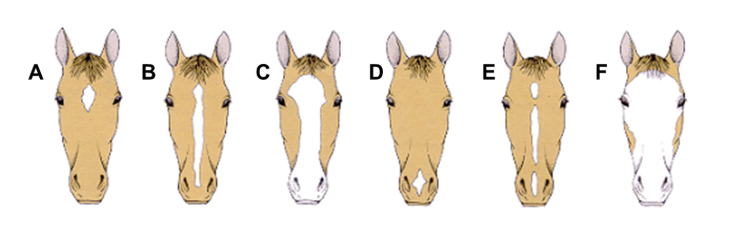
What are ‘white markings’, and what are the different types?
Areas of naturally occurring white hair on face/legs
Each horse has their own unique set of white markings
These must be recorded on the silhouette and narrative
Narrative for all white markings must be written as concisely
as possible
Red pen and hatching is used to indicate white marking
A: Star D: Snip
B: Stripe E: Interrupted stripe
C: Blaze F: White face
What are Ermine marks?
Small black dots within a white marking
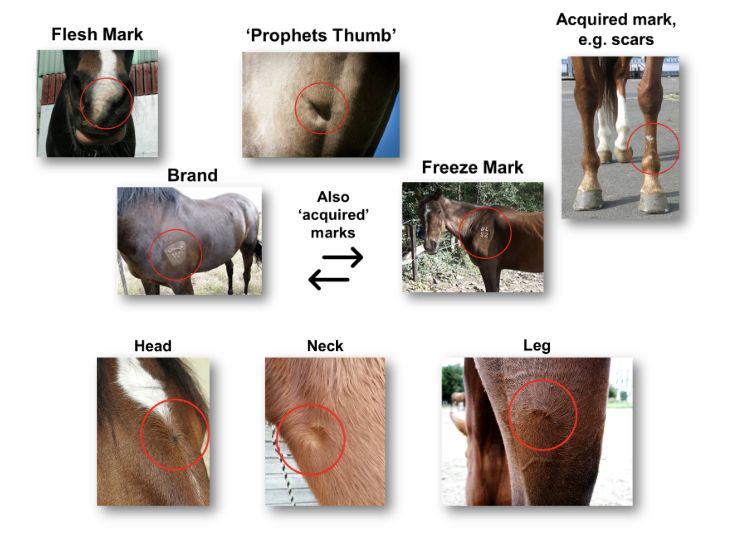
What are the different characteristics you may see on horses? Specifically those which should be labelled on an equine passport
Lower images: whorls
How do you measure equine height?
Traditionally measured in ‘hands high’. One hand= 4 inches
A measuring stick is used to take an accurate height (measured from ground to highest point of withers). Horse should be stood ‘square’ on a level surface
Most modern designs have 3 measurements (hands, inches, centimetres)
Horses: 14.3 hh or over at maturity
Ponies: 14.2 hh or under at maturity
What are the basic coat colours of horses?
Bay (main body can vary from light to dark whilst mane, tail and lower limbs are predominantly black)
Brown (dark brown, almost black body with a black mane, tail and lower limbs)
Black (black body with a black mane, tail and lower limbs)
Chestnut (main body can vary from light to dark with white or similar coloured lower limbs)
Grey (not white- several shades/variations exist but all have black skin)
Piebald (irregular patches of black and white)
Skewbald (irregular patches of white on a non-black coat)
Cream/cremello (pale cream to ivory coat, pink skin and nose with blue/amber eyes)
Dun (dilutes black and red pigments to lighter shades whilst leaving mane, tail and lower limbs dark)
Palomino (golden body paired with white/flaxen mane, tail and lower limbs)
Roan: red or blue colourings on the muzzle and feet