Respiratory and vessels
 Call Kai
 Learn
Learn Practice Test
 Spaced Repetition
 Match
Match Flashcards
 Knowt Play
1/197

There's no tags or description
Looks like no tags are added yet.
Name | Mastery | Learn | Test | Matching | Spaced | Call with Kai | Chat |
|---|
No analytics yet
Send a link to your students to track their progress
198 Terms
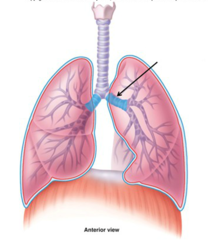
Main pulmonary bronchus
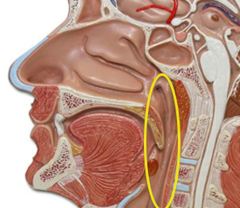
Pharynx
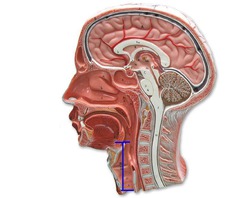
Larynx
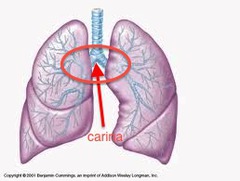
carina of trachea
Trachea
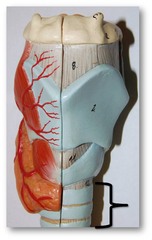
NO exchange of gases occurs here.
segmental (tertiary) bronchi
Secrete a fluid containing surfactant.
Type II alveolar cells
Where the respiratory zone of the lungs begins
respiratory bronchioles
Composed of simple squamous epithelium
Type I alveolar cells
Terminates in alveoli.
alveolar duct
Composed of cuboidal cells.
Type II alveolar cells
The respiratory membrane is composed of fused basement membrane of the capillary walls and?
Type I alveolar cells
TV + IRV + ERV + RV.
total lung capacity (TLC)
ERV + RV
functional residual capacity (FRC)
TV + IRV + ERV.
vital capacity (VC)
TV + IRV.
inspiratory capacity (IC)
A drop in blood pH is likely to cause a slower breathing rate.
False
During normal quiet breathing, males breathe 25% more than females.
False
In chronic bronchitis, mucus production is decreased and this leads to the inflammation and fibrosis of the mucosal lining of the bronchial tree.
False
Labored breathing is termed hypercapnia.
False
The largest amount of carbon dioxide is transported in the bloodstream in the form of
carbonic anhydrase.
False
Increased temperature results in decreased O2 unloading from hemoglobin.
False
The paired lungs occupy the mediastinum of the thoracic cavity.
False
The Heimlich maneuver is a procedure in which air in the lungs is used to expel a piece of
food lodged in the esophagus.
False
The average individual has 500 ml of residual volume in his lungs.
False
The inflation (Hering-Breuer) reflex is a potentially dangerous response that may cause overinflation of the lung
False
As carbon dioxide enters systemic blood, it causes more oxygen to dissociate from
hemoglobin (the Haldane effect), which in turn allows more CO2 to combine with hemoglobin
and more bicarbonate ions to be generated (the Bohr effect).
False
Oxygenated hemoglobin releases oxygen more readily when the pH is more basic
False
Which bone does NOT contain paranasal sinuses?
temporal
The loudness of a person's voice depends on the ________.
force with which air rushes across the vocal folds
The walls of the alveoli are composed of two types of cells, type I and type II alveolar cells. The function of type II alveolar cells is to ________.
secrete surfactant
Air moves out of the lungs when the pressure inside the lungs is ________
greater than the pressure in the atmosphere
Which of the following is true regarding normal quiet expiration of air?
It is a passive process that depends on the recoil of elastic fibers that were stretched during
inspiration.
Which of the following maintains the patency (openness) of the trachea?
C-shaped cartilage rings
Intrapulmonary pressure is the ________
pressure within the alveoli of the lungs
The relationship between gas pressure and gas volume is described by _____
Boyle's law
The statement, "in a mixture of gases, the total pressure is the sum of the individual partial pressures of gases in the mixture" paraphrases ________.
Dalton's law
Surfactant helps to prevent the alveoli from collapsing by ________.
interfering with the cohesiveness of water molecules, thereby reducing the surface tension of
alveolar fluid
As the tension of vocal folds in the larynx increase, the voice becomes ________
higher in pitch
The Bohr effect describes the tendency for hemoglobin to more readily unload oxygen under
which conditions
decreased pH and increased PCO2
The most powerful respiratory stimulus for breathing in a healthy person is ________
increase of carbon dioxide
The local matching of blood flow with ventilation is ________.
ventilation-perfusion coupling
In the plasma, the quantity of oxygen in solution is ________
only about 1.5% of the oxygen carried in blood
Which of the following is the leading cause of cancer death for both men and women in North America?
lung
Which of the choices below describes the forces that act to pull the lungs away from the
thorax wall and thus collapse the lungs?
the natural tendency for the lungs to recoil and the surface tension of the alveolar fluid
Which of the following counteracts the movement of bicarbonate ions from the RBC?
chloride shifting
Hemoglobin has a much greater affinity for carbon monoxide than oxygen. Which principle explains why a hyperbaric chamber (containing high levels of oxygen) can treat carbon monoxide poisoning?
Henry's law
Which of the following refers to the movement of air into and out of the lungs?
pulmonary ventilation
The major nonelastic source of resistance to air flow in the respiratory passageways is
________.
friction
Which of the following determines lung compliance?
alveolar surface tension
Tidal volume is air ________
exchanged during normal breathing
Which of the choices below determines the direction of respiratory gas movement?
partial pressure gradient
Possible causes of hypoxia include ________.
too little oxygen in the atmosphere
The lung volume that represents the total volume of exchangeable air is the ________
vital capacity
Which of the following is correct regarding acclimatization?
High-altitude conditions always result in lower-than-normal hemoglobin saturation levels
because less O2 is available to be loaded.
Which of the following is NOT a stimulus for breathing?
rising blood pressure
Respiratory control centers are located in the ________.
medulla and pons
The amount of air that can be inspired above the tidal volume is called ________.
inspiratory reserve volume
Which statement about CO2 is FALSE?
More CO2 dissolves in the blood plasma than is carried in the RBCs
Inspiration occurs when the ________ is less than the ________.
intrapulmonary pressure; atmospheric pressure
The left lung differs from the right in that the left lung has ________.
a cardiac notch
The larynx contains ________
the thyroid cartilage
Which respiratory-associated muscles would contract or relax during forced expiration, for
example blowing up a balloon
internal intercostals and abdominal muscles would contract
How is the bulk of carbon dioxide transported in blood?
as bicarbonate ions in plasma after first entering the red blood cells
Which of the choices below is NOT a role of the pleurae?
assist in blood flow to and from the heart because the heart sits between the lungs
Which of the following incorrectly describes mechanisms of CO2 transport?
attached to the heme part of hemoglobin
Factors that influence the rate and depth of breathing include ________.
voluntary cortical control
Which of the following provide the greatest surface area for gas exchange?
alveoli
Which of the following is NOT part of the respiratory membrane of the lungs?
single layer of smooth muscle cells
The symptoms of hyperventilation may be averted by breathing into a paper bag because it
________.
helps retain carbon dioxide in the blood
Inspiratory capacity is ________.
the total amount of air that can be inspired after a tidal expiration
Which center is located in the pons
pontine respirator group (PRG)
The nose serves all of the following functions EXCEPT ________
as the direct initiator of the cough reflex
According to the oxygen-hemoglobin dissociation curve, PO2 in the lungs of 100 mm Hg
results in Hb being 98% saturated. At high altitude, there is less O2. At a PO2 in the lungs of 80
mm Hg, Hb would be ________ saturated.
95%
Which of the following is an appropriate response to carbon monoxide (CO) poisoning?
hyperbaric oxygen chamber to increase PO2 and clear CO from the body
Which pressure actually keeps the lungs from collapsing
transpulmonary pressure
Which of the choices below is NOT a factor that promotes oxygen binding to and
dissociation from hemoglobin?
number of red blood cells
Which of the following is responsible for holding the lungs to the thorax wall?
surface tension from pleural fluid and negative pressure in the pleural cavity
The erythrocyte (red blood cell) count increases after a while when an individual goes from a
low to a high altitude because the ________.
concentration of oxygen and/or total atmospheric pressure is lower at high altitudes
Most inspired particles such as dust fail to reach the lungs because of the ________.
ciliated mucous lining in the nose
Which of the following is INCORRECT?
Pressure gradient equals gas flow over resistance
Select the correct statement about the physical factors influencing pulmonary ventilation.
As alveolar surface tension increases, additional muscle action will be required.
Select the correct statement about oxygen transport in blood
A 50% oxygen saturation level of blood returning to the lungs might indicate an activity level
higher than normal
Which of the disorders below is characterized by destruction of the walls of the alveoli
producing abnormally large air spaces that remain filled with air during exhalation?
emphysema
Which of the following does NOT influence hemoglobin saturation?
A) tempera
nitric oxide
For inspiration of air, which of the following happens first?
diaphragm descends, thoracic volume begins to increase, and rib cage rises
Spirometry results reveal a vital capacity of two liters which is well below the predicted
value of five liters. This suggests which disorder?
restrictive disease
Which law describes the relationship between the pressure and volume of a gas?
Boyle's law
The Bohr effect refers to the unloading of ________ in a RBC due to declining blood pH.
oxygen
Which structure is lined with simple squamous epithelium?
alveolus
Using spirometry, a patient discovers their forced expiratory volume (FEV) after the first
second is 40%. What does this suggest?
restrictive disease
Which of the following anchor(s) the vocal folds?
arytenoid cartilages
Which of the following is a conducting zone structure?
terminal bronchiole
Sinusoid capillary
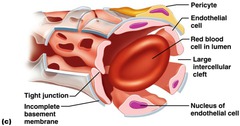
Capillary found in endocrine organs that allows hormones to gain rapid entry into the blood.
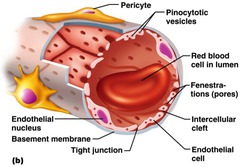
Capillary with intercellular clefts found in the skin and muscles
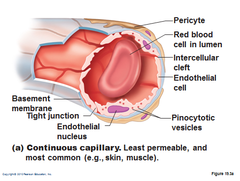
Capillary that has a discontinuous, incomplete basement membrane.
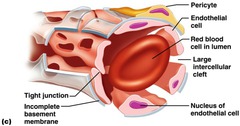
Capillary found where active capillary absorption of filtrate occurs.
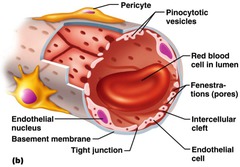
Largest artery of the body
aorta
Supplies the kidney
renal artery