L2 and 3
 Call Kai
 Learn
Learn Practice Test
 Spaced Repetition
 Match
Match Flashcards
 Knowt Play
1/135

There's no tags or description
Looks like no tags are added yet.
Name | Mastery | Learn | Test | Matching | Spaced | Call with Kai | Chat |
|---|
No analytics yet
Send a link to your students to track their progress
136 Terms
What is cell stress?
changes that are nonlethal and disrupts homeostasis
What is cellular injury?
alteration in cell structure or biochemical functioning that overwhelms the cell’s ability to compensate and adapt
When does injury occur?
Cell can’t adapt to the changes and cannot maintain normal, critical functions
How does the cell respond to stressors/injurious stimuli?
Adapts or dies
What does cell response vary based on?
cell type, nature and intensity of injury, metabolic state at injury
What’s the difference between reversible vs. irreversible cell injury?
Reversible the cell can reestablish function
Irreversible the cell cannot reestablish function
What can lead to irreversible cellular injury?
longer duration or higher intensity injuries
Which occurs faster in the cell: morphological/histological changes or functional changes?
Functional
Microscopic lesions develop ___ hours after an ischemic event
4-12
In what type of tissue/cell is acute cell swelling is worse?
Neurons
What is the most common reversible cellular injury?
Acute Cellular Swelling
What causes cell to swell?
Na/K pump failure causing influx of Na and H2O
How does hypoxia cause acute cell swelling?
Lack of ATP production → Na/K pump failure
What can cause cell membrane injury?
Free radicals, lytic pores, bacterial cytolysins, NK Cells
How does acute cellular swelling show macroscopically?
Rounded margins, bulges at the surface, pale, heavy, wet
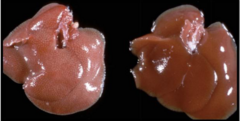
What is being shown
hydropic degeneration
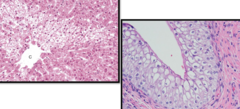
What is being shown? Parenchymal organ.
Hydropic degeneration
What characterizes irreversible cell injury?
Inability to repair cell damage
Inability to restore cell or mitochondria function
What cells are most susceptible to hypoxia causing irreversible cell injury?
Neurons, cardiomyocytes, renal tubular epithelium
What is the most crucial in the transition from reversible to irreversible damage?
membrane damage and calcium homeostasis
What things cause cytoplasmic changes in irreversible cell damage?
Mitochondrial swelling and increased membrane permeability
What are characteristics of mitochondrial swelling?
loss of dense granules, formation of amorphous densities, calcium deposits
What are signs of increased membrane permeability?
myelin figure formation, leakage of enzymes, inflammation
What are the irreversible nuclear changes?
pyknosis, karyorrhexis, karolysis
What is pyknosis?
chromatin condensation, nuclear shrinking
What is karyorrhexis?
nuclear fragmentation
What is karyolysis?
nuclear dissolution
What are the 4 mechanisms of cellular injury
Hypoxia
Free radicals
Chemical/traumatic
Infectious
What is hypoxia due to?
ischemia usually
Where do free radicals do most damage?
cell membrane
What are the 2 pathways of ATP production?
oxidative phosphorylation and glycolytic pathway
How is ATP made in oxidative phosphorylation?
Oxygen is reduced to transition ADP to ATP
Oxidative phosphorylation is a major pathway in what species?
mammals
How does oxidative phosphorylation cause reduction of oxygen?
by electron transport chain in mitochondria
How is ATP made in glycolytic pathway?
Hydrolysis of glucose in absence of oxygen
What is produced as a by product in glycolytic pathway?
lactate
ATP depletion as little as _____ has widespread effects and is the fundamental cause of ____.
5-10%, necrotic cell death
What does a loss of ATP do?
Na/K and Ca pumps malfunction
No oxidative phosphorylation
Structure disrupted
Accumulation of misfolded proteins
What are the major causes of ATP depletion?
reduced supply of oxygen and nutrients
mitochondrial damage
toxins
How can the mitochondria be damaged?
increased cytosolic Ca, free radicals, oxygen deprivation
What are the consequences of mitochondrial damage?
Membrane proteins, cytochrome C and apoptosis-inducing enzymes (Capases) are released into the cytosol and causes apoptosis.
What does mitochondrial permeability transition pore cause?
loss of membrane potential, stopping oxidative phosphorylation, loss of ATP then necrosis
What does cytochrome C in cytosol do?
causes apoptosis
Cytosolic Ca is maintained at ___ concentrations
very low
Where is most intracellular Ca sequestered?
in mitochondria and ER
How does increased intracellular Ca cause cell injury?
Opening of mitochondrial transmission pore
Activation of phospholipases, proteases, endonucleases and ATPase
Induction of apoptosis by caspases
What is a free radical?
any molecule with an unpaired electron
What do free radicals do?
react with substances to damage cells or create abnormal cells
What are reactive oxygen species (ROS)?
an oxygen free radical
What are the most important reactive oxygen species?
hydrogen peroxide, hydroxyl, nitric oxide
Where are hydrogen peroxide, hydroxyl, nitric oxide produced?
in mitochondrial respiration in cell
What is oxidative stress?
increased production or decreased scavenging of ROS leading to excess damage
What are the pathologic effects of free radicals?
Lipid peroxidation in membranes
Oxidative modification of proteins
DNA fragmentation
When there is free radical accumulation what things work to minimize injury?
Antioxidants (Vit A, C, E)
Binding of iron and copper to storage/transport proteins
Scavenging enzymes
What are important antioxidants?
Vitamin A, C, E and glutathione
What are examples of scavenging enzymes?
glutathione peroxidase, superoxide dismutase, Catalase
What does glutathione peroxidase do?
Decomposes H2O2 into water
What does superoxide dismutase do?
converts O2 to hydrogen peroxide (H2O2)
What is a consistent feature of most forms of cell injury?
Loss of selective membrane permeability
How does indirect membrane damage occur?
ATP depletion
Ca-mediated activation of phospholipases
How does direct membrane damage occur?
Bacteria, viruses, lytic complement components
How do reactive oxygen species (ROS) injure the cell membrane?
via lipid peroxidation
How does decreased phospholipid synthesis injure the cell membrane?
via defective mitochondria function or hypoxia
How does increased phospholipid breakdown injure the cell membrane?
increased degradation of membrane phospholipids
What are the most important sites of membrane damage?
mitochondrial, plasma, lysosomal membranes
If damage is too severe to DNA what happens?
apoptosis
Why is the brain more susceptible to irreversible cell injury than muscle?
Brain does almost no glycolysis
Muscle does abundant glycolysis for oxygen support
How does acute cellular swelling appear microscopically?
Expanded, rounded, pale eosinophilic or vacuolated cytoplasm
What is the nucleus composed of
chromatin surrounded by a bi-layered nuclear membrane with pores
Describe euchromatic nuclei
loosely coiled, active transcription to mRNA
Describe heterochromatic nuclei
tightly coiled, inactive
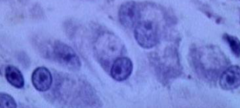
What is shown
euchromatic nuclei where you can clearly see nuclei
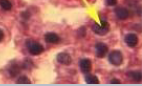
What is being shown?
heterochromatic nuclei where cells are dense
Where is the nucleolus found
within the nucleus
The nucleolus ____ membrane bound
IS NOT
What is the function of the nucleolus
rRNA synthesis
What measures the cells synthetic activity?
prominence of nucleoli
What are examples of cells that have more prominence of nucleoli
mitotically active and cancer cells
What lines the rough ER
ribosomes
What is the rough ER continuous with
nuclear membrane
What is the rough ER responsible for
protein synthesis and basophilia of cells cytoplasm
What is the function of the smooth ER
metabolizing drugs, lipids, steroids, carbohydrates, glycogen
Describe cells with abundant smooth ER
pink, finely vacuolated cytoplasm (like endocrine)
What cells have abundant smooth ER
endocrine
What does the golgi apparatus do
synthesis and packaging center for proteins to be exported out of cell
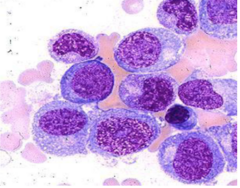
What is this showing
cells with granulated golgi
What does the mitochondria do?
produces ATP through oxidative phosphorlation
The mitochondria is involved in
apoptosis
How does the mitochondria make ATP
through oxidative phosphorylation
What cell activities is the mitochondria part of
cell signaling, differentiation, growth
Lysosomes contain
hydrolytic enzymes
Enzymes in lysosomes are synthesized by
the rough ER
Enzymes in lysosomes are processed and packaged in the
golgi
Enzymes in the lysosomes are released into
cytosol
Lysosomes aid in
intracellular digestion
What do membrane bound structures interact with
cytoskeleton
What is the cytoskeleton
structural network that helps in movement, cell division, and biochemical pathways
What are the types of filaments found in the cytoplasm?
microfilaments, intermediate filaments, microtubules
Describe microfilaments
in microvilli that facilitate in cell motility
Describe intermediate filaments
provide physical strength to cells often via junctional complexes near base of cell