Chapter 15: Social and Cultural Constraints in Motor Development
 Call Kai
 Learn
Learn Practice Test
 Spaced Repetition
 Match
Match Flashcards
 Knowt Play
1/48

There's no tags or description
Looks like no tags are added yet.
Name | Mastery | Learn | Test | Matching | Spaced | Call with Kai | Chat |
|---|
No analytics yet
Send a link to your students to track their progress
49 Terms
Socio-cultural is
Group attitudes that affect motor behaviors of an individual
Social values, ideals, norms, stereotypes
Culturally specific concepts about movement behaviors. Often reinforced by media
Social constraints are
pervasive group attitudes, values, and norms that influence behaviors of individuals within the group.
Social constraints create
an atmosphere encouraging socially acceptable and discouraging socially unacceptable movement activities.
Socialization process
The process by which one learns a social role in groups with certain values, morals, and rules.
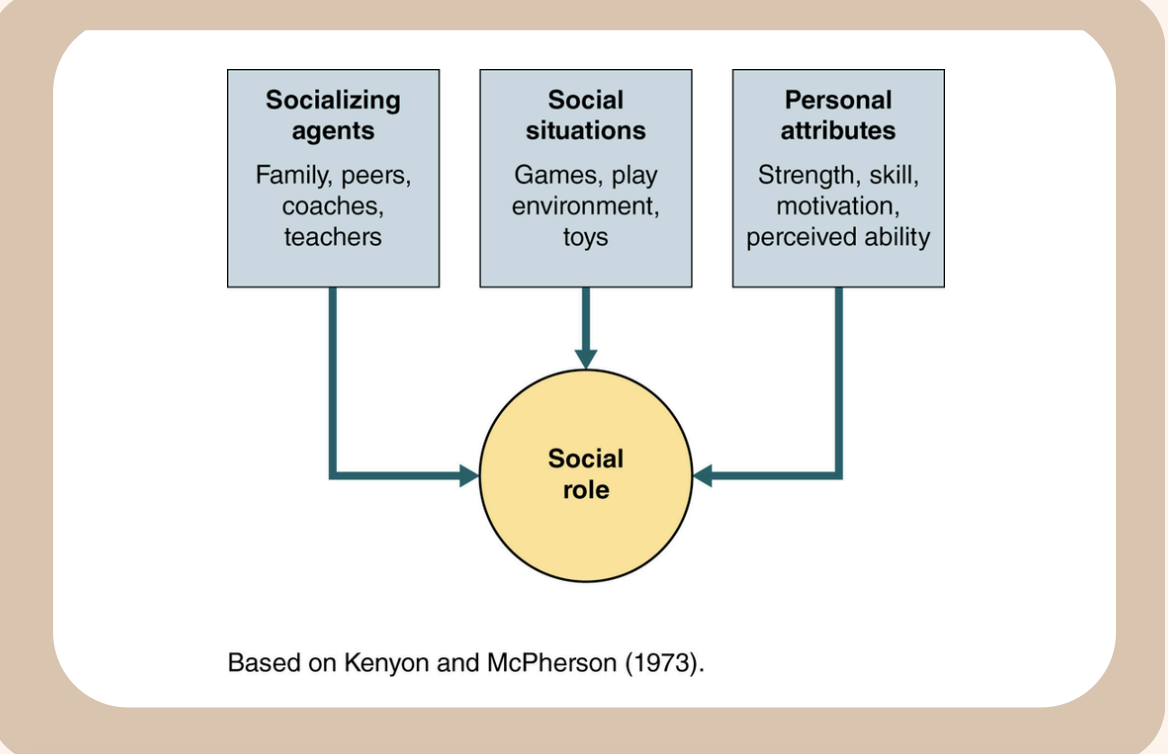
For the socialization process, people and situations influence?
individuals in their choice of activities throughout their lives
What are 3 major elements of the socialization process ?
1. Significant others: Influential or important people, called
socializing agents
2. Social situations: Places where socialization takes place (e.g., schools, home, playgrounds)
3. Personal attributes: Individual constraints (e.g., strength, motivation, skill)
Sex refers to male or female
biological characteristics (individual constraint)
Gender refers to
socially determined masculine or feminine characteristics (sociocultural constraint)
Gender Typing occurs when a
a significant other encourages activities that are deemed “gender appropriate”.
(gender stereotyping)
Regarding gender typing, societal attitudes about gender-appropriate activities can restrict
physical activity options for boys and girls
In the United States, these societal attitudes linger, but the number of girls participating in sports has dramatically
increased
Girls still lag behind boys in number of participants.
Girls are still more likely to drop out of sports after high school.
What federal civil rights law passed in 1972 that protects people from discrimination based on sex in education programs or activities that receive Federal financial assistance?
Title IX
"No person in the United States shall, on the basis of sex, be excluded from participation in, be denied the benefits of, or be subjected to discrimination under any education program or activity receiving Federal financial assistance.”
What gender stereotypes are associated with the following activities?
Ballet
Baseball
Soccer
Wrestling
Ballet : girl
Baseball : boy
Soccer : both
Wrestling : boy
Can you think of cases where athletes went against the stereotype? How many?
volleyball, gymnastics
Socializing Agent are people that are
Most likely to play a role in an individual's socialization process.
Significant Others : parents/caregivers (have a lot of influence), siblings, friends, teachers, and coaches
Significant Others : Parents are particularly important during
early childhood
Gender of both child and parents matters , fathers tend to
reinforce gender typing in boys
same sex parents may be more influential
Significant Others: Siblings constitute a child’s
first play group
after childhood, sibling influence diminishes
Patterns of family influence vary by social background, race, and geographic location.
Girl sports participation is influenced by
brothers and sisters
Significant Others: Peers have a large influence on
participation in certain activities
playgroups
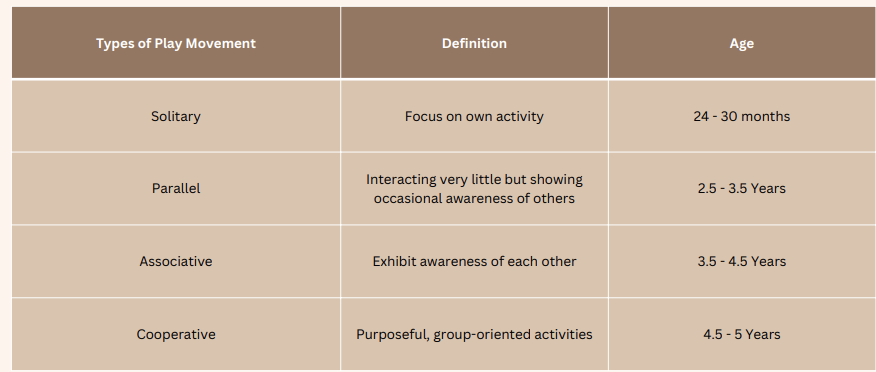
Play : Activity that is repetitive, spontaneous, voluntary and fun
What are the different types of play?
Solitary (24-30 months)
Parallel (2.5-3.5 Years)
Associative (3.5-4.5 Years)
Cooperative (4.5-5 Years)
Types of Play Chart
When are peer groups important?
after childhood
Peers provide a strong influence for
group activities, including team sports and nonsport clubs.
Peer group preference for passive activities can lead
once-active children into sedentary adolescence
Significant Others: Coaches and Teachers have potential to expose a
different pov to that of parents and family members
introduce them to activities and stimulate them to learn skills within the sport
Potential to turn students away from sport and physical activity
Teachers and coaches must avoid providing
aversive socialization (Snyder & Spreitzer, 1973), which discourages participation
Significant Others: Coaches and teachers have
Potential For aversion socialization (you throw like a girl)
Negative socialization experiences that deter an individual from present/or future participation in sport
Fail to learn skills
Avoid physical activity
Social Situations include
play environments and games
Play environments and games are an adequate
environment for play, such as a backyard or playground can provide engagement in physical activity and sports
Play space can influence what?
Activity participation/selection
Gender-associated values
Equipment accommodations (Body Scaling)
Playing with toys can act as
constraints
May encourage children to be active or inactive
Gender typing via toys
Toys marketed to boys tend to be more complex and encourage more vigorous activity than those marketed to girls.
Toys can encourage traditional gender roles.
Marketing, advertising, and packaging of toys can lead to gender typing.
Parents enjoy giving their children the same kinds of toys they played with as children.
Parents can promote gender typing by negatively reinforcing play with toys the judge to be gender inappropriate.
Video, computer, or streamed games are increasingly influential.
Caregiver
Initial Interactions
Infants engage in
visual exchange, touch, and express distress when caregiver leaves
Infancy Locomotion
Crawling and Creeping
Infancy and Early Childhood Practice Play is
movement-oriented
Early Childhood : Family is the most ___________
influential
siblings are a child’s first playgroup
Young children’s physical activity participation often reflects
parents interest and encouragement
During middle childhood, ______ environment becomes influential
school
conflicting findings
sport specialization
Peers Influence (Cliques)
During adolescence, ____ have a _____ influence
peers , higher
seeking approval
seeking opportunities to do sport
gender roles
Early Adulthood transitions
Workforce, School, Marriage, Parenthood
peers influential
reduction of physical activity for individual who are married or dating
marriage and living together
During middle and late adulthood, you will go through
transitions
retirement, leaving the nest
Ageism
Race relate to
genetic similarities between groups
Ethnicity have cultural
similarities within groups
SES (socioeconomic status) is describing
individuals based on their education, income, and type of job (National Cancer Ins.)
Stereotype threat is
Experience of being at risk of conforming to sociocultural stereotypes related to racial, ethnic, gender, or cultural groups.
Sociocultural constraints continually interact with
functional individualconstraints that encourage and discourage movements through participation in activities.
Youth are socialized into
sport