HW1: 1D Motion
 Call Kai
 Learn
Learn Practice Test
 Spaced Repetition
 Match
Match Flashcards
 Knowt Play
1/20

There's no tags or description
Looks like no tags are added yet.
Name | Mastery | Learn | Test | Matching | Spaced | Call with Kai | Chat |
|---|
No analytics yet
Send a link to your students to track their progress
21 Terms
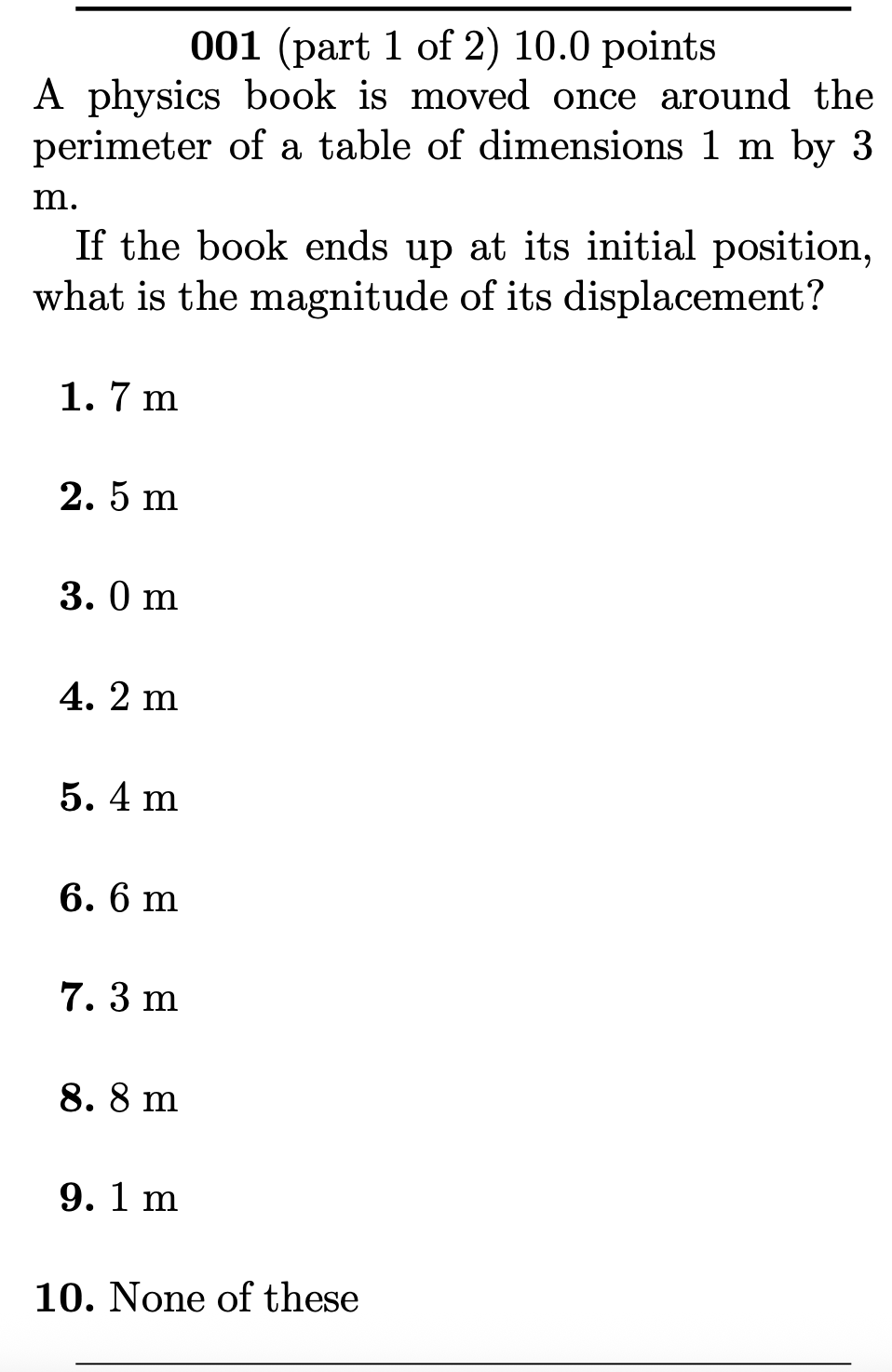
0 m
displacement = xf- xi. the book begins and ends in the same spot so displacement = 0
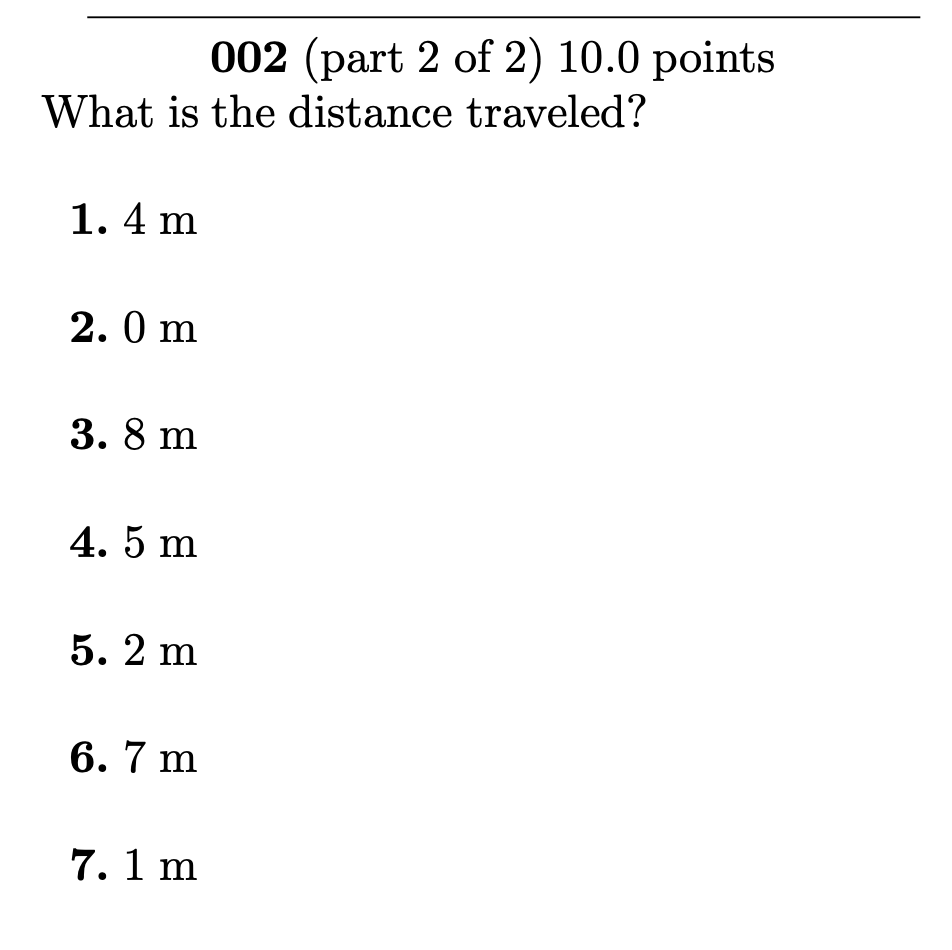

8 m
distance traveled = 3m + 3m + 1m + 1m
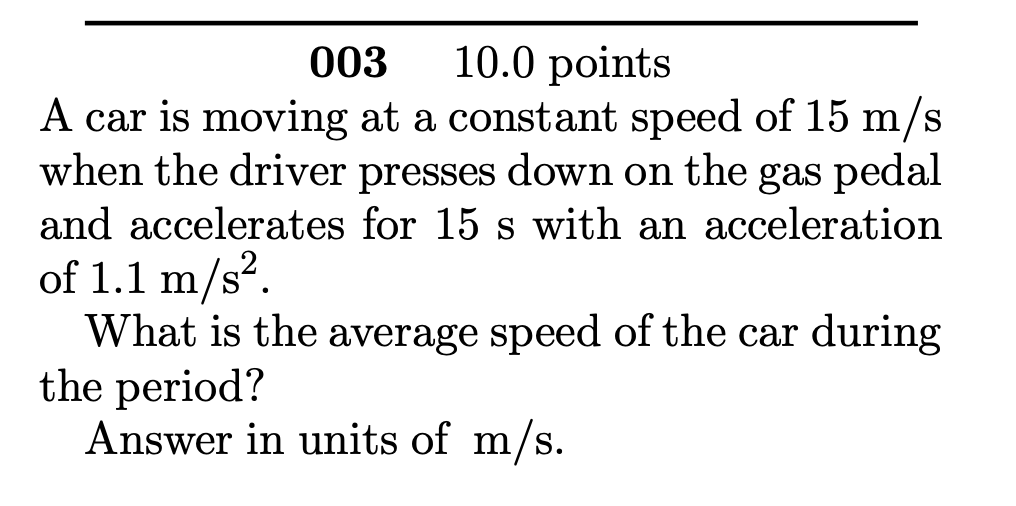
23.25 m/s
Vo = 15 m/s, constant a= 1.1 m/s², the car accelerates for t = 15 s
The question asks for average speed. To find average speed we will use the equation (Vf-Vo)/2.
Step 1: find Vf
- Using the equation under Motion constant acceleration: vf = vo + at = 15 + (1.1×15) = 31.5 m/s
Step 2: find average speed
(Vf-Vo)/2 = (31.5-15)/2 = 23.25 m/s
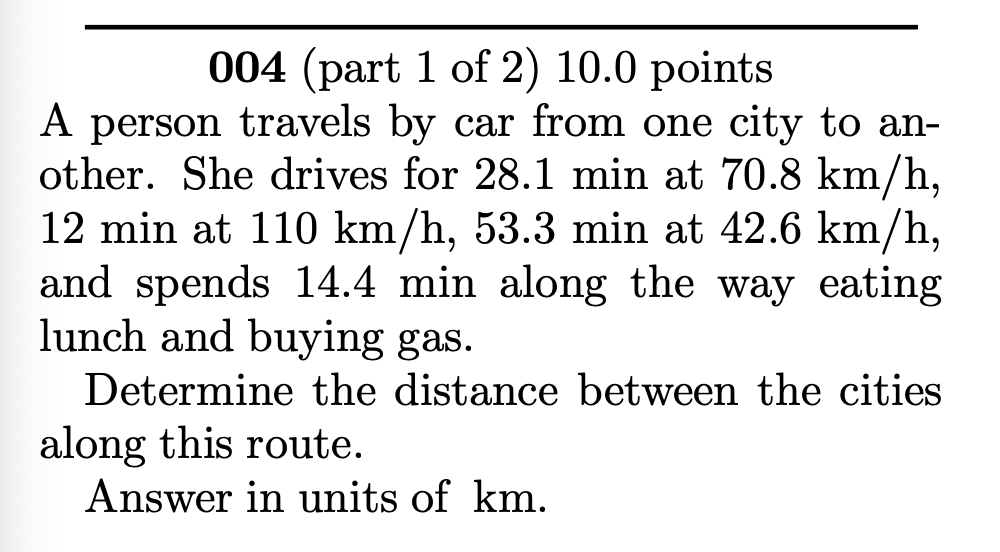
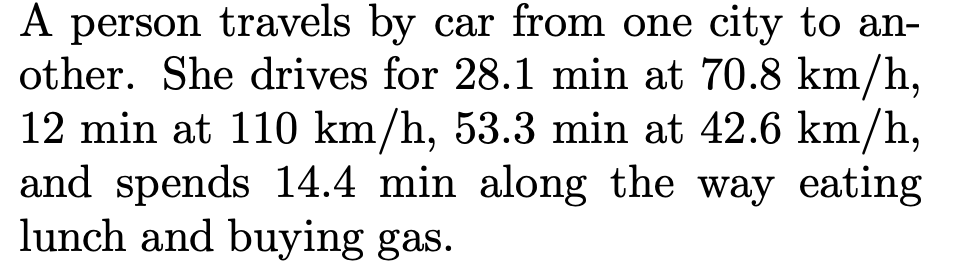
93.001 km
Explanation:
Find the distance traveled for d1, d2, d3
divide t by 60 min → hr
v = d/t → d = t v
t1= 28.1 min v1=70.8 km/h
t2= 12 min v2= 110 km/h
t3= 53.3 min v3= 42.6 km/h
d1= 70.8×28.1/60 = 33.158 km
d2= 110×12/60 = 22 km
d3= 42.6×53.3/60 = 37.84 kmFind dtot
dtot= d1+d2+d3= 33.16+22+37.84= 93.001 km
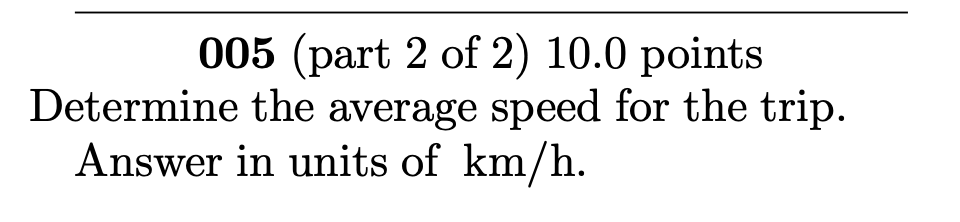
51.76 km/hr
Explanation:
1. Find average speed: vtot=dtot/ttot
ttot = (28.1+12+53.3+14.4)/60
divide time (min) by 60 → hr
14.4 min comes from the time stopped/not driving
vtot = 93.001 km/[(28.1+12+53.3+14.4)/60] = 51.76 km/hr
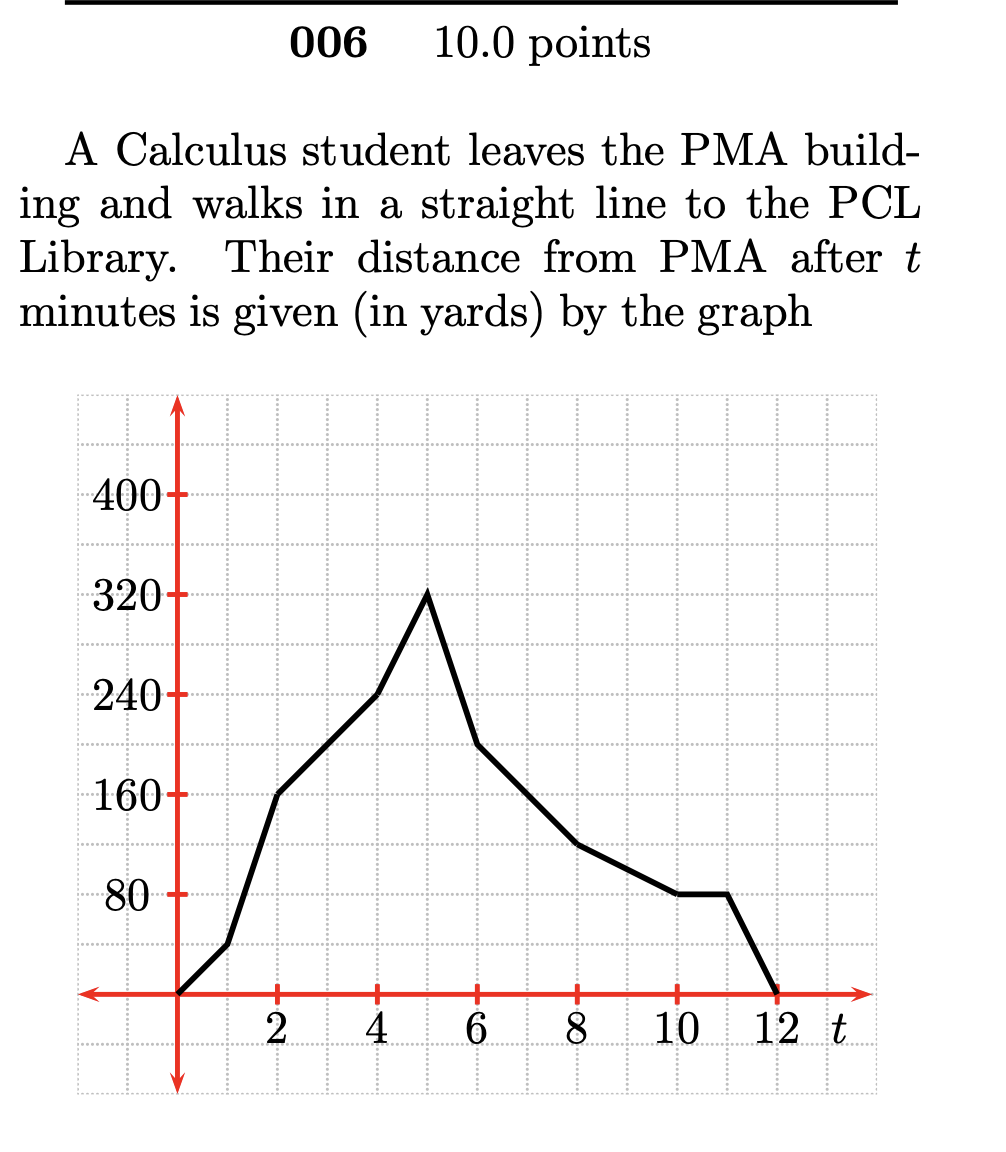
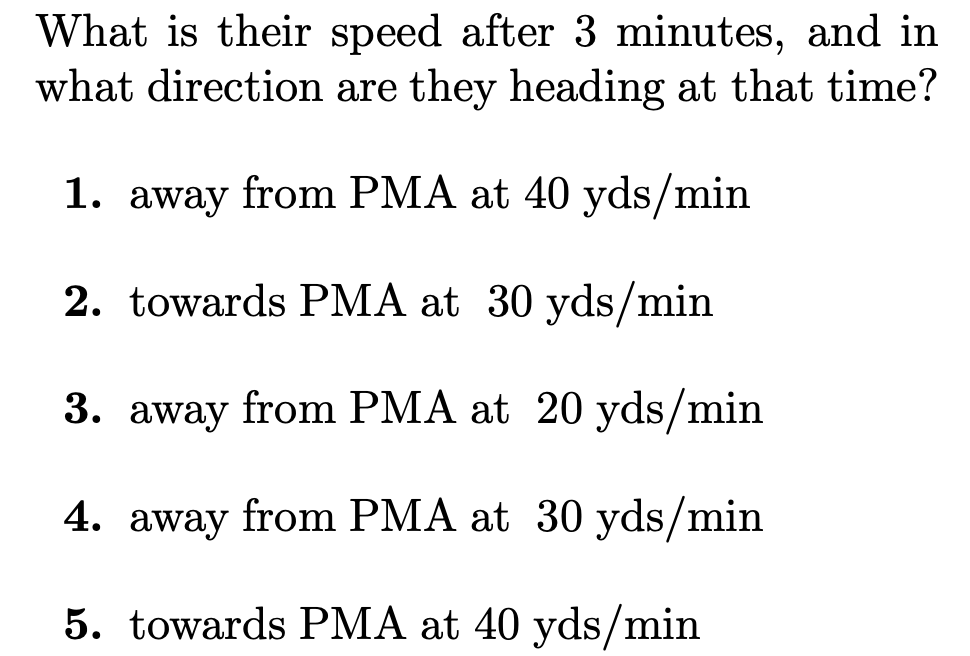
away from PMA at 40 yds/min
Explanation:
Find the slope at t=3 using (rise/run)
(240-160)/(4-2) = 40
10.3 m
Explanation:
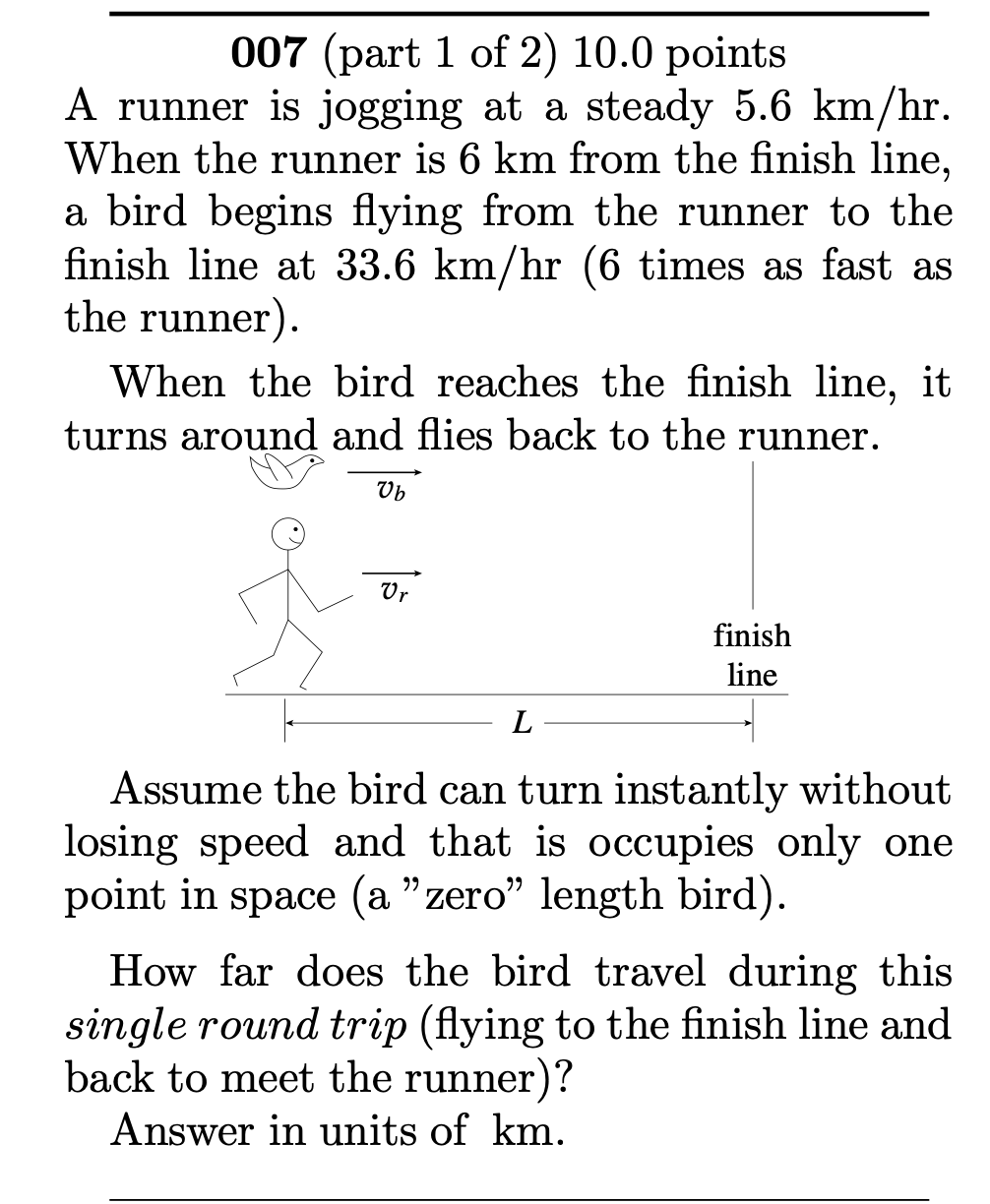
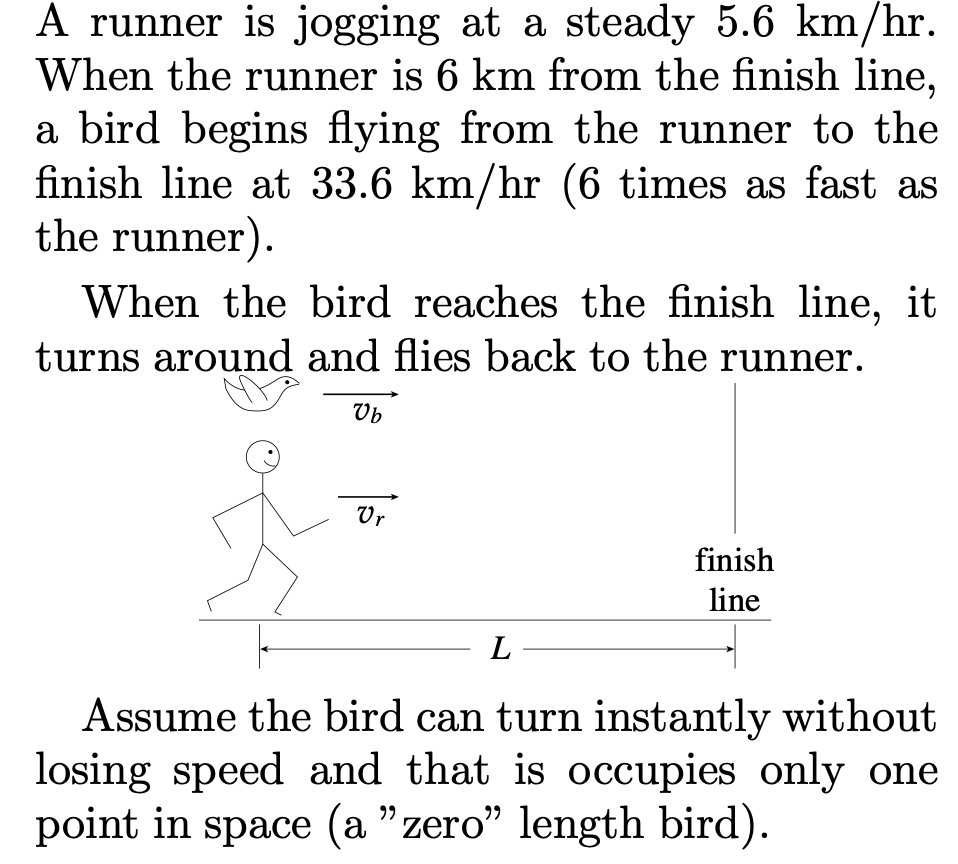
find tb for the bird to finish flying the L
given: vb = 33.6 km/hr, d = 6 km
vb = db/tb → tb = db/vb = 6/33.6 = 0.1786 hrfind xr at tb
- find the distance traveled by the runner during the time it took for the bird to make it to the finish line
dr = vr*tr = 5.6 * 0.1786 = 1 km
6 km - 1km = 5 km left for the runnerfind closing velocity (vclose)
vb + vr = 33.6 + 5.6 = 39.2 km/hrfind closing time (tclose) to travel 5 km
tclose = d/vclose = 5 km/ 39.2 km/hr = 0.128 sfind xb at tclose
xb = vb*tclose = 33.5 × 0.128s = 4.3008 mfind dtotal traveled by the bird
= 6 + 4.3008 m = 10.3 m
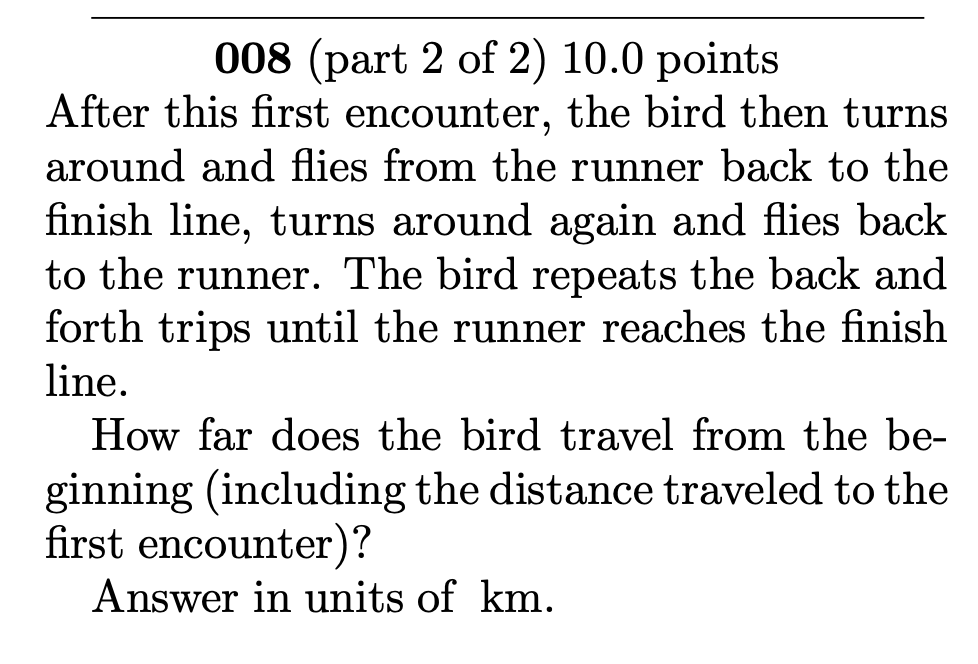
36 km
Explanation:
vb = vr * 6
distance traveled by the bird will always be 6x dr
dr will always be 6km
6 *6 = 36
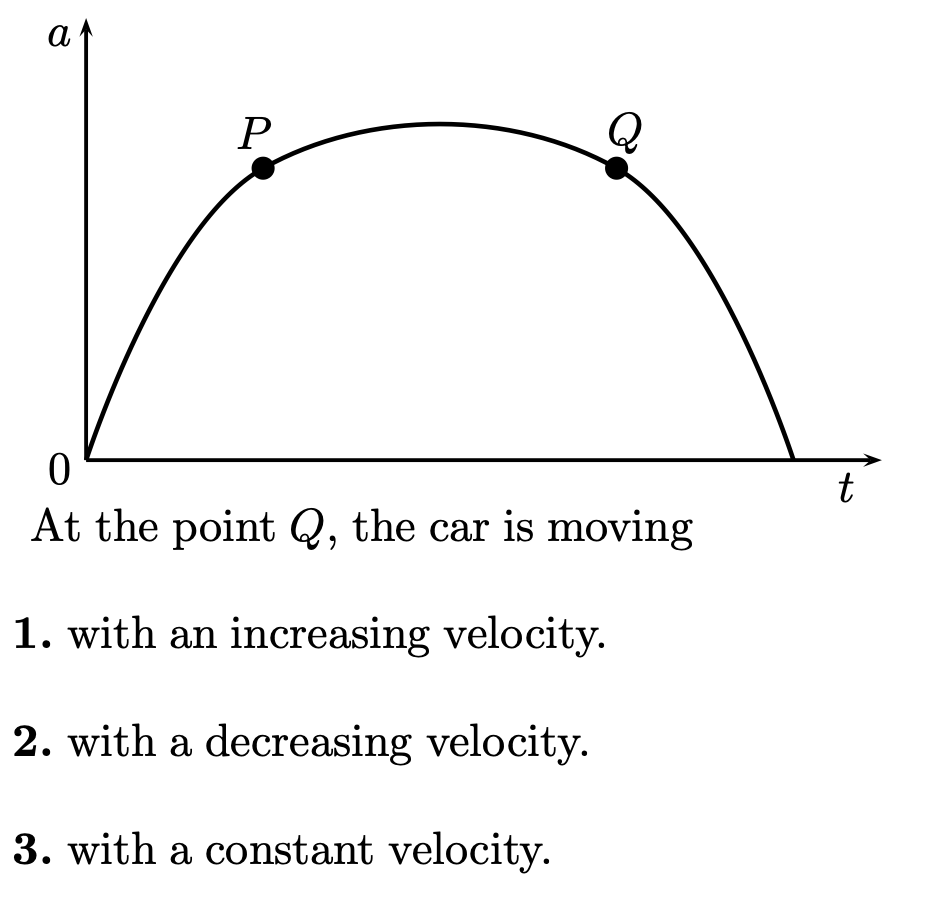
The diagram describes the acceleration vs. time behavior for a car moving in the x-direction
with an increasing velocity
Explanation:
when a is +, v incr
a is -, v decr
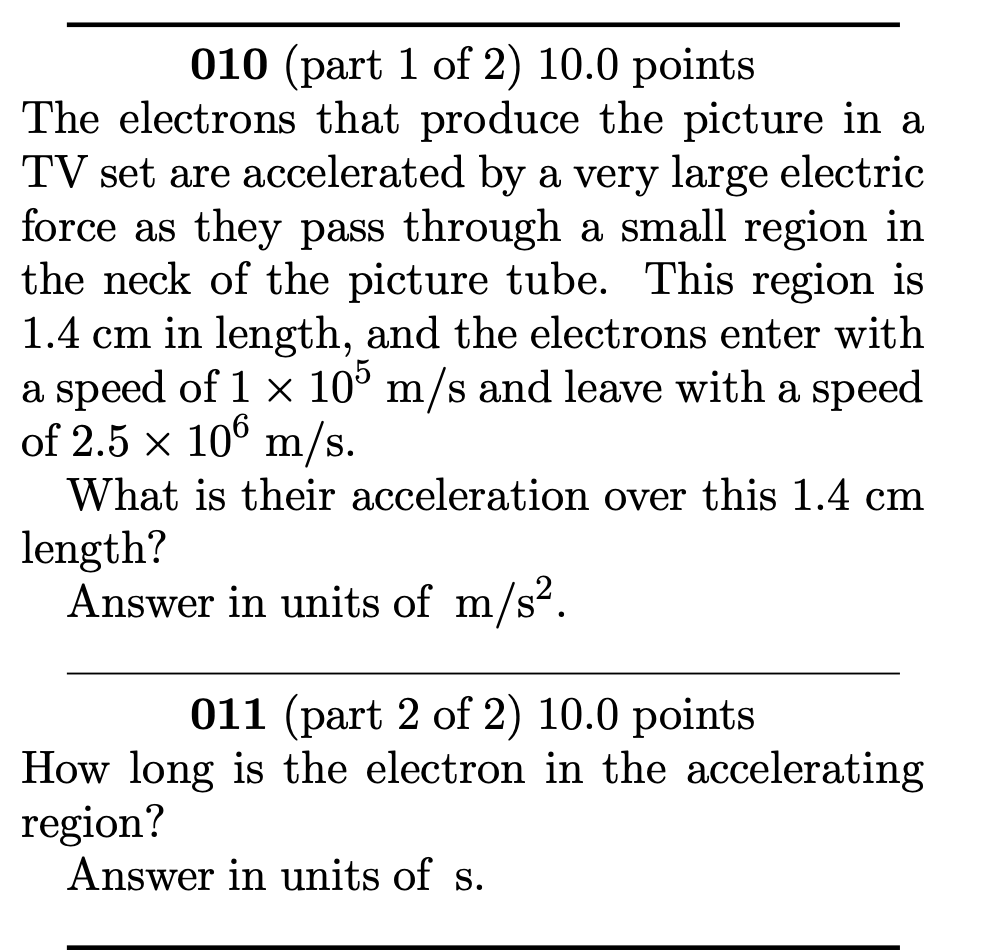
10) 2.23×10¹⁴ m/s²
11) 1.07 × 10⁻⁸ m/s
Explanation:
10) what is their a over d = 1.4 cm
find a
given: x = 1.4 cm, vo = 1 × 10⁵ m/s, vf = 2.5 × 10⁶
v² = vo²+2aΔx → a = (v²-vo²)/2a = 2.23×10¹⁴ m/s²
11) what is t = ? when the electrons are in the accelerating region
find t
given: x = 1.4 cm, vo = 1 × 10⁵ m/s, vf = 2.5 × 10⁶, a = 2.23×10¹⁴ m/s²
v = vo + at → t = v-vo / a = 1.07 × 10⁻⁸ m/s
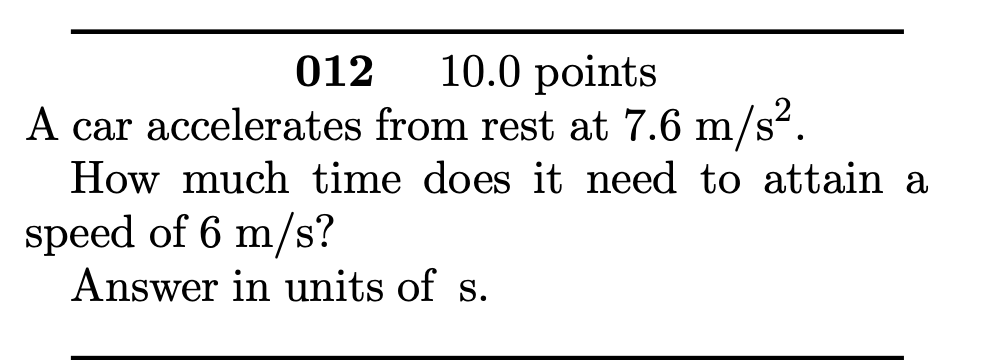
0.789 s
Explanation:
1. find t for car to reach vf = 6 m/s
given: vo = 0, a = 7.6 m/s², vf = 6 m/s
v = vo + at → t = v-vo / a = 0.789 s
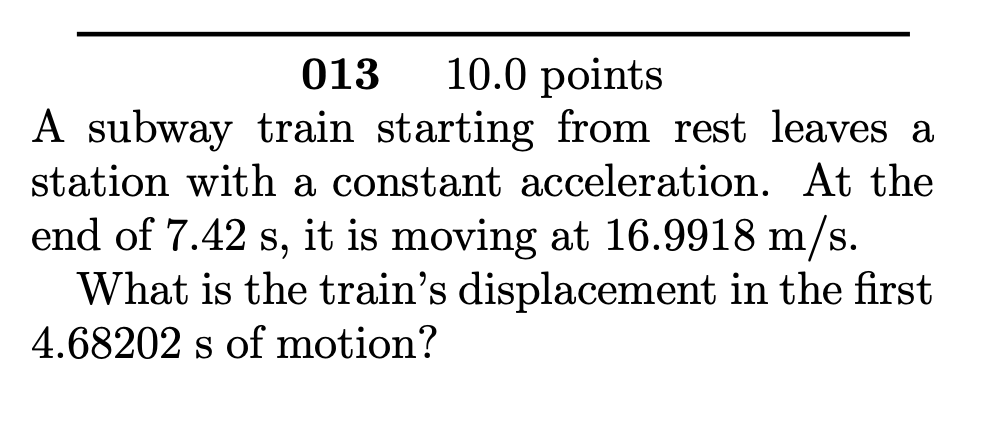
25.1 m
Explanation:
given: vo = 0, vf = 16.9918 m/s at the end of t = 7.42 s, const acceleration during this period
find a during t = 7.42s
v = vo + at → a = v-vo / t = 2.24 m/s²
2. find Δx @ t = 4.68202 s
Δx = vot + ½at² = 25.1 m
CAN NOT USE Δx = (vo+v)t/2. WHY? we do not know vf at t=4.68202 s
EZ
—
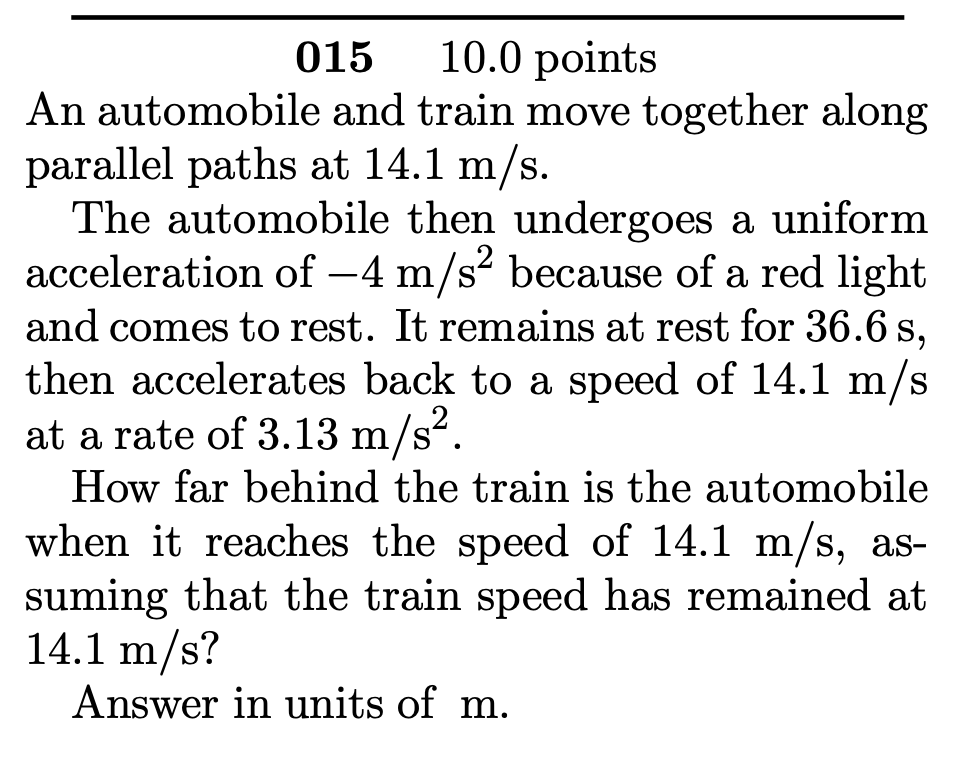
Explanation:
A. vo1 = 14.1 m/s, a1 = -4 m/s², vf1= 0 @ red light
v = 0 for t = 36.6 s
vo2 = 0, a2 = 3.13, vf2 = 14.1 m/s
T. const v = 14.1 m/s,
find ta1 for A to stop at light
find ta2 after red light to get to vf2
find ttotalA traveled by A
find xa1 traveled to the light
find xa2 traveled from light to vf2
find xb using ttotalA
find distance between T and A
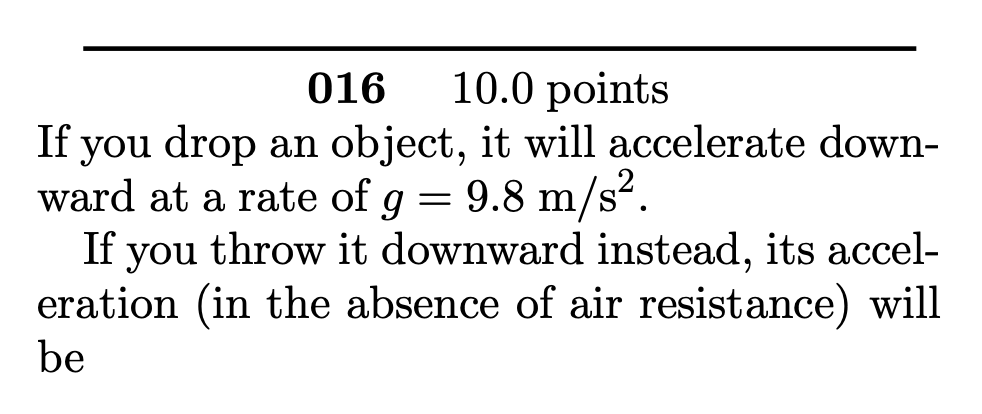
1. 9.8m/s²
Unable to determine
less than 9.8 m/s²
greater than 9.8 m/s²
1.9.8 m/s²
Explanation:
being thrown downward only charges initial velocity. acceleration will always be 9.8 m/s^2 from gravity.
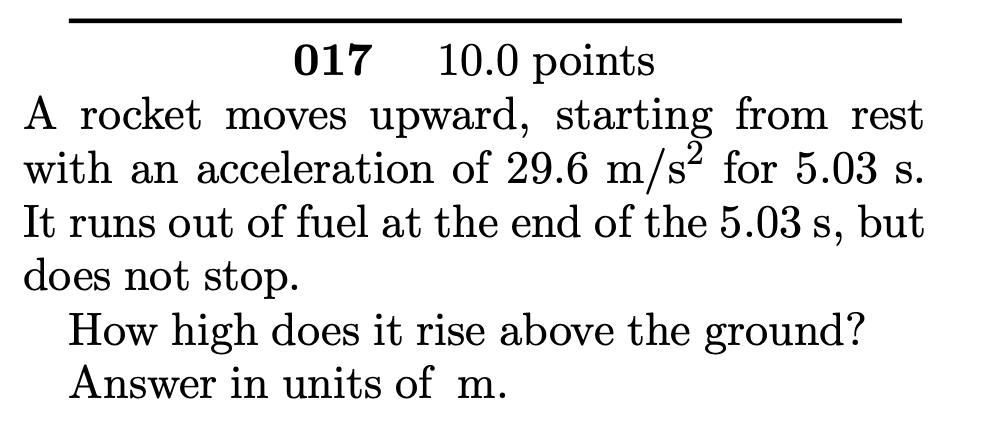
Rocket
1505.45 m
Explanation:
1. find vf1 of rocket when it runs out of fuel
given: vo1 = 0, const a1 = 29.6 m/s² for t= 5.03 s
vf1 = vo + at= 0 + (29.6×5.03) = 148.888 m/s
for step 3
find Δx1 traveled by rocket until it runs out of fuel
Δx = vot + ½at² = ½at² = ½(29.6)(5.03)² = 374.453 mfind Δx2
given: v02 = vf1 = 148.888 m/s, a = -9.8 m/s², vf2 = 0 m/s
v² = v²o + 2aΔx2 → Δx2 = v² -v²o / 2a = 0-148.888²/(2*-9.8) = 1131 mfind xtot
374.453 + 1131= 1505.45 m
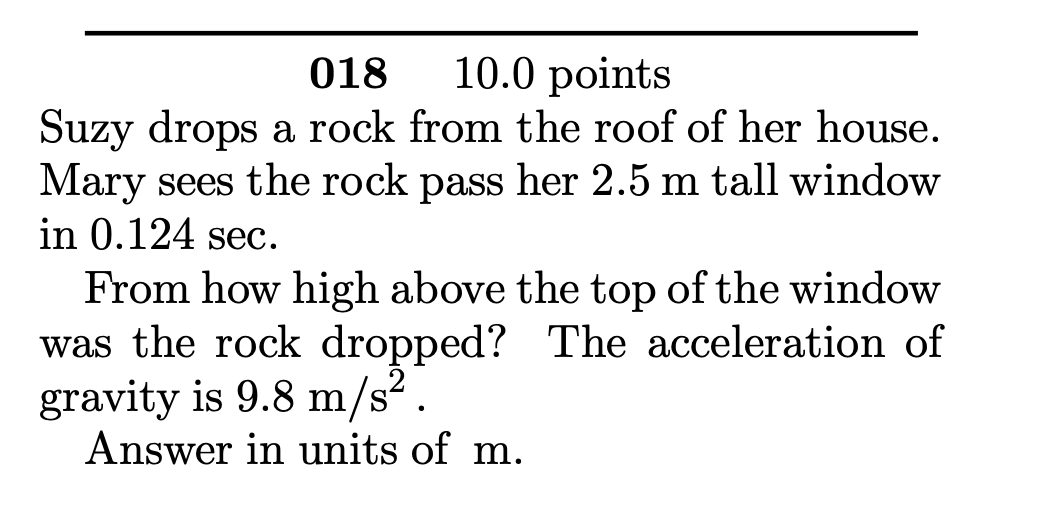
Ball Roof/window
19.51 m
Explanation:
draw diagram
Start with the window
Find vow at top of window
given: vfw = n/a don’t need, t = 0.124 s, Δxw = 2.5, a = 9.8 m/s²
Δx = vot + ½at² → vo = Δx-½at² / t = 19.55 m/sFind Δxr
given: voR = 0 (from rest), a = 9.8 m/s², vfr = vow = 19.55 m/s
v² = v²o + 2aΔx → Δx = v² -v²o/2a = 19.51 m
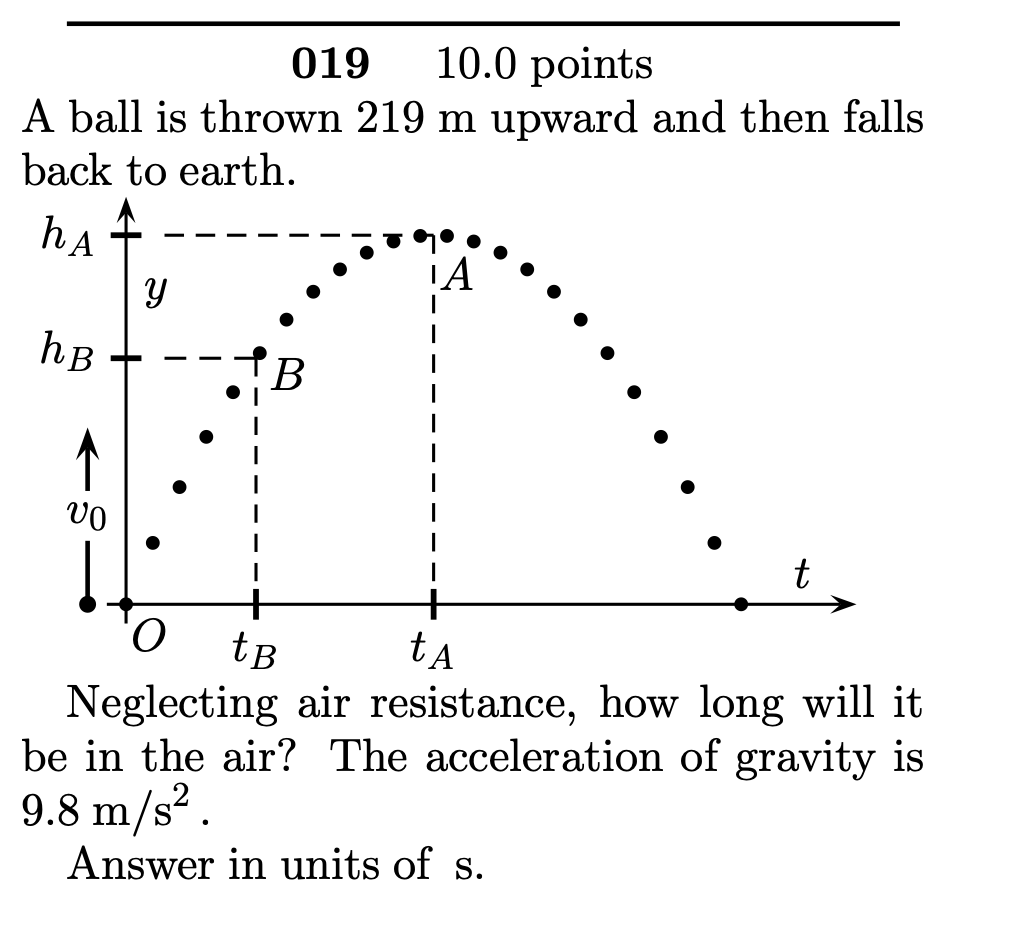
13.37 s
Explanation:
Look at the 2nd half of the graph
tA * 2 = total time ball is in the air
@ peak voA = 0
vf = n/a unknown, dont need
find tA
given: a = 9.8 m/s², Δy = 219 m, vo = 0
Δy = vot + ½at² → 219 = 0 + ½at² → t = (219/(½a))^1/2 = 6.685 sfind ttot
tA x 2 = 6.685 x 2 = 13.37 s
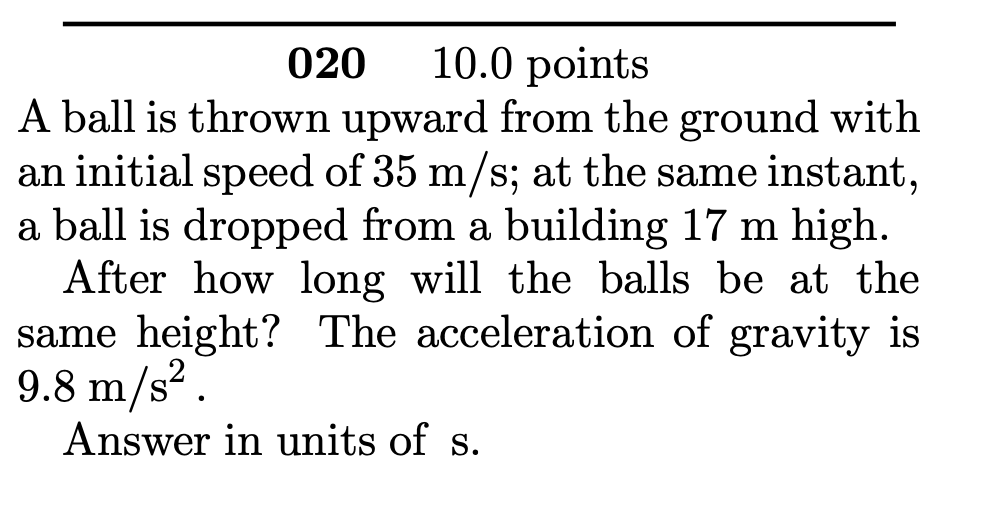
0.4957 s
Explanation:
set 2 equations for b1 & b2 together: yf = yi + vot + ½at²
ground is y = 0
1. ball 1
yf = yi + vot + ½at² = 17 + 0t + ½(-9.8)t²
ball 2
yf = yi + vot + ½at² = 0 + 35t + ½(-9.8)t²
set equal
17 + ½(-9.8)t² = 35t + ½(-9.8)t²
17 = 35t → t = 17/35 = 0.4957 s
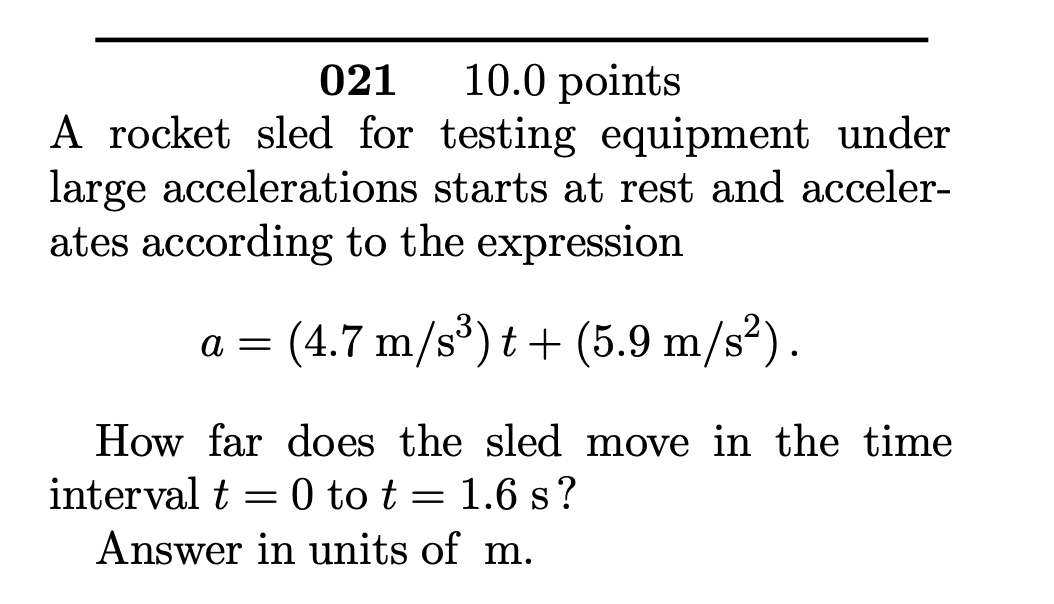
10.76 m
Explanation:
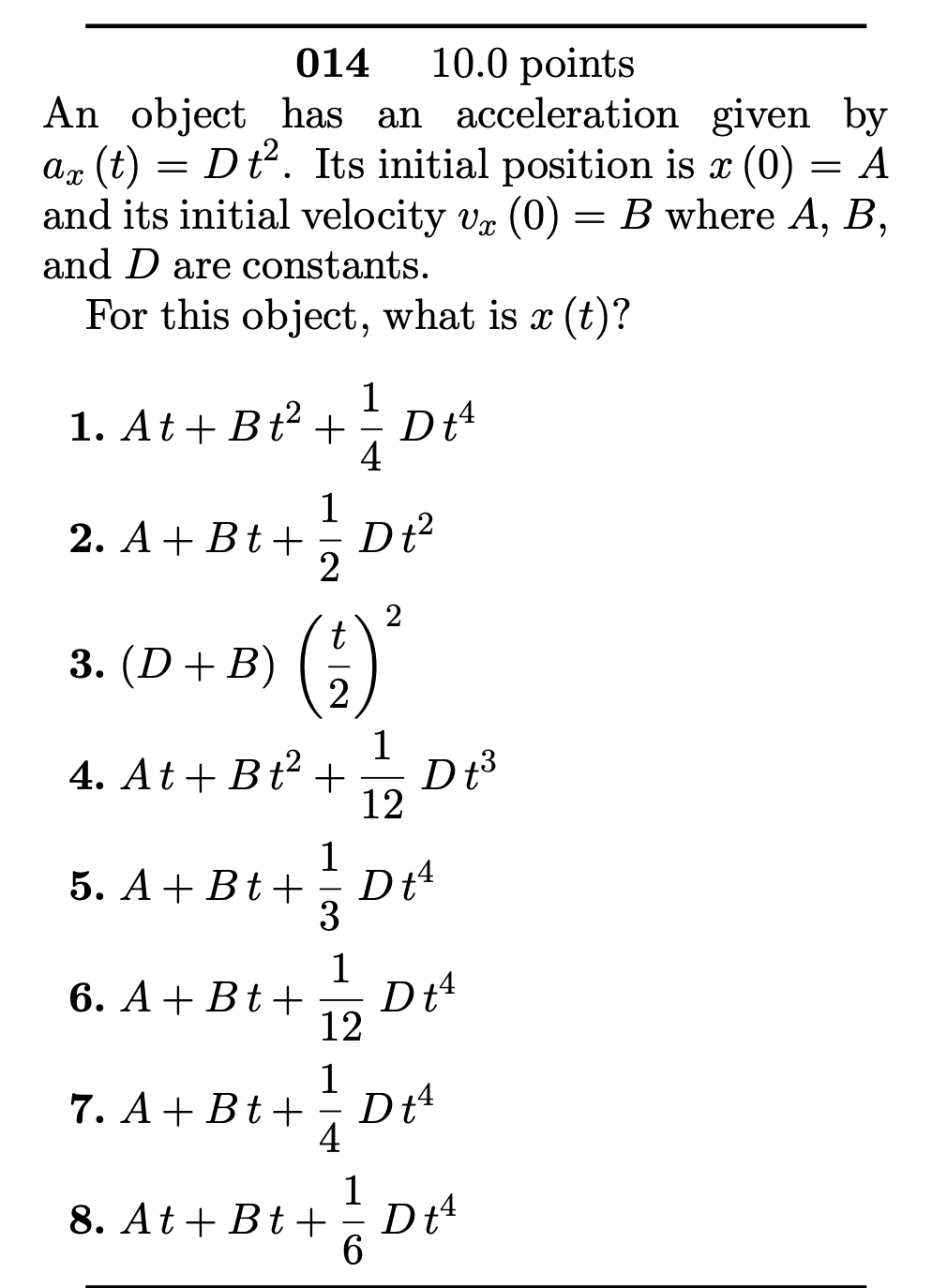
To find the distance of the sled, take the integral of a(t) to find v(t)
v(t) = ∫ a(t) dt = (4.7/2)t² + 5.9t + c
because the rocket starts at rest: v(0) = 0Plug in v(0) = 0 to find the value of C
v(0)= (4.7/2)0² + 5.90 + c = 0
c = 0Find x(t) between t=0 & t=1.6s by taking integral of v(t)
x(t) = ∫1.60 v(t) dt = ((4.7/2)/2)t³ + (5.9/2)t² |1.60
= [((4.7/2)/2)(1.6)³ + (5.9/2)(1.6)²] - [(4.7/2)/2)0³ + (5.9/2)0²]
= 10.76 m
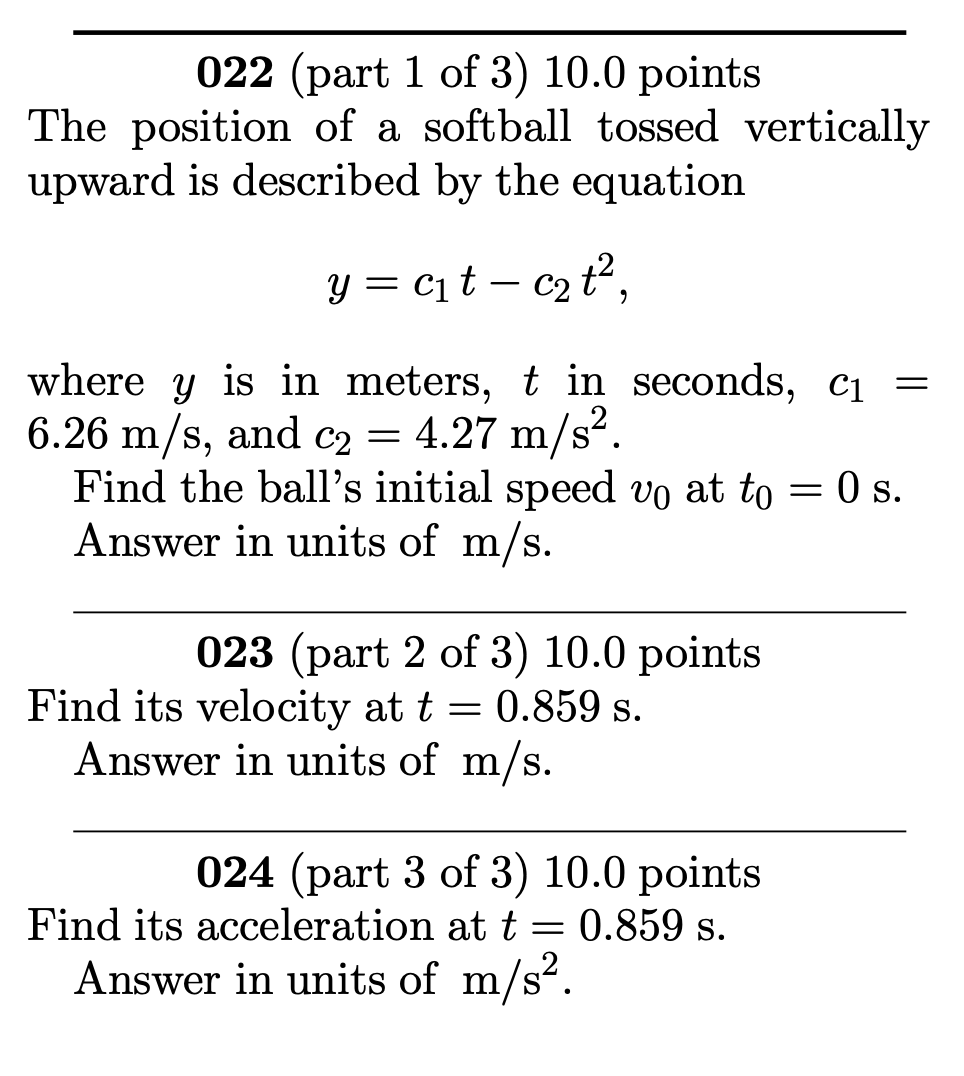
22) 6.26 m/s
23) -1.08 m/s
24) -8.54 m/s²
Explanations:
y(t) = 6.26t - 4.27 t²
22) To find the ball’s initial speed.
Find velocity equation by taking the derivative of y(t)
v(t) = dy/dt → 6.26 - 8.54tvi = when t = 0s = v(0)
v(0) = 6.26 - 8.54×0
v(0) = 6.26 m/s
23) Find velocity at t = 0.859 s
same thing as v(0.859). plug in
v(0.859) = 6.26 - 8.54×0.859 s = -1.08 m/s
24) Find acceleration at t = 0.859 s
Find acceleration equation by taking the derivative of v(t)
a(t) = dv/dt → - 8.54
This means acceleration is constant @ -8.54 m/s²