WGU D413 Telecomm & Wireless Review: Key Terms & Definitions With 100% accuracy
 Call Kai
 Learn
Learn Practice Test
 Spaced Repetition
 Match
Match Flashcards
1/42

There's no tags or description
Looks like no tags are added yet.
Name | Mastery | Learn | Test | Matching | Spaced | Call with Kai |
|---|
No analytics yet
Send a link to your students to track their progress
43 Terms
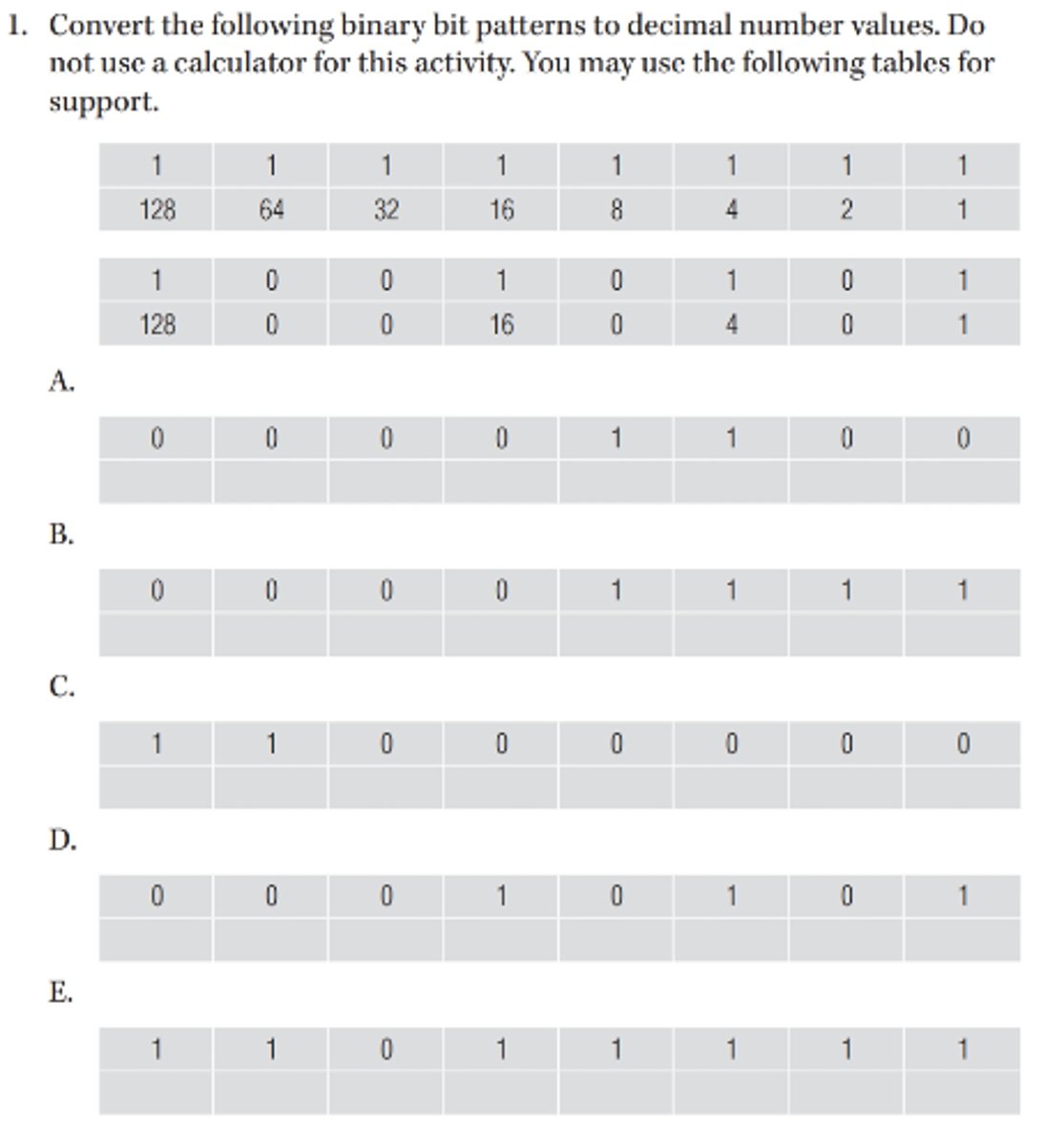
Convert the following binary bit patterns to decimal number values. Do not use a calculator for this activity. You may use the following tables for support.
A subnet mask can be divided into two descriptive sections. What are the two sections called?
Network portion and Host portion.
Explanation: The subnet mask separates the IP address into these two sections, which define the network and the specific devices within that network.
Why would a network administrator create subnets?
To improve network management, efficiency, and security.
Explanation: Subnetting helps manage network traffic, improves performance by reducing broadcast domains, and enhances security by isolating network segments.
What do the binary ones in a subnet mask indicate?
The network portion.
Explanation: Binary ones in a subnet mask represent the network part of the IP address, distinguishing it from the host part.
What do the binary zeros in a subnet mask indicate?
The host portion.
Explanation: Binary zeros in a subnet mask define the portion of the IP address used for host addresses within the subnet.
Using the information provided, identify which part of the IP address 190.134.124.112 with a subnet mask of 255.255.255.0 is the network address and which part is the host address?
Network address: 190.134.124.0
Host address: 112
Explanation: With the subnet mask 255.255.255.0, the first three octets define the network (190.134.124), and the last octet specifies the host (112).
How many bits are borrowed from a Class B host address to create 30 new subnets?
5 bits.
Explanation: To create 30 subnets, you need at least 5 bits (2^5 = 32 subnets) since 2^4 = 16 subnets are insufficient.
How many bits are borrowed from a Class C host address to create six new subnets?
3 bits.
Explanation: For 6 subnets, 3 bits are needed (2^3 = 8 subnets), as 2^2 = 4 subnets are insufficient.
How many subnets can be formed using a subnet mask of 255.255.255.224 for a Class C network and using hardware that allows the use of all zeros and all ones in the network portion of the subnet mask?
8 subnets.
Explanation: A subnet mask of 255.255.255.224 (or /27) provides 5 bits for subnetting, allowing 2^5 = 32 subnets, but excluding the all-zeros and all-ones subnets yields 8 usable subnets.
How many hosts are created from the following Class C subnet mask: 255.255.255.240?
14 hosts.
Explanation: The mask 255.255.255.240 (/28) leaves 4 bits for hosts, which provides 2^4 - 2 = 14 usable hosts (subtracting 2 for the network and broadcast addresses).
A network administrator decides to partition an existing Class C network into six equal parts. Each part of the network must hold at least 22 computers. What subnet mask must be used to satisfy the requirement?
255.255.255.224.
Explanation: A /27 subnet mask provides 32 addresses per subnet (30 usable), which satisfies the requirement for at least 22 hosts.
How many subnets can be created from the following Class C subnet mask: 255.255.255.224?
8 subnets.
Explanation: The /27 mask allows for 5 bits of subnetting, resulting in 2^5 = 32 possible subnets (including all-zero and all-one subnets).
How many subnets can be created from the following Class C subnet mask: 255.255.255.248?
16 subnets.
Explanation: The /29 mask provides 3 bits for subnetting, yielding 2^3 = 8 subnets, but considering all zeros and ones subnets, it actually creates 16 subnets.
What is the difference between a router and a layer 3 switch?
Routers operate primarily at the network layer (Layer 3) and manage traffic between different networks, while layer 3 switches provide both switching and routing functions within the same device, often in the same LAN.
Explanation: Layer 3 switches combine routing capabilities with traditional switching, whereas routers focus on inter-network traffic.
A bridge filters frames based on which type of address?
MAC address.
Explanation: Bridges use MAC addresses to determine whether to forward or filter frames within the same network segment.
A switch filters frames based on which type of address?
MAC address.
Explanation: Switches use MAC addresses to decide how to forward frames to the appropriate ports.
A router filters frames based on which type of address?
IP address.
Explanation: Routers use IP addresses to direct packets between different networks.
At which layer of the OSI model do bridges operate?
Layer 2 (Data Link).
Explanation: Bridges operate at Layer 2 to filter traffic based on MAC addresses.
At which layer of the OSI model do routers operate?
Layer 3 (Network).
Explanation: Routers operate at Layer 3 to route packets based on IP addresses.
Name three devices that will forward a broadcast.
Hub, switch, and router (in some cases).
Explanation: Hubs and switches forward broadcasts to all ports, while routers generally do not forward broadcasts between different networks.
Name one device that will not forward a broadcast.
Router.
Explanation: Routers do not forward broadcasts to other networks; they limit broadcast domains.
What is a broadcast domain?
A broadcast domain is a network segment where all devices can directly receive broadcast messages sent by any other device within the same domain.
Explanation: Broadcast domains are bounded by routers or layer 3 switches, separating traffic into isolated segments.
What is the difference between an Interior Gateway Protocol and an Exterior Gateway Protocol?
Interior Gateway Protocols (IGPs) manage routing within a single autonomous system, while Exterior Gateway Protocols (EGPs) handle routing between different autonomous systems.
Explanation: IGPs are used within an organization's network, whereas EGPs are used for inter-domain routing.
What is an autonomous network?
An autonomous network is a collection of IP networks and routers under the control of a single organization, operating with a unified routing policy.
Explanation: It represents a single administrative entity’s network domain.
Which IGP router protocol uses only hop count to determine the best path?
RIP (Routing Information Protocol).
Explanation: RIP uses hop count as its sole metric for determining the best path to a destination.
List four IGP protocols.
RIP, OSPF, EIGRP, IS-IS.
Explanation: These are common Interior Gateway Protocols used for routing within an autonomous system.
What is a VLAN?
A Virtual Local Area Network (VLAN) is a network segmentation method that groups devices into a single broadcast domain regardless of their physical location.
Explanation: VLANs create logical separation within a network to improve management and security.
What is the difference between a static and dynamic VLAN?
Static VLANs are manually assigned to switch ports, while dynamic VLANs are assigned based on criteria like MAC addresses or other attributes, often using VLAN Management Protocol (VTP).
Explanation: Static VLANs require manual configuration, whereas dynamic VLANs adapt to network changes automatically.
What is STP?
Spanning Tree Protocol (STP) is a network protocol that prevents loop formation in Ethernet networks by creating a loop-free logical topology.
Explanation: STP ensures there are no redundant loops in the network that could cause broadcast storms.
What network class is represented by the following CIDR: XXX.XXX.XXX.XXX/16?
Class B.
Explanation: A /16 subnet mask is typical for Class B networks, which support a range of IP addresses.
What is the network portion of 179.124.244.2/16?
179.124.0.0
Explanation: With a /16 mask, the first 16 bits define the network address, so the network portion is 179.124.0.0.
What is the host portion of 179.124.244.2/16?
244.2
Explanation: The host portion is the part of the IP address not included in the network portion, so here it is 244.2.
How does link aggregation increase bandwidth for network backbones?
By combining multiple network connections into a single logical link to increase overall bandwidth and provide redundancy.
Explanation: Link aggregation allows multiple physical links to act as one, thus enhancing throughput and reliability.
John works for a large bank. He is attempting to create a Class A network. What subnet mask is used to identify a typical Class A network and host?
A. 255.255.255.255
B. 255.255.255.0
C. 255.255.0.0
D. 255.0.0.0
Answer: D. 255.0.0.0
Explanation: A Class A network uses a default subnet mask of 255.0.0.0, which allows for a large number of hosts on a single network segment.
Maria is a network administrator for a small financial company. She is planning to expand the network and add several devices to the network. Which devices can filter network frames? (Select two.)
A. Server
B. Repeater
C. Bridge
D. Switch
E. Router
Answer:
C. Bridge
and
D. Switch
Explanation: Bridges and switches operate at Layer 2 (Data Link layer) and use MAC addresses to filter and forward frames. Servers and repeaters do not filter frames.
Gregory is responsible for network administration at a large e-commerce company. He is trying to create a map of his network, and all the network IP addresses. What is the network class most likely associated with the IP address 150.150.23.34?
A. Class A
B. Class B
C. Class C
D. Class D
Answer: B. Class B
Explanation: The IP address 150.150.23.34 falls within the range 128.0.0.0 to 191.255.255.255, which is designated for Class B networks.
Which of the following IP addresses is a reserved address and cannot be used when connecting to the Internet?
A. 123.001.001.21
B. 192.168.0.23
C. 154.23.168.32
D. 200.200.200.200
Answer: B. 192.168.0.23
Explanation: The IP address 192.168.0.23 is part of the reserved private IP address range (192.168.0.0 to 192.168.255.255), which cannot be used on the public Internet.
Mary is trying to master the concepts of subnetting. She is trying to recall what portion of the IP address represents the network, and what part represents the node. What is the host address for an IP address of 199.200.12.45 with a subnet mask of 255.255.255.0?
A. 199.200.12
B. 45
C. 255.255.255
D. .0
Answer: B. 45
Explanation: With a subnet mask of 255.255.255.0, the first three octets (199.200.12) represent the network portion, and the last octet (45) represents the host portion.
You have been assigned the task of creating subnets for your company's network. You have to select the appropriate subnet masks. What subnet mask is used to identify a typical Class B network and host?
A. 255.255.255.255
B. 255.255.255.0
C. 255.255.0.0
D. 255.0.0.0
Answer: C. 255.255.0.0
Explanation: A Class B network uses a default subnet mask of 255.255.0.0, which separates the first two octets for the network and the last two for hosts.
What is the network class most likely associated with the IP address 198.150.25.10? (Hint: The network class can be identified by the first octet.)
A. Class A
B. Class B
C. Class C
D. Class D
Answer: B. Class B
Explanation: The IP address 198.150.25.10 falls within the range 128.0.0.0 to 191.255.255.255, which is designated for Class B networks.
Juan is very concerned about switch loops. He wants to use a protocol that will mitigate this concern. Which protocol is designed to prevent switch loops?
A. ICMP
B. STP
C. FTP
D. SSL
Answer: B. STP
Explanation: Spanning Tree Protocol (STP) is designed to prevent loops in Ethernet networks by creating a loop-free logical topology.
What does a router use to determine the best route?
A. Metric
B. Vector
C. MAC address
D. TTL
Answer: A. Metric
Explanation: Routers use metrics, such as hop count, bandwidth, or delay, to determine the best route for forwarding packets.
Which two are link-state router protocols?
A. RIP
B. OSPF
C. IS-IS
D. RIPng
Answer: B. OSPF and C. IS-IS
Explanation: OSPF (Open Shortest Path First) and IS-IS (Intermediate System to Intermediate System) are link-state routing protocols that use the state of links to build a network topology and compute the best paths. RIP is a distance-vector protocol, and RIPng is its version for IPv6.