environmental conditions
 Call Kai
 Learn
Learn Practice Test
 Spaced Repetition
 Match
Match Flashcards
 Knowt Play
1/71

There's no tags or description
Looks like no tags are added yet.
Name | Mastery | Learn | Test | Matching | Spaced | Call with Kai | Chat |
|---|
No analytics yet
Send a link to your students to track their progress
72 Terms
CV adaptations within one week of acclimatization
increased plasma volume
reduced heart rate
improved stroke volume
enhanced skin blood flow and sweating
reduced core temp
sweating response to acclimatization
sweating changes take longer (2-3 weeks)
earlier onset
increased sweating rate
reduced electrolyte loss
lower body temp for sweating
change in sweating location
increased conversion of sodium
can be lost in 3-4 wks
Male unacclimatized to heat can sweat up to
1.5L/hr
Acclimatized male can have peak sweat rates…
above 2.5L/hr
Lower Body Temperature for Sweating
The body core temperature at which sweating begins decreases, allowing for more efficient cooling
Change in the sweating location
From chest and back to more on the lim
Increased conservation of sodium
From up to 60mmol/L to as low as 5mmol/L
thermoregulation
• body maintains a core temperature of ~37°C
hypothalamus
hypothalamus regulation of core temp
Receives input from sensors in skin, mucous membranes (peripheral thermoreceptors) and internal structures (central thermoreceptors)
response to decrease in core body temp
heat response
sweating
response to increase in core body temp
cooling response
shivering
temp above 104
106-112 - heatstroke and brain lesions
5 step rectal temp
explain procedure and ensure privacy
position patient on side and put gloves on
lubricate and insert, 4in
measure and monitor
remove, clean, document
what temperature should the core temp be cooled to?
102
heat loss
convection
conduction
evaporation
radiation
convection
transfer of heat through a medium such as air or water (whirlpool)
conduction
transfer of heat through direct contact (ice bags, heat packs)
evaporation
dissipation of heat via removal of a conducting medium such as air (fans)
radiation
transfer of heat through a vacuum
This is how the body loses the most heat, accounting for approximately 60% of heat loss under normal circumstances
hyperthermia
elevated body temperature
Exposure to heat triggers increase in core body temperature
Sensors regulate this to the hypothalamus
Sympathetic nervous system activated
Cutaneous vasodilation
Sweat gland activation
where does body heat come?
Muscle activity (breakdown of ATP)
Increased muscle activity (e.g. exercise) results in more ATP being broken down, and more heat subsequently generated
% of heat production for muscle and skin during exercise
90%
Eccrine sweat glands
body temp regulation
Apocrine glands (think ‘armpits’) produce a unique, oily secretion and are not effective at cooling the body
how are sweat glands activated?
via acetylcholine
% of sweat glands active at rest
5%
bead of sweat
Via chemical reactions, fluid is osmotically ‘pushed’ out of the gland to the skin, where we see it as a bead of sweat
factors that affect evaporation
Humidity
Temperature
Skin exposure (e.g. uniforms, clothing, etc.)
Activity level
Can increase heat production ten-fold or more
Wind
More airflow = more evaporation
components of sweat
sodium
potassium
calcium
magnesium
trace metals
fluid replacement pre exercise
2-3 hours pre: 17 to 20 fluid oz
10- 20 min pre: 7-10 oz
fluid replacement during exercise
Replacement should approximate sweat and urine loss
Maintain hydration at less than 2% body weight reduction (7 to 10 ounces of water or sports drink every 10 to 20 minutes)
fluid replacement post exercise
ingest fluid equal to 150% of the weight loss, ideally within two hours and no more than four to six hours after the event
Weight loss between practices
should be no more than 2-3%
Any weight lost should be ‘regained’ prior to the next practice
oz to drink per pound od fluid loss during practice
15oz
heat index
‘How hot it feels’
Marker of how well the body’s systems can collectively cool the body
Combination of temperature and humidity
Humidity decreases evaporation rates
Influences how much sweat can be evaporated
reduces the body’s cooling ability
Does not factor in wind speed
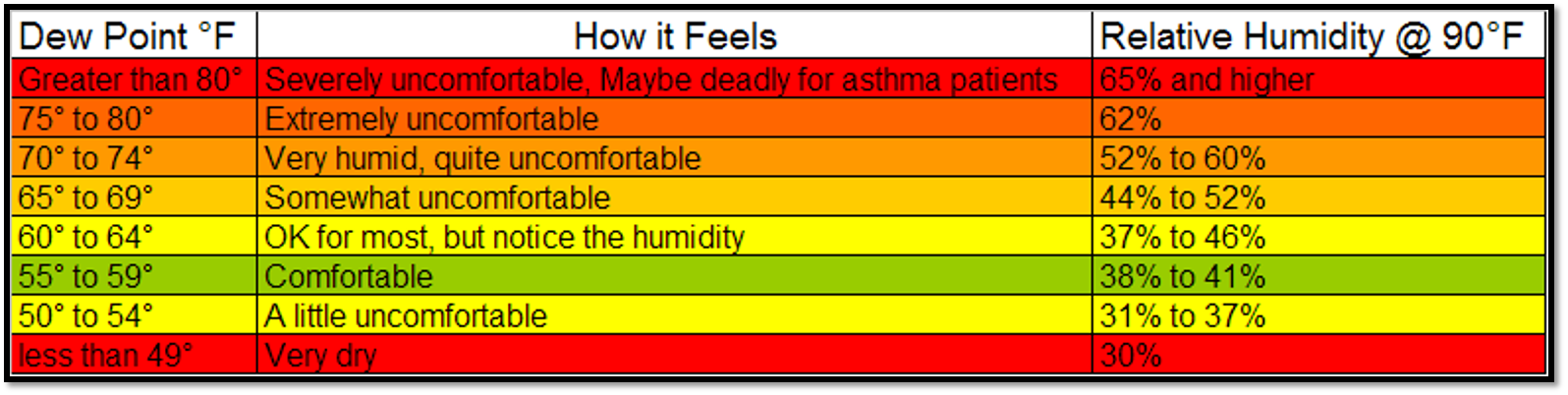
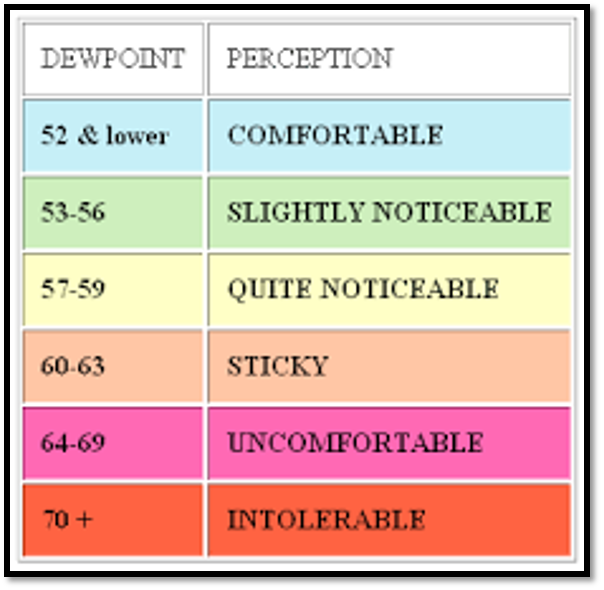
dew point
atmospheric temperature below which water droplets begin to condense and dew can form
factor of relative humidity
When the air can't "hold" all the moisture (i.e. becomes saturated), then it condenses as dew
humidity
indicates the amount of moisture in the air compared to what the air can "hold" at that temperature
indicates the ‘closeness’ of the temperature and dew point
condensation
temp is near the dew point
when does temp peak?
3-4:30pm
suns rays most direct btwn this time
11am- 1pm
Practice Guidelines in the Heat (NATA, 2002)
Acclimate 10-14 days
Increasing intensity
Acclimated athletes should train 1-2 hours in identical conditions as event
Match fluid intake with sweat and urine losses
If WBGT is >82F, move or delay event
Increased clothing should require a lower WBGT to modify practice schedule
Avoid scheduling during the hottest times of day
Think southern U.S. high school fall season practice times
Schedule adequate rest breaks
Supply ample fluids
Minimize clothing requirements
biometrics and sweat
patch has a spiral microfluidic channel that wicks up the sweat
The speed of the sweat through the channel provides a measure of the rate of sweating
The channel takes the sweat to sensors that detect biomarkers such as potassium, sodium, and glucose
The biometric device
Monitors sweat, electrolyte loss and other factors, notifying workers when to take a break, hydrate or move to a shaded area
heat rash
Thought to be due to blockage of sweat glands-
Common in babies, but can occur in adults
Hot, humid climates
Often occurs under clothing
Appearance of tiny dots or pimples
Treatment – none required
heat cramps
•Thought to be caused by water/electrolyte loss
•True cause is not well understood
•Occurs more often with
High heat/humidity
Low acclimitization/training level
•Mainly occurs in the legs, but can occur anywhere
Treatment of heat cramps
Cessation of physical activity
Rehydration
Helps alleviate extended cramping
May take a while to have an effect
Gentle passive stretching is most rapid and effective relief!
Gentle massage
Should be a last step in the chain – likely to have little effect
Beware of ‘snake oils’ – treatments that have no real effect but ‘sound’ great for preventing heat cramps
Heat exhaustion
Occurs when the body cannot adequately cool itself during physical activity or exposure to a hot environment
Precursor to heat stroke – recognition and intervention is key!
Considered a preventable medical condition
Hydration
Monitoring of environmental conditions
Body is trying all possible avenues to cool itself
Not considered a medical emergency
Highly reversible if caught early enough
Dependent upon recognition timeframe and skill of the evaluator
heat exhaustion s/s
Heavy sweating Pale, cool, or clammy skin Elevated body temperature (typically below 104°F / 40°C) Fatigue or weakness Dizziness or lightheadedness Headache | Nausea or vomiting Muscle cramps Rapid pulse Excessive thirst Fainting or near-fainting Decreased exercise performance Difficulty concentrating or mild confusion |
Individuals with heat exhaustion generally do not have severe central nervous system dysfunction (such as seizures, unconsciousness, or profound confusion
Any worsening mental status should raise concern for progression to heat stroke and requires immediate medical attention
heat exhaustion treatment
•Move to a cool environment
•Check and monitor all vital signs
•Monitor core body temp
•Remove excess clothing
•Cool using ice tub
•Cold towels, air flow (fan), ice packs if tub unavailable
•Rehydrate
heat stroke
Most severe heat illness
Occurs when the body's temperature regulation system fails, causing a dangerous rise in core body temperature
Characterized by severe hyperthermia and central nervous system dysfunction
Does not require heat exhaustion episode to occur first
Medical emergency
Can result in death
heat stroke s/s
Bright red, hot, possibly dry skin
Depends on whether sweat still remains
Very high core body temperature (>104F)
Exertional Heat Stroke (EHS) is often specifically classified at or above 105F)
Little or no sweating representative of the activity
Rapid pulse
Reported as either strong or weak
Lethargic appearance
Heat stroke treatment
Call 9-1-1 immediately
Move athlete to a cooler area
Remove excess/saturated clothing
Increase air flow (fans, breeze)
Ice bath immersion
hypothermia
body temperature below 95°C
Cold receptors (peripheral and internal) activated
Hypothalamus activates sympathetic response
Hypothalamus sympathetic response
•Cutaneous vasoconstriction
•Arrector pili contraction
•Epinephrine secretion from adrenal medulla
Non-shivering thermogenesis (increased metabolism)
•Activation of the ‘primary motor center for shivering’ area of the hypothalamus
Sends signals down the brainstem to the spine
Spindles trigger a group of muscles to involuntarily contract
Contracture generates heat
Can increase metabolic rate four-fold
heat loss in the cold affected by
Temperature
Skin exposure
Activity level
Wind
Wind Chill
Representation of how your body loses heat when factoring in temperature and wind
Chilblains
Localized skin injuries that develop after repeated exposure to cold, damp conditions above freezing temperatures
Damage occurs due to inflammation of small blood vessels in the skin
chillblains s/s
Red or purple discoloration of the skin
Itching or burning sensation
Swelling
Tenderness or pain
Small blisters in some cases
Most commonly affects fingers, toes, ears, and nose
immediate management of chillblains
Remove the person from the cold environment
Gradually warm the affected area
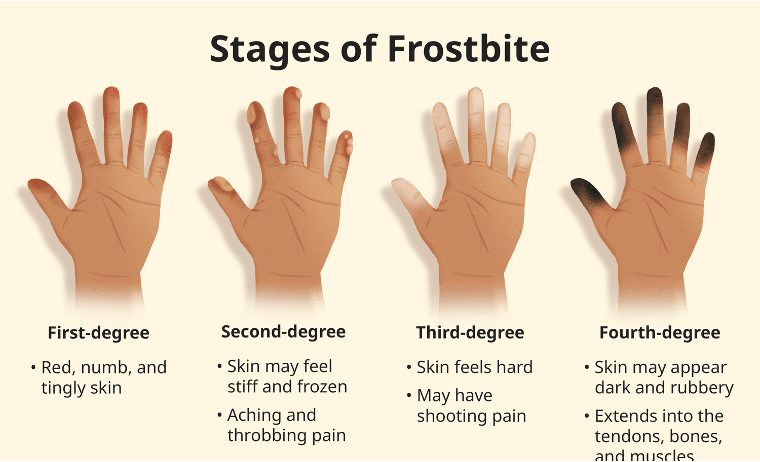
frostbite
A localized cold injury in which body tissues freeze, resulting in damage to the skin and underlying structures
Most commonly affects exposed areas such as the fingers, toes, ears, nose, and cheeks
frostbite s/s
Cold, numb skin
Tingling or burning sensation
White, gray, yellow, or waxy-looking skin
Loss of sensation
Hard or frozen-feeling tissue
immediate management of frostbite
Remove the person from the cold environment
Protect the affected area from further injury
Rewarm rapidly in warm water (98–104°F / 37–40°C) if refreezing can be prevented
Refer for medical evaluation
hypothermia
A systemic cold injury that occurs when the body's core temperature falls below normal and the body can no longer generate enough heat to maintain proper function
Can become life-threatening if untreated
Affects the entire body and is defined by a dangerous reduction in core body temperature accompanied by progressive neurological and cardiovascular dysfunction
mild hypothermia s/s
Shivering
Cold skin
Fatigue
Difficulty performing tasks
Impaired judgment
Slowed thinking
moderate hypothermia s/s
Intense shivering or cessation of shivering
Confusion
Slurred speech
Loss of coordination
Drowsiness
Memory impairment
severe hypothermia
Significant alteration in mental status
Unconsciousness
Very slow heart rate
Slow breathing
Dilated pupils
Cardiac arrest
hypothermia immediate management
Remove the person from the cold environment
Remove wet clothing and replace with dry insulation
Provide warm blankets and shelter
Begin gradual rewarming
Offer warm fluids if the person is alert and able to swallow
Activate emergency medical services for moderate or severe hypothermia
Wet bulb globe temperature (WBGT)
Temperature
Humidity
Wind speed
Sun angle
Cloud cover
Sling psychrometer
Two thermometers
Air temperature
Wet-bulb temperature
Requires user to swing the top unit to obtain wet-bulb temp
Can calculate humidity
how many people are killed fromm lightning strikes in a year
20-50
what time of year do 90% of casualties ocurr?
may-sept
july with most victims
the mortality rate for lightning-strike victims
8% to 10%
Most lightning deaths are due to cardiac or respiratory arrest at the time of injury