Chemistry - Ch.6 Key Concepts
 Call Kai
 Learn
Learn Practice Test
 Spaced Repetition
 Match
Match Flashcards
 Knowt Play
1/23

There's no tags or description
Looks like no tags are added yet.
Name | Mastery | Learn | Test | Matching | Spaced | Call with Kai | Chat |
|---|
No analytics yet
Send a link to your students to track their progress
24 Terms
The Mole
A unit to express large numbers that is used to simplify the number of atoms/objects one is working with
1 mol = 6.022×10²³
Using Avogadro’s Number
One mole of atoms is any element equals the atomic mass in grams/mol
EX: First, align units for cancelation, multiply across, and label units + convert to scientific notation
Calculation of Molar Mass
Count atoms
Add up atomic masses of all the atoms
Concentration
The ratio of solute in a solution to solvent (total solution)
Solute
A component of a solution that presents at a MUCH LOWER concentration than a solvent
Solvent
A component with a concentration that is SIGNIFICANTLY GREATER than that of all other components
Mass Percent
An element’s percentage of the total mass of the compound
Mass % = mass of x in sample / mass of the sample (100%)
Converting mass % to grams
Assume you have an 100g sample of the compound
1.) convert percentage to a decimal
2.) Identidy the total mass
3.) Multiply :3
Determining the Empirical Formula
Assume 100g sample of compound to change % to grams
Convert the grams of each element into moles
Divide the mass of each element by its atomic mass (amu)
Divide the mole values of all the element by the smallest mole value of the compound
multiply all numbers by the smallest integer that converts subscripts into whole numbers
—> if whole numbers, use as subscript
Determining Molecular Formula from Empirical Formula and Molar Mass
Use: x formula units/ molecule = molecular/molar mass (AMU of g/mol)
Plug in: (AxBy)n = AnxBny
Molarity
A different way of representing concentration
M = Mol Solute / L Solution
Volume Percentage
Volume Solute / volume solution
Mass-volume percentage
Mass Solute / volume solution
parts per million (ppm)
mass solutex10^6 / mass solution
parts per billion (ppb)
mass solutex^9 / mass solution
Electrolytes
Substances that—when dissolved—undergo either a physical or chemical change
yields ions in solution
Strong Electrolytes
The physical/chemical process that generates the ions is essentially 100% efficient
all dissolved compounds yield ions
Weak electrolytes
Only a relatively small fraction of the dissolved substance undergoes the ion-producing process
Non-electrolytes
Substances that do not yield ions when dissolved
Conductivity
To conduct electricity, a substance must contain freely mobile, charged species
The brighter the bulb/electrical reactivity, the higher conductivity
Ion-dipole Attraction
The electrolyte attraction between an ion and a molecule with a dipole
The more dissociation, the more ion formation —> STRONG electrolyte :)
Dipole
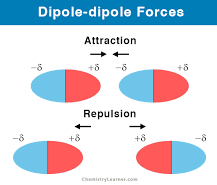
The separation of positive and negative electrical charges within a molecule, creating a "two-poled" system
Dissociation
The process by which a compound breaks into smaller components such as ions, atoms, or radicals
often a reversible manner
EX: H2O and KCl
Molecules in Dissociation
Anions attract the positive charge of the dipole
Cations attract the negative charge of the dipole