Micro 150 CH 3.1 Quiz + HW WIP
 Call Kai
 Learn
Learn Practice Test
 Spaced Repetition
 Match
Match Flashcards
 Knowt Play
1/42

There's no tags or description
Looks like no tags are added yet.
Name | Mastery | Learn | Test | Matching | Spaced | Call with Kai |
|---|
No analytics yet
Send a link to your students to track their progress
43 Terms
The identities of microorganisms on our planet
are still mostly unknown.
Not only is blood agar an enriched medium that can support fastidious organism growth, but it can also serve as a differential medium in the identification of streptococcal species because of the presence of red blood cells that can be destroyed by an organism's hemolysins. Looking at this photo, how could you describe the organism growing on the surface of this blood agar plate?
Beta-hemolytic
If a Gram stain result is unclear, which of the following should be considered?
All of the choices are correct.
A fastidious organism must be grown on what type of medium?
Enriched medium
Choose the description that best fits a medium that has been designed to support the growth of MRSA (methicillin-resistant Staphylococcus aureus) while inhibiting all species and strains of other bacteria.
Selective
Viruses are commonly grown in/on
animal cells or tissues.
Choose the term that describes motility media.
Semisolid
Select the type of media where the chemical composition is precisely known
Defined
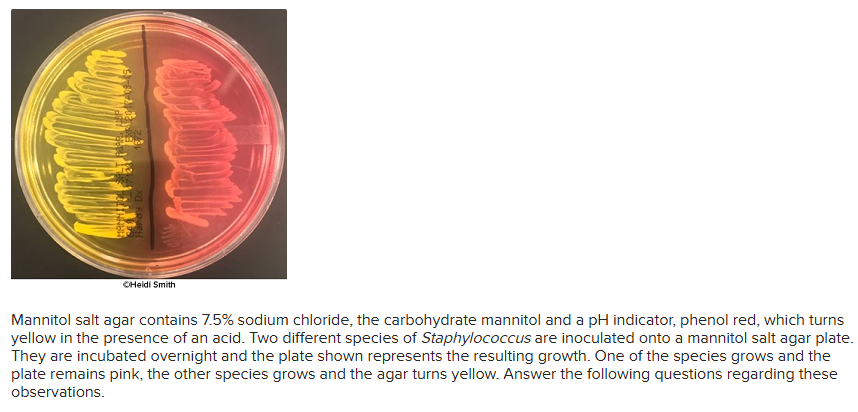
Some organisms ferment certain carbohydrates to produce an acidic byproduct while others don’t. What component of mannitol salt agar makes this media differential?
Both the mannitol and the phenol red
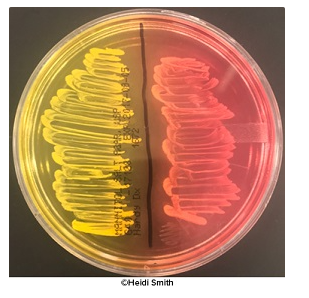
E. coli is an intestinal organism, and Staphylococcus epidermidis resides on the skin. What do you hypothesize will occur when both are inoculated onto mannitol salt agar?
The salt inhibits the growth of E. coli which is not a halophile; the S. epidermidis will grow.
Choose the media categorization that includes enriched, selective, and differential media.
Media categorized by its purpose
Enterococcus faecalis broth
Sodium azide allows for the growth pf fecal enterococci
MacConkey Agar
Bile and crystal violet allow for the growth of gram-negative enterics
Lowenstein-Jensen
Malachite green allows for the growth of Mycobacterium
Sabouraud's Agar
Acidic media which allows for the growth of fungi
Blood Agar
Demonstrates hemolysis of erythrocytes by Streptococcus species
Mannitol Salt Agar
Phenol red allows for identification of Staphylococcal species
Triple-sugar Iron Agar
Identification of hydrogen sulfide producing bacteria
MacConkey Agar
Neutral red allows for identification of lactose fermenting bacteria
Range of the human eye can view
1 mm
Range of a light microscope can view
100 um
10 um
1 um
Range of an electron microscope
200 nm
100 nm
10 nm
1 nm
Requires special microscope to view
0.1 nm
What are the 5 I’s
Inoculation
Incubation
Isolation
Inspection
Identification
Inoculation
Sample is spread onto several types of culture media or growth medium via inoculation. Medium can be solid or liquid or a live animal such as a chicken embryo
Incubation
Culture media are placed at the proper growth temperature and allowed time to grow.
Isolation
A colony is spread onto a new plate of media using a quadrant streak method.
Inspection
Cultures are observed macroscopically and Microscopically. Possibly with the aid of staining
Identification
The identity of the isolated microbe is determined. Usually to the special level inspection may be enough to identify some microbes. Techniques include Biochemical test, Immunologic tests, and genetic analysis (A variety of biochemical tests are used to characterize a microbe.)
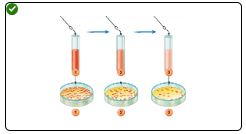
Loop Dilution/Pour Plate
Pour plating involves adding a sample to liquefied agar, and then pouring the agar into a plate to solidify.
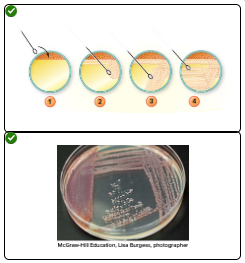
Streak Plate
Involves diluting one inoculum across the surface of a plate using a quadrant pattern
Spread Plate
Involves adding a sample to the surface of a plate and then using a L-shaped glass rod to evenly spread across the surface.
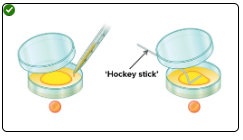
Types of Media physical states
Liquid
Semisolid
Solid (can become liquid)
Solid (cannot be liquefied)
Media Functional Types
General purpose
Enriched Selective
Differential Anaerobic growth
Speciment transport
Assay
Enumeration
Types of Media Chemical Composition
Chemically defined
Complex, not chemically defined
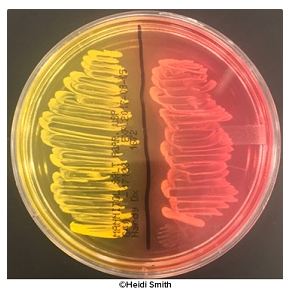
Mannitol salt agar is defined as both a selective and a differential agar since it selects against non-halophiles and allows the researcher to distinguish between organisms that vary in their ability to ferment mannitol. T/F
True
The terms "sterile" and "pure" can be used interchangeably when discussing cultures, because they both refer to a culture that has not been contaminated. T/F
False
Chocolate agar purpose
Enriched
Mannitol salt sugar purpose
Selective and differential
Nutrient Agar purpose
General-purpose
Phenylethanol agar purpose
Selective
Reducing media
Growing anaerobic microbes
Urea agar purpose
Differential