Mechanics of Muscle Contraction & Reflexes
 Call Kai
 Learn
Learn Practice Test
 Spaced Repetition
 Match
Match Flashcards
 Knowt Play
1/91

There's no tags or description
Looks like no tags are added yet.
Name | Mastery | Learn | Test | Matching | Spaced | Call with Kai | Chat |
|---|
No analytics yet
Send a link to your students to track their progress
92 Terms
refers to all the muscle fibers innervated by a single motor neuron
motor unit

True or false: A single neuron can have multiple axon terminals.
true
Do muscles used for fast and fine functions have fewer or more muscle fibers per motor unit?
In other words, if just that particular motor unit has an action potential, will fewer or more muscle fibers be innervated?
fewer
(since innervation needs to be more precise, such as with eye muscles)
Do muscles used for gross functions have fewer or more muscle fibers per motor unit?
In other words, if just that particular motor unit has an action potential, will fewer or more muscle fibers be innervated?
more
(doesn't have to be as precise as in fine movements)
Does a larger muscle group mean more or fewer fibers per motor unit?
more
True or false: In a single motor unit, some muscle fibers may be fast and some may be slow.
false
(motor units might vary in type, but all the fibers innervated by a particular motor unit are the same type)
A motor unit refers to...
A. a single motor neuron plus all of the muscle fibers it innervates
B. a single muscle fiber plus all of the motor neurons that innervate it
C. all of the motor neurons supplying a single muscle
D. a pair of antagonistic muscles
E. a sheet of smooth muscle cells connected by gap junctions
A
Which of the following muscles would have the smallest motor units?
A. extraocular muscle
B. deltoid (shoulder)
C. quadricep (thigh)
D. soleus (calf)
A
refers to generally adding together individual twitch contractions (whether through the amount of motor units or frequency of contractions) to increase the overall strength of muscle contraction
summation
single contractile response due to a single action potential
twitch
refers to summation in which a stronger muscle contraction is created by increasing the number of motor units contracting simultaneously
multiple fiber (also called spatial summation)
How do you get a stronger overall contraction with multiple fiber summation?
recruit more motor units
(based on AMOUNT of stimulation)
refers to summation in which a stronger muscle contraction is created by increasing the rate of contractions
frequency (also called temporal summation)
How do you get a stronger overall contraction with frequency summation?
stimulate more contractions
(based on RATE of stimulation)
True or false: If a muscle fiber is restimulated after it has completely relaxed, then the second twitch is the same magnitude as the first twitch.
true
True or false: If a muscle fiber is restimulated before it has completely relaxed (i.e. another twitch occurs before the first twitch has finished), then the second twitch is still the same magnitude as the first twitch.
false

What happens if a muscle fiber is restimulated before it has completely relaxed? (i.e. another twitch occurs before the first twitch has finished)
twitch summation
(second twitch is added on to the first twitch)

condition in which maximal summation is achieved due to successive contractions being so rapid (muscle does not get a chance to relax) that they fuse together and you cannot determine one from the next
tetanus

Does tetanus occur with multiple fiber or frequency summation?
frequency
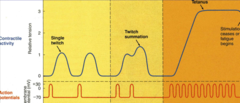
Can tetanus occur indefinitely to keep producing stronger contractions? Why?
no, muscle will become fatigued
How do you calculate the amount of work done in muscle contraction?
force load x distance
Why is energy required for muscle contraction?
needed for cross bridge cycling, pumping calcium back into the SR, and restoring the membrane potential with the sodium potassium pump
What are three forms of energy for muscle contraction?
ATP, phosphocreatine, glycogen
How does ATP provide energy for muscle contraction? About how long?
direct energy source, 1-2 seconds
How does phosphocreatine provide energy for muscle contraction? About how long?
its high energy bond converts ADP to ATP, 4-6 seconds
(its phosphate can be removed and attached to an ADP to generate ATP quickly)
How does glycogen provide energy for muscle contraction? About how long?
broken down into glucose and then into pyruvic acid and lactic acid, 1 minute
If we need to sustain contraction for longer than a minute, then just ATP, phosphocreatine, or glycogen isn't going to cut it. What happens then?
pyruvic acid is used in oxidative phosphorylation to generate enough ATP for up to 2-4 hours
About how much of input energy is actually used in muscle contraction? What happens to the other percentage?
25% for contraction, 75% lost as heat
What are three examples of non-contractile components of muscle, or series elastic components?
tendons, blood vessels, sarcolemma
Non-contractile components of muscle stretch during muscle contraction against a load, kind of like a rubber band or a spring. Consequently, the muscle must contract about how much more to compensate for this passive tension?
3-5%
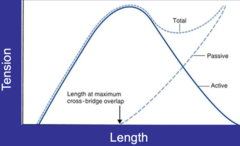
refers to a contraction in which the muscle does not shorten or lengthen, but it does change tension/force, so you're just getting the cross bridge to form to generate tension
isometric
refers to a contraction in which the muscle shortens or lengthens as tension/force remains constant; depends upon the load against which the muscle contracts
isotonic

If you try to lift a 100 lb weight without success, or you lean against a wall, is this an example of isometric or isotonic contraction?
isometric
(you've generated a significant amount of tension to do that, but you aren't actually changing the length of the muscle because you aren't doing any work)
If you lift a can of soda to drink and put it back down, is this an example of isometric or isotonic contraction?
isotonic
(you pick it up with a constant amount of force)
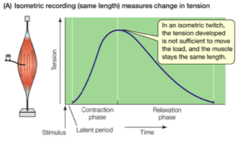
Why does the muscle remain the same length in an isometric twitch?
tension is not enough to move the load
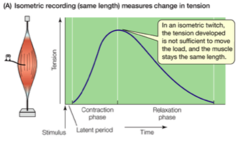
Why does the muscle length change in an isotonic twitch?
tension is enough to move the load
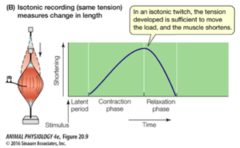
refers to an isotonic contraction in which the muscle shortens but the tension remains constant
concentric
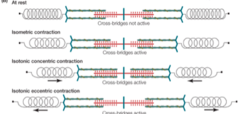
refers to an isotonic contraction in which the muscle lengthens but the tension remains constant
eccentric
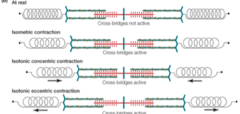
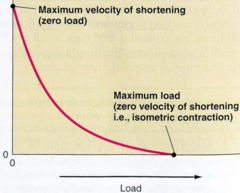
A skeletal muscle contracts very quickly when it contracts against no load (little weight). As the load increases, what happens to the velocity of the muscle shortening?
decreases
(when the load equals the maximum force that the muscle can exert, the shortening stops)

Muscle contraction is [isotonic/isometric] up until you've reached the maximum load- then it becomes [isotonic/isometric].
isotonic; isometric
True or false: Different size muscles have different speeds of isometric contractions, since they have different purposes for what they're meant to do.
true

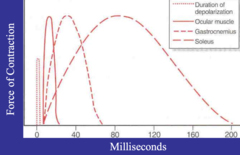
If you stimulate a contraction in ocular muscles, they contract for less than 1/40 of a second. Why must ocular movements be extremely rapid?
to maintain fixation on a specific object
If you stimulate a contraction in the gastrocnemius (calf) muscle, it contracts for about 1/15 of a second. Why must it be moderately rapid?
to provide minimal velocity for limb movement
If you stimulate a contraction in the soleus (calf) muscle, it contracts for about 1/5 to 1/3 of a second. Why must it contract relatively slowly?
for continual long term support of the body against gravity
Do larger muscle groups have a shorter or longer contraction time?
longer
There are two types of receptors that detect change in the muscle. What are they, and what do they monitor?
muscle spindle monitors length, Golgi tendon organ monitors tension
muscle receptor that monitors changes in muscle tension and is located in the muscle tendon and activated by stretch
Golgi tendon organ
muscle receptor that monitors changes in muscle length and is located in the muscle and activated by stretch
muscle spindle

refers to fibers in muscle spindles that have a central non-contractile region and contractile ends
intrafusal

refers to normal muscle fibers that are completely contractile
extrafusal

What is the structure of intrafusal fibers within muscle spindles?
central part is non-contractile, ends are contractile
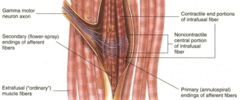
The contractile portions of muscle spindle intrafusal fibers are innervated by what kind of neurons?
gamma motor neurons

The normal extrafusal fibers of muscles (completely contractile) are innervated by what kind of neurons?
alpha motor neurons

Muscle fibers that make up the muscle spindle are which type of fiber?
A. intrafusal
B. gamma
C. alpha
D. extrafusal
A
Muscle spindles have primary and secondary nerve endings. Where are primary nerve endings found specifically? Secondary?
primary found at non-contractile portions, secondary found at contractile ends
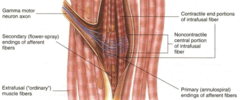
Are primary nerve endings found at contractile or non-contractile portions?
non-contractile
Are secondary nerve endings found at contractile or non-contractile portions?
contractile
What do primary nerve endings found at the non-contractile portions of muscle spindles detect?
changes in length and speed with which they occur
What do secondary nerve endings found at the contractile ends of muscle spindles detect?
changes in length (only)
What activates a muscle spindle?
stretch
Is the stretch reflex in muscle spindle a positive or negative feedback mechanism? Why?
negative, it resists passive changes in muscle length to maintain an optimal resting length
Stretch reflex in muscle spindle 1: Primary and secondary nerve endings sense a change in ____ in the spindle, even if it's very small.
length

Stretch reflex in muscle spindle 2: Primary and secondary nerve endings sense a change in length of the muscle spindle, and they send an ____ signal back to the spinal cord.
afferent
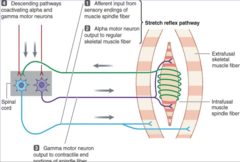
Stretch reflex in muscle spindle 3: After sending a change in length of the muscle spindle, primary and secondary nerve endings send an afferent signal back to the spinal cord, where it synapses directly onto what kind of neuron?
alpha motor neuron
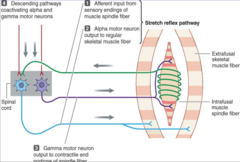
Stretch reflex in muscle spindle 4: When the afferent signal (triggered by the slight muscle stretch) reaches the alpha motor neuron in the spinal cord, this neuron sends signals back to what kind of fibers to contract and restore optimal length?
extrafusal
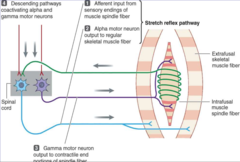
Stretch reflex in muscle spindle 5: As the alpha motor neuron sends signals to extrafusal fibers to contract and restore optimal length, interneurons between the alpha motor neuron and what other neuron also cause a signal to be sent out to cause the spindle to contract with the muscle?
gamma motor neuron
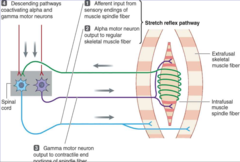
How does the knee-jerk response work?
**routinely performed as a preliminary assessment of nervous system functioning
passive stretch of the muscle spindle induced by the tap results in a contraction of the quadriceps, which causes the muscle spindle to trigger the knee jerk response
What are two other names for fast fibers?
type IIb, fast glycolytic
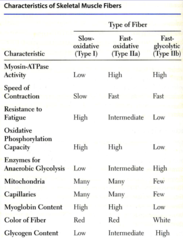
What are two other names for slow fibers?
type I, slow oxidative
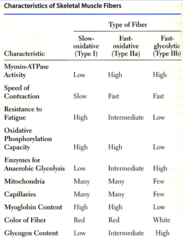
What is the difference between fast and slow fibers in regards to mechanism of ATP formation?
fast uses glycolysis, slow uses oxidative phosphorylation
What is the difference between fast and slow fibers in regards to color?
fast are white/lighter, slow are red/darker
What is the difference between fast and slow fibers in regards to resistance to fatigue?
fast has low resistance, slow has high
What is the difference between fast and slow fibers in regards to size?
fast are large, slow are small
What is the difference between fast and slow fibers in regards to amount of blood vessels and therefore oxygen supply?
fast has less, slow has more
(since oxidative metabolism is secondary in fast fibers but the main process in slow fibers)
What is the difference between fast and slow fibers in regards to strength of contraction?
fast is stronger, slow is weaker
What is the difference between fast and slow fibers in regards to organelles in abundance? Why?
fast has more sarcoplasmic reticulum for rapid release of calcium, slow has more mitochondria for higher levels of oxidative metabolism
What is the difference between fast and slow fibers in regards to what they are beneficial for?
fast is for short bursts of strength and speed, slow is for endurance
What is the difference between fast and slow fibers in regards to myosin ATPase activity?
fast has high myosin ATPase activity, slow has low
What is the difference between fast and slow fibers in regards to amount of glycolytic enzymes?
fast is high, slow is low
What is the difference between fast and slow fibers in regards to myoglobin content?
fast has less, slow has more
What is the difference between fast and slow fibers in regards to glycogen content?
fast has more glycogen, slow has less
Which type of fibers are more beneficial for sprinters: fast or slow?
fast

Which type of fibers are more beneficial for marathon runners: fast or slow?
slow
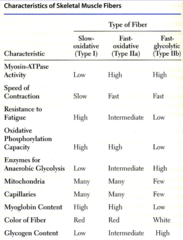
Do extraocular muscles have low or high myosin ATPase activity?
**they are technically fast fibers, even though they have characteristics of fast and slow!
high
Do extraocular muscles have slow or fast speed of contraction?
**they are technically fast fibers, even though they have characteristics of fast and slow!
fast
Do extraocular muscles have low or high resistance to fatigue?
high
refers to tautness of a muscle at rest, as a result of a low rate of nerve impulses coming from the spinal cord
there is always some level of contraction happening in muscle, so this gets them in a "ready state" so that they can contract whenever they need to
(muscle) tone
refers to the inability of muscle to maintain force of contraction after prolonged activity; correlates to loss of glycogen, most likely due to an inability of the muscle to maintain high energy supplies at a high enough level of activity
(muscle) fatigue
refers to the thickening of muscle fibers due to an increase in the number of actin and myosin filaments in each muscle fiber
(muscle) hypertrophy
refers to the shrinking in size of a muscle, whether that is due to not being used or stretched enough ("disuse ____") or loss of nerve supply ("denervation ____")
(muscle) atrophy
You break your leg, and when you finally take the cast off, your leg seems to have decreased in diameter. Is this an example of disuse or denervation atrophy?
disuse
Are injury and disease, such as Werdnig-Hoffmann disease, contributors to disuse or denervation muscular atrophy?
denervation