Bacteria and Viruses
 Call Kai
 Learn
Learn Practice Test
 Spaced Repetition
 Match
Match Flashcards
1/36

There's no tags or description
Looks like no tags are added yet.
Name | Mastery | Learn | Test | Matching | Spaced | Call with Kai | Chat |
|---|
No analytics yet
Send a link to your students to track their progress
37 Terms
1. Most bacteria are ________________________ (autotroph / heterotroph) because they must get food from an outside source. However, cyano-bacteria can use the sun to produce food, therefore are called ___________________________. Some perform _____________________________, getting food from chemical compounds.
heterotroph
autotrophic
chemosynthesis
2. The three shapes of bacteria are ____________________ (which is round/spherical), _____________________ (which is rod-shaped), and ___________________, (which is spiral-shaped).
cocci
bacilli
spirilla
What is the tail of a bacteria called?
falgellum
In what ways are bacteria beneficial to us/
can produce food (yogurt), serve to protect against harmful bacteria, clean up oil spill
What can be taken to treat a bacterial infection
antibiotic
List 3 ways to prevent a bacterial infection
1. wash hands and surfaces
2. use of disinfectants on surfaces
3. use refrigerator to slow growth on food
True or False
Disinfectants are used to destroy bacteria on nonliving inanimate objects
TRUE
True or False
A pathogen is harmful to living organisms because it causes disease
TRUE
9. Antibiotics are effective against ________________________but not ____________________.
bacteria
viruses
10. The process by which a dead or disabled pathogen (or proteins from that pathogen) is introduced into the body so that an immune response results without an actual infection is called?
Vaccination/Vaccine
autotroph
Use energy from the sunlight to produce food/energy
heterotroph
obtains energy from organic matter
Are viruses living or non-living?
non-living
What are viruses composed of?
What is on the inside?
Capsid (protein coat) with DNA or RNA inside
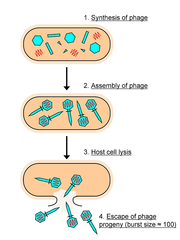
When a virus injects its DNA into the host cell, it hijacks the host, forcing it to _______________________the viral DNA. Once the viral proteins are assembled, the cell _________________________, releasing the viruses. This is referred to as the __________________________ cycle.
replicate/make copies
bursts
lytic
If the viral DNA is not immediately copied, it becomes integrated within the host's ____________________. When the host cell divides, the daughter cells produced will also contain copies of the ________________. The virus may be ____________________ for several years in this state, but it is being spread. This is called the ___________________ cycle. Once it becomes active again, the lytic cycle will take over.
DNA
viral DNA
dormant/inactive
lysogenic
Pathogenic
disease causing either from a bacteria or virus
Viruses do not respond to _______________________. The body produces interferons to help fight viruses. Humans can receive immunity from viruses through _______________________, which is when we are injected with dead or weakened viruses so that ___________________________ will be produced against it.
antibiotics
vaccines
immunity/antibodies
Which cycle is a cycle of viral infection, replication, and cell destruction?
lytic
Is the host cell destroyed during the lysogenic cycle?
No
What is the protective outer coat of a virus called?
capsid
Does a typical virus or bacteria consist of a protein coat and a nucleic acid core of DNA or RNA
Virus
Viruses are surrounded by a _________________ coat called a capsid.
protein
List some reasons why viruses are NOT considering living
1. a virus needs a host cell to reproduce, obtain, and use energy
2. does not contain all characteristic of life
bacteriophage
viruses that invade bacteria
binary fission
when a bacterium grows to twice its normal size and replicates its DNA and divides is called...
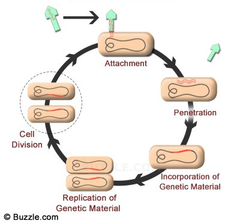
lysogenic cycle
a viral reproductive cycle in which the viral DNA is added to the host cell's DNA and is copied along with the host cell's DNA
prokaryotes
cells that do not have a nucleus
archae
the smaller group of prokaryotes that tend to live in harsh/extreme environments
conjunction
the process by which bacteria exchange genetic information through a 'bridge like' structure
lytic cycle
a viral reproductive cycle in which copies of a virus are made within a host cell, which then bursts open, releasing new viruses
virus
a non-cellular particle made up of genetic material and protein that can invade living cells
Discuss why it is important to take an antibiotic through the whole course of treatment.
After the first few days, any remaining bacteria is more resistant to the antibiotics. Therefore, if the medicine is not taken for the time prescribed, the stronger bacteria can survive and reproduce. This then leads to an increase of antibiotic resistant bacteria
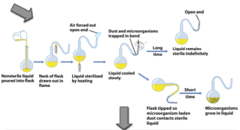
Louis Pasteur
A French chemist, this man discovered that heat could kill bacteria that otherwise spoiled liquids including milk, wine, and beer (pasteurization).
Koch's Postulates
a sequence of experimental steps for directly relating a specific microbe to a specific disease
Germ Theory of Disease
the principle that microorganisms cause disease
Robert Koch
Developed the culture plate method to identify pathogens