AP bio unit 1
 Call Kai
 Learn
Learn Practice Test
 Spaced Repetition
 Match
Match Flashcards
 Knowt Play
1/96

There's no tags or description
Looks like no tags are added yet.
Name | Mastery | Learn | Test | Matching | Spaced | Call with Kai | Chat |
|---|
No analytics yet
Send a link to your students to track their progress
97 Terms
Aqueous solutions
Those in which are solvent in water
Polar covalent Bond
between oxygen and hydrogen in the same water molecule
hydrogen bond
between adjacent water molecules
Polar molecule
Uneven distribution of charge
Cohesion
the attraction between water molecules
Responsible for surface tension
Due to hydrogen bonds
Surface tension
the elastic tendency of a liquid surface making it resist external force and shrink into the minimum possible surface area
Adhesion
attraction between water molecules and other polar molecules
Capillary Action
ability of water to move up small tubes
Combination of cohesion and adhesion
Important for plant transport
Specfic heat
the amount of energy required to change the temperature by 1o C
Water has high specific heat: It takes more energy to heat/cool water than most other substances
Due to hydrogen bonds
Importance: Moderates temperatures on Earth and in organisms- you are 50-65% water!
Heat of Vaporization
it takes a lot of energy to convert 1 g of liquid water to gas
As a liquid evaporates, its remaining surface cools, a process called evaporative cooling
Prevents bodies of water from evaporating
Temperature regulation in animals and transpiration in plants
Expansion upon Freezing
Happens because water molecules form a rigid, open hexagonal crystal lattice linked by hydrogen bonds, which holds the molecules farther apart than they are in a loose liquid state
Versatile Solvent
Water is the universal solvent because it dissolves more substances than any other substance
Hydration Shell
When an ionic substance is dissolved in water, each ion is surrounded by a sphere of water
This allows for water to dissolve and transport ionic and polar substances
Ionization of H2O
is the process of converting electrically neutral atoms or molecules into charged particles (ions) by adding or removing electrons
Water is capable of transferring a proton from one water molecule to another
Bicarbonate Buffer
a vital chemical mechanism that keeps the pH of human blood stable between 7.35 and 7.45
pH
measures how acidic or basic a water based solution is
Measures the concentrations of H+ ions
Organic Compounds
Living things
Organic compounds contain carbon (and usually hydrogen)
Hydrocarbons
lengths of covalently-bonded carbons, bonded to hydrogens
non-polar
Isomer
are these alternate arrangements and have different properties
Structural Isomer
a molecule that has the same exact molecular formula as another, but a different physical connection of its atoms

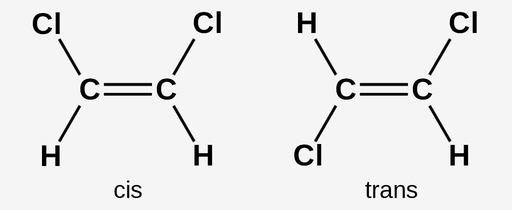
Cis-Trans Isomer
two elements are on the same side

Trans Isomer
Two elements on opposite sides
Hydroxyl
Chemical Formula: -OH
Structural Formula: -OH
Carboxyl
Chemical Formula: -COOH
Structural Formula: -C=O(OH)
Sulfhydryl
Chemical Formula: -SH
Structural Formula: -SH
Amino
Chemical Formula: -NH2
Structural Formula: -N-H(H)
Phosphate
Chemical Formula: PO4
Structural Formula: O=P-O-O
Carbonyl (Aldehyde)
Chemical Formula: -COH
Structural Formula: -C=O(H)
Carbonyl (Ketone)
Chemical Formula: -CO
Structural Formula: -C=O
Monomer
One Subunit
Polymer
Chain of repeating monomers
Polymerization
Formation of polymer from monomers
Dehydration synthesis
joins monomers together by removing a hydrogen atom from one and a hydroxyl group from the other - creating a new covalent bond and a water molecule
Hydrolysis
separates monomers by adding a molecule of water to break a covalent bond
Control group
Treatment in which the independent variable is either eliminated or is set at a standard value
Experimental Group
Treatment(s) in which the independent variable is manipulated
Positive Control
Exposed to a treatment level that is known to produce the expected effect
Ensures that there is an effect when there should be an effect
If the positive control does not produce the expected result, there may be something wrong with the experimental procedure
Negative Control
Not exposed to the experimental treatment or to any other treatment that is expected to have an effect.
Ensures that there is no effect when there should be no effect (aka NOTHING SHOULD HAPPEN)
Constants
Variables that are kept equal in all treatments
Dependent Variable
The variable measured or observed during the experiment
Responds to the change in the independent variable
Independent Variable
The variable changed by the researcher during the experiment
Monosaccharide
Monmers of Carbohydrates
Carbohydrates
Molecules with CHO
Functional groups: hydroxyl, carbonyl (aldehyde OR ketone)
Functions: Energy, building blocks of other organic molecules, Structure
Polysaccharides
Polymers of carbohydrates
Disaccharide
Dimers of carbohydrates
Glycosidic linkage
Covalent bond between carbohydrates
Glycogen
Storage carbohydrate of animals
branched structure makes it easier for energy release
Starch
Storage carbohydrate of plants
Cellulose
A structural carbohydrate used in plant cell walls, due to its linear nature
indigestible by humans because we don’t have the enzymes
Chitin
a polysaccharide, is found in the exoskeleton of arthropods and the cell walls of many fungi.
Peptidoglycan
A polysaccharide that makes up bacterial cell walls
Lipids
CHO and sometimes P
Functional Groups: carboxyl, methyl, and sometimes phosphate
Ester Linkage
Covlent bond for glycerol to fatty acids
glycerol
Three carbon alcohol

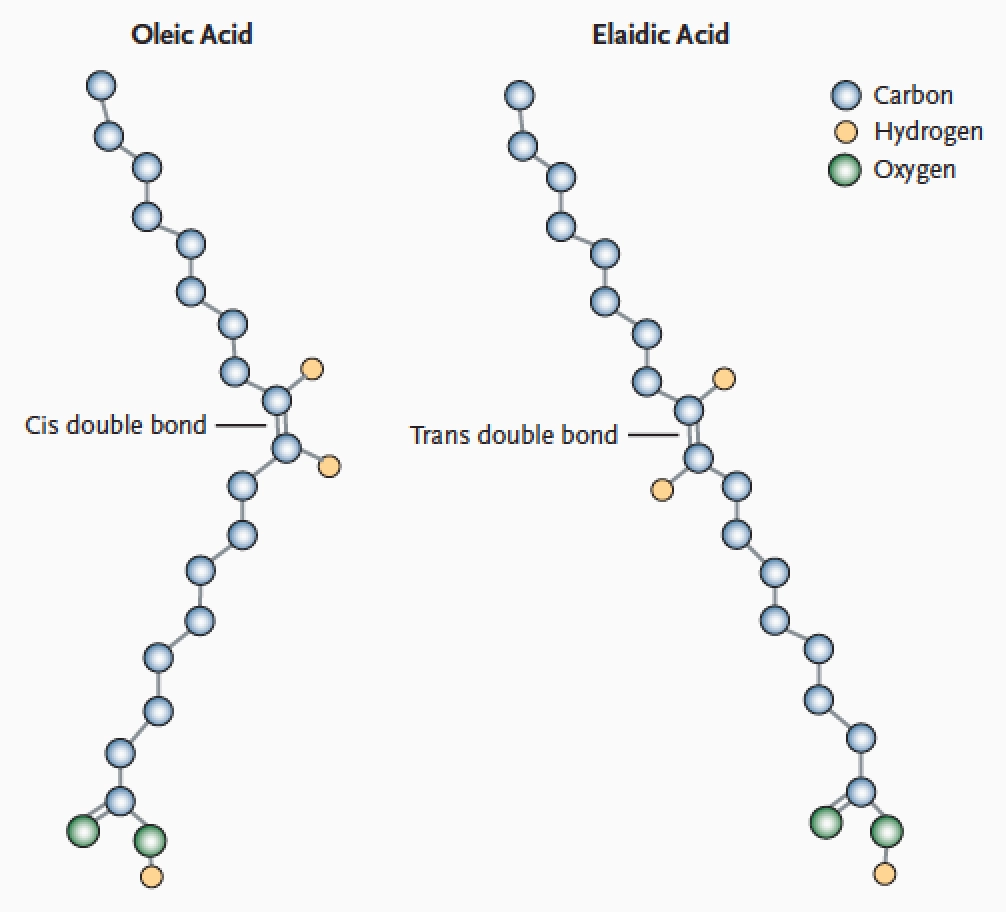
Saturated fatty acids
possess single bonds in the hydrocarbon chain, and have linear structure
Solid @ room temp

Unsaturted fatty acids
at least one double bond in the hydrocarbon chain, which creates a kinked structure
Liquid @ room temp

Trans fat
artificially, partially hydrogenated to be solid at room temperature.
Helps keep food shelf-stable (last longer)
Double bond but still relatively straight → pack tightly together
Triglycerides
Made of 3 fatty acids attached to a glycerol molecule
If at least ONE fatty acid is unsaturated it is classified as an unsaturated triglyceride
Functions - stored energy, cushion, insulation
Ester linkages bond fatty acids to glycerol backbone
Phosolipids
The main component of cells membranes
Two fatty acid tails and a phosphate head bound to a glycerol backbone
The phosphate head is polar while the fatty acid tails are nonpolar
Steriods
Nonpolar molecules consisting of four fused carbon rings
Some have hormonal properties and are used in cell-to-cell communication
Cholesterol
Found in cell membranes (helps keep it fluid and flexible); low density type (LDL) can build up in blood vessels
Waxes
Formed when fatty acids are reacted with alcohol
Diverse in structure but all have long, nonpolar hydrocarbon chains
Water is polar and waxes are nonpolar so waxes are good barriers
Lipid Functions
Storage of energy for long-term use (e.g. triglycerides)
Hormonal roles (e.g. steroids such as estrogen and testosterone)
Insulation – thermal (triglycerides)
Protection of internal organs through insulation and cushioning (e.g. triglycerides and waxes)
Structural components of cells (e.g. phospholipids and cholesterol)
Nucleic acids
Store and transmit genetic information
Comprised of a 5-carbon sugar, a phosphate, and a nitrogenous base
Elements - C, H, O, N, P
Functional Groups - phosphate, hydroxyl
Nucleotides
Are monomers of nucleic acids
Pentose sugar
Ribose
Deoxyribose
Ribose
found in RNA nucleotides.
Deoxyribose
found in DNA nucleotides.
Nitrogenouse bases
Purines
Pyrimidines
Purines
Bases with TWO rings; adenine and guanine
Pyrimidines
Bases with ONE ring; cytosine, thymine, and uracil
Nitrogen base pairings
Hydrogen bonds form between complementary nitrogenous bases
A bonds to T (or U) with 2 bonds
C bonds to G with 3 bonds
Phosphodiester bonds
Covalent bonds between nucleotides
These links create a backbone of sugar-phosphate units
In DNA the backbones run in opposite (antiparallel) 5′ → 3′ directions from each other
DNA
Functions to store genetic information
Two strands form a double helix
Bases are adenine, guanine, cytosine, and thymine
Larger and more stable
RNA
Functions to carry genetic information from the DNA
Single stranded
Bases are adenine, guanine, cytosine, and uracil
Smaller and less stable
Proteins
Composed of amino acids
Elements - C, H, O, N, sometimes S
Functional Groups - amino, carboxyl, various others depending on the amino acid
Have diverse structures and functions:
Enzymes
Structure
Carrier/transport proteins
Cell communication signals and receptors
Defense/immunity
Movement
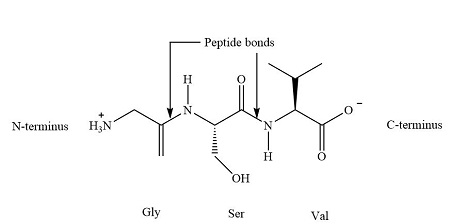
Peptide bond
Covalent bond between proteins
Amino acid
proteins monomers
contains a central carbon atom covalently bonded to an amine functional group, a hydrogen atom, a carboxyl group and an R-group
Dipeptide
Dimer of proteins
Polypeptide
Chain of amino acids
Carboxyl group

R group
A variable group that differs in each of the 20 amino acids
Decides if the amino acids are polar, nonpolar or charged/ionic
Central carbon
Carbon in the middle of amino acid

C-terminus
the end of a protein or polypeptide chain that has a free carboxyl group

N-terminus
the starting end of a protein or polypeptide chain that features a free amine group (-NH₂)
Primary structure
Hydrophobic/Nonpolar amino acids
amino acids have R groups tend to hide away from water molecules in the folded polypeptide

Hydrophillic/Polar amino acids
R groups tend to stick to each other by hydrogen bonding; often found on the outside of the folded polypeptide to interact with water molecules
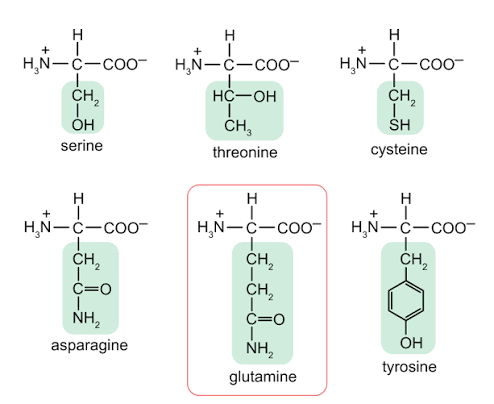
Acidic R group
negative charge
Basic R group
Postive charge
Primary structure
the amino acid sequence (specified by an mRNA sequence)
AKA just the polypeptide chain - no folding yet!

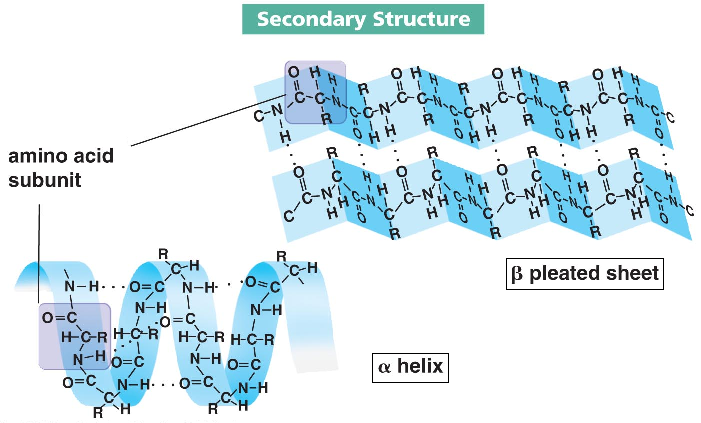
Secondary structure
In the backbone of the polypeptide chain the oxygen atoms (in carboxyl) can hydrogen-bond with the H of the amino group.
Forms alpha helices or beta-pleated sheets.
No R group interactions
Tertiary structure
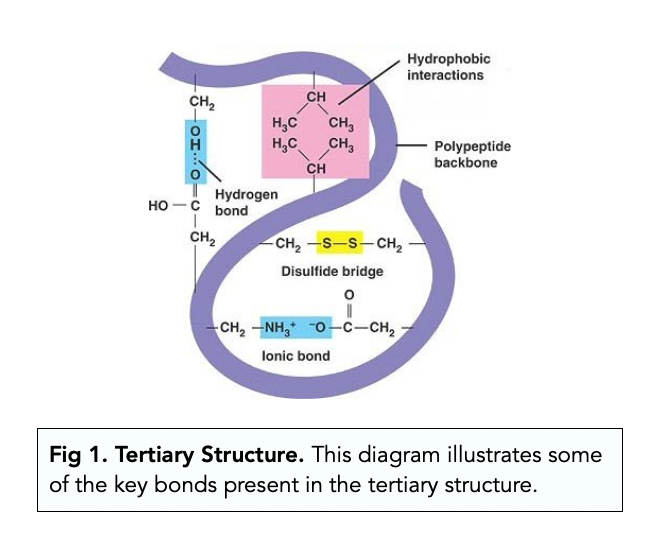
functional groups of R-groups interact, forming a three-dimensional, globular structure
Possible bonds between R-groups:
Hydrophobic interactions
Hydrogen bonds
Ionic bonds
Covalent bonds (disulfide bridges)
Quaternary Structure
more than one tertiary structure binds to another polypeptide, forming a multi-unit complex
The polypeptides are held together by: hydrophobic interactions, hydrogen bonds, ionic bonds, covalent bonds (disulfide bridges) between R groups
ALL proteins have a primary, secondary, and tertiary structure. Many also have a quaternary structure.

Denaturation
Means a protein unfolds or loses its shape.
High temperatures or pH disrupts bonds between the R groups and H bonds in backbone (alpha helices and beta pleated sheets)
The protein will lose all folding EXCEPT the primary structure.
The primary structure is never lost!!!!
Hydrophobic interactions
the natural tendency of nonpolar, water-fearing molecules to clump together in water instead of mixing
In tertiary structure
Disulfide bridge
strong covalent chemical linkages (represented as –S–S–) formed between the thiol groups of two cysteine amino acid residues