AIHA & DIIHA
 Call Kai
 Learn
Learn Practice Test
 Spaced Repetition
 Match
Match Flashcards
 Knowt Play
1/126

There's no tags or description
Looks like no tags are added yet.
Name | Mastery | Learn | Test | Matching | Spaced | Call with Kai | Chat |
|---|
No analytics yet
Send a link to your students to track their progress
127 Terms
Immune Hemolytic Anemia
Shortened RBC survival mediated through the immune response, specifically by the humoral antibody
Immune Hemolytic Anemia
What does IHA stand for?
1. Alloimmune
2. Autoimmune Hemolytic Anemia
3. Drug-Induced Immune Hemolytic Anemia
List the 3 categories that IHA falls under
Alloimmune
What is the most come type of IHA?
ABO discrepancy
Positive Rh control
Positive DAT
What 3 discrepancies can you see in your workup if patients' RBC are coated with an antibody?
autoantibodies
Antibodies directed against your own RBCs
aka autoagglutinins
1. Compensated anemia
2. Uncomponsated anemia
What are the 2 types of anemia caused by the destruction of RBCs?
Compensated anemia
The rate of RBC production will nearly equal the rate of RBC destruction
- common in elderly patients
Uncompensated anemia
The rate of RBC destruction is > the rate of RBC production
DAT
Antibody ID
Cold autoantibody
What are the 3 diagnostic tests performed in symptomatic patients?
Warm Autoimmune Hemolytic Anemia
What does WAIHA stand for?
70%
WAIHA are what % of IHA?
IgG
What antibody is seen in WAIHA?
37C
What is the optimal temperature for reactivity in WAIHA?
protein antigen on RBC surface
In WAIHA, IgG reacts against what?
spherocytes
In WAIHA, we see in increase in what type of erythrocyte?
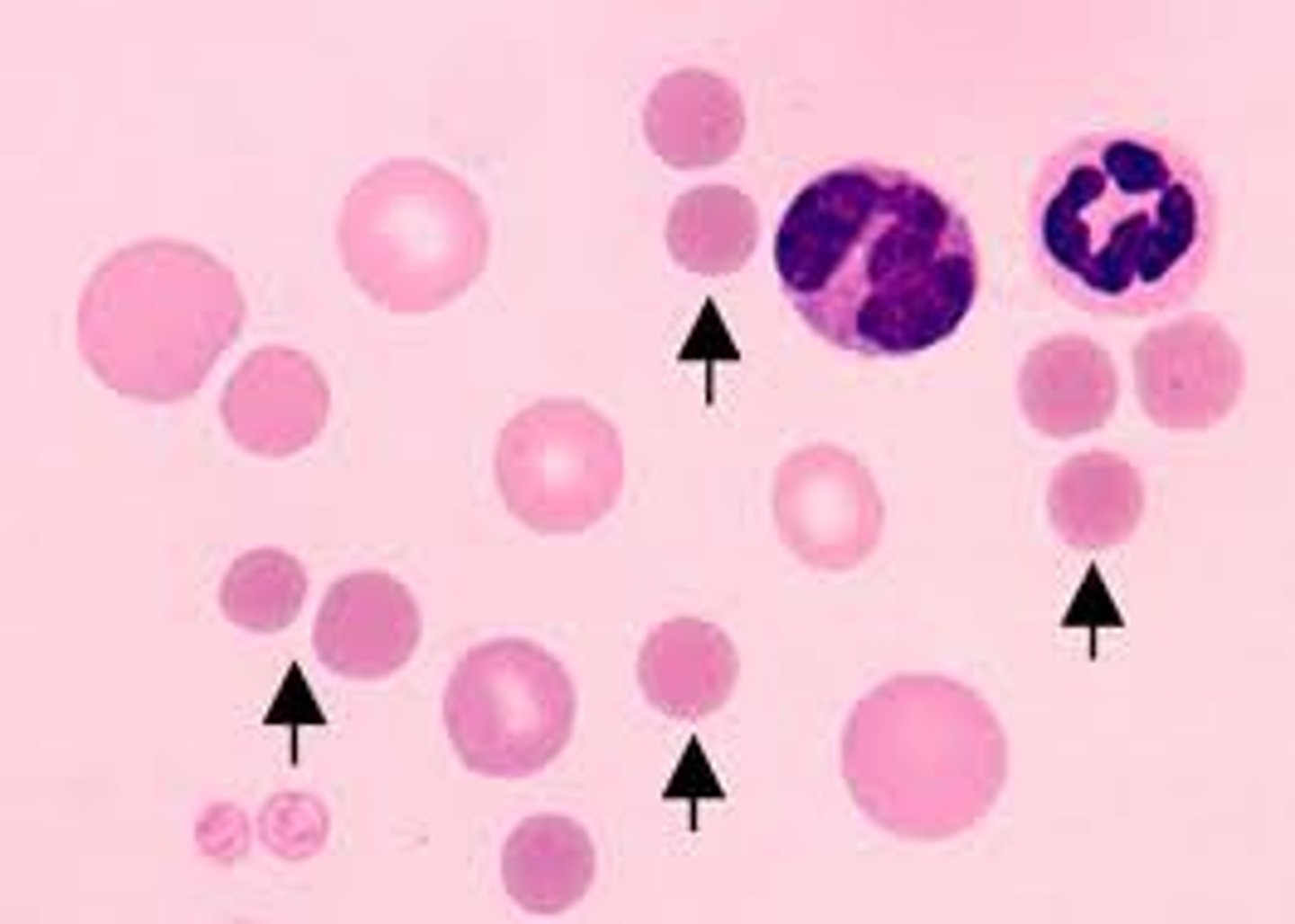
18%
Cold reactive autoantibodies are what % of IHA?
IgM
What antibody is seen in cold reactive autoantibodies?
< 30C
What is the optimal temp for reactivity for cold reactive autoantibodies?
polysaccharide antigens
In cold reactive autoantibodies, IgG reacts against what?
RBC agglutination
In cold reactive autoantibodies, we see in increase in what?
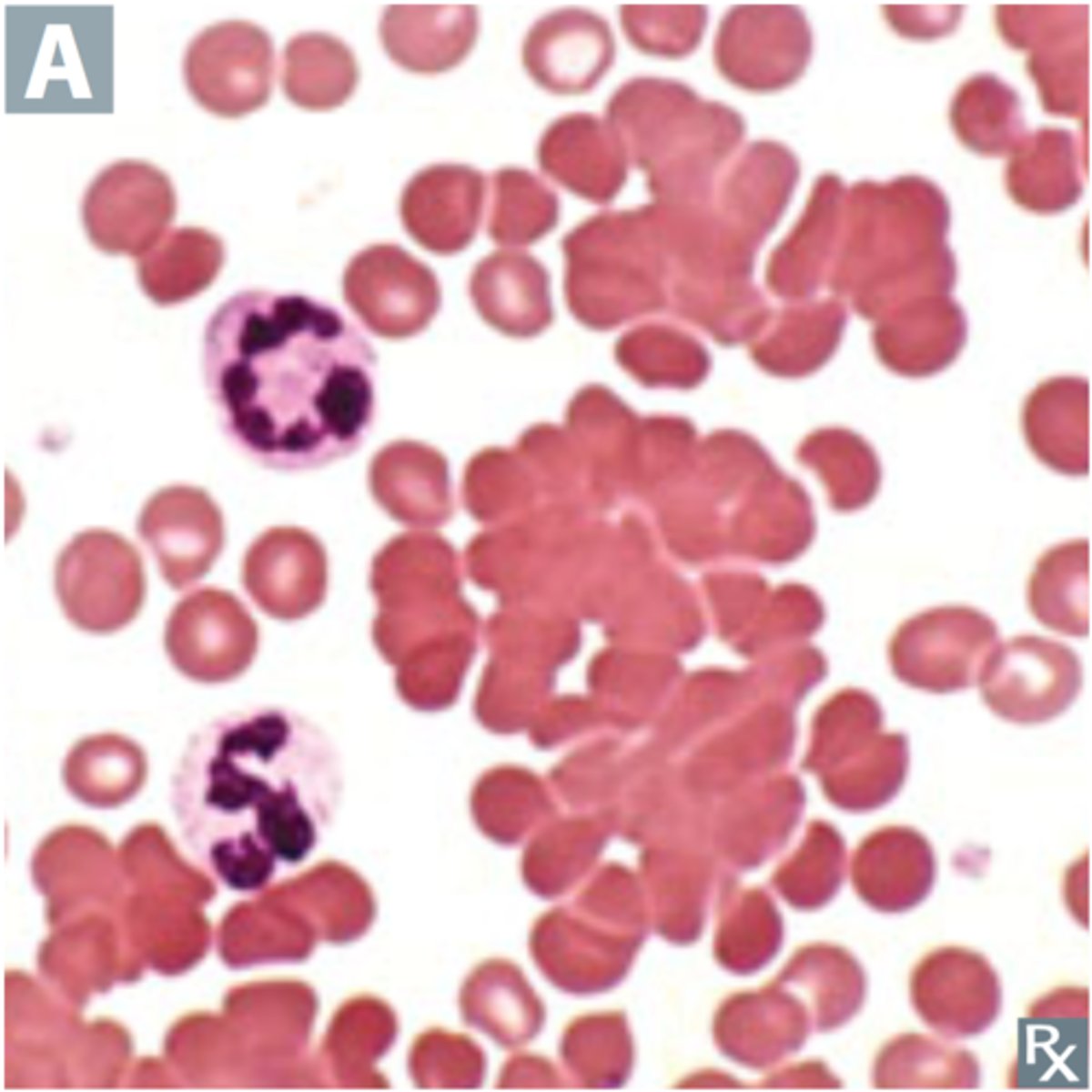
12%
Drug-Induced is what % of IHA?
4C
What temperature do most of the cold autoantibodies react best at?
benign cold agglutinin
When testing is performed at 4C, what is the most common autoantibody found in normal healthy people?
interfere with routine testing being performed at room temperature
Even though most cold agglutinins are clinically insignificant, what problem do they pose?
ABO typing
DAT
Ab detection and ID
Compatibility testing
Cold agglutinins can potentially affect what tests (4)?
false-positives
ABO typing affected by Cold Autoagglutinins
RBCs heavily coated with cold agglutinins may directly agglutinate causing false __________ with routine ABO reagents
warm washing RBCs
When ABO typing is affected by cold autoagglutinins, how can we solve this problem?
true
True or False
When cold autoagglutinins are interfering with ABO typing, you should warm wash every reagent that is performed at room temperature
true
True or False
Cold autogglutinins frequently cause discrepancies in ABO reverse typing too
Cold auto adsorption
When cold autoagglutinins cause discrepancies in ABO reverse typing, how should we resolve this problem?
warm washing & monoclonal reagents
When cold autoagglutinins cause discrepancies in Rh typing, how should we resolve this problem?
thiol reagents
When cold autoagglutinins cause discrepancies in Rh typing, and warm washing doesn't work, what should we use?
Dithiothreitol
aka Thiol Reagent used when warm wahing with saline is ineffective
warm washing
When cold autoagglutinins cause discrepancies in DAT, how should we resolve this problem?
negative
DAT of patient with benign cold autoagglutinins will usually come out positive/negative
Cold auto adsorption
When cold autoagglutinins cause discrepancies in Antibody Detection and ID, how should we resolve this problem?
clinically significant alloantibodies
Cold autoagglutinins can mask the presence of what in an antibody detection and ID
prewarm
auto adsorbed serum
allogenic adsorbed serum
anti-IgG antiglobulin reagent
When cold autoagglutinins cause discrepancies in compatibility testing, what 4 things can we do/use?
RBC blood warmer
When infusing patients with cold agglutinins, what should we use?
reactive at ≤ 20-24C
Normal (Benign) Cold Autoantibody
What is the thermal range
**hint: reactive at immediate spin (RT)
≤ 64
Normal (Benign) Cold Autoantibody
What is the titer at 4C
marginally enhanced
Normal (Benign) Cold Autoantibody
Reactivity marginally / strongly enhanced with albumin
anti-I or anti-IH
Normal (Benign) Cold Autoantibody
Common specifcity (common antibodies)
0-1+
Normal (Benign) Cold Autoantibody
Capable of binding complement (in vitro) due to being IgM
DAT will show what type of agglutination?
no
Normal (Benign) Cold Autoantibody
Are they clinically significant?
no
Normal (Benign) Cold Autoantibody
Are they assocaited with disease
reactive at ≥ 30C
Pathological Cold Autoantibody
What is the thermal range?
**hint: 37C
≥ 1000
Pathological Cold Autoantibody
What is the titer at 4C?
strongly
Pathological Cold Autoantibody
Reactivity marginally / strongly enhanced with albumin
anti-I or anti-i (in babies)
Pathological Cold Autoantibody
Common specificity (common antibody)
2-4+
Pathological Cold Autoantibody
Capable of binding complement (in vitro) due to being IgM
DAT will show what type of agglutination?
yes
Pathological Cold Autoantibody
Are they clinically significant?
yes
Pathological Cold Autoantibody
Are they associated with diseases?
secondary infection to viral infections or Mycoplasma pneumoniae
Pathological Cold Autoantibody
Can cause what type of disease?
anti-I
What is the most commonly encountered
adults
the I antigen is fully expressed in the RBCs of adults or children?
anti-i
Which antibody is relatively uncommon autoantibody, but common in babies?
anti-H and anti-IH
Cold agglutinins found in the sera of group A1 and A1B individuals (& occasionally group B)
Group O and A2 cells
Which cells react best because they have the largest amount of H antigen?
Group A1 and A1B cells
Which cells react weakly because they have the least amount of H antigen?
Cold Hemagglutinin Disease
Occurs predominantly in older individuals
- peaking in those older than 50 years old
anti-I
What antibody is almost always in CHD?
- less common: anti-i
- rarely anti-Pr
reticulocytes
positive DAT at complement
Lab findings in CHD (2)
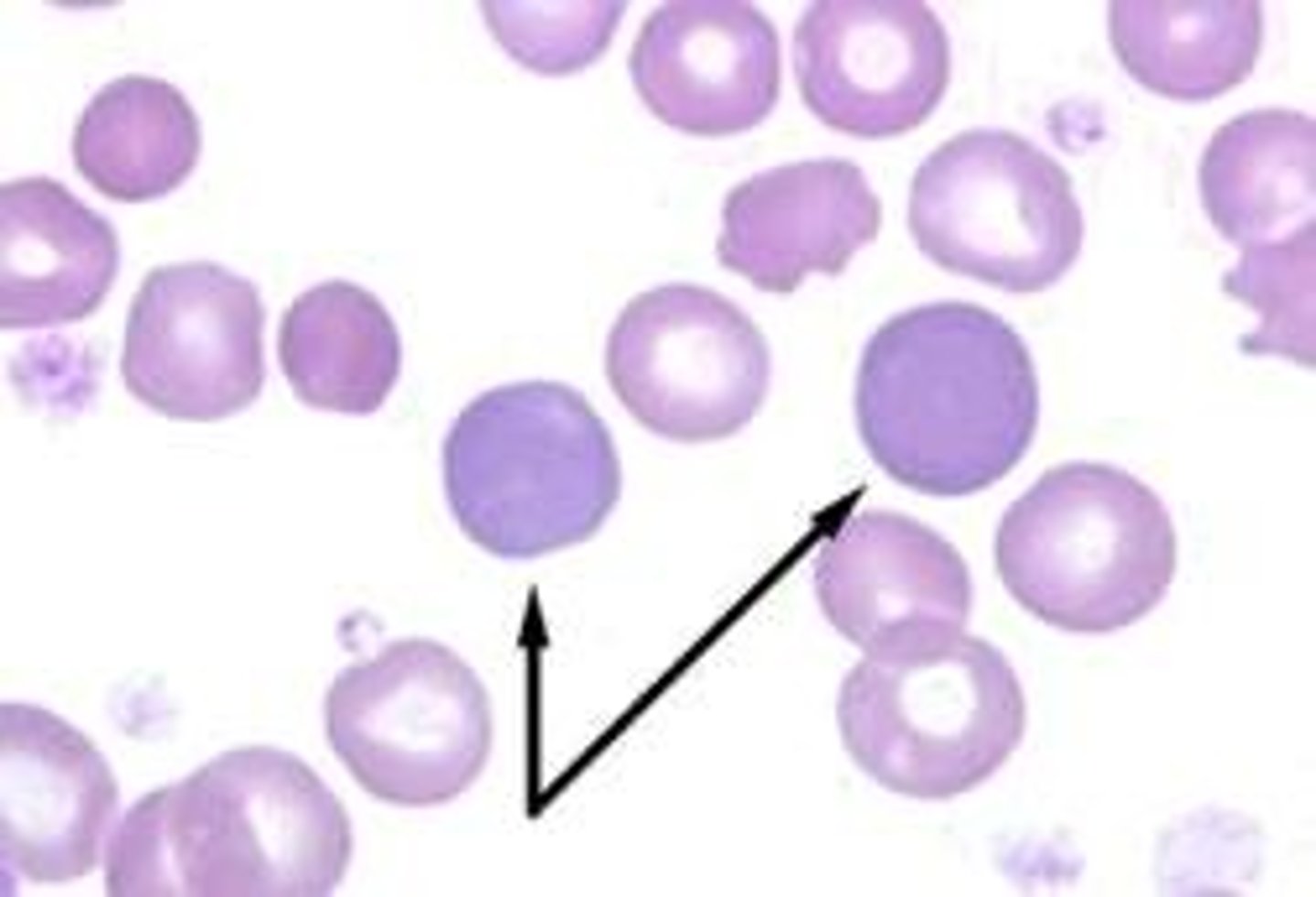
agglutinated RBCs
polychrommasia
mild to mod anisocytosis (size)
poikilocytosis (shape)
Peripheral smear of CHD may show (4)
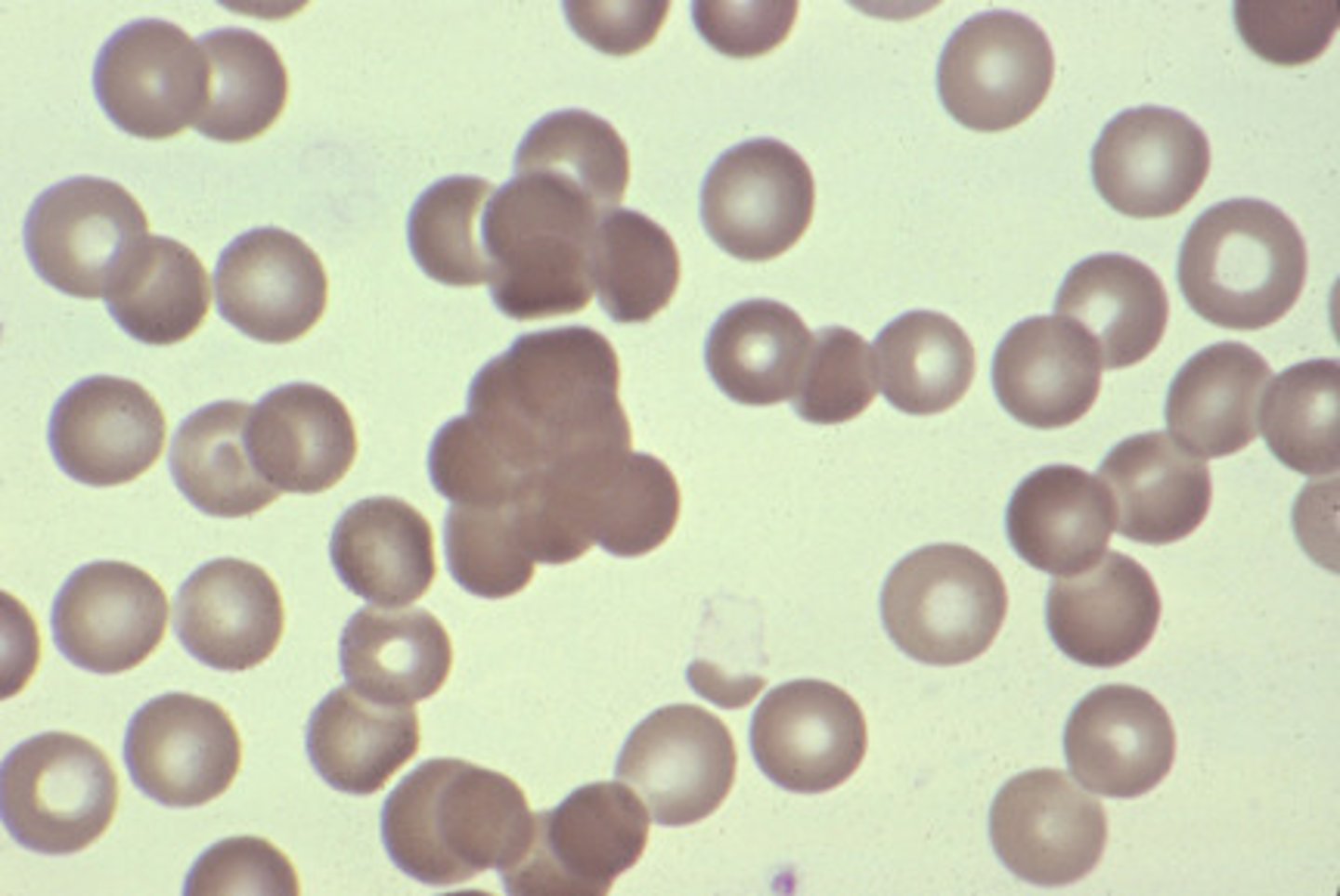
avoid cold, keep warm or move to a milder climate
Most patients with CHD do not require no treatment, but are instructed to do what?
plae
hard time breathing
What are the #1 symptoms of CHD
**hint: lack of O2
Idiopathic cold AIHA
Cold Hemagglutinin Disease is also known as?
Secondary Cold AIHA
Transient disorder secondary to infection
- often occur after upper respirtoy infection
Mycoplasma pneumoniae
~ 50% of patients suffering from pneumonia caused by what bacteria?
> 64
~ 50% of patients suffering from pneumonia caused by M. pneumonia to have cold agglutin titers higher than?
infection subsides
Secondary cold AIHA resolves when?
infectious mononucleosis
an infection that also may be associated with hemolytic anemia resulting form cold autoantibody
moderate chronic hemolytic anemia
Produced by a cold autoantibody that optimally reacts at 4C but also reacts at between 25-30C
IgM
antibody in Secondary Cold AIHA
**hint: efficient activates complement
Paroxysmal Cold Hemoglobinuria
- least common type of AIHA with incidence between 1-2%
- most often seen in children in association with viral
- classic antibody produced: anti-P
Donath-Landsteiner test
What test is used to determine anti-P
**hint: its the only test
anti-P
Donath-Landsteiner antibody
protection from cold exposure
Treatment for Chronic Paroxysmal Cold Hemoglobinuria
steroids & transfusion (depending on the severity)
Treatment for Acute Paroxysmal Cold Hemoglobinuria
Warm Autimmune Hemolytic Anemia
What does WAIHA stand for?
Warm Autoantibodies
- reacts best at 37C and are usually enhanced by enzymes techniques
- not as common as cold autoanti-I
true
True or False
More of the true AIHAs are warm type (70%) than of the cold-reactive type (18%)
transfusion
A significant percent of Warm Autoantibody cases suffering from anemia of sufficient severity require what?
polychromasia and macrocytosis
NRBCs
spherocytosis, occasional RBC fragmentation, indicating extravascular hemolysis
Peripheral blood smear for Warm Autoantibodies
↑ LDH, bilirubin (mainly unconjugated), urine urobilinogen
↓ depleted haptoglobin
hemoglibinemia and hemoglobinuria
Chemistry results of Warm Autoantibodies due to hemolysis
67%
RBC Hemolysis
% of patients with warm autoimmune hemolytic anemia have both IgG and complement on RBCs
20%
RBC Hemolysis
% of patients with warm autoimmune hemolytic anemia have IgG only on RBCs
13%
RBC Hemolysis
% of patients with warm autoimmune hemolytic anemia have complement only on RBCs
liver and spleen
What organ is involved in removing sensitized RBCs?
**hint:
ABO typing
What routine testing performed that warm agglutinins has shown not to interfere?
Rh typing
DAT
antibody detection and ID
evaulation of autoantibody
What lab tests are affected by warm agglutinins?
Rh typing
Warm autoagglutinins affected test
Most of the warm autoantibodies react with a high-incidence RBC ag, often with a general specificity within the Rh blood group system -- use monospecific
False positive Rh typing can occur when the patient's cells are coated with immunoglobulins
DAT
Warm autoagglutinins affected test
Positive results expected
In rare cases, may be negative or cells may be coated only with IgA or IgM
antibody detection and ID
Warm autoagglutinins affected test
Clinically significant alloantibodies & the autoantibodies themselves react best at the indirect antiglobulin phase; therefore, more complicated and time-consuming procedures for resolving the problems may have to be used
-- doing autoadsoprtion
never
Many patients with WAIHA _______ require transfusion, they can be managed with medical treatment
true
True or False
Occasionally, anemia from WAIHA pose problems when blood is needed for surgical procedures
treat underlying disease
Treatment of WAIHA
First thing to do?
accelerate hemolysis
Treatment of WAIHA
Transfusion should be avoided, if possible, because it may only do what?
Corticosteroid administration & use of IVIG
Splenectomy
Immunosuppressive Drugs
What 3 other treatments can be used for WAIHA