rates
 Call Kai
 Learn
Learn Practice Test
 Spaced Repetition
 Match
Match Flashcards
 Knowt Play
1/11

There's no tags or description
Looks like no tags are added yet.
Name | Mastery | Learn | Test | Matching | Spaced | Call with Kai |
|---|
No analytics yet
Send a link to your students to track their progress
12 Terms
Rate of reaction and units
The change in concentration of a substance in unit time
Mol dm ^-3 s^-1
Name the 3 types of orders and what do they do? How do you work out the total order for a reaction
Total order of reaction- adding all the individual orders together
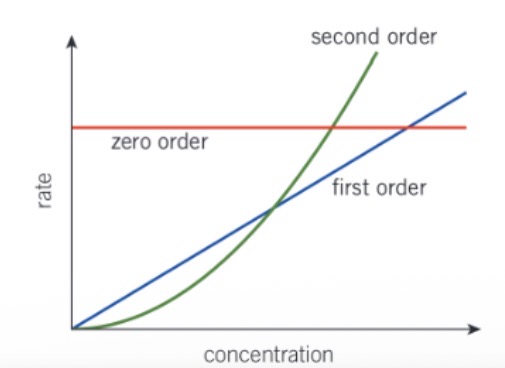
Zero order - the conc of this reactant does not change the rate of reaction
It would not appear in the rate equation
First order- whatever happens to the concentration also happens to the rate of reaction
Second order - whatever ever you do to the concentration, the square of that happens to the rate
Define rate constant, half life and rate determining step
The rate constant is is only constant when the temperature and activation energy are constant. Increasing temperature and adding a catalyst would increase k
Half life- is the time taken for the concentration of a reactant to half
Rate determining step - the slowest step of a reaction
(understanding) How do you find different orders of reaction?
Experimental data
How do you determine the half life of a reaction? What is the half life for reaction orders 0, 1 and 2
From a concentration time graph (time on the x axis)
Zero order- successive half life becomes longer
First order - the half life stays CONSTANT- independent of the initial concentration
Second order - successive half lives get shorter
T 1/2
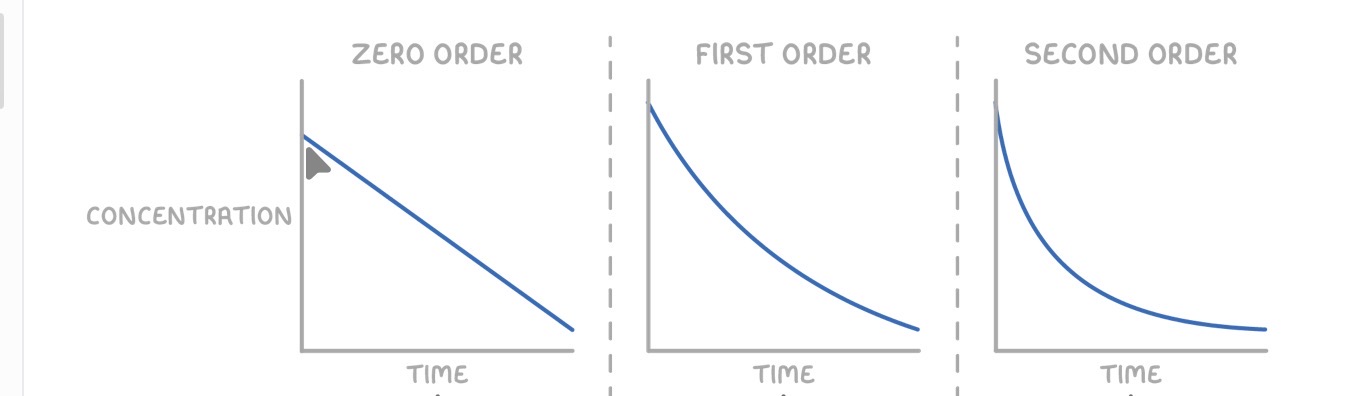
Draw all concentration- time and rate- concentration graphs for 0,1 and 2 orders
The rate constant of a first order reaction is related to its half life by which equation
Ln(2) / t(1/2)
What effect does the change of temperature have on the rate of reaction and hence the rate constant
Changing the temp or adding a catalyst also changes rates of reaction - both affect the rate constant, k
Increasing the temperature shifts the Boltzmann distribution to the right - increasing the proportion of particles that exceed activation energy- particles collide faster and collide more frequently (and correct orientation)
What is the Arrhenius equation
Shows the effect that changing the temperature or the activation energy of the reaction has on the rate constant
The activation energy is changed if you add a catalyst.
K is the rate constant
Ea is the activation energy
T is the temperature in kelvin
R is the gas constant
A is approximately constant , and is taken as constant over small temperature ranges
E is mathematical entity
How do you determine Ea and A graphically? To do this, what is the log form of the Arrhenius equation
In K = -Ea/RT + In A
A plot of In k against 1/T gives a straight line graph of y=mx+c
GRADIENT m of -Ea/R
INTERCEPT c of In A on the y axis
Predicting reaction mechanisms: the rate equation only includes what?
The orders in the rate equation match the number of species involved in the ‘- - -‘
The rate equation only includes reacting species involved in the rate determining step
The orders in the rate equation match the number of species involved in the rate determining steps
Ways to measure rates of reaction
Colorimeter- measure the intensity of light passing through a sample
Continuous monitoring- gas (use gas syringe) or mass loss
Time for visual change to occur