Chapter 8: An Introduction to Metabolism
 Call Kai
 Learn
Learn Practice Test
 Spaced Repetition
 Match
Match Flashcards
 Knowt Play
1/55

Name | Mastery | Learn | Test | Matching | Spaced | Call with Kai | Chat |
|---|
No analytics yet
Send a link to your students to track their progress
56 Terms
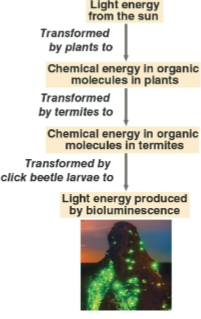
First Law of Thermodynamics
Law that states that energy can be transferred or transformed, but not created or destroyed
Demonstrated through energy use by living things
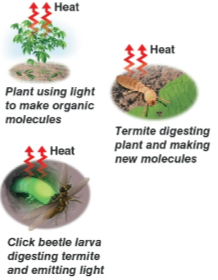
Second Law of Thermodynamics
Law that states that energy transfer or transformation increases universal entropy
Demonstrated through the conversion of energy to heat by living things through inefficienies in conversion
Metabolism
The totality of an organism’s chemical reactions
Arises from orderly interactions between molecules
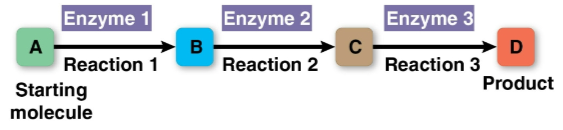
Metabolic pathway
Pathway where a specific molecule is altered in a series of steps to produce a product, catalyzed by enzymes
Enzyme
A macromolecule that speeds up a specific reaction
Catabolic pathway
Metabolic pathway that releases energy by breaking down complex molecules into simpler compounds
Seen through cellular respiration breaking down glucose with O2
Allows for energy use by anabolic pathways
Described as “downhill”
Anabolic pathway
Metabolic pathway that consumes energy by building up complex molecules from simpler ones
Seen through the synthesis of protein from amino acids
Uses energy from catabolic pathways
Described as “uphill”
Energy
The capacity to cause change or do work, existing in various forms
Living cells must transform energy from one form to another to do the work of life
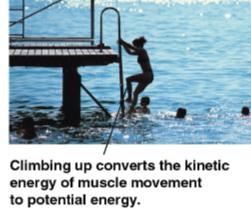
Kinetic energy
Energy associated with motion
Moving objects impart motion to other matter
Thermal energy
The kinetic energy associated with random movement of atoms or molecules
One object to another is called heat
Light is another type, done through photosynthesis
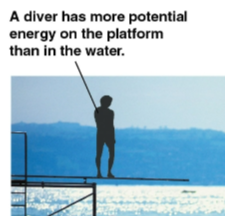
Potential energy
Energy that matter possesses because of its location or structure
Possessed due to the arrangement of electrons in bonds between atoms
Chemical energy
Potential energy available for releaes in a chemical reaction
Glucose has more of this as it is released during catabolism
Thermodynamics
The study of energy transformations in a collection of matter
Isolated system
A system that is unable to exchange energy or matter with its surroundings, as in a vacuum-sealed drink bottle
Open system
A system that is able to transfer energy and matter between the system and its surroundings, as in organisms that absorb energy and release heat and waste
Spontaneous processes
Processes that increase the entropy of the universe without energy input, happening at varying rates
Balances out anabolic reactions that build up molecules through the breakdown of molecules in catabolic reactions for heat and small molecules
Nonspontaneous processes
Processes that decrease entropy and require an input of energy
Seen through anabolic reactions amongst amino acids to proteins
Balanced by the catabolic breakdown of organized form of matter
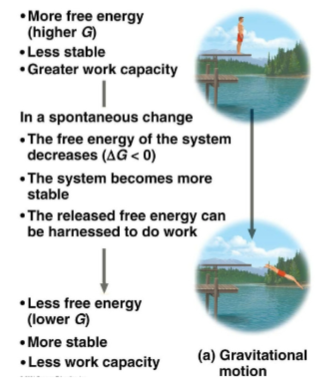
Free energy (G)
The portion of a system’s energy that can do work when temperature and pressure are uniform throughout the system, as in a living cell
Delta G
The change in free energy, related to changes in temperature, total energy, and entropy
Represents the difference between the free energy of the final state and free energy of the initial state
Lower levels signify more stability after spontaneous expenditure
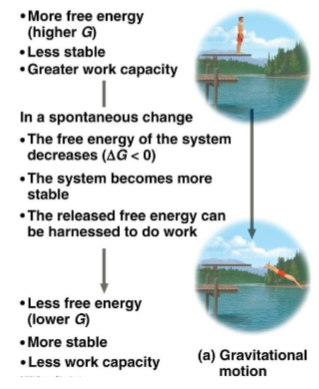
Spotaneous processes
Processes that use energy and increase total entropy
Causes a negative change in free energy (negative delta G)
Creates more stability in a system to work towards equilibrium

Nonspontaneous processes
Processes that build up or maintain total levels of energy or entropy
Causes a zero or positive change in free energy (positive delta G)
Used by the cell to perform work

Unstable systems
Systems with higher levels of free energy (G)
Seen with a diver on a platform being less stable than in the water

Stable systems
Systems with lower levels of free energy
Seen with a diver in the water after jumping off a platform, thus using energy
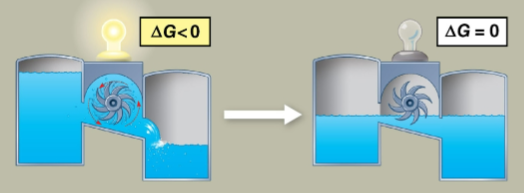
Equilibrium
The point at which forward and reverse reactions occur at the same rate, creating maximum stability
Systems must nonspontaneously work to move away from equilibrium
Eventually reached by closed or isolated systems, but never reached in an open living cell with flowing materials enabling work
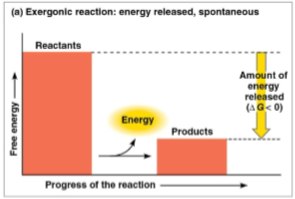
Exergonic reaction
A reaction that creates a net release of free energy to the surroundings, causing energy to be expended outward
Products store less free energy than reactants, creating a negative delta G and thus signifying a spontaneous reaction towards equilibrium
This releases potential energy
G determines how much work a reaction can perform
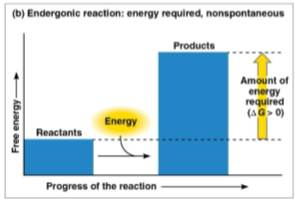
Endergonic reaction
A reaction that absorbs free energy from the surroundings, causing energy to be drawn inward
Products store more free energy than the reactants, creating a positive delta G and thus signifying a nonspontaneous reaction away from equilibrium
Higher delta G amounts require more initial energy input
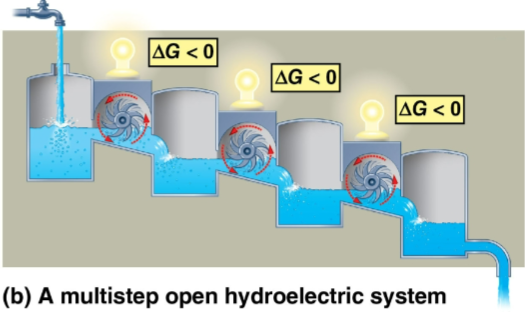
Catabolic pathway
A chain of reactions as seen in cellular respiration’s individual products becoming reactants for the next steps
Steady glucose and waste progression ensure that equilibrium is never reached
Chemical work
Work that pushes endergonic reactions
Transport work
Work that pumps substances across membranes against the direction of spontaneous movement
Mechanical work
Work such as beating cilia or contracting muscle cells
Energy coupling
The use of an exergonic process to drive an endergonic one to manage energy resources in a cell
Mediated by ATP in most cells
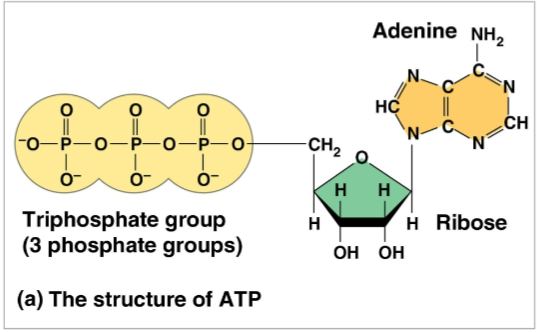
Adenosine triphosphate (ATP)
Particle composed of ribose (a sugar), adenine (a nitrogenous base), and three phosphate groups
Functions in energy coupling and as one of the nucleoside triphosphates used to make RNA
Energy is released when the terminal phosphate bond is broken by hydrolysis (adding water molecules)
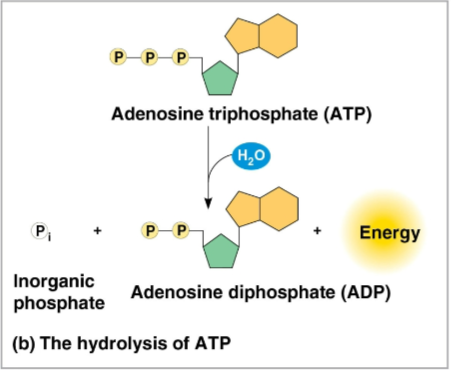
Hydrolysis
The addition of a water molecule to break a bond in another molecule
Used to release energy in ATP by breaking the terminal bond through its chemical change to a state of lower free energy in the products
This is an exergonic change to drive later endergonic reactions as well as transport and mechanical work in the cell
Repulsion
A word that describes molecules pushing away from each other in a bond
Phosphate groups do this in ATP, creating lots of potential energy as in a compressed spring
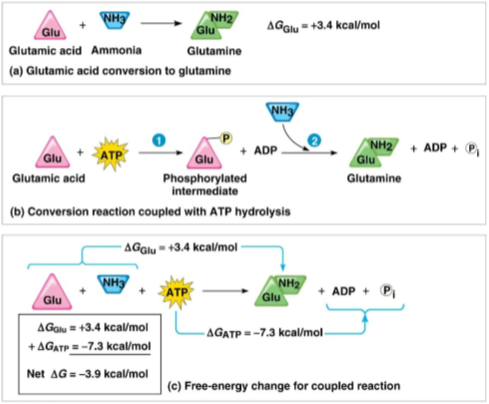
Phosphorylation
The transfer of a phosphate group from ATP to another molecule typically used to power endergonic reactions
Seen in ADP gaining a group after exergonic, catabolic reactions
Adenosine diphosphate (ADP)
One of the products after ATP hydrolysis that helps regenerate ATP through the addition of a phosphate molecule
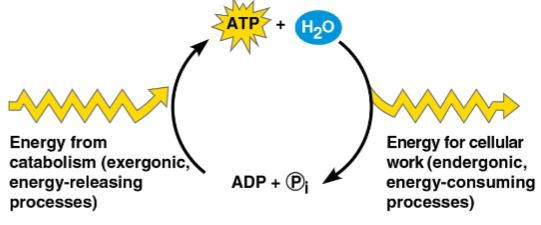
ATP cycle
The shuttling of inorganic phosphate and energy between ATP and ADP that couples energy-yielding processes to energy-consuming ones
Spontaneous reaction
A reaction that does not need added energy but can be slow enough to be imperceptible
Hydrolyzing sucrose to glucose and fructose with water can take years without a catalyst
Catalyst
A chemical agent that speeds up a reaction without being consumed by the reaction
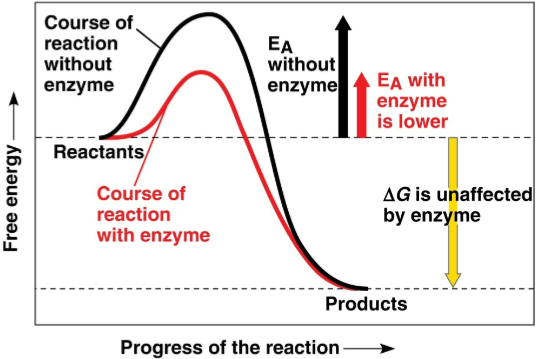
Enzyme
A macromolecule (typically protein) that acts as a catalyst to speed up a specific reaction
These lower the activation energy barrier enough for the reaction to occur at moderate temperatures while being reusable
Names typically end in -ase for a specific reaction and substrate
Chemical bonds
These break and form in a chemical reaction
Breakage requires excessive contortion before absorbing energy from its surroundings
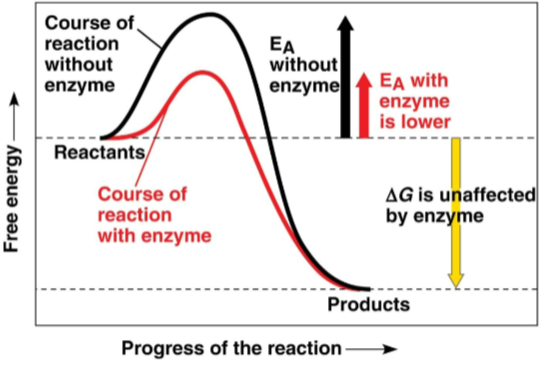
Activation energy (EA)
The initial energy needed to break the bonds of the reactants, often seen as heat from the surroundings
Instability occurs when enough energy is absorbed to start the reaction
Provides a barrier that determines the rate of spontaneous reactions
Only changes speed and not overall effect of the reaction
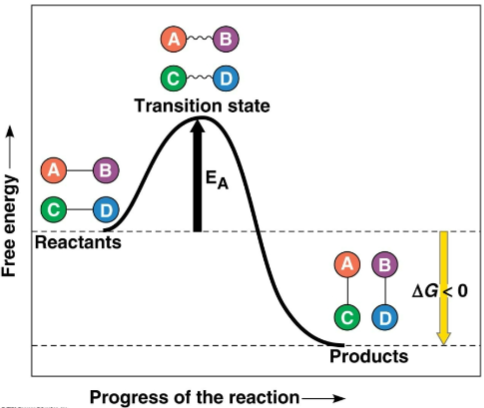
Exergonic reaction
A reaction that releases more energy than was initially invested through the formation of new bonds
These new bonds increase stability
Catalysis
The process by which a catalyst selectively speeds up a reaction without itself being consumed
Avoids the excessive use of heat to speed up reactions which can cause denaturation
Substrate
The reactant that an enzyme acts on through catalytic activity for a conversion to products
Typically held in the enzyme’s active site by weak bonds, such as hydrogen bonds
Can be reoriented, stretched, or placed in a microenvironment to favor the reaction
Rates of reaction can be increased with higher concentrations until complete enzyme saturation
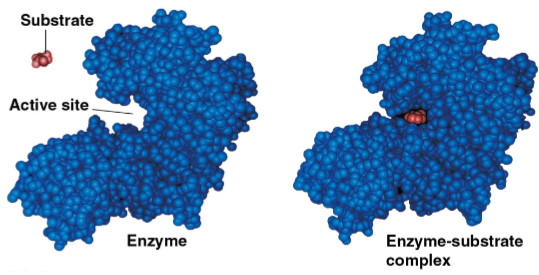
Active site
The region on the enzyme that binds to the substrate, fitting the specific shape of the substrate
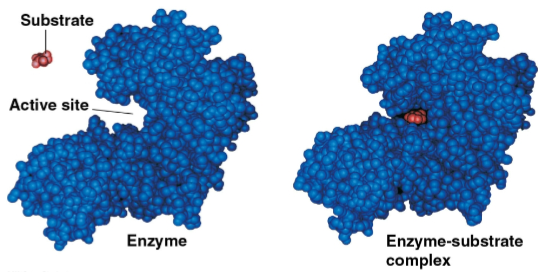
Induced fit
The slight change in shape of the enzyme like a handshake that results from chemical interactions on the substrate and active site
This ultimately enhances catalysis of the reaction
Optimal conditions
Conditions that are most conducive to an enzyme’s function, mainly defined within a range of temperature, pH, and chemicals that influence the enzyme
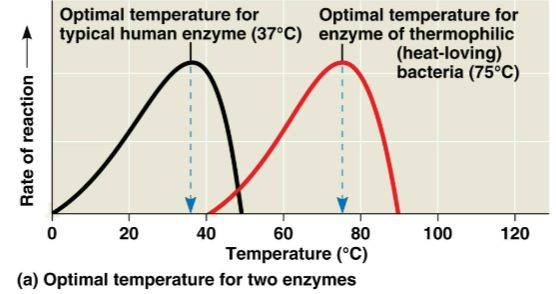
Optimal temperature
The temperature at which an enzyme catalyzes its reaction at the maximum possible rate, increasing with increasing temperature until it is met and begins to drop and denature
Typically defined by the environment in which it functions — human enzymes adapt to human body temperature, or around 37 degrees C
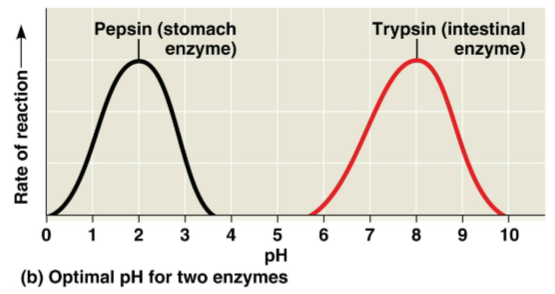
Optimal pH
The pH at which an enzyme is typically active, usually dependent on the environment at which it functions
Pepsin in the stomach has an optimal pH of 2
Cofactors
Nonprotein helpers that bind to the enzyme permanently or reversibly with the substrate
Inorganic includes metal atoms such as zinc, iron, and copper in ionic form
Organics are called coenzymes, found in vitamins or made from their raw materials
Coenzymes
Organic cofactors that include vitamins or their raw materials as helpers to enzymes
Enzyme inhibitor
A chemical that inibits the action of specific enzymes
Inhibition with covalent bonds to the enzyme are usually irreversible
Weak interactions can be reversible and are used in most cases
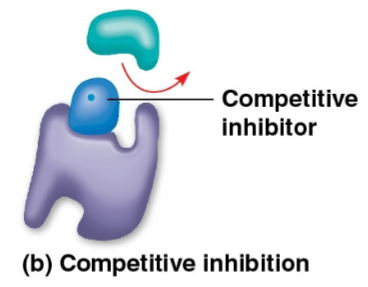
Competitive inhibitors
Inhibitors that closely resemble the substrate of an enzyme and can bind to the enzyme’s active site, thus reducing enzyme productivity due to blockage
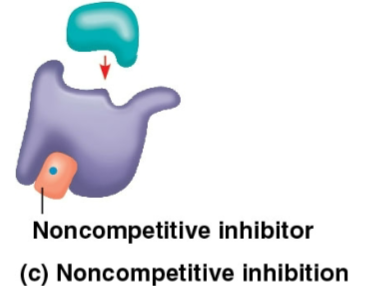
Noncompetitive inhibitors
Inhibitors that bind to another part of the enzyme away from the active site
These cause the enzyme to change shape and makes the active site less effecive at catalyzation
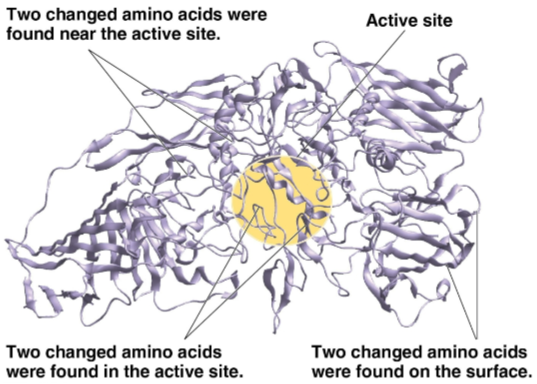
Genes
The encoding method for enzymes; mutations in these can lead to a positive or negative change in the enzyme’s amino acid composition and thus new activity or substrate specificity