Med Gen Week1
 Call Kai
 Learn
Learn Practice Test
 Spaced Repetition
 Match
Match Flashcards
 Knowt Play
1/22

Earn XP
Description and Tags
Fall 2026
Name | Mastery | Learn | Test | Matching | Spaced | Call with Kai | Chat |
|---|
No analytics yet
Send a link to your students to track their progress
23 Terms
Monogenic (Mendelian) Diseases
Diseases caused by mutations in a single gene that lead to specific hereditary conditions. Examples include cystic fibrosis (autosomal recessive) and sickle cell anemia (autosomal recessive).
Multifactorial Diseases
Diseases caused by the combination of multiple genes, environmental factors, and lifestyle. Examples include diabetes and asthma.
Pharmacogenetic
The study of how your unique genes affect the way your body responds to medications.
Developmental Milestones Guidelines
CDC: Informal surveillance and parent-provider discussion; 2 mo to 5 years
Denver II: Standardized screening test; Birth to 6 years
Eugenics
Pseudoscience that claims complex human traits can be improved by selective breeding
Sources of Genetic Variation
Amount of DNA: Chromosomal (CNVs)
Genetic sequence itself: SNVs; repeat expansion disorders
Epigenetic methylation: Methylation conditions; UPD
Acrocentric chromosome
The centromere is located very close to one end, creating one long arm (q-arm) and one extremely short arm.
Chromosomes 13, 14, 15, 21, 22, and the Y chromosome are acrocentric.

Chromatin
Loose, uncoiled, combination of DNA wrapped around structural histone proteins. DNA is accessible and active for protein synthesis.
Chromossome
A tightly condensed, organized package of DNA and proteins. Visible during cell division (mitosis or meiosis).
Chromatid
One of two identical halves of a chromosome that has been replicated
Gain of Function Variant
Variants that increase the amount of the normal protein OR increase the normal function OR create a new function of a protein
Loss of Function Variant
Variants that result in decreased/absent amount of normal protein. Examples are: most autosomal recessive conditions, monosomies, and microdeletions.
Note: most common variant type
Dominant Negative Variant
Genetic variant that produces a faulty protein which actively blocks and disrupts the normal protein made by the healthy gene copy
Locus
Location of a gene on a chromosome

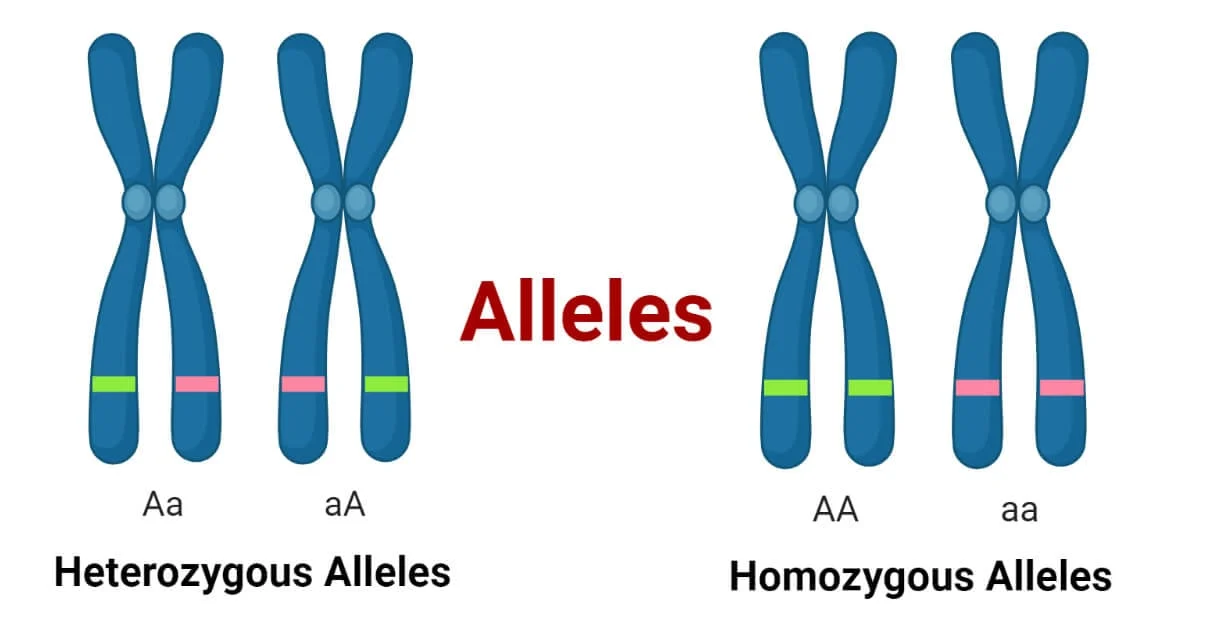
Allele
Alternate forms of the same gene/One of multiple versions of a gene.
Genotype
Refers to the specific information encoded at a given locus in the genome (the actual DNA sequence at a specific locus)
Key types:
Homozygous Dominant, Homozygous Recessive, Heterozygous
Phenotype
Set of observable characteristics or traits of an organism. Examples are height, eye color, behavior, and biochemical properties.
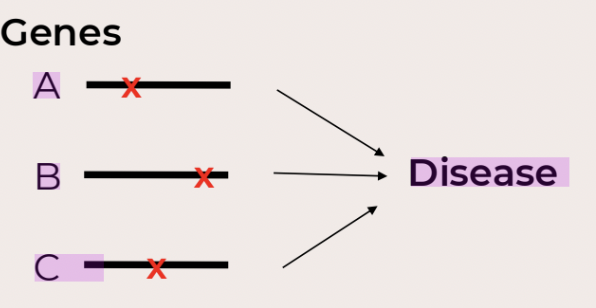
Locus Heterogeneity
Phenomenon where many genotypes (different genes) cause a specific/same phenotype.
Allelic Heterogeneity
Phenomenon where numerous variants in one gene cause the same phenotype. Example: Cystic Fibrosis, which is caused by 1000+ variants in CFTR.
Variable Expressivity
Phenomenon where the same genotype can cause different symptoms within a phenotype from one person to the next
Gene
Section of DNA that encodes for a functional product
Incomplete Penetrance
Phenomenon where symptoms may not always occur in a person with a pathogenic genetic variant
Pleiotropy
Phenomenon where a genetic variant causes numerous symptoms in unrelated body systems in an affected person