Carcass Apprasial, Grading & Evaluation
 Call Kai
 Learn
Learn Practice Test
 Spaced Repetition
 Match
Match Flashcards
 Knowt Play
1/63

Earn XP
Description and Tags
Includes slides from the lab
Name | Mastery | Learn | Test | Matching | Spaced | Call with Kai | Chat |
|---|
No analytics yet
Send a link to your students to track their progress
64 Terms
How is grading sorted?
Within sex classes
Classified by gender and maturity based on relative values
What is an animal grade?
Predicts the carcass an animal will produce, based on evaluating the live animal (before slaughter).
What is a carcass grade?
Groups carcasses of similar market desirability, based on relative palatability (quality grade) and/or cutability (yield grade) — evaluated after slaughter.
What does it mean that livestock are heterogenous?
Individual animals vary in sex, maturity/age, fatness, and muscling — grading exists to sort this variation into uniform, predictable groups.
What is the purpose of grading?
To sort a heterogeneous population into homogeneous groups of similar value/desirability.

How do sexes differ?
Differences result from age of marketing vs age of puberty.
Dressing percentage
Males are higher
Carcass proportions
Female normally smaller
Cutability
Yield grade (% of muscle coming off of skeleton)
Palatability
Acceptability
As an animal increases in age, what happens?
They become:
Less tender
Collagen increase
More flavorful
Darker in lean color
Yellow in fat color
Diseased
Fatter
What causes a yellow fat color? How can it be reversed?
Forage-based diets
Can be reversed by feeding a grain diet for the last few months of life
What are the beef maturity classes?
A, B, C, D, E
A is youngest, E is oldest
Pubery vs age of marketing for beef
Puberty: 12 months
Market: 18 months
Pubery vs age of marketing for swine
Puberty: 7 months
Market: 7 months
Pubery vs age of marketing for sheep
Puberty: 8 months
Market:
8 months — “spring lambs/lamb”
14 or older — “old crop/mutton”
What do quality grades predict?
Palatability (eating experience: tenderness, juiciness, flavor).
What do yield grades predict?
Cutability — the % of the carcass that becomes salable muscle (boneless, closely-trimmed retail cuts) rather than fat, bone, or waste.
What are the two systems for palatability estimation?
Dichotomous (bipartite): binary pass/fail — acceptable or unacceptable. Used for pork.
Hierarchical: a ranked scale (poor → best). Used for beef and lamb.
What palatability estimation is used for each species?
Pork: Dichotomous
Beef: Hierarchy
Lamb: Hierarchy
How are cutability grades defined?
An estimate of the proportion of lean, edible meat a carcass will yield from its major wholesale primal cuts, relative to bone and fat.
How cutability is measured differently by species
Pork: bone-in, skin-on, closely-trimmed primal cuts
Beef & Lamb: boneless, closely-trimmed retail cuts from the primals
What does a yield grade of 1 mean? A yield grade of 4-5?
YG 1 = highest cutability (most usable lean meat per carcass)
YG 4–5 = lowest cutability (fattest, most wasteful carcass)
(Applies across beef, lamb, pork — though pork only goes to US #4, not 5.)
What happens as an animal increases in weight?
Its carcass becomes fatter and, therefore, its retail cuts become larger
What is the purpose of the USDA meat grading service?
Apply quality and yield grades
Both grading and inspection are USDA programs
Who administers meat inspection?
USDA’s Food Safety Inspection System/Service (FSIS)
What is the difference between inspection and grading?
Inspection
Required by law
Funded through tax dollars
Grading
Not required by law
Purchased from the US government by meat packers and processors
All animals and their carcasses must pass what before they can be graded?
Inspection
what shape are USDA AMS carcass stamps?
Shield-like
Ovine Sex Classes
Ewe
Female
Wether
Male that was castrated before reaching puberty
Ram
Uncastrated male
Stag
Male that was castrated after reaching puberty
Lamb Quality Grades
Prime
Choice
Good
Utility
Cull
Utility and Cull tend to be very old sheep
Lamb Yield Grades
1, 2, 3, 4, 5
1 is greatest cutability, 5 is lowest
Lamb Yield Grade Factors
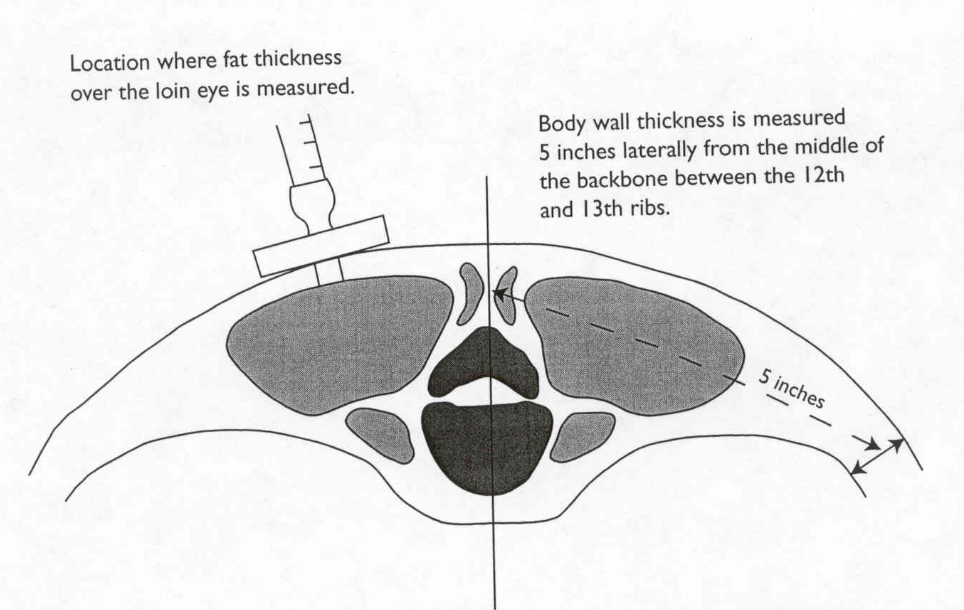
Back fat
Body wall
Loineye area
Hot Carcass Weight
Measuring Loineye Area and Body Wall Thickness on Lamb
Factors that determine lamb quality grade
Leg conformation score
Flank streakings
Carcass maturity
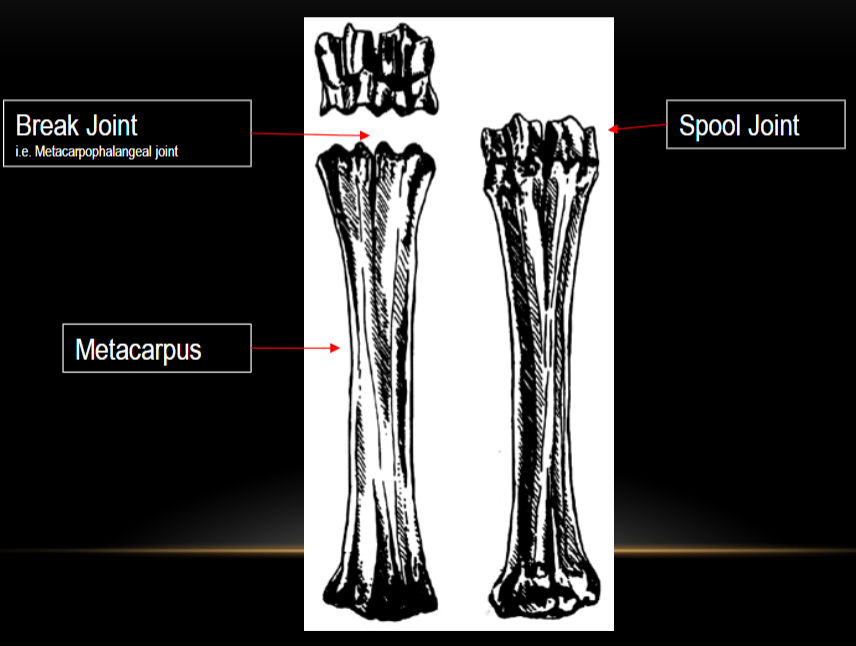
Break vs Spool joints
Flank color

Break and Spool Joint
Spool = older
Think “spool of yarn,” as older folk tend to knit
Porcine Sex Classes
Gilt
Female that has not given birth before
Barrow
Male that was castrated before reaching puberty
Sow
Female that has given birth before
Boar
Uncastrated male
Stag
Male that was castrated after reaching puberty
Porcine Muscling Scores
Thick = 3
Average = 2
Thin = 1
Porcine muscling scores are based on (live weight/carcass/both) basis
Carcass
Porcine Yield Grades
US #1, 2, 3, 4
1 is greatest cutability, 4 is lowest
Bovine Sex Classes
Heifer
Female that has not given birth before
Steer/Bullock
Castrated male
Cow
Female that has given birth before
Bull
Uncastrated male
How is beef quality evaluated?
Skeletal maturity
Lean maturity
Degree and distribution of marbling
Bovine Maturity Groups
A, B, C, D, E
A is youngest, E is oldest
How is the maturity group for a bovine determined?
Dentition; teeth
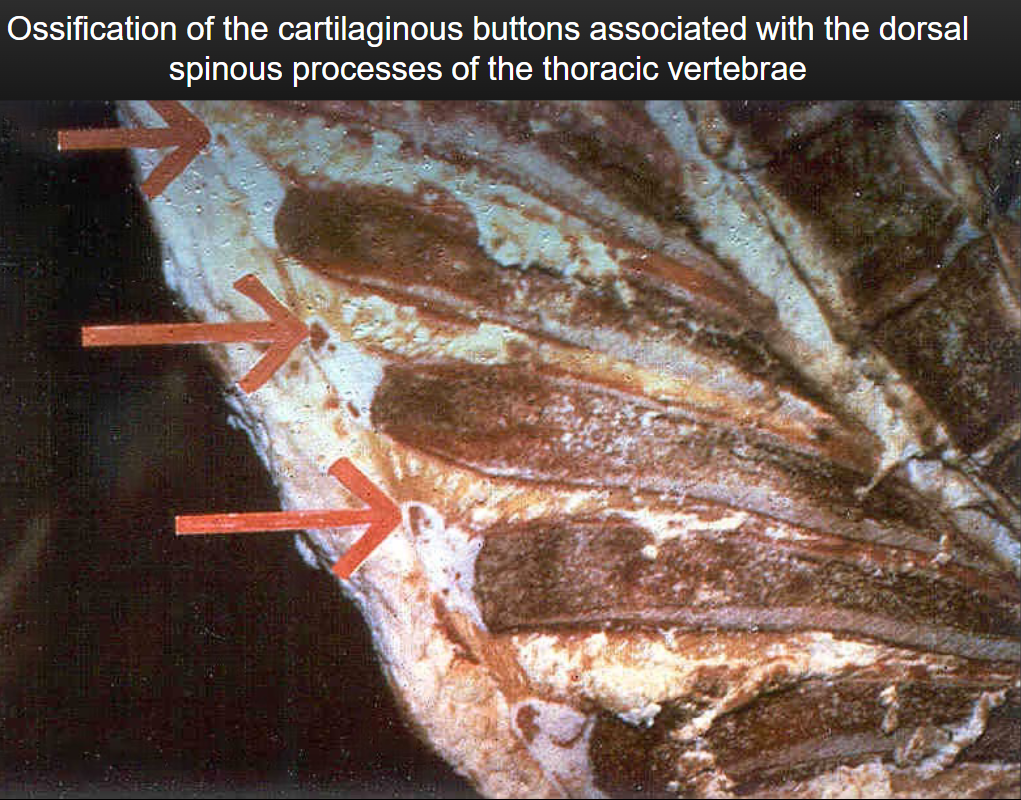
Ossification of the cartliaginous buttons
Ribs
Older animals: whiter, wider, flatter
Younger animals: red, round, porous
What is the maturity cut-off for bovines? What do we risk with cattle older than the cut-off?
30 months
Older than 30 months increases risk of BSE
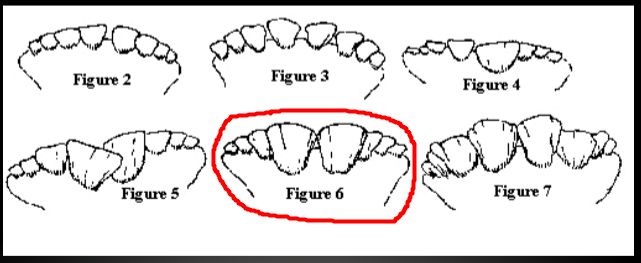
For maturity group determination of bovine, how is dentition used to determine age?
Based on the eruption of the incisors
Figure 6 shows full eruption and leveling
Figure 3 shows rough cut-off point (~30 months)
Bovine Yield Grades
1, 2, 3, 4, 5
1 is greatest cutability, 5 is lowest
How are bovine yield grades determined?
4 considered factors:
Preliminary Yield Grade (PYG)
Ribeye Area (REA)
Hot Carcass Weight (HCW)
% of Kidney, Pelvic, and Heart Fat (KPH)
Bovine Quality grades
Prime
Choice
Select
Standard
Commercial
Utility
Cutter
Canner
How are bovine quality grades determined?
Marbling score (Abundant → Practically Devoid)
Carcass maturity (A → E)
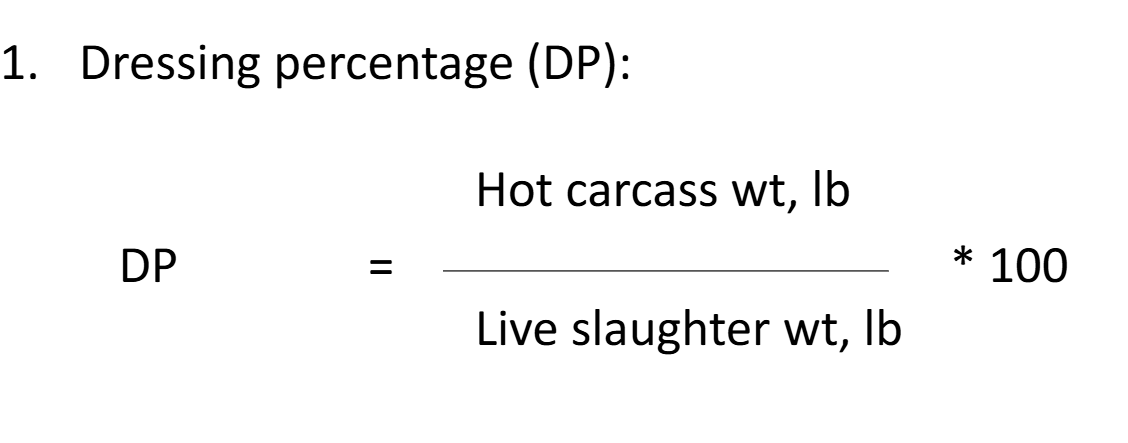
Dressing percentage
Weight of the hot carcass expressed as a percentage of live weight
Must know formula
What two basis can an animal be sold on?
Live Weight
Carcass
What does selling on a live weight involve?
The slaughter weight of the animal and its live price on a per hundred weight ( 1 cwt = 100 lbs) basis
$0.66 / lb x 100 = $66/cwt
1,200 lbs / 100 = 12 cwt
12 cwt x $66/cwt = $792 total
Drift
Live weight shrinkage due to feces, urine, fasting, etc
What is the average % drift?
4%
Drop Credit
Potential revenue to be recieved for the byproducts of a live animal
Hide and offal
Todays beef is typically sold on a combination of what?
Yield and quality grade
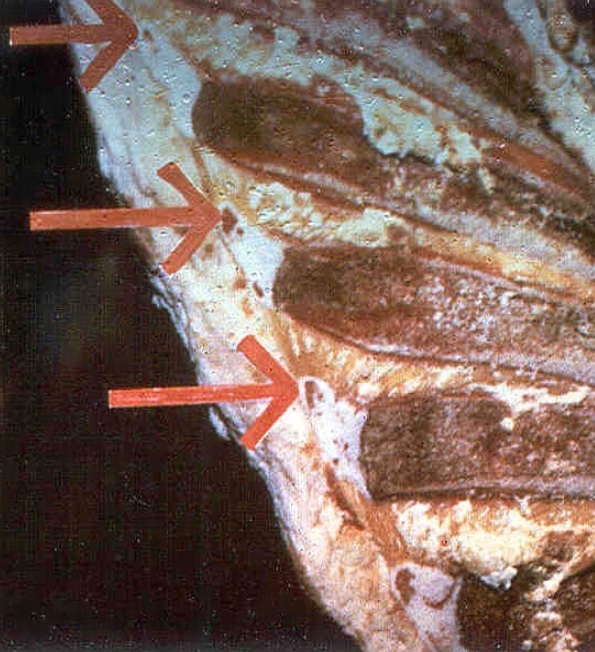
Hardbones
Defect seen in carcasses with C, D, and E maturity
Also called “blue backs”
Caused by age—increase of ossification
Dark Cutter
Defect resulting in darker-colored meat
Caused by long-term stress

Heavy Carcasses
Defect seen by double-muscled cattle
Caused by double-muscled gene (defective myostatin)
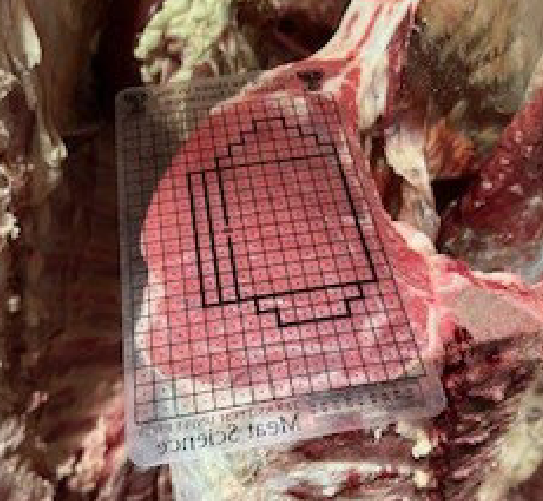
Conformation
Defect seen primarily in dairy cattle
Caused by Holstein genetics

Calloused Eye
Defect seen in a carcass caused by Steatosis
Caused by an injury long before harvest

Yellow Fat
Defect seem from a forage-based diet
Caused by beta-keratin in plants

Hump Height
Defect seen in Bos Indicus (Brahman) cattle
If the hump exceeds 2 inches in height, the meat cannot be sold as Angus beef

Blood Splash / Ecchymosis
Defect seen from hemmorages in the veins and artieries in the muscle
Caused by stress just before death (bursting of capillaries)
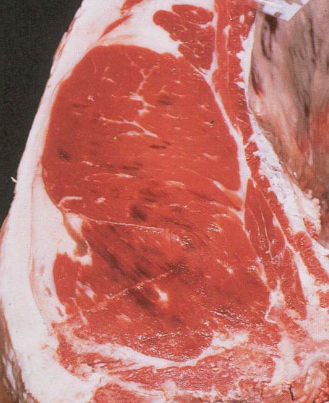

What primal cuts are at each position of the beef carcass?
Chuck
Rib
Loin
Round

What primal cuts are at each position of the lamb carcass?
Shoulder
Rack
Loin
Leg
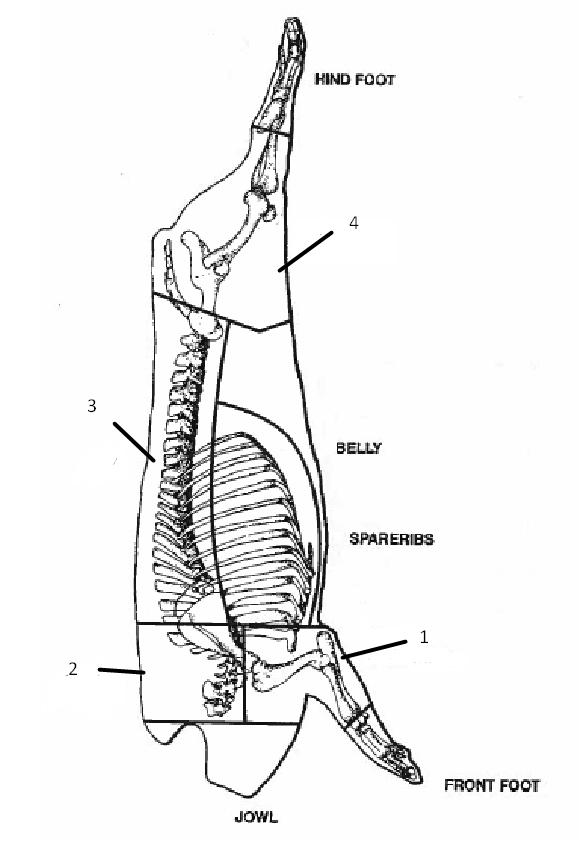
What primal cuts are at each position of the pork carcass?
Picnic Shoulder
Boston Butt
Loin
Ham