CCE: Lifespan
 Call Kai
 Learn
Learn Practice Test
 Spaced Repetition
 Match
Match Flashcards
 Knowt Play
1/196

There's no tags or description
Looks like no tags are added yet.
Name | Mastery | Learn | Test | Matching | Spaced | Call with Kai | Chat |
|---|
No analytics yet
Send a link to your students to track their progress
197 Terms
Define genotype & phenotype.
genotype = person's genetic inheritance
phenotype = observed characteristics; due to COMBO of heredity & environ
--> e.g., super tall genes + environ stressors = taller-than-average, but shorter than potential
What are Rutter's indicators? what were his thoguhts on positive outcomes for high-risk babies?
Rutter: predictors of child psychopathology; the higher the number, the more likely the negative outcomes
Indicators:
1. severe marital discord
2. low SES
3. overcrowding/large fam size
4. parental criminality
5. maternal psychopathology
6. placement outside home
positive outcomes for high-risk babies MORE LIKELY when:
a) fewer stressors right after birth
b) easy temperament (⬆️social responsively, communication, eating/sleeping bxs)
c) stable support from parent/other caregiver
Explain Bronfenbrenner's Ecological Model
says development is the result of interactions between systems:
- microsystem = direct, immediate environ (family, peers, teachers)
- mesosystem = interactions btw microsystem components (e.g., how family members interact w/teachers, school)
-exosystem = external social settings or broader community structures that do not directly involve the individual, but still indirectly influence them
- macrosystem = overarching environ influences (cultural beliefs & practices, econ conds., political ideologies)
- chronosystem = (think TIME) effects of factors long-term/over time

what is niche-picking?
when children actively seek out experiences consistent with their genetic predisposition
--> e.g., A child genetically inclined toward athletics chooses to join the soccer team, seeks physical activity, and spends time with sporty peers
what is reaction range?
the idea that genes set the limits & the environment determines where you fall within those limits
also called canalization (like "canal")
What are the 3 types of genotype-environment correlations?
(importance in order, from early childhood ➡️ adulthood/independence)
1. PASSIVE genotype-environ = parents providing both your genes & environ
--> e.g., A musically talented parent provides both the genes and a music-rich home. The child didn't choose this environment, but it aligns with their genetic potential.
2. EVOCATIVE (or REACTIVE) genotype-environ = others responding to you based on you genetic traits
--> e.g., a naturally outgoing child gets more social attention & positive reinforcement, which strengthens their social skills
3. ACTIVE genotype-environ (i.e., NICHE-PICKING) = when children actively seek out experiences consistent with their genetic predisposition
--> e.g., A child genetically inclined toward athletics chooses to join the soccer team, seeks physical activity, and spends time with sporty peers
explain what an evolutionary perspective (on psychology) is
focuses on how natural selection predisposes organisms toward certain behaviors
ethologists = focus on adaptive insincts & drives
evolutionary psychogists = mental & emotional adaptations that helped ancestors survive & reproduce
What are critical vs. sensitive periods?
critical periods = specific & predetermined, crucial periods of time
sensitive periods = longer in duration, more flexible; what we believe HUMANS have
critical = crucial // sensitive = best not to miss
types of chromosomal disorders
Disorder due to
1) Dominant (e.g., Huntington's) or Recessive gene (e.g., cystic fibrosis, sickle cell disease, Tay-Sachs, & PKU)
2) Chromosomal abnormality = variation in number or structure of chromosome(s)
- varied number (aneuploidy) - Down syndrome (autosomal); Klinefelter, Turner (sex)
- altered structure:
(a) deletion = part of chrome missing (e.g., Prader-Willi)
(b) translocation = transfer of segment to another chrome
(c) inversion = piece breaks off and reattaches upside down
Huntington's disease
autosomal dominant gene disorder
hereditary, progressive neurodegenerative disorder that affects movement, cognition, and emotions
- when one parent has dominant gene, child has 50% chance; both parents, 75% chance

Phenylketonuria (PKU)
an autosomal recessive disorder, which means it is caused by two autosomal recessive genes.
In other words, it occurs when a biological child inherits the PKU gene from both parents and, consequently, is homozygous with regard to that gene.
When both parents are carriers of the recessive gene (i.e., they each have only one recessive gene for PKU), each of their biological children has a 25% chance of having the disease.
A person with PKU is unable to adequately metabolize the amino acid phenylalanine.
Consequently, treatment is a diet low in phenylalanine that begins soon after birth and is maintained through the lifespan (e.g., no milk, cheese, meat, fish, or eggs).
Without treatment, the build-up of phenylalanine causes intellectual disability, hyperactivity, seizures, eczema, a musty body odor, hypopigmentation, and stunted growth.
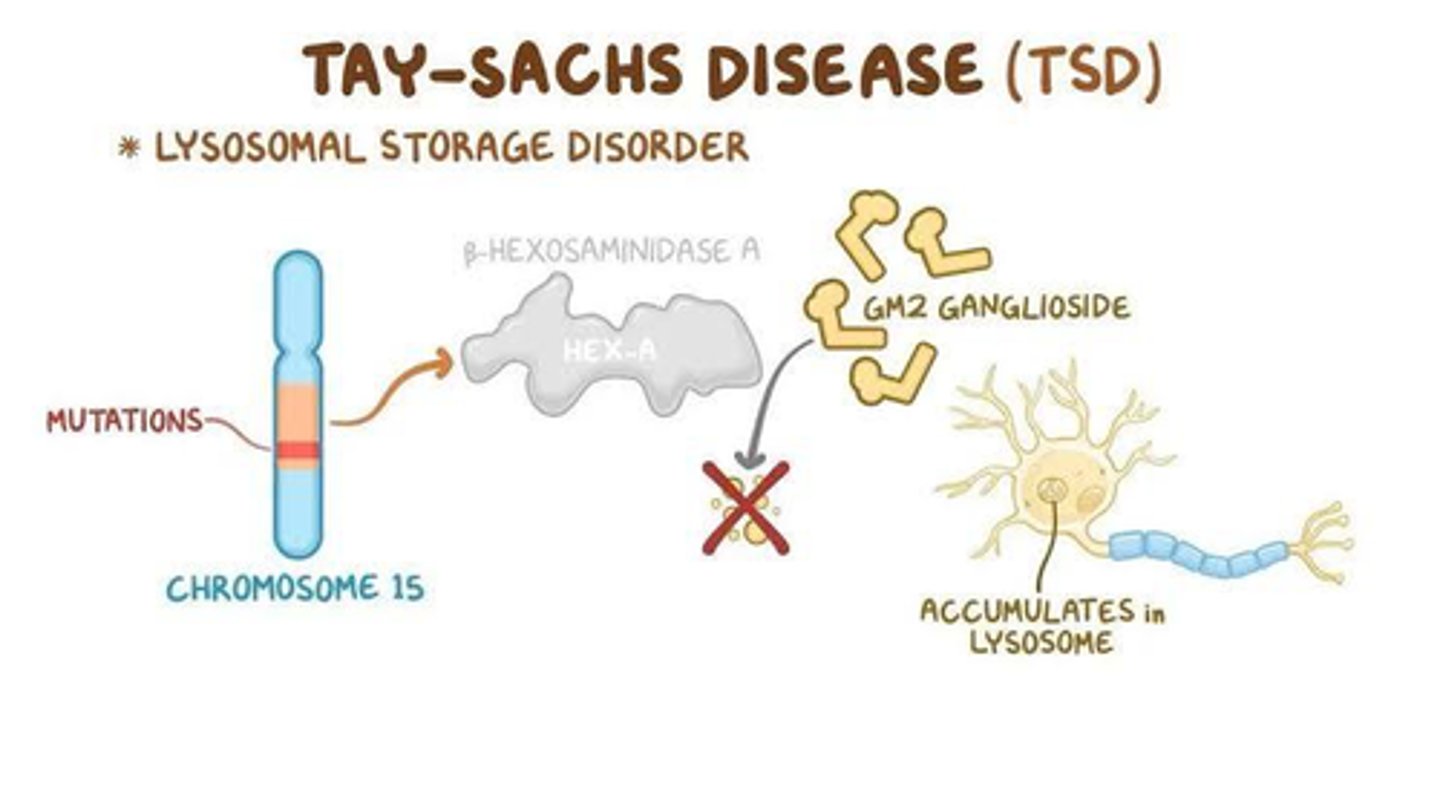
Tay-Sachs disease
An autosomal recessive disorder
The disease progresses rapidly, leading to vision and hearing loss, seizures, muscle stiffness, and eventual loss of motor skills
Prader-Willi syndrome
caused by a deletion on the paternal chromosome 15.
characterized by intellectual disability, low muscle tone, and a constant feeling of hunger (hyperphagia), leading to excessive eating and obesity
What are the prenatal stages of development?
Prenatal Stages:
1) GERMINAL = ≤ 2 weeks
2) EMBRYONIC = 3rd-8th week
3) FETAL = ≥ 9th week
Explain the basics of chromosomes & the broad categories of chromosomal disorders.
first 22 pairs (autosomes) + the 23rd pair (that contains the sex chromosomes) ==> 46 TOTAL CHROMOSOMES (23 pairs)
autosomal disorder = d/o carried on autosome
sex-linked disorder = d/o carried on sex chromosome
Disorders happen via:
1) 1 DOM gene
2) 2 REC genes
3) ABNORMALITY
What are disorders due to dominant or recessive genes
Dominant = due to receiving 1 DOM gene
--> e.g., Huntington's (autosomal gene d/o)
Recessive: due to receiving 2 REC genes
--> e.g., cystic fibrosis, sickle cell disease, Tay-Sachs, PKU
disorders due to a chromosoal abnormality
chromosal d/o's = due to variation in NUBMER (aneuploidy) or structure of chromoses
Down Syndrome, Klinefelter syndrome, Turner syndrome
Down Syndrome
autosomal d/o; extra chromosome 21 --> causes intellect. disability, stunted physical growth & motor dev., distinct physical feats, & ⬆️risk leukemia, Alzheimers, & heart defects
Klinefelter syndrome
(males only) presence of 2+ X chromosomes, 1 Y chromosome --> small penis & testes, breasts during puberty, limited interest in sexual activity, often sterile, & possible learning disability
Turner syndrome
(females only) only one X chromosome --> short, drooping eyelids, webbed neck, stunted/absent secondary sex characteristics, possible cog deficits
Types of alterations in chromosomal structure
DELETION = part of chrome missing
TRANSLOCATION = transfer of segment to another chromo
INVERSION = chromo breaks in 2 places & segment formed by the breaks turns upside down & reattaches to the chromo (can be inherited, but in humans usually don't affect phenotype)
what are some common teratogens? is there a period of pregnancy when exposure's most dangerous?
substances causing birth defects in developing fetus
- EMBRYONIC stage exposure (3rd-8th week) ==> most likely cause MAJOR STRUCTURAL abnormalities (e.g., CNS damage most likely 3rd-6th wk)
ALCOHOL --> fetal alcohol spectrum disorder; 🧠areas most likely affected - corpus callosum, hippocampus, hypothalamus, cerebrum, basal ganglia, & frontal lobes
COCAINE --> ⬆️risk spontaneous abortion & stillbirth; high risk SIDS (sudden infant death syndrome), seizures, low birthweight, smaller head circumference; often exhibit tremors, exaggerated startle response, high-pitched cry, sleep & feeding difficulties
NICOTINE --> placental abnormalities, can cause fetal death/stillbirth; higher risk low birthweight, SIDS< & respiratory disease, emotional social cognitive deficits
LEAD --> low birthweight, intellectual disability
Alcohol consumption by a pregnant woman is likely to have the most adverse effects on her baby's prenatal development when the woman drinks during:
The first trimester.
Alcohol consumption by a woman during pregnancy can have detrimental effects on the developing fetus, with the severity and extent of the effects depending on the amount of alcohol consumed and the time during which it is consumed. There does not appear to be any safe time for alcohol consumption during pregnancy. However, the worst effects are associated with drinking during the first trimester.
What is Fetal Alcohol Spectrum Disorder?
- range of conditions w/largely irreversible physical, behavioral, &/or cognitive abnormalities
1) Fetal Alcohol Syndrome (FAS) = most severe form of FASD
- from🍺 ~daily or binge drinking; esp. during 2nd half 1st trimester (~8-13 weeks)
- look like? facial abnormalities; stunted physical growth; 🫀heart, kidney, liver defects; 👁️👂impairments; 🧠deficits; behavioral probs (hyperactivity, impulsivity, social withdrawal)
2) LESS SEVERE FORMS FASD: previously fetal alcohol effects (FES)
alcohol-related neurodevelopmental disorder (ARND) = characterized by 🧠cog deficits & behavioral probs 🚫👨🏻prominent facial abnormalities; stunted growth, physical defects
& alcohol-related birth defects (ARBD) = physical defects (🫀& kidney probs, 👁️👂impairment); 🚫other prominent symptoms
🧠regions affected by 🍺exposure = depends, but most likely: corpus callosum, hippocampus, hypothalamus, cerrebellum, basal ganglia, & frontal lobes
Effects of maternal malnutrition?
- associated w/miscarriage, stillbirth, & low birth weight
- may result in suppressed immune system, intellectual disability, & other serious probs
severe in 3rd trimester (esp protein deficiency) = especially damaging for developing brain; reduced neurons, myelination, & NT abnormalities
lack of folic acid = maybe spina bifida, other neural tube defects
effect of rubella, cytomegalovirus, HIV/AIDS, & stress on baby?
1) Rubella: if infected, esp during 1st trimester, 👶🏼⬆️risk for 🫀defects, blindness, deafness, intellectual disability
2) Cytomegalovirus (CMV): type of herpes virus; when passed to fetus through placenta; some have symptoms, most survive; 20-30% die perinatally; most common sx's: 🧠intellectual disability & hearing, vision impairments
3) HIV/AIDS: 20-30% passing to 👶🏼 w/out preventative measures; with antiretroviral 💊's: <1%
symptoms: slow growth, ⬆️bacterial infections, oral candidiasis
w/antiretroviral drugs: UP TO 50% survive past 10, many lasting into adolecense/young adulthood
4) stress: when severe/prolonged, ⬆️risk miscarriage, painful labor, premature delivery; ⬆️risk 👶🏼 low birthweight, hyperactive & irritable, irregular feeding, sleeping, & bowels
Important concepts w/brain development
PACE: @ birth: brain is ~25% of adult weight...by 2 y.o., 80% adult weight...this (bc synaptogenesis - new synapses/connections) & formation of glial cells (responsible for myelination of nerve fibers)... full adult weight by 16
cerebral cortex: almost entirely UNdeveloped @ birth; higher-level cognitive funcs.
- 0-3 months: primary motor & sensory areas
- by adolescence-adulthood: prefrontal cortex
- by 30: starts shrinking; neurons atrophy
- 60+: faster cell death
BUT compensation for neural loss via ➕synaptic connections & neurogenesis in hippocampus
What are early newborn reflexes?
1) Babinski = toes fan out & upward when soles of feel tickled
2) Moro (Startle) = flings arms & legs outward then toward body in response to loud noise or sudden loss of physical support
3) Rooting = turns head in direction of touch applied to cheek
4) Stepping (Walking) = makes coordinated walking movement when held upright with feet touching flat surface
What is Rooting?
Early newborn reflex. turns head in direction of touch applied to cheek
What is Moro?
AKA startle. flings arms & legs outward then toward body in response to loud noise or sudden loss of physical support. early newborn reflex
What is Babinski?
early newborn reflex. toes fan out & upward when soles of feel tickled
Infant's vision?
- WORST sense @ birth
- sees @ 20 ft what adults see @ 200-400ft
- but by 6 months, close to adult's
systematic visual cue acquisition: kinetic➡️binocular➡️pictorial cues
prefer?
- newborns prefer HIGH CONTRAST 🏁patterns
- 👩🏼 face preference w/in 2-5 days
- by 2 months, prefer their mom's face 👩🏼
Infant's auditory localization?
- @ birth, almost as good as adult's
- some auditory localization (ability to orient toward direction fo a sound) present @ birth; disappears btw 2-4 months, then reappears during rest of 1st year
- by 3 months, distinguish voices & prefer mom's
Infant's pain perception?
- sensitive to pain
- male 👶 circumsized w/out anesthesia can have more adverse reaction to later medicals (💉) 4-6 months later
infant bodies keep the score
what are the developmental milestone periods?
1-3 months: raise chin from ground & turn head side-to-side; by 3rd month: plays w/hands, fingers, brings objects to mouth
4-6 months: rolling, sitting, standing
- 4 months: rolls from tummy to back
- 5 months: sits on lap, reaches & grasps
- 6 months: sits alone, stands w/help
- 5-9 months: 🦷appear
7-9 months: more coordination, independence
- ⬆️good coordination
- 8-9 months: sits alone w/out support & begins crawling & creeping
- 9-10 months: pulls self to stand by holding furniture
10-12 months: standing, first steps
- 10-11 months: stands alone, walks w/help
- 12 months: first steps alone👣
13-15 months: walking alone, stairs, scribbling, cup
- 13-14 months: walks alone w/wide-based gait
- 15 months: creeps up stairs, scribbles spontaneously, uses cup well
16-24 months: stairs, spoon, 1/2 kids potty trained
- 18 months: runs clumsily, walks up stairs w/hand held, can use spoon🥄
- 24 months: up & down stairs alone, kicks ball, turns book pages, ~50% kids using 🚽
25-48 months: 30 jumping jacks/hand-finger; 36 tricycle/dressing/potty-trained; R-L preference 4 yrs
- 30 months: jumps w/both feet, good hand-finger coordination
- 36 months: rides tricycle🚲, dresses & undresses👗simple clothing, completely 🚽trained
- 48 months: stable preference for R or L hand✋
What are developmental milestones between 1-3 months?
raise chin from ground & turn head side-to-side;
then plays w/ hands, fingers, brings objects to mouth
What are developmental milestones between 4-6 months?
rolling, sitting, standing
- rolls from tummy to back
- sits on lap, reaches & grasps
- sits alone, stands w/help
What are developmental milestones between 7-9 months?
more coordination, independence
- ⬆good coordination
- sits alone w/out support & begins crawling & creeping
- pulls self to stand by holding furniture
What are developmental milestones between 10-12 months?
standing, first steps
- stands alone, walks w/help
- first steps alone👣
What are developmental milestones between 13-15 months?
walking alone, stairs, scribbling, holding a cup
- walks alone w/wide-based gait
- creeps up stairs, scribbles spontaneously, uses cup well
What are developmental milestones between 16-24 months?
stairs, spoon, 1/2 kids potty trained
- runs clumsily, walks up stairs w/hand held, can use spoon🥄
- up & down stairs alone, kicks ball, turns book pages, ~50% kids using 🚽
gross- motor milestones for 2 yr old children?
include climbing up on furniture, walking alone, walking up and down stairs one at a time, and catching a large ball using hands and chest.
gross motor milestones for 3 yr old children?
pedaling a tricycle, kicking a stationary ball forward, throwing a ball overhand, going up stairs using alternate feet, and running without falling.
gross motor milestones for 4 yr old children
include hopping on one foot, standing on one leg, running to kick a ball, bouncing a ball, and going down stairs using alternate feet.
gross motor milestones for 5 yr old children?
include riding a scooter or bicycle, jumping rope, hopping on alternate feet, jumping over low obstacles, and catching a ball with both hands and arms bent.
What are the stats on illicit drug use in adolescents?
# 1) 🍺 11.6% - alcohol
# 2) 💊 8.8% - illicit drugs (of this, ⬆️ marijuana @ 7.1%)
# 3) 🚬 7.8% - tobacco
Describe physical maturation in adolescence
- growth spurt: starts 11-12 (G), 13-14 (B) ---lasts 3-4 yrs---> done ~15 (G), ~17 (B)
- gender diffs: girls more balance, flexibility, agility; boys more strength, gross-motor abilities
effects of early vs. late-maturing in boys vs. girls?
BOYS:
early growth:
- ✅⬆️popular, athletic
- 🚫but ⬆️body dissatisfaction, ⬆️drug, alc use
late growth:
- seen as more "childish"
- ⬆️attention-seeking, ⬇️self-confidence
early OR late: ⬆️depression
GIRLS:
early-maturing:
- 🚫: poor self-concept, unpopular, ⬆️dissatisfied w/physical dev, ⬇️ academic achievement, ⬆️sexual precocious behavior, drug/alc use, ⬆️depression, eating disorder
late-maturing:
- treated like "little girls"
late-maturing:
- 🚫treated like "little girls"; dissatisfied w/appearance
- ✅ outperform peers academically
IN GENERAL:
- most severe when perceive selves diff from peers
Describe visual changes in adulthood
- ~40: some inability to focus (presbyopia)
- 65+: visual changes interfering w/reading, driving, other daily life aspects -- loss visual acuity, ⬇️perception depth, color; ⬆️💡sensitivity; deficits 👁️🔎visual search deficits; dynamic vision🏃🏻(moving objects); speed visual processing
Describe sexual activity in late adulthood
sex activity mid-life predictor sex activity late adulthood
across the board:
- % identifying as "sexually active" decreases w/age
- health problems in men - primary reason for lack of sex activity, across men & women
Describe hearing changes in late adulthood
- by 40: most adults hearing probs
- by 75+: but MOST no probs until after 75; btw 75-79, 50% have 👂deficits impacting daily life
--> biggest prob: ⬆️frequency sounds
Changes in strength, coordination, reaction time as you age?
- most consistently, behavioral slowing
What is Piaget's Constructivism?
- Piage's theory of cognitive development
- says we actively construct higher levels of knowledge from the contributions of biological maturation & environment
- motivation for cog dev. ==> from drive toward cognitive equilibrium (equilibration)
- development via disequilibrium: we develop when we face a discrepancy btw reality & our existing understanding of the world (repotoire of cognitive schemas) --> resolved via adaptation
Piaget's "adaptation"?
resolves disequilibrium
involves 2 processes:
1) assimilation = incorporating new knowledge into existing cog schemas
--> e.g., childing banging, hitting, etc. a new toy as she would other toys, bc she's assimilating it into her existing repotoire of schemas
--> e.g.,
2) accomodation = modification of existing schemas to incorporate new knowledge
--> e.g., child modifying her behavior w/the new toy to accomodate it's unqiue properties (maybe has to be gentle with it)
--> e.g.,
What are Piaget's stages of cognitive development?
1) SENSORIMOTOR (0-2 yrs):
- sensory learning
- learning via circular reactions
🔑developments: object permanence (substage 4); causality, deferred imitation (imitating another's behavior hours/days after emitted), & make-believe/symbolic play
2) PREOPERATIONAL (2-7 yrs) :
- learning via symbolic learning
- precausal (transduction) reasoning = incomplete understanding cause/effect; magical thinking; animism; egocentrism = inability to separate perspective from that of others (e.g., __)
- 🚫conservation --> irreversibility, centration
- 🚫 theory of mind !
3) CONCRETE OPERATIONAL (7-11 yrs):
- sophisticated classification; seriate (order items); understand part-whole relationships
- ✅conservation = conservation of # first, then liquids, length, etc.; req's reversibility & decantation; acquired via horizontal decalage = gradual acquisition of abilities w/in a stage of development
4) FORMAL OPERATIONAL (11 or 12+ yrs):
- ✅ abstract thought, hypothetico-deductive reasoning = can identify competing hypotheses abt problem & strategies for systematically testing those hypotheses
- adolescent egocentrism = renewed egocentrism
Elkind (1984):
--> personal fable = belief one's unique & not subject to natural laws governing others; no one can understand them
--> imaginary audience = belief one is always the center of attention
What is the order of Piaget's stages of cognitive development?
1) SENSORIMOTOR (0-2 yrs)
2) PREOPERATIONAL (2-7 yrs)
3) CONCRETE OPERATIONAL (7-11 yrs)
4) FORMAL OPERATIONAL (11 or 12+ yrs)
Describe Piaget's sensorimotor stage
1) (0-2 yrs):
- learns about objects through sensory info; how they look, feel, taste;
- learning via circular reactions = actions performed in order to reproduce events that initially occurred by chance; predominant type of learning in this phase
- 6 substages: 1️⃣reflexive schemes (0-1 mo) 2️⃣primary circular reactions (1-4 mo) 3️⃣ secondary circular reactions (4-8 mo) 4️⃣coordinated secondary circular reactions (8-12 mo) 5️⃣tertiary circular reactions (12-18 mo) 6️⃣ mental representation (18-24 mo)
🔑developments: object permanence (substage 4); causality, deferred imitation (imitating another's behavior hours/days after emitted), & make-believe/symbolic play
Circular reactions:
primary (repetition of actions on the infant's own body, 1-4 months), secondary (repetition of actions on external objects for desired consequences, 4-8 months), and tertiary (intentional experimentation with new actions to achieve varied results, 12-18 months)
What are the substages occurring in Piaget's sensorimotor phase? How is the child learning in this phase?
#1 - Reflexive Schemas (0-1 mo.) = infant exercises their reflexes
#2 - Primary Circular Reactions (1-4 mo) = 👶🏼 attempts to repeat pleasurable events involving own body (e.g., thumbsucking)
#3 - Secondary Circular Reactions (4-8 mo) = attempts to reproduce pleasurable events involving other ppl/objects (e.g., shakes a rattle)
#4 - Coordinated Secondary Circular Reactions (8-12 mo) = combines secondary circular reactions (schemes) into new, more complex action sequences (e.g., uncovers object then grasps it)
#5 - Tertiary Circular Reactions (12-18 mo.) = deliberately varies an action/action sequence to discover consequences of doing so (e.g., drops toy from different heights)
#6 - Mental Representation (18-24 mo.) = develops representational (symbolic) thought; these allow them to think abt absent objects & past events and to anticipate consequences of an action
What are reflexive schemas?
(0-1 mo.) infant exercises their reflexes
part of Piaget’s sensorimotor stage (substage 1)
What are primary circular reactions?
(1-4 mo) attempts to repeat pleasurable events involving own body (e.g., thumb sucking)
part of Piaget’s sensorimotor stage (substage 2)
What are secondary circular reactions?
(4-8 mo) attempts to reproduce pleasurable events involving other ppl/objects (e.g., shakes a rattle)
part of Piaget’s sensorimotor stage (substage 3)
What are coordinated secondary circular reactions?
(8-12 mo) combines secondary circular reactions (schemes) into new, more complex action sequences (e.g., uncovers object then grasps it)
part of Piaget’s sensorimotor stage (substage 4)
What are tertiary circular reactions?
(12-18 mo.) deliberately varies an action/action sequence to discover consequences of doing so (e.g., drops toy from different heights)
part of Piaget’s sensorimotor stage (substage 5)
What is mental representation?
(18-24 mo.) develops representational (symbolic) thought; which involves forming internal representations that allow him/her to think about absent objects and past events and to anticipate the consequences of an action.
part of Piaget’s sensorimotor stage (substage 6)
When does object permanence begin to develop according to Piaget’s stages of cognitive development?
In substage 4 of the sensorimotor stage (coordinated secondary circular reactions)
Describe Piaget's preoperational stage
2) (2-7 yrs) :
- can learn through: symbolic (semiotic) function = extension of representational thought; permits learning via language, mental images, & other symbols
- more sophisticated symbolic play
- limited by:
- precausal (transduction) reasoning = incomplete understanding cause/effect;
- magical thinking = thinking abt something will cause to occur; animism = (i.e., anthropomorphizing) tendency to attribute human characteristics to inanimate objects
- egocentrism = inability to separate perspective from that of others (e.g., __)
- irreversibility = actions can't be reversed
- centration = focus on only ONE feature of an object;
- can't conserve = says liquid in taller glass is MORE liquid
What are the main limitations present in Piaget’s preoperational stage?
can't conserve (says liquid in taller glass is MORE liquid)
centration
egocentrism
precausal (transduction) reasoning
magical thinking
animism
irreversibility
What is necessary for reversibility to develop?
symbolism
What is precausal (transduction) reasoning?
incomplete understanding of cause and effect. can cause a child to tend to see a causal relationship between events that occur in sequence when none exists.
limitation in preoperational stage
What does egocentrism result in during the preoperational stage?
leads to precausal (transductive) reasoning which ultimately results in magical thinking and animism
What is magical thinking?
thinking about something will cause it to occur.
limitation in preoperational stage and is a result of transduction reasoning
What is animism?
(i.e., anthropomorphizing) tendency to attribute human characteristics to inanimate objects.
limitation in preoperational stage and is a result of transduction reasoning
What is egocentrism in Piaget’s preoperational stage of cognitive development?
inability to separate perspective from that of others
limitation in preoperational stage and result of centration and what causes a lot of the other limitations
What is centration?
focus on only ONE feature of an object, usually the most noticeable feature
limitation in preoperational stage
What is irreversibility?
inability to recognize that actions can be reversed
limitation in preoperational stage
Describe Piaget's concrete operational stage
3) (7-11 yrs):
- capable of mental operations (logical rules for transforming & manipulating info) which results in more sophisticated classification; seriate (order items); understand part-whole relationships in relational terms (ex/ brighter, lighter)
- conservation = conservation of # first, then liquids, length, etc.; req's reversibility & decentration; acquired via horizontal decalage = gradual acquisition of abilities w/in a stage of development
What is conservation?
develops gradually, with conservation of number occurring first, followed by liquid, length, weight, and then displacement volume.
What does the development of conservation depend on?
reversibility and decentration
What is horizontal decalage?
Piaget coined it to describe the gradual acquisition of conservation abilities and other abilities within a specific stage of development
ex/ are unable to apply a learned function to specific problems.
Describe the Piaget's formal operational stage of development
4) (11 or 12+ yrs):
- ✅ abstract thought, hypothetico-deductive reasoning = can identify competing hypotheses abt problem & strategies for systematically testing those hypotheses
- adolescent egocentrism = renewed egocentrism
--> personal fable = belief that one is unique & not subject to natural laws governing others
--> imaginary audience = belief that one is always the center of attention
What is imaginary audience?
belief that one is always the center of attention
limitation in Piaget's formal operational stage of development and a result of adolescent egocentrism
What is personal fable?
belief that one is unique & not subject to natural laws governing others
limitation in Piaget's formal operational stage of development and result of adolescent egocentrism
What does adolescent egocentrism result in?
personal fable and imaginary audience
What are information processing theories of cognitive development?
say ⬆️complexity of individual cognitive abilities = ⬆️complexity & efficiency of cognition
- focus on development w/in specific domains (attention, memory, processing speed) rather than global principles
- cog ability = task-specific; interested in how specific skills used for specific tasks
what is Vygotsky's sociocultural theory?
- all learning is socially mediated & cognitive development is first interpersonal
- zone of proximal development (ZPD) = level of development just beyond current level, reachable when adult/older peer gives appropriate scaffolding
- scaffolding = instruction, assistance, & support; most effective when involves modeling, giving cues, & encouragement;
- symbolic play = practice
Vygotsky's internalization
a key concept in his sociocultural theory; process by which we transform social activities and interactions into internal mental processes
Theory of mind (ToM) development?
theory of mind = ability to make inferences about another's representational states & predict behavior accordingly
- 2-3 y.o. = become aware other's mental states & begin understand ppl have different perceptions, emotions, & desires influencing their actions
- 4-5 y.o. = understand another's thoughts can be false/inaccurate & ppl can act on false beliefs
- 5+ y.o. = more sophisticated around 6; ppl's actions not always consistent w/their true thoughts & feelings; perception is subjective (ppl interpret, not just record events); ppl can have mixed feelings about events/ppl
Describe memory strategies in childhood
- preschoolers: non-deliberate strategies ("incidental mnemonics") in ineffective ways
- early elementary: more effective, but often distracted irrelevant info; can apply strategy in immediate situation, but doesn't translate to new
- 9-10: regular memory strategy use; rehearsal, organization, elaboration
- adolescence: strategies "fine-tuned," used more deliberately & selectively
- memory improvments related to metacognition (ability to think about thinking) & metamemory (ability to reflect on own memory processes)
What is childhood (infantile) amnesia?
idea that we have no memory of events prior to age 3-4 bc our brain centers aren't developed...
BUT research says early memory varies across the lifespan
What are the effects of age on memory?
- vary, some memory affected more than others
- ⬆️age, decrease in explicit memory (more so than implicit)
- greatest age-related declines:
(1) recent long-term (secondary) memory ex/recall list of words recently read
(2) working memory
- episodic MORE affected than semantic
- effects caused by processing speed decline
What are theories on language development?
1) NATIVIST = biological mechanisms facilitate language acquisition
- language acquisition device (LAD) = proposed by Chomsky; like a built-in algorithm that allows us to learn language just by being exposed to it
- (i.e., nature vs. nurture)
2) BEHAVIORIST approach = language acquired like ANY OTHER behavior... via imitation & reinforcement
- (i.e., nurture vs. nature)
3) INTERACTIONISTS = language dev attributable to COMBO of biological & environmental factors
- (i.e., nature AND nurture)
What is semantic bootstrapping?
using the meaning of words to figure out grammar
What is syntactic bootstrapping?
using grammar to infer meaning of new words
What are phonemes & morphemes?
phonemes = smallest units of SOUND (e.g., letters in alphabet)
morphemes = smallest units of SOUND W/MEANING (e.g., cat, un-, pre-, -ed)
What are the stages of language acquisition?
1) Crying:
- 3 distinct patterns = (1) basic (hunger) cry, (2) angry cry, & (3) pain cry
- pain cry most likely to elicit immediate response; ⬆️physio response
- "best" response = mom raises & holds baby upright on should for close physical contact
2) Cooing & Babbling:
- 6-8 weeks
- mainly vowels, when happy/contented
- @ 4 months: babbling; sounds from all languages
- deaf children: "babble" w/their hands
3) Echolalia & expressive jargon:
- 9 months
- echolalia = imitating speech sounds & words w/out understanding of meaning
- then expressive jargon = vocalizations that sound like sentences but still have no meaning
4) First words:
- by 13 mo., understand ~50 words
- 10-15 months: first word
- first words: often nominals (labels for objects), people, or events, but action words, modifiers, & personal-social words also occur; nomals most likely refer to dynamic objects (dog, car) or familiar, often-used items (spoon)
- holophrastic speech = using single words to express whole phrases & sentences; most exhibit by ~1-2 yrs old (12-24 mo.)
--> single word = question, comment, or command
5) Telegraphic speech:
- 18-24 mo.: telegraphic speech = string 2+ words to make sentence ("me go." "more juice.")
- by 27 months: prepositions, pronouns added to nouns, verbs, & adjectives; vocab = 300-400 words
What is telegraphic speech?
(18-24 months) string 2+ words to make sentence ("me go." "more juice.")
What is holophrastic speech?
(12-24 months) using single words to express whole phrases & sentences; most exhibit by ~1-2 yrs old
What are the language errors of overextension & underextension?
underextension = word applied too narrowly to an object/situation
--> e.g., using "dish" to refer to the specific plastic dish he normally uses
overextension = when a word is applied to a wider collection of objects/events than is appropriate
--> e.g., calls all four-legged animals "doggie"
What is temperament?
a person's basic disposition, which influences how they respond to situations
How is behavioral inhibition related to temperament?
Kagan (1998) said behavioral inhibition:
- has a biological contribution (CNS reactivity)
- is relatively stable characteristic
but also:
- warm, supportive parents can reduce intensity of inhibited child reactions
- cold, intrusive, overprotective parenting can increase intensity