Adaptations for transport
 Call Kai
 Learn
Learn Practice Test
 Spaced Repetition
 Match
Match Flashcards
 Knowt Play
1/80

There's no tags or description
Looks like no tags are added yet.
Name | Mastery | Learn | Test | Matching | Spaced | Call with Kai | Chat |
|---|
No analytics yet
Send a link to your students to track their progress
81 Terms
What does vascular tissue do?
Transports materials around the plant, comprismised of the xylem and phloem found in vascular bundles
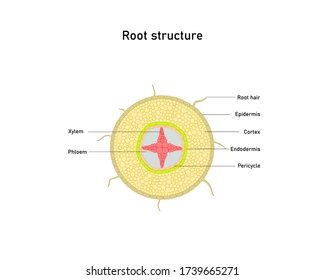
Where is xylem and phloem in roots? What does this do?
Xylem is central and star shaped, phloem is between the xylem cells. This resists vertical stresses and anchors the plant in the soil
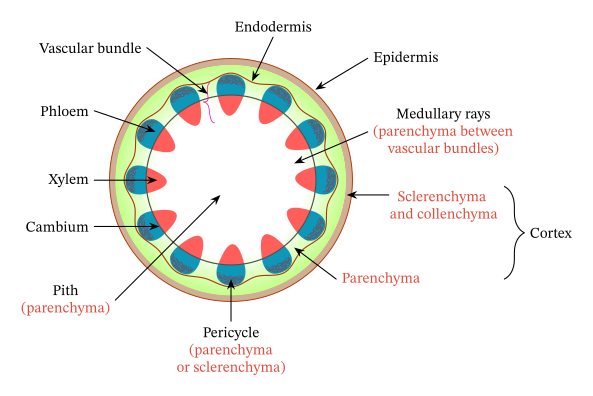
Where is xylem and phloem in stems. What does this do?
Xylem is located toward the center, phloem is found toward the outer edge of the stem. This arrangement supports the plant structurally and flexibly, resisting bending.
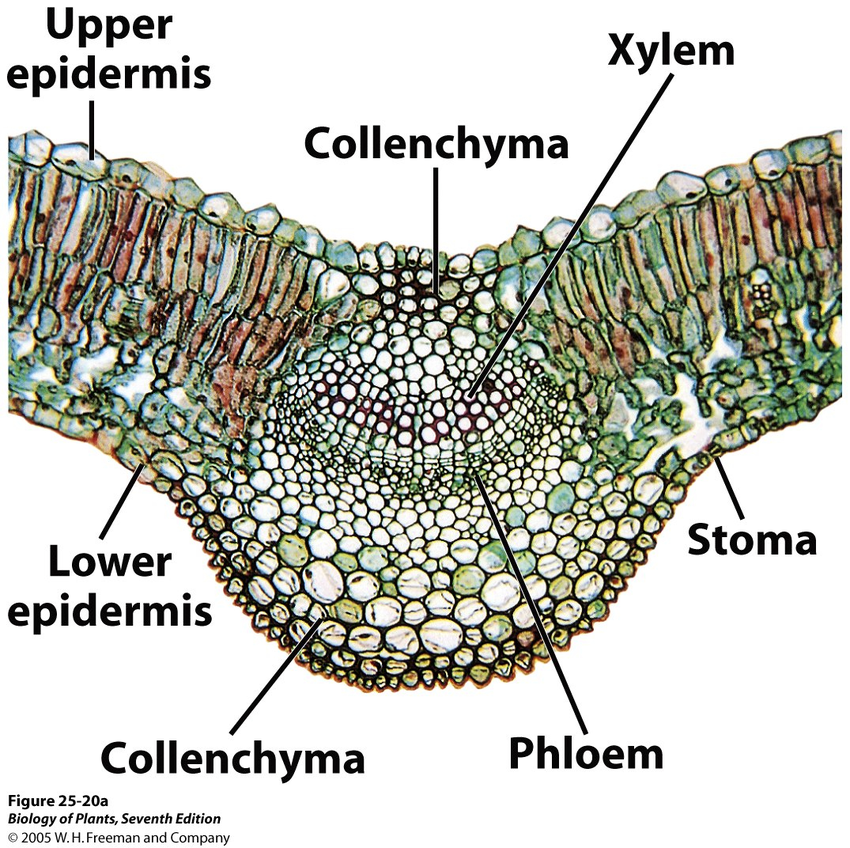
Where is xylem and phloem in leaves. What does this do?
In leaves, xylem is located on the upper side and phloem on the lower side of the leaf veins. This arrangement gives flexible strength and resistance to bending.
open circulatory system
blood is not in vessels e.g. insects
closed circulatory system (+single/double)
blood is in blood vessels e.g. fish or mammals, can be single which consists of a heart with two chambers meaning the blood passes through the heart once for every circuit of the body or double, where the heart has four chambers and blood passes through the heart twice for every circuit of the body
How does water move into root hair cells?
Water moves into root hair cells through osmosis because soil has a higher water potential so cells draw water from the soil.
apoplast pathway
water moves in the cell walls
Symplast pathway
water moves through the cytoplasm of cells via plasmodesmata
vacuoler pathway
water moves vacuole to vacuole
how and why does water leave the apoplast pathway
The endodermis is blocked with a waxy material suberin forming a band called the casperian strip, which is hydrophobic, so prevents water moving in the apoplast. Instead, water and dissolved minerals leave the apoplast and enters the cytoplasm to cross the root
Two explanations for how water moves from the root endodermis into the xylem, across the endodermal cell membranes
Hydrostatic pressure is incresed by active transport of ions intot the endodermal cells or the diversion of water to endodermal cells
Decreased water potential in the xylem by active transport of mineral ions from the endodermis or water being diverted to the endodermal cells
How are minerals taken into plants
Enter the root by active transport to move across the apoplast pathway in solution to be actively transported intot the xylem
Cohesion tension theory
Cohesion + adhesion + root pressure
Cohesion in the xylem
Water molecules are attracted to each other because of the hydrogen bonds explaining why water moves in a continuous column up the xylem
Adhesion in the xylem
Water molecules being attracted to the walls of the xylem, explaining why they don’t move towards with gravity
Capillarity in xylem
The movement of water up a narrow tube (xylem) by capillary action
Root pressure in the xylem
Upward force of water in roots from osmosis
What is translocation?
The transport of soluble organic materials such as sucrose and amino acids in a plant
Why are the products of photosynthesis translocated?
To other parts of the plants called sinks for growth and storage
Structure of phloem
A living tissue, consists of seive tubes and companion cells
Mass flow theory of translocation
Glucose converts to sucrose in palisade cells, sucrose moves to companion cell by facilitated diffusion, then into the phloem down a concentration gradient using ATP. Xylem has a higher water potential than phloem so water enters by osmosis, increasing hydrostatic pressure in the phloem. Sucrose moves from phloem to sink cells by active transport an water enters by osmosis, decreasing hydrostatic pressure of phloem meaning contents of phloem move from source to sink
3 peices of evidence for mass flow theory
Ringing- when bark containing phloem is removed from trees the rings of tissue below die because the source has been cut off, material above ring swells because of fluid accumulation
Aphids- when body is removed from mouthpiece in phloem sap seeps out which proves there’s pressure, sap was postively tested for containing sucrose
Radioisotopes- plants allowed to photosynthesise in radioactive carbon dioxide, phloem shows as radioactive when stem exposed to x-ray film
Limitations of mass flow theory
solutes including sucrose moves through the plant at the same speed, sieve plates appear to impede mass flow
4 factors effecting rate of transpiration
light intensity
temperature
air flow
humidity
how does an increase in temperature effect rate of transpiration
increases rate because it lowers the water potential in the atmosphere, increases kinetic energy which accelerates rate of diffusion
how does an increase in humidity effect rate of transpiration
decrease rate because the air inside a leaf is 100% humid, meaning water vapour diffuses out down a concentration gradient, so the less humid it is, the steeper the concentration gradient
how does an increase in air speed effect rate of transpiration
increase rate because the movement of surrounding air blows away the layer of humid air at the leaf surface, increasing the concentration gradient between the leaf and atmosphere
how does an increase in light intensity effect rate of transpiration
increases rate because light intensity opens stomata wider for CO2 intake for photosynthesis
mesophytes what? habitat? adaptions?
plants that have evolved in conditions with adequate water supply, most crop plants, habitats are well drained soil with moderately dry air, they shed their leaves, have parts die off and become dormant in winter to reduce metabolism, water loss and water requirement
xerophytes what? habitat? adaptions?
plants that have evolved where water is scarce, live in hot, dry conditions or cold regions with frozen soil water or exposed windy conditions, e.g. marram grass in sand dunes, has rolled leaves, sunken stomata, stiff hairs, thick cuticle, stiff fibres
Hydrophytes what? habitat? adaptations?
Plants evolved where water is surplus, grown partially or fully submerged in water, e.g. water lily, little supportive tissues as water is a supportive medium, poorly developed xylem as no need for transport, little cuticle on leaves as no need to reduce water loss, stomata on upper side of leaves, stems and leaves have large air spaces providing buoyancy
3 layers in arteries and veins
Tunica intima
Tunica media
Tunica externa
What is the tunica intimia?
The innermost layer, a single layer of endothelium, smooth lining to reduce friction
What is tunica media?
The middle layer, contains elastic fibres and smooth muscle that allows the blood vessel to stretch to allow for changes in blood flow
What is tunica external?
The outer layer, contains collagen fibres which resist overstretching
Role and structure of arteries
Carry blood away from heart
Thick muscular walls to withstand high pressure
Branch into smaller vessels called atrioles
Role and structure of capillaries
Forms a vast network that penetrates all tissues and organs of the body to deliver nutrients and oxygen
Connect artieres and veins to help organs function
Role and structure of veins
Returns blood to the heart
Large diameter and thin walls with less muscle than arteries
Low blood pressure and flow rate
Semi luna valves ensures blood flows in one direction and prevents backflow
What is a period of relaxation called?
Diastole
3 steps of the cardiac cycle
Cardiac diastole
Atrial systole, ventricular diastole
Atrial diastole, ventricular systole
What’s happening in cardiac diastole?
All chambers are relaxed, blood at a low pressure in the veins flows into the atria, increasing the pressure in the atria, some blood trickles down into the ventricles
What’s happening in Atrial systole, ventricular diasole?
When the atria are full they go into atrial systole so the walls contract, increasing pressure which pushes blood though the valves into the ventricles, this increased the pressure in the ventricles as they fill with blood
What’s happening in Atrial diastole, ventricular systole?
Ventricles contact from the base upwards, increasing pressure due to the contraction, this pushes blood against the atrio-ventricular valves, closing them. The semi lunar valves open under the pressure and the blood leaves the heart, ventricles can relax (diastole) and the semi-lunar valves snap shut behind the blood
What’s meant by the heart is myogenic
The heart controls itself and its contractions rather than from an impulse form the nervous system
Where does the signal for contraction from and what is it called?
From the sino-atrial node and it’s called a wave of depolarisation
Why does the wave not spread into the ventricles?
A band of fibres with high electrical resistance
What passes the wave onto the ventricles, how long is the delay, how is it passed?
The atrio-ventricular node, after a 0.1s delay, passed along the Bundle of His and up the Purkunje fibres
Where is the SAN located?
In the wall of the right atrium
Where is the AVN located?
In the wall between the atrium and ventricle
Adaptations of red blood cells/ erythrocytes
Biconcave shape maximises surface area for gas exchange
Small (7micrometers) and flexible to pass through narrow capillaries
No nucleus to maximise space for carrying respiratory gases
Packed with haemoglobin
Haemoglobin structure and function
4 globular proteins with one iron ion in each
Has an affinity of oxygen (can carry 4 O2 molecules) which allows RBCs to carry oxygen
Why does haemoglobin bind to oxygen?
To maintain the concentration gradient for oxygen to diffuse into the blood from the lungs
When does haemoglobin dissociate from oxyhemoglobin?
In respiring tissue so oxygen can diffuse out of RBCs and into the respiring cells
What is 100% oxygen saturation?
The haemoglobin is carrying its maximum amount of oxygen
What is partial pressure for oxygen?
Amount of oxygen in the tissue
Where is percentage of haemoglobin saturation highest?
In the lungs
Why is it difficult to reach 100% oxygen saturation
After 1 oxygen molecule associates, the haemoglobin changes making it easier for the 2nd and 3rd oxygen molecules to associate but this makes the haemoglobin ‘full’ making it difficult to associate
How does foetal haemoglobin differ to adult?
It has a higher affinity for oxygen meaning at the same partial pressure it will saturate at a higher level than an adults
3 ways that carbon dioxide is transported through the circulatory system
dissolved in plasma, associaton with Hb to form carbamino-haemoglobin, as hydrogen carbonate ions
how are hydrogen carbonate ions formed in RBCs?
CO2 diffuses into cell, dissolves in water producing carbonic acid which dissociates into H+ ions and hydrogen carbonate ions which enter the plasma by facilitated diffusion
what is the catalyst for CO2 dissolving in water?
carbonic anhydrase
why do chloride ions enter the red blood cell in CO2 transport?
to balance the flow of negative charge
how does oxygen leave the RBC in CO2 transport?
hydrogen ions cause oxyhaemoglobin to dissociate into oxygen and hydrogen allowing oxygen to diffuse out of the cell
how is the pH of the RBC prevented from falling
hydrogen ions are removed by binding to the haemoglobin to make haemoglobinic acid
what effect does carbon dioxide concentration have on hemoglobin’s affinity for oxygen +why?
decreases affinity because oxygen is released more readily
what is tissue fluid?
liquid that cells bathe in, acting as a bridge between cell and blood. it leaks out of capillaries
what is lymph?
the same composition as tissue fluid, just found in lymph vessels instead of body cells
What is plasma?
Liquid component of blood, transports nutrients, hormones and waste products
What is the site of plasma?
Blood vessels
Where is tissue fluid found?
Surrounding body cells
Does plasma or tissue fluid have white and red blood cells?
Plasma
Does plasma or tissue fluid have more nutrients?
Plasma
Does plasma or tissue fluid have less oxygen?
Tissue fluid
Which of plasma or tissue fluid has large protein molecules?
Plasma
Does plasma or tissue fluid have a higher water potential?
Tissue fluid
What is the exchange of substances?
Plasma solutes and oxygen move from the blood to the cells and waste products such as CO2 and urea move from cells to the blood
What’s capillaries adaptations for exchange of materials?
Thin permeable walls, large surface area, slow blood flow to allow time for exchange
How is tissue fluid formed?
When blood plasma leaks out of capillaries due to high hydrostatic pressure
What components of the plasma can’t leak out of capillaries?
Red blood cells or large proteins as they are too big
What % of tissue fluid becomes lymph fluid
10%