My Parents
 Call Kai
 Learn
Learn Practice Test
 Spaced Repetition
 Match
Match Flashcards
 Knowt Play
1/8

There's no tags or description
Looks like no tags are added yet.
Name | Mastery | Learn | Test | Matching | Spaced | Call with Kai | Chat |
|---|
No analytics yet
Send a link to your students to track their progress
9 Terms
Main themes in 'My Parents' by Stephen Spender
Social class division, parental overprotection, social isolation, childhood vulnerability vs. aggression, and unrequited desire for acceptance.
Structure and stanza form of 'My Parents'
Three four-line stanzas (quatrains) written in free verse without a regular rhyme scheme, mirroring the speaker's fractured emotions and lack of harmony.
'threw stones and who climbed cliffs / And stripped by the country streams'
showing their unrestricted freedom, wild energy, and connection to nature.
'Their words were like muscles tossing on the arms',
presenting their speech as a physical force that causes tangible pain and intimidation.
'They barked at my knees like dogs'
dehumanizing the boys as feral, hostile, and predatory toward the speaker.
'lisp' and 'pretended to smile',
showing extreme self-consciousness, physical fragility, and defensive concealment of pain.
'I longed to forgive them, but never smiled'
Highlights the speaker's desperate desire for friendship and reconciliation, contrasted against the boys' persistent cruelty and mocking indifference.
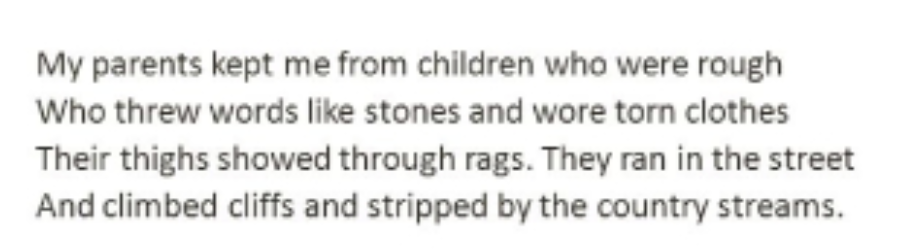
Vivid verb “kept me”
emphasises the segregation between these two wealth groups, suggesting how they are portrayed as dangerous. The parents are positioned in a protective, almost suffocating manner towards the speaker.

“children who were rough” vivid adjective
Presents working-class children in a negative way, suggesting a perceived lack of refinement