Psych of lang final (lectures and textbook)
 Studied by 3 people
 Call Kai
 Learn
Learn Practice Test
 Spaced Repetition
 Match
Match Flashcards
 Knowt Play
1/212

Earn XP
Description and Tags
sorry if things overlap from lectures to textbook! but if they do that means they are probably the most important :)
Name | Mastery | Learn | Test | Matching | Spaced | Call with Kai |
|---|
No analytics yet
Send a link to your students to track their progress
213 Terms
Monolingual
A person who can speak only one language
Key points:
Less common globally
Most common in countries with little linguistic diversity
Bilingual
A person who can speak two or more languages.
Key points:
Most people in the world are ____
____ rarely speak all languages with equal proficiency
Balanced Bilingual
A person who grows up speaking two languages and can communicate equally well in both.
Key points:
Very rare
Both languages have equal proficiency in speaking, understanding, reading, and writing
Unbalanced Bilingual
A bilingual person with greater proficiency in one language (dominant language).
Key points:
Most bilinguals fall into this category
The weaker language is often the second language (L2)
Language–Dialect Distinction
The distinction is more political than linguistic.
Examples:
French vs Italian → separate languages because separate countries
Chinese “dialects” → often not mutually intelligible but considered one language
Dialect
A regional or social variety of a language.
Examples:
British English vs American English
Southern vs Northern dialects
Mutual Intelligibility
The degree to which speakers of two varieties can understand each other.
Examples:
American and British English → mutually intelligible
Mandarin and Cantonese → not mutually intelligible
Social Attitudes & Mutual Intelligibility
Key insight:
Understanding is influenced by social bias, not just linguistic ability
Example: Scandinavian languages
Swedes understand Danish poorly
Danes understand Swedish well
Preschool children understand both equally → bias develops in adulthood
Heritage Language
The language spoken at home and tied to family and cultural identity.
Key points:
Easier for expressing emotions and family topics
Often maintained by first-generation immigrants
Societal Language
The language spoken by the majority in a society.
Key points:
Used for school, work, and public life
May feel easier for abstract or formal topics
First generation
keep heritage identity, speak societal language with accent
Accent switching can occur depending on social group
Second generation
aim to assimilate, speak societal language with local accent
Accent switching can occur depending on social group
Codeswitching
Switching between languages within a single conversation or sentence.
Key points:
Can happen between sentences or mid-sentence
Seen even in young bilingual children
Rule-governed, not random
Organization of the Bilingual Mind — Lexical Decision Task
Participants decide quickly whether a letter string is a real word.
Key finding:
Bilinguals activate both languages simultaneously
Example:
NOCHE → not English, but Spanish word
Slower reaction time for Spanish-English bilinguals
Cross-Language Priming
A word in one language speeds recognition of a related word in another language.
Example:
German ARZT → primes English NURSE
Depends on number of shared senses
L2 → L1 priming more likely
L1 → L2 priming less likely
Eye-Tracking Evidence
Words are recognized before they’re fully spoken.
Example:
Russian marka → stamp
English marker
Russian-English bilinguals look at both objects
Translation Equivalents
Words in different languages referring to the same concept.
Example:
dog ↔ chien
Mutual Exclusivity (Children)
Children assume a new word refers to a new concept.
Key exception:
Bilingual children do not apply this across languages
Shows awareness of two linguistic systems
Cognates
Words with similar form and meaning across languages.
Examples:
English–German (shared origin)
English–French (borrowing)
Interlingual Homographs
Words that look the same across languages but differ in meaning.
Key point:
Both meanings are briefly activated
Examples:
German Gift → poison
German Chef → boss
Dutch spot → mockery
The Bilingual Disadvantage — Observed Disadvantages
Smaller vocabulary in each language
More difficulty retrieving words
More tip-of-the-tongue states
Important:
Measurable in labs
No major impact on daily communication
Tip-of-the-Tongue (ToT)
Temporary inability to retrieve a known word.
More common when:
Word is low frequency
Speaker is bilingual
Lexical Decision Differences — Monolinguals
rely on surface familiarity
Lexical Decision Differences — Bilinguals
rely on meaning
Bilinguals process semantics even for nonwords
Explaining the Bilingual Disadvantage — Weaker Links Hypothesis
Bilinguals use each word less often
Lower frequency → weaker memory links
Leads to slower lexical access
Interference Hypothesis
Both languages are always active
Translation equivalents compete
Requires constant inhibition
Example:
DOG vs CHIEN interference
Models of the Bilingual Lexicon — Revised Hierarchical Model
Separate lexicons for each language
Shared conceptual system
Strength of links depends on proficiency
Balanced bilingual:
Strong links both ways
Unbalanced bilingual:
Easier L2 → L1 translation
Priming mostly L1 → L2
Sense Model — Core Idea
Words have multiple meanings (senses) that don’t fully overlap across languages.
Concrete words
more shared senses
Faster translation
Abstract words
less overlap
Picture Naming Evidence
Chinese-typical images → faster in Chinese
Western-typical images → faster in English
Meaning includes sensory & visual information
The Bilingual Advantage — Metalinguistic Awareness
Understanding how language works.
Benefits:
Better communication
Greater creativity and problem solving
Adaptive Control Hypothesis
Language control strengthens general cognitive control.
Result:
Better multitasking
Faster task switching
Executive Control Components
Interference inhibition
Selective attention
Mental flexibility
Simon Task
An experimental procedure that requires participants to respond to the colour of a stimulus regardless of its location
Bilinguals show less slowdown on incongruent trials
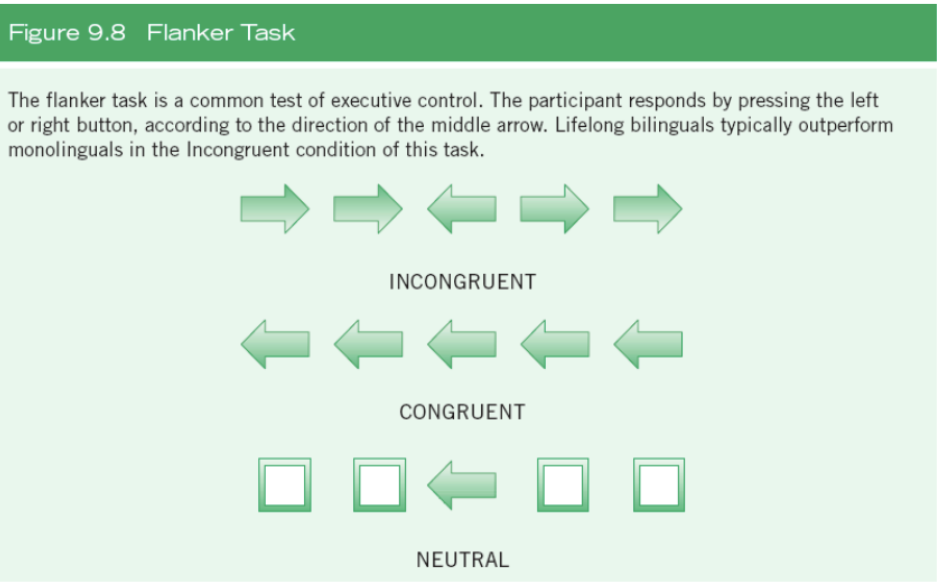
Flanker Task
Measure of executive control
Participants respond to direction of central arrow, regardless of direction other arrows are pointing
Executive Control Across Lifespan — Monolinguals
peaks in young adulthood
EC low in childhood, peaks in young adulthood, declines in later adulthood
Executive Control Across Lifespan — Bilinguals
develops early, remains high
Language Development (Infancy) — Protoconversation
Early social exchanges between an infant and a caregiver that resemble conversations even though the infant is not yet using words.
Protoconversation (more details)
Key characteristics:
Turn-taking (infant does not vocalize over caregiver)
Mutual gaze
Facial expressions
Gestures
Vocalizations
What infants learn (before words):
Conversational timing
Volume and pitch
Emotional expression
Gestural communication (e.g., pointing)
Why it matters:
teach the structure of conversation long before language itself develops.
Infant Attention to Face (Eyes vs Mouth)
Developmental pattern:
~4 months: Infants focus mostly on the caregiver’s eyes
5–12 months: Shift attention more to the mouth
After 12 months: Shift back to the eyes
Why the shift happens:
Mouth provides articulatory information for speech sounds
Eyes provide emotional and social information
Language Comprehension Difficulty & Visual Attention
When comprehension is difficult, both infants and adults look more at the speaker’s mouth
Examples:
12-month-olds hearing an unfamiliar language
Adults listening to a language they don’t understand
Conclusion:
Looking at the mouth supports speech perception; looking at eyes supports emotion understanding.
Speaker Variability
Early stage:
Infants initially encode words with:
Speaker voice
Accent
Emotional inflection
By 7–8 months:
Infants recognize familiar words across different speakers
Can generalize across prosodic contexts
Prosodic context
Rhythm, stress, and intonation of speech
Walking & Talking — Motor Development as a Catalyst
Motor development triggers advances in cognitive, social, and language development.
Babbling & Motor Rhythms — Reduplicated babbling
Repeated CV syllables (e.g., da-da-da, ma-ma-ma)
Babbling & Motor Rhythms — Timing
Emerges around same time as rhythmic arm movements (e.g., shaking a rattle)
Babbling & Motor Rhythms — Interpretation
Shared neural capacity for rhythmic movement in limbs and speech articulators.
Self-Locomotion & Language Explosion
Key milestone:
Crawling or walking
Effects:
Active exploration
Hands free to manipulate objects
More independent interactions
Why language improves:
More objects encountered → more labels needed
More caregiver speech
More complex social interactions
Walking Changes Communication
New communication dynamics:
Toddler asserts will
Challenges authority
Begins “talking back”
Result:
Rich sociolinguistic interactions
Vocabulary spurt in second year
Practical reason parents talk more:
To keep the child safe (“stop,” “don’t touch,” etc.)
Caregiver Interaction — Business Talk
Caregiver speech focused on instructions and prohibitions.
Examples:
“Stop.”
“Don’t touch that.”
“Drink your milk.”
Risk:
If dominant, increases likelihood of language delays or disorders.
Caregiver Interaction — Descriptive Talk
Speech that labels objects and comments on shared attention.
Examples:
“That’s a wagon.” to a one year old
“That’s a red wagon like yours.” to a two year old
Why it matters:
Drives higher-order language development
Encourages vocabulary growth and syntax
Key principle:
Language development thrives on talk with no immediate goal.
Critical Period
A biologically determined window during which language must be acquired for full proficiency.
Case Studies — Genie
Extreme deprivation
Failed to acquire full grammar
Evidence for critical period
Case Studies — Victor (Wild Boy of Aveyron)
Lived without language input
Limited success learning language
Case Studies — Oxana Malaya
Lived with dogs
Later acquired language
Shows some plasticity but limits remain
The Preschool Years — Fast Mapping
Learning a new word after one or two exposures.
Age:
Begins around 2 years
Limitation:
Memory for word may fade without reinforcement
The Preschool Years — Slow Mapping
Gradual consolidation of a word’s pronunciation and meaning over multiple exposures.
Importance:
Essential for long-term vocabulary development
Lexical Configuration
Result of fast mapping
Linking sound → meaning
Lexical engagement
Result of slow mapping
Linking word to other known words and concepts
Mental Lexicon Structure
Words are connected by:
Synonyms
Antonyms
Categories
Co-occurrence frequency
Key insight:
Vocabulary is a network, not a list.
Preschool Categories — Category Hierarchies
Superordinate (animal)
Basic level (dog) ← learned first
Subordinate (dalmatian)
Basic Level Categories
Categories that are neither too broad nor too specific.
Examples:
Dog
Chair
Why its important:
Cognitively salient
Learned first
Scaffold learning of other categories
Syntax Development — Pattern-Based Learning
Preschoolers rely on familiar word sequences
Example:
Easier: sit in your chair
Harder: sit in your truck
Conclusion:
Abstract grammatical rules emerge later.
Oral Language & Academic Success
Strong predictor:
Oral narrative ability in kindergarten
Assessment method:
Picture-based storytelling
Skills involved:
Pronunciation
Vocabulary
Syntax
Discourse structure
Oral language supports
Reading
Writing
Math
Decoding
Converting print into spoken word forms.
Requires:
Print knowledge
Alphabet knowledge
Phonological awareness
Short- and long-term memory
Phonological Short-Term Memory
Role:
Holds sound sequences during decoding
Poor readers:
Forget beginning of word before reaching the end
Working memory overload
Orthography
Spelling system of a language
Deep Orthography (English)
Inconsistent mapping between letters and sounds
Examples:
Tough
Though
Through
Bough
Consequence:
Readers rely heavily on spoken vocabulary.
Vocabulary Growth
Growth continues throughout life
Most rapid during school years
~40,000 words learned between grades 1–12
Vocabulary & Literacy
Large vocabulary → reading success
Small vocabulary → academic risk
Contextual Abstraction
Inferring word meaning from surrounding text.
Depends on:
Word difficulty
Text complexity
Number of unknown words
Morphological Analysis
Breaking words into morphemes to infer meaning.
Example:
violinist → someone who plays violin
Morphological Awareness
Understanding that words contain meaningful units.
Improves with instruction
Adulthood & Aging — Auditory Decline
Sensory level:
Cochlear damage
Perceptual level:
Brain processing changes
Compensation Strategies — Older adults
Have larger vocabularies
Use context and semantics
Rely on pragmatic knowledge
Elderspeak
Simplified speech used with older adults.
Features:
Slow rate
Simple sentences
Repetition
Parallel:
Infant-directed speech
Language Development (Adolescence) — Teen Speech Characteristics
Fillers: like, you know
Speed prioritized over accuracy
More errors in demanding tasks
Syntax vs Vocabulary
More complex syntax
Simpler vocabulary
More fillers
Breath Pausing
Fewer pauses
Pauses at major linguistic boundaries (sentences)
The Whorf Hypothesis (Sapir–Whorf)
The language we speak affects how we think and perceive the world.
Linguistic Determinism (Strong Version)
People can only perceive and categorize the world according to the structures provided by their language.
Implication:
Thought is constrained by language
Without words for something, you cannot think about it
Status:
Generally rejected as too extreme
Linguistic Relativity (Weak Version)
The language people speak influences (but does not determine) how they perceive and think.
Status:
Widely accepted
Innatism
Perceptual and cognitive processes are not influenced by language at all.
Position on spectrum:
Innatism ← Linguistic Relativity → Linguistic Determinism
Language & Thought — Verbal Thinking
Inner dialogue
Language-based reasoning
Language & Thought — Visual Thinking
Mental imagery
Spatial representations
Aphantasia
Inability to voluntarily form mental images.
Significance:
Demonstrates individual differences in thinking styles
Whorf’s Observations (1956)
Much conscious thought is linguistic
Languages carve up the world differently
Conclusion:
Language must influence thought
Colour Perception
Visible light spectrum is continuous
Humans perceive discrete colour categories
Language Differences
Languages differ in number of basic colour terms
Supports linguistic relativity
Universal Patterns
Common colour category centers across languages
Supports innatism
Focal Colours
Best example of a colour category.
Six universal focal colours:
Black
White
Red
Green
Yellow
Blue
Categorical Perception of Colour — Sorting Task
Participants sort colour chips into groups.
Findings:
Blue–green speakers sort into two categories
Grue speakers (one word for blue & green) sort differently
Grue Speakers
Speakers whose language has one term for both blue and green.
Boundary Disagreement
Blue–green speakers agree on boundary
Grue speakers disagree
Delayed Match-to-Sample Task
Procedure:
See target colour
Delay
Choose which item matches
Result:
Blue–green speakers perform better on blue vs green distinctions
Ekman’s Universal Emotions
Original six:
Happiness
Sadness
Fear
Surprise
Anger
Disgust
Later added:
Contempt
Picture Naming Task
Participants name emotion in face
Large variability within and across cultures
Picture Matching Task
Decide if two faces show same emotion
Even more disagreement
 Note
Note  Flashcards (142)