Developments in Investigative Interviewing
 Studied by 0 people
 Call Kai
 Learn
Learn Practice Test
 Spaced Repetition
 Match
Match Flashcards
 Knowt Play
1/18

There's no tags or description
Looks like no tags are added yet.
Name | Mastery | Learn | Test | Matching | Spaced | Call with Kai |
|---|
No analytics yet
Send a link to your students to track their progress
19 Terms
Investigative Interviewing
Complex task that requires
building rapport and trust
ask right questions at right time
Basic knowledge of human memory
Professional knowledge and competence
Not easily learned
Helps get detailed account from cooperative interviewees
Issues can be addressed by interviewer
Building rapport
Provision of retrieval support (mental context reinstatement; memory compatible free report; non-leading cues/prompts)
Giving sufficient time and appropriate conditions for retrieval
Setting expectations for detail
instructions to promote completeness and accuracy
Giving interviewee control of the report
Investigative Interviewing - Cooperation
Investigators and witness working together to get information
Cooperativeness = willingness to co-operate with investigation
Investigator rely on
Witness memory
Witness cooperation
Cost benefit analysis of cooperation
Crime witnesses cooperation – series of decisions
Decision to report crime – evidence of under reporting
Decision to report remembered crime information in the interview
Decision to act as witness in court
For information to be disclosed there has to be some positive elements of appraisal
Some benefit to the disclosure that outweighs the cost of reporting
Witness disclosure of information results from positive subjective appraisal of benefits outweigh the costs of cooperation
Conversely high costs with no perceived benefits of cooperation negatively affects disclosure of information
Interviewing techniques have the potential to influence interviewee’s disclosure by reducing perceived costs and increasing benefits
Investigative Interviewing - Cost benefit analysis of cooperation
series of decisions
Decision to report crime
Decision to report remembered crime in interview
Decision to act as witness in court
Has to be benefit to disclosure that outweighs the cost of reporting
Witness disclosure of information results from appraisal of benefits outweigh the costs of discoloured
Interviewing techniques can influence interviewee’s disclosure by reducing perceived costs and increasing benefits
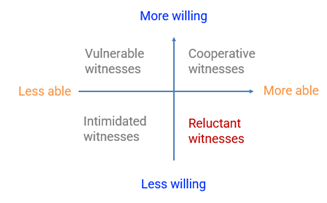
Reluctant Witnesses
Reluctant witnesses
can remember but unwilling to give detailed statements
due to motivational factors not cognitive limitations
Prevalence of reluctant witness
5-49% of reluctant witness reported by officers in England (Wheeler et al. 2017)
Netherlands, England and Sweden reported encountering uncooperative witnesses frequently (study)
consider lack of cooperation an obstacle to information elicitation
Witnesses have civil duty but not legal obligation to cooperate
Reluctant Witnesses - Cooperation
Lack of cooperation in interview
Witness unwilling:
Intimidated
Hostile toward police
Resistant to engage with system
Reluctant to talk

Relectuant witnesses - Techniques
Verbal
Unrelated topic
Little or well known information
incomplete information
Minimistaion pleas
Passive verbal
Monosyllabic responding
Claiming lack of memory/knowledge
Passive
Silence
Lack of engagement
Active avoidance
humour to deflect
Minimal responding
Challenging the question
Denying the information
Fabricating information
Handicapping excuses
Reluctant Witnesses - Ministry of Justice Guidance
Establish reasons for witnesses reluctance
Special measures for intimated witnesses
Build rappot
No pressure on witnesses to speak to police
Records – notes or video
Advice and supervision
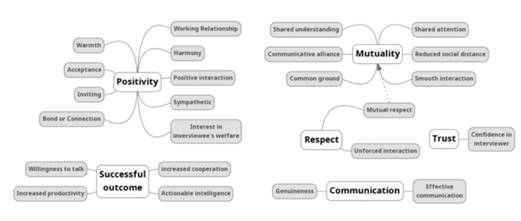
Rapport
Building Rapport
rapport has been found to gain more detailed and accurate memory reports
What is rapport
Lots of definitions but they are describing the same thing
Perception of having positive interaction, connection between two interactants
Working relationship between operator and source based on mutually shared understanding of goals and needs
Rapport - Witness interviews
agreed that it important to conduct effective interviews
rapport elicit significantly more detailed and accurate memory reports
Rapport refers to ‘quality of the interviewer-interviewee interpersonal interaction
Rapport Building Techniques
Verbal
Active listening
Showing personal interest
Reciprocity
Self-disclosure – stating you understand their experience (trying to understand the situation their in)
Empathetic responses
Use of interviewee’s name
Non-verbal
Smiling
Head-nodding
Eye-contact
Open body language
Para-verbal
Tone of voice
Self-administered interview
Obtaining detailed accounts at the scene of an incident or shortly after
Large number of witnesses at a crime
Identify key witness and prioritized for interview
Limited resources = delay before interview
In this period memory is
Prone to forgetting
Prone to distortion or error
SAI Content
Explicit about what is expected from witnesses
Instructions and questions that provide retrieval support
Core mnemonic components from Cognitive Interview:
Mental Reinstatement of Context instructions
Report Everything instructions
Open ended report
Non-leading cues and prompts
Repeated warning about guessing
Emphasis on providing accurate information
Sketch prompt
Other people or vehicles present
Witnessing conditions
Distance
Time spent encoding
Obstruction
Lighting
Weather
SAI - Findings
Empirical Research
Since 2006 the accuracy of this has been tested
It been translated into at least 15 different languages
Overview of key findings
The SAI instructions produce significantly more correct information than a standard recall instruction – at equivalent accuracy rate
Completing an SAI after witnessing a (mock) crime:
Reduces forgetting over a delay
Maintains high accuracy rates
Preserves descriptive details
Protects against memory distortions caused by exposure
Enhances performance in a subsequent Cognitive Interview
SAI - Case Studies
8 key witnesses
But also load of other witnesses
88% of selected witnesses completed an SAI
SAI identified three additional important witnesses
SAI allowed for extra charges to be brought
Timeline Technique
Extracting information about ‘who did what and when?’
Better for linking people to action if multiple people were present ‘I was there but didn’t do anything’
What is it
Initial reporting process to maximise memory
A self-administered technique designed to optimize an interviewee’s ability to
recall and report a particular time period in sequence
identify individuals involved
link those individuals with specific actions
Uses a ‘timeline’ of the relevant time period to provide a structure for remembering and reporting
Can be used to facilitate a comprehensive (initial) download’ of information for time periods of interest
Timeline Technique - Adaptability of ‘timeline’ approache
Adaptability of ‘timeline’ approaches
Common ‘sense-making’ tool in investigation
timeline
Common technique in autobiographical memory research
Historical ‘timeline’ and calendar techniques (EHC) increasingly used technique in social and medical surveys
For autobiographical information, timeline formats enhance recall accuracy
Particularly when recall task is difficult
Timeline Approach - assist retrieval
Memory search theories highlight the important role of temporal context for memory
Retrieval process is guided by internal context representation, produces organisation effects
Temporal-contextual cues play an important role in retrieval processes
Episodic memory systems stores information about temporally dated episodes or events
Allow people to write things down and put it where it fits on the timeline rather than trying to remember things in order and forgetting certain things that spring to mind
Timeline Approach - Recalling Multiple People
Timeline technique helps reporting more correct information about who did what and when
Without externally generated memory cue or prompts
Enhanced reporting of group conversations
What does SAI and timeline technique offer investigators
Standardised multi-purpose reporting approach
SAI: major incidents, public order, road collisions
Timeline: extended or complex events involving multiple people or time periods
Cooperative witnesses can provide initial accounts efficiently – without being led by interviewer
Elicits relevant information with high levels of detail/accuracy
Facilitates the effective prioritisation of witnesses and/or interviewee topics
Can be used in combination with other good practice techniques (e.g. Cognitive Interview)
 Note
Note  Flashcards (20)