research exam 2: wk 7 content
 Call Kai
 Learn
Learn Practice Test
 Spaced Repetition
 Match
Match Flashcards
 Knowt Play
1/61

Earn XP
Description and Tags
intro to quantitative research, experimental vs quasi-experimental designs
Name | Mastery | Learn | Test | Matching | Spaced | Call with Kai | Chat |
|---|
No analytics yet
Send a link to your students to track their progress
62 Terms
measures of central tendency (3) in descriptive statistics (& the purpose)
describe the typical value of the dataset
mean, median, mode
measures of variability/spread in descriptive statistics (3)
** describe how spread out or clustered the data is
range: difference between highest & lowest values
standard deviation: avg distance of scores from mean
variance: SD squared
descriptive statistics purpose
summarize the data
** think central tendency & spread
inferential statistics
allows researchers to draw conclusions about a population based on sample data; used to test hypothesis
** infer or generalize conclusions from data
t-test
inferential test compares means of 2 groups
ANOVA
inferential test compares means of 3+ groups
Chi-square
inferential test examines relationships between categorical variables
Correlation (Pearson’s r)
inferential test examines the strength/direction of a relationship between 2 variables
null hypothesis (Ho)
NO relationship or difference between variables
** researchers use statistical tests to decide whether to REJECT or FAIL TO REJECT Ho
alternative hypothesis (Ha)
there is a relationship or difference between variables
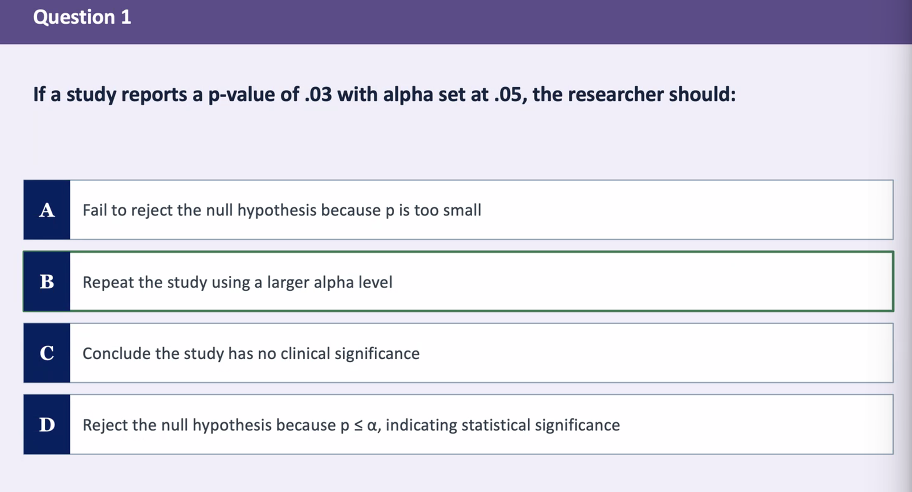
is the p-value statistically significant?
D. reject the null hypothesis
rationale: p-value is .03 which is less than alpha (.05) thus reject Ho
if p-value is less than or equal to .05 (alpha) → results are statistically significant → reject Ho
if p-value > a → fail to reject Ho
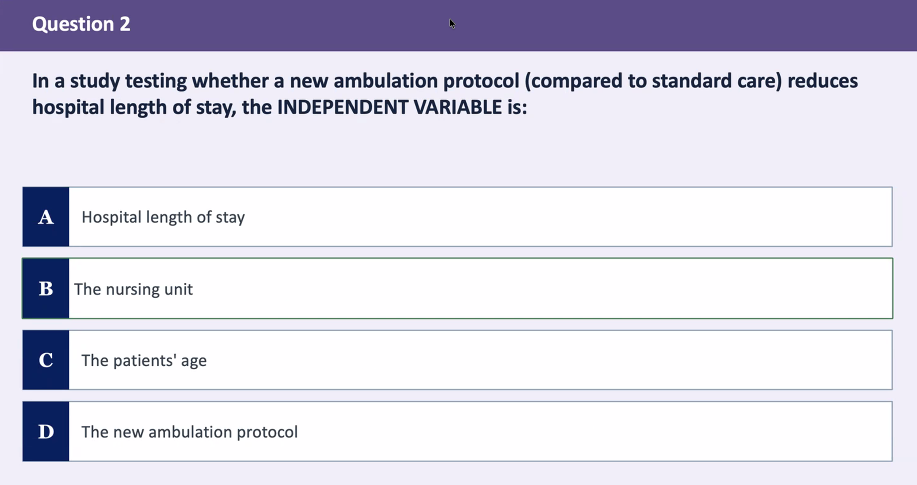
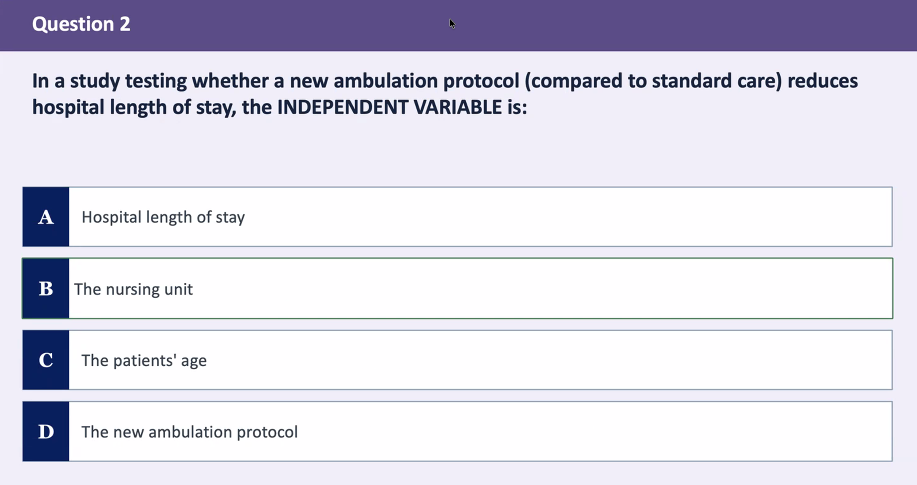
what is the independent variable
D. the new ambulation protocol
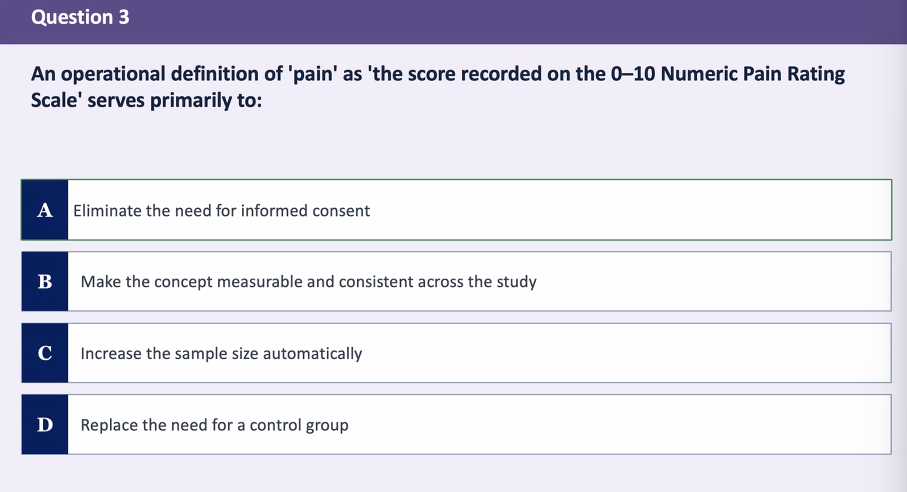
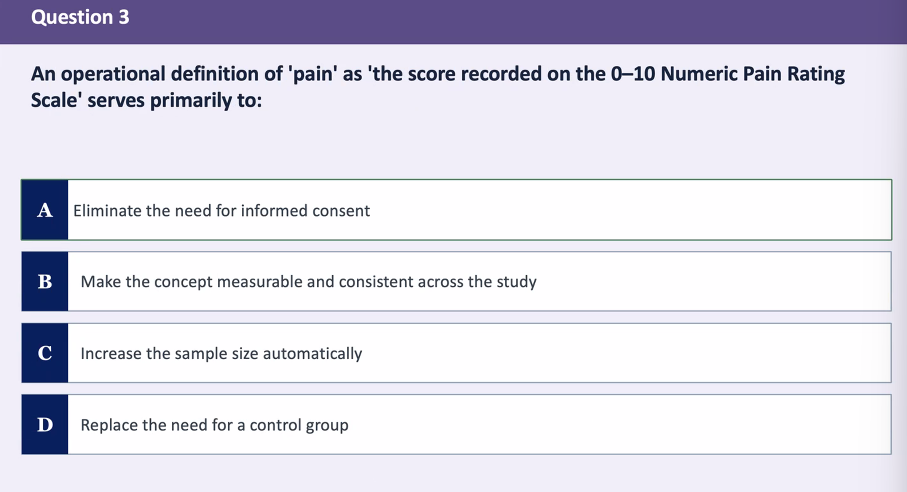
purpose of operational definition
B. make the concept measurable and consistent across the study
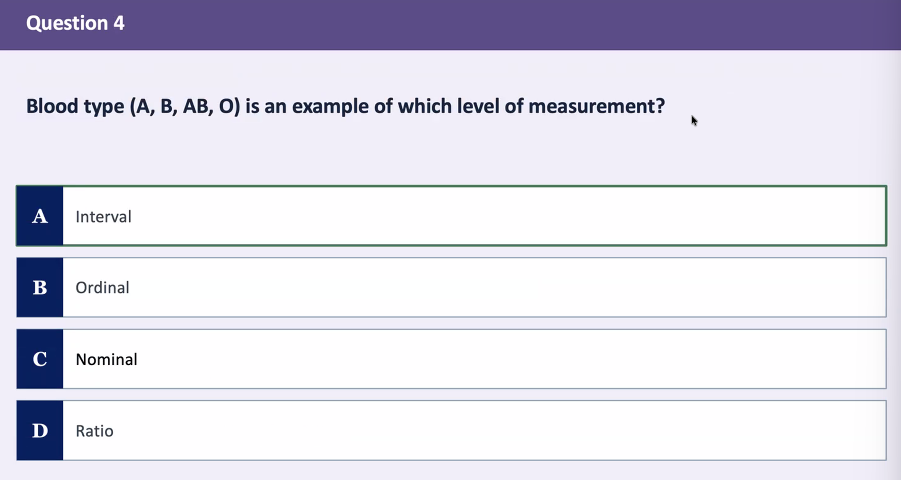
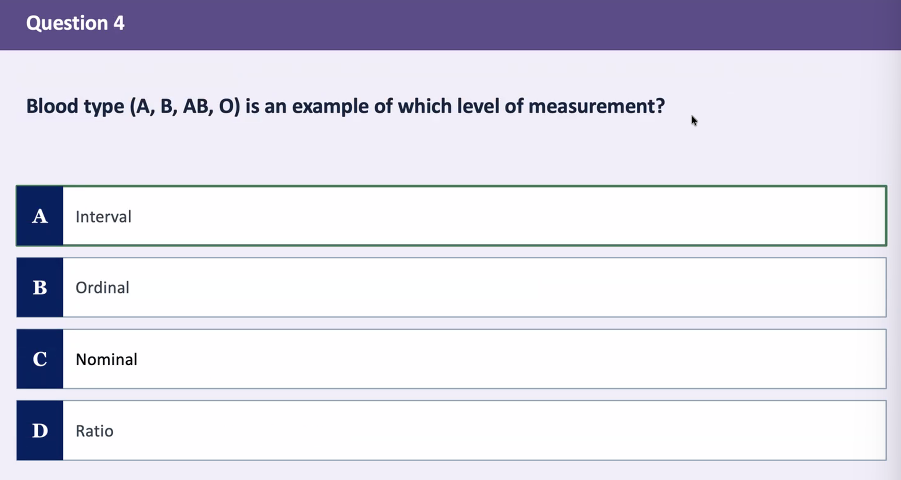
what is the level of measurment?
C
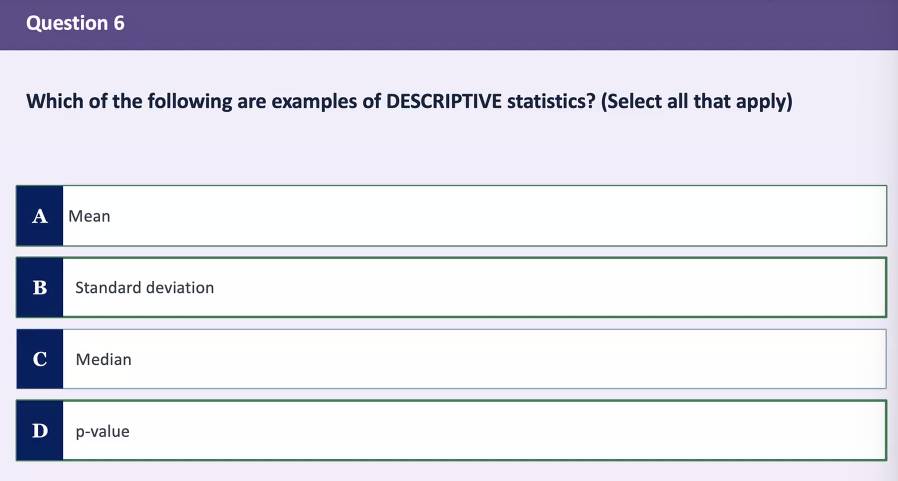
SATA
A, B, C
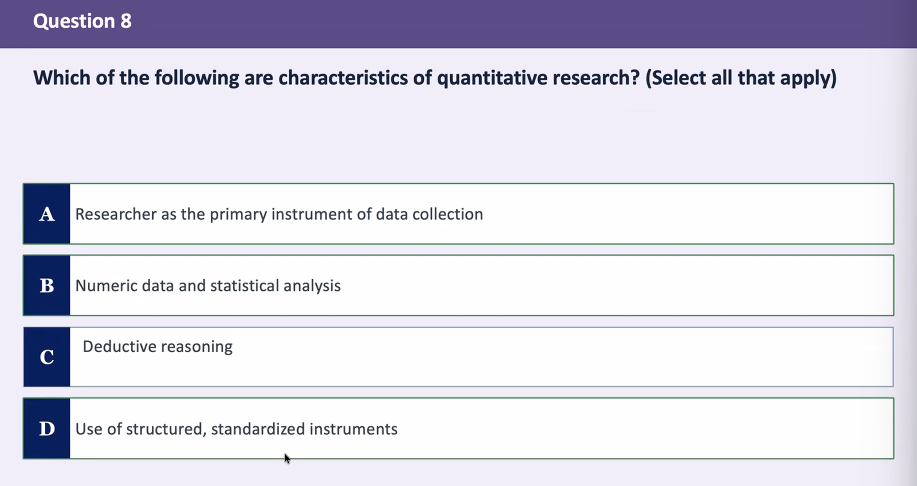
B, C, D
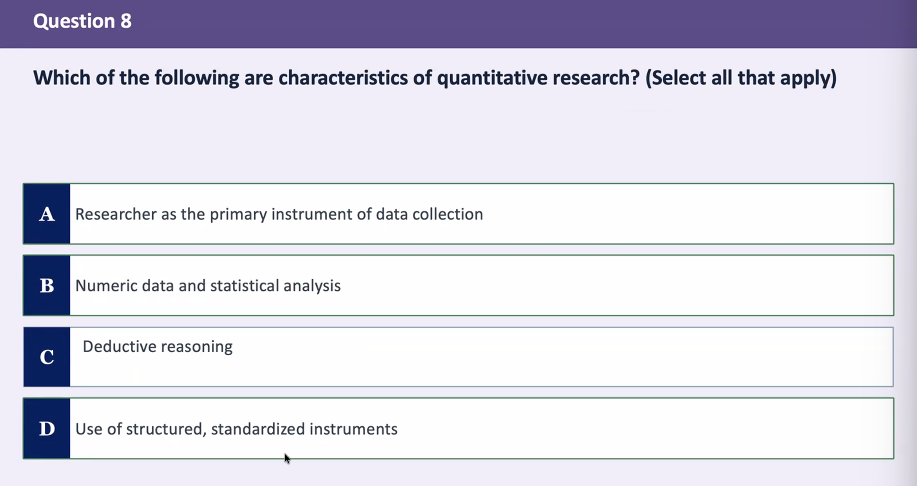
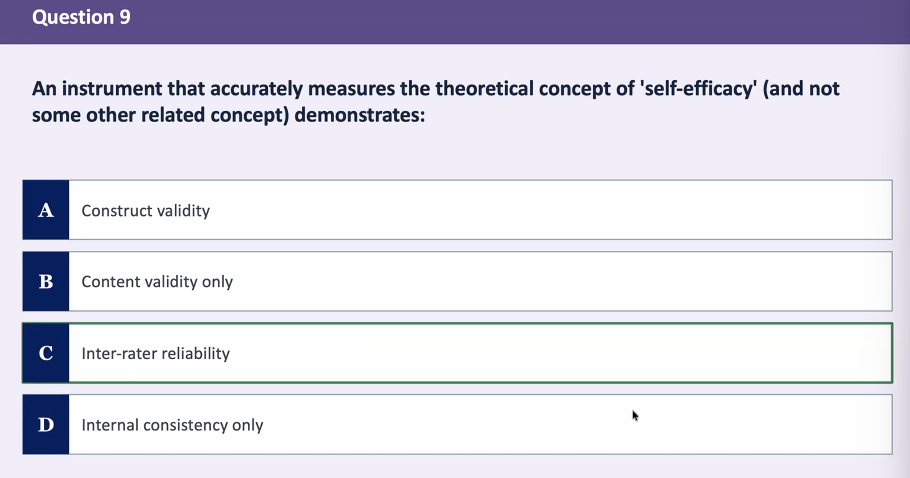
A
3 defining features of true experimental designs
Randomization: every subject has an equal chance of being assigned to any group; distrubutes known & unknown cofounders evenly
Control: control/comparison group is used to evaulate the effect of the IV
Manipulation: researcher actively manipulates the IV
experimental design notations standard symbols:
R
X
O
R = random assignment to groups
X = treatment/intervention (manipulation of IV)
O = observation/measurement (pretest or posttest)
pretest-posttest control group design
R O2 X O2 - experimental group
R O1 (no intervention) O2 - control group
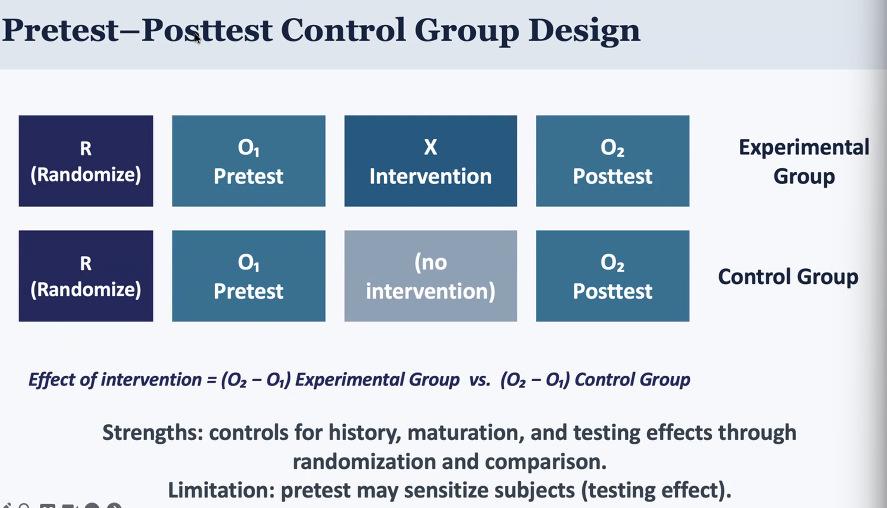
posttest-only control group design
R X O
R (no intervention) O
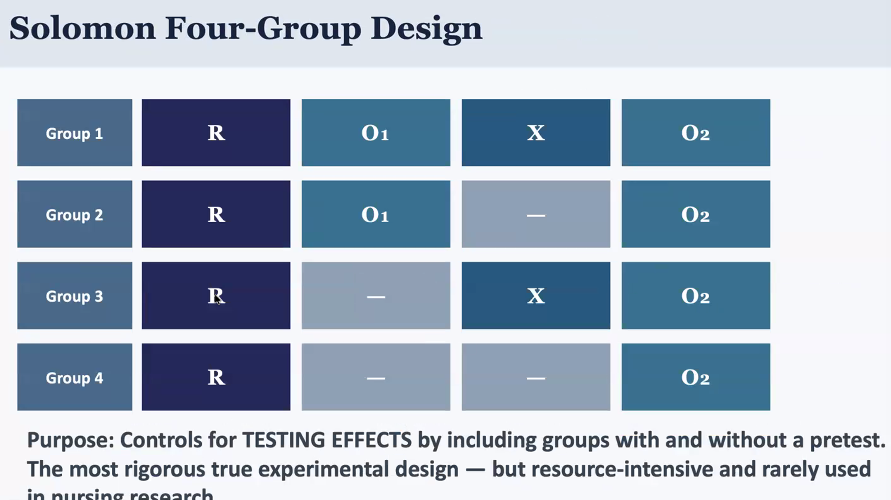
explain solomon four-group design (purpose)
CONTROLS FOR TESTING EFFECTS
most rigorous true experimental design; resource-intensive, rarely used in nursing research
posstest-only control group design
R X O - experimental group
R O control group
subjects randomized to groups, NO pretest given
random controlled trial (RCT)
a true experimental design, gold standard for testing intervention effectiveness (STRONGEST evidence for cause-and-effect relationships, Level II)
strengths of true experimental designs (5)
strongest design for establishing cause-and-effect
randomized controls for known and unknown confounders
highest level of quantitative evidence (Level II)
findings support strong clinical recommendations
replicable methodology
limitations of true experimental designs (5)
may not be ethical or feasible (cannot randomize all variables)
highly controlled settings may reduce real-world applicability (external validity)
costly & time-intensive
Hawthorne effect: subjects may alter behavior because they know they’re being studied
attrition can compromise randomization over time
quasi-experimental designs
shares goal of testing cause-and-effect BUT lacks 1+ features of a true experiment; Level III evidence, weaker than RCT but stronger than non-experimental designs
used when…
randomization is not ethical
randomization is not feasible
natural experiments
time-series design
a single group is measures repeatedly before and after an intervention
PURPOSE: multiple measurements before intervention establish a stable BASELINE TREND, multiple measurements after intervention show there the trend CHANGES
repeated-measures design
same subjects are measured multiple times under different conditions
each subject serves as their own control → reduces variability d/t individual differences
crossover design - what is it, key limitation, useful for?
subjects receive ALL interventions being studied but in different sequences/order
washout period: a time interval between treatments to allow effects of the first treatment to dissipate
carryover effect: when the effect of the first treatment persists and influences the second treatment’s results (KEY LIMITATION)
useful for studying interventions w/ REVERSIBLE, short-term effects
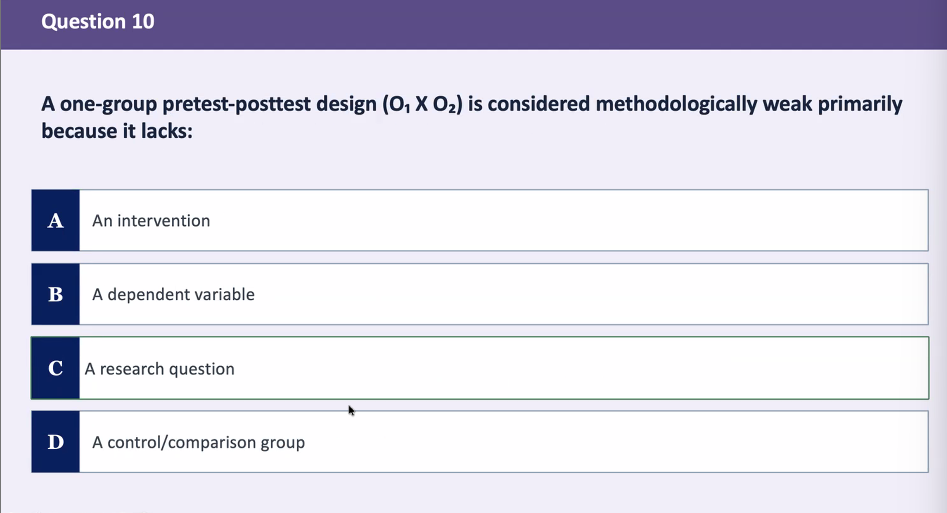
one-group pretest-posttest design - what is it, what is it missing
O1 X O2 - a single group is measured, given the intervention, measured again
weakest design b/c NO control group
vulnerable to history, maturation, testing effects (weak internal validity)
aka pre-experimental
static-group comparison design
X O (Group A) / O (Group B) - 2 existing groups compared, no pretest, no randomization
cannot determine if groups were equivalent before the intervention
sometimes used in pilot/feasibility studies but conclusion must be very cautious
what is internal validity
how well a study demonstrates that changes in DV are caused by IV, not other uncontrollable factors
threats to internal validity in experimental research (8)
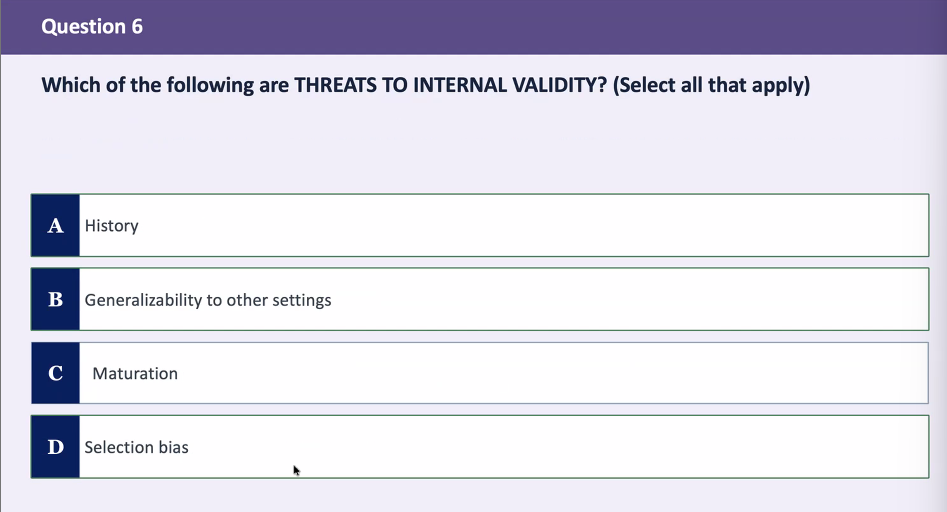
history, maturation, testing, instrumental, selection bias, mortality/attrition, statistical regression, diffusion of treatment
history
an event outside the study occurs between pretest and posttest, affecting the DV (e.g., a hospital policy change)
**threat to internal validity
testing
taking a pretest influences performance on the posttest (practice effect)
**threat to internal validity
maturation
natural development, biological, or psychological changes occurs in subjects over time, independent of the IV
**threat to internal validity
instrumentation
changes in the calibration of instruments, or in observers/raters, over the course of the study
**threat to internal validity
selection bias
groups differ systematically at baseline d/t non-random assignment (common in quasi-experimental designs)
**threat to internal validity
statistical regression
subjects with extreme scores tend to score closer to the mean on retesting, regardless of intervention
**threat to internal validity
mortality (attrition)
subjects drop out of the study differentially across groups, biasing the remaining sample
**threat to internal validity
diffusion of treatment
control group subjects receive elements of the intervention (contamination), masking the true effect
**threat to internal validity
what is external validity
the extent to which findings can be generalized to other settings, populations, and times
** generalizability; can it be applied to other settings/groups?
threats to external validity (4)
selection effects, reactivity/Hawthorn effect, experimenter effects, novelty effect
selection effects
sample characteristics interact with treatment in ways that limit generalizability to other groups
**threat to external validity
reactivity (Hawthorne effect)
subjects behave differently simply because they know they are being observed/studied
**threat to external validity
experimenter effects
researcher’s expectations or behaviors unintentionally influence subject responses
**threat to external validity
novelty effect
subjects respond to newness of an intervention rather than its actual content
**threat to external validity
true experimental vs quasi-experimental designs:
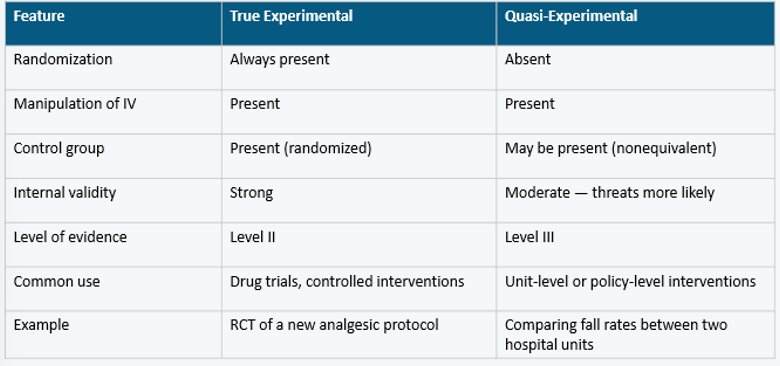
randomization, manipulation of IV, control group, internal validity (chart)
randomization: always present in true, absent in quasi
manipulation of IV: present in both
control group: present in true, may be present in quasi
internal validity: strong in true, moderate in quasi
level of evidence: II for true, III for quasi
level of evidence of true experimental
Level II
level of evidence of quasi-experimental
Level III
what suggests a practice change? consideration?
a body of RCT evidence supports a practice CHANGE
a single quasi-experimental study suggest a practice CONSIDERATION
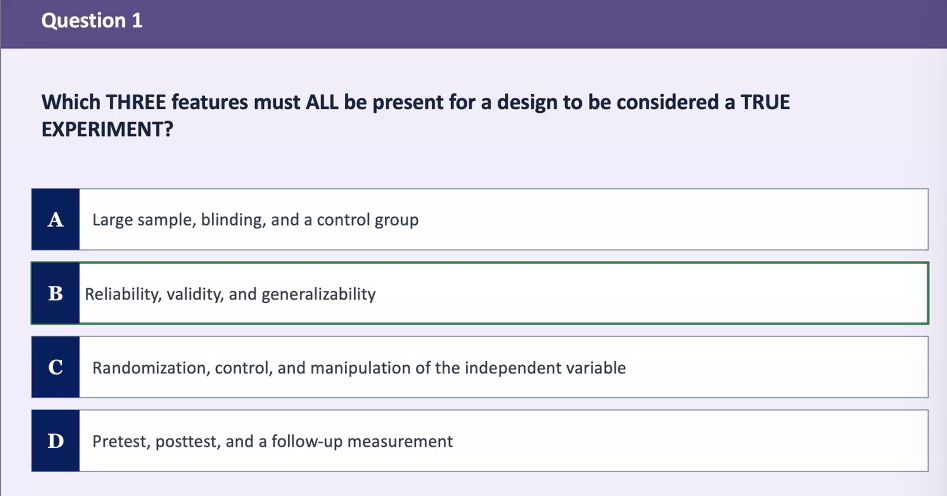
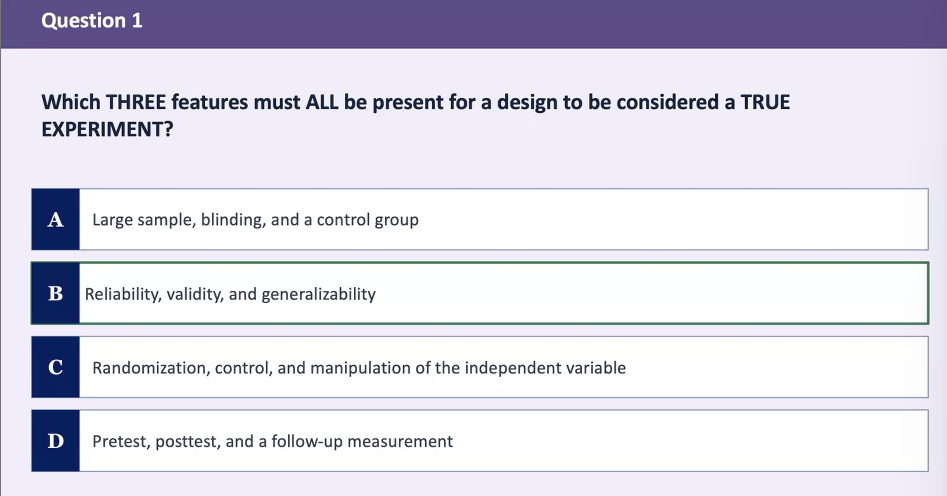
which 3 features must all be present for a design to be considered a true experiment
C. randomization, control, and manipulation of the IV
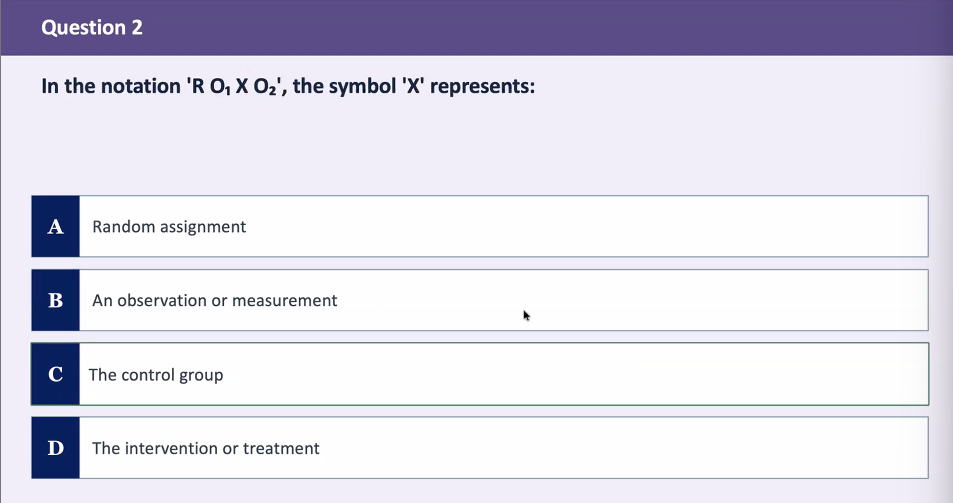
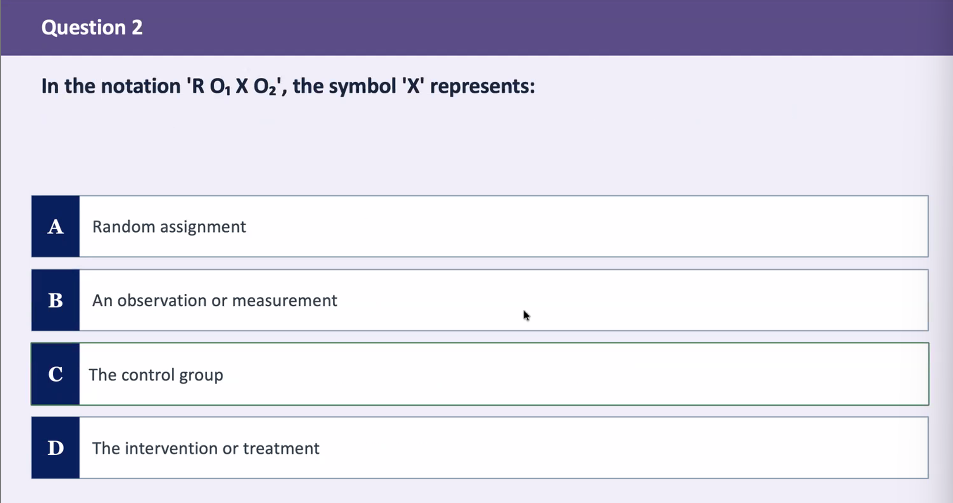
the symbol ‘X’ represents
D. the intervention or treatment
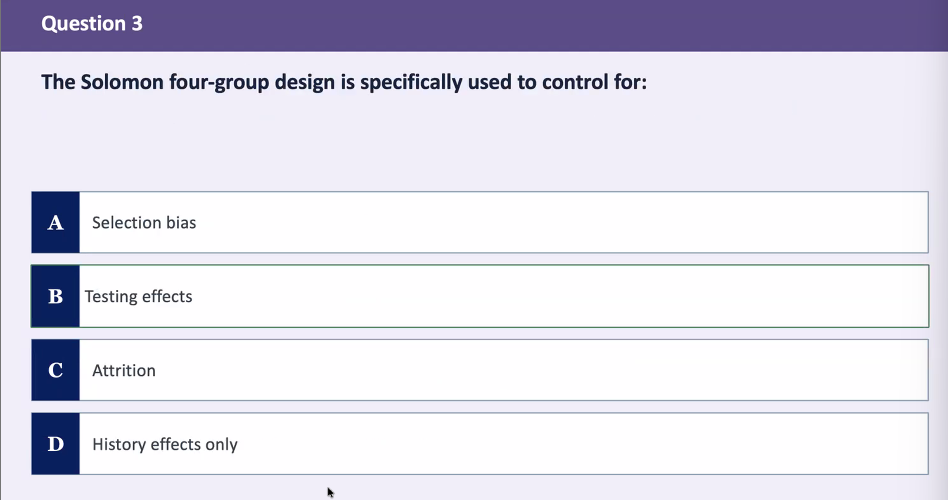
what is the Solomon four-group design is specifically used for
B. testing effects
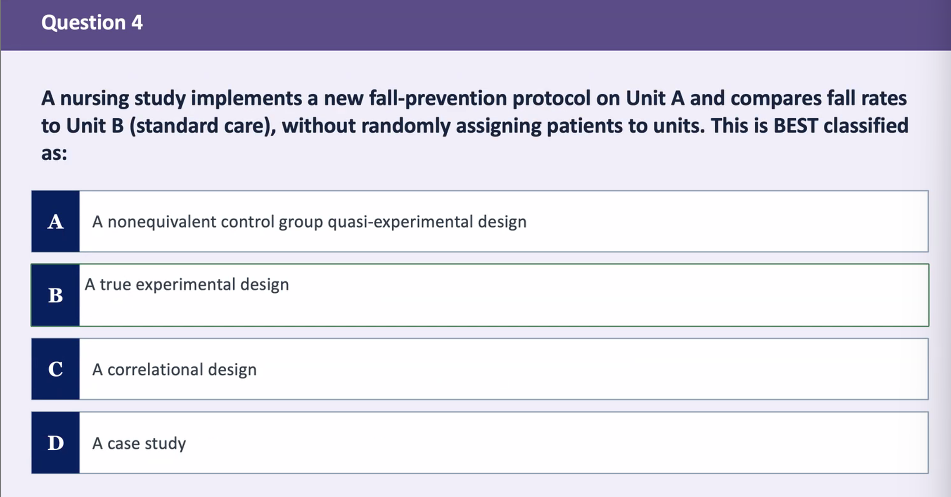
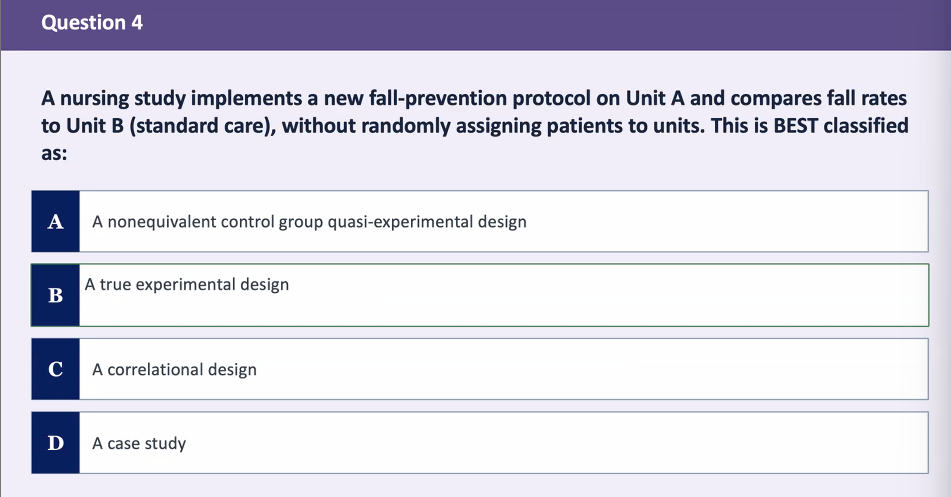
what is this best classified as
A. a nonequivalent control group quasi-experimental design
rationale: no randomization → quasi-experimental
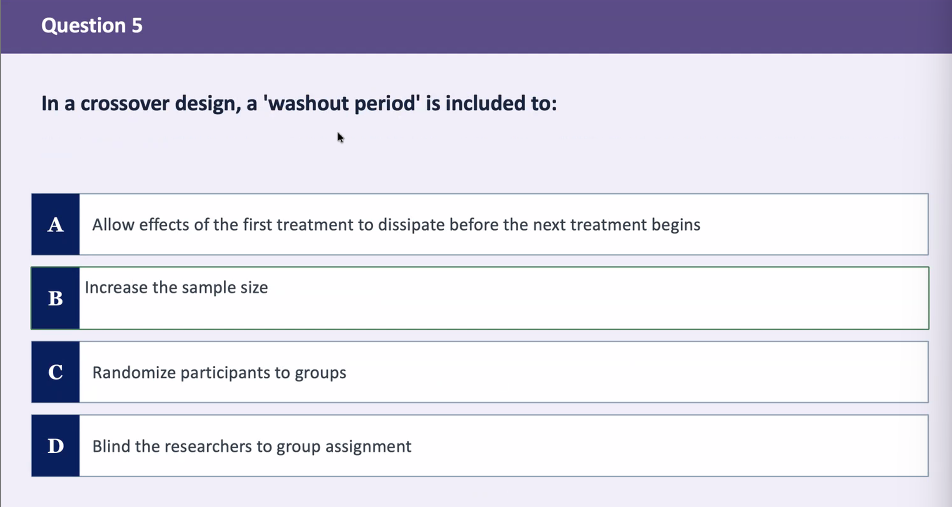
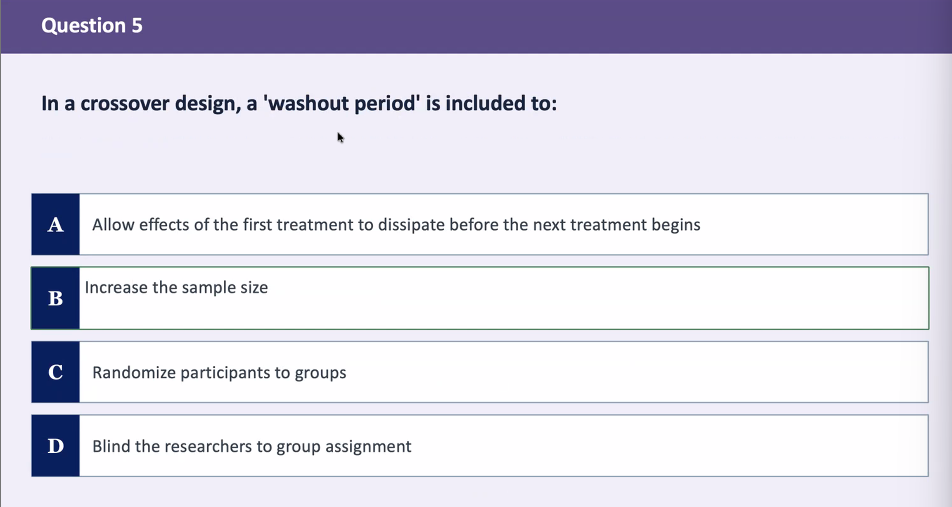
why is a washout period included in a crossover design
A. allow effects of the first treatment to dissipate before the next treatment begins
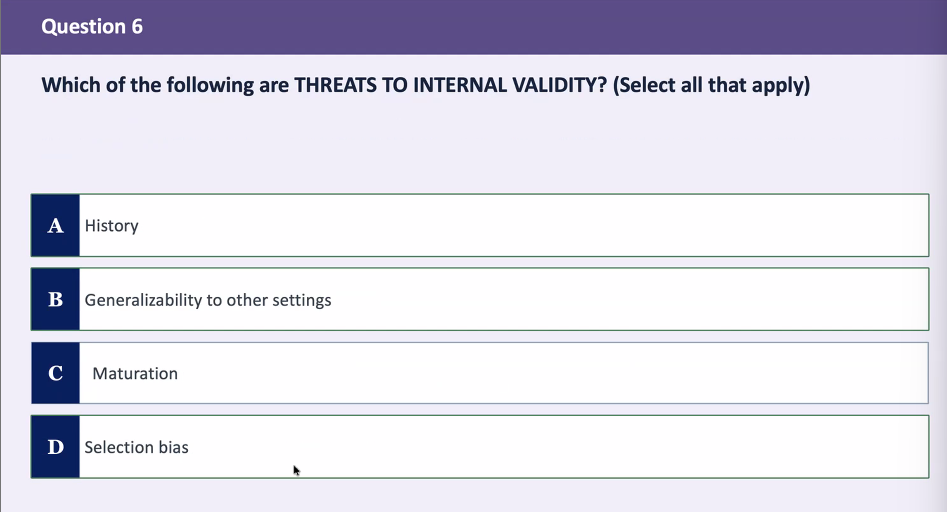
which of the following are threats to internal validity (SATA)
A. history
C. maturation
D. selection bias
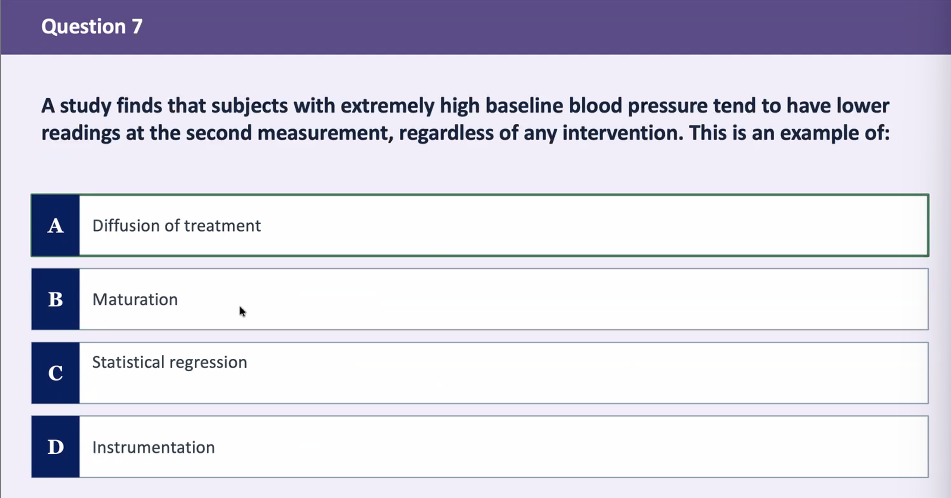
what is this an example of?
C. statistical regression
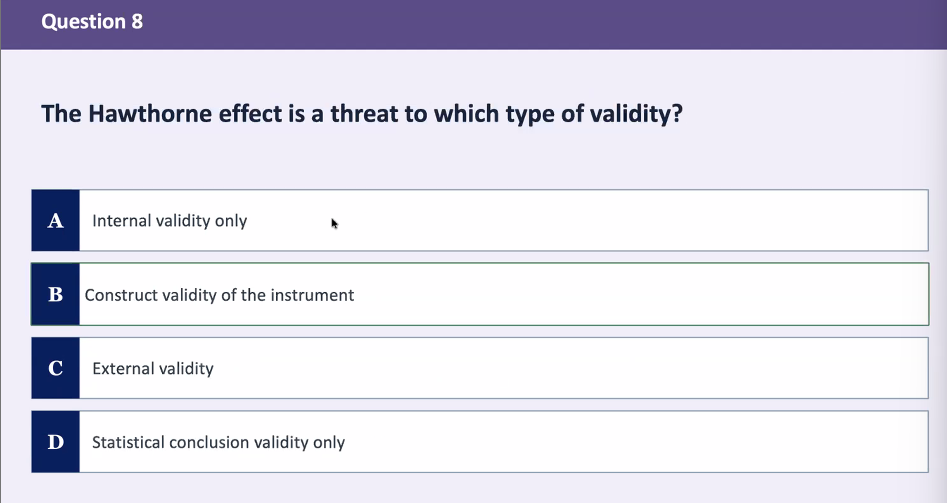
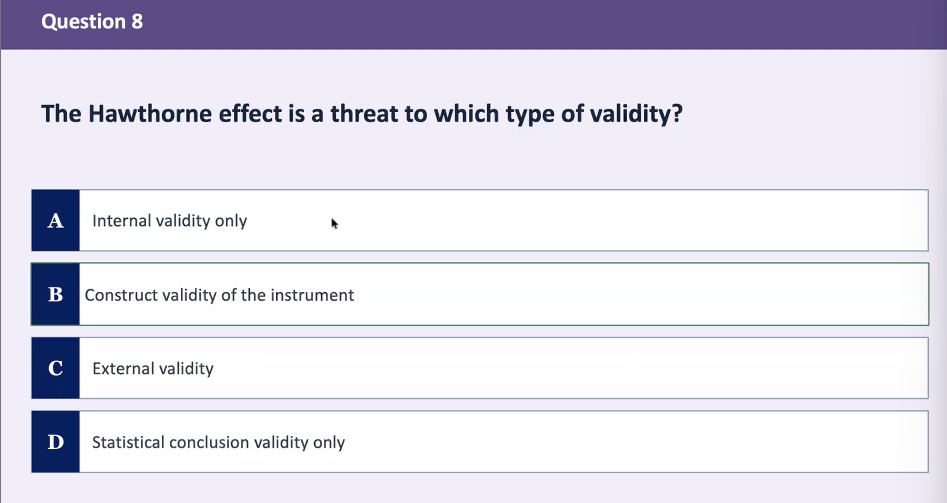
the Hawthorne effect is a threat to which type of validity?
C. external validity
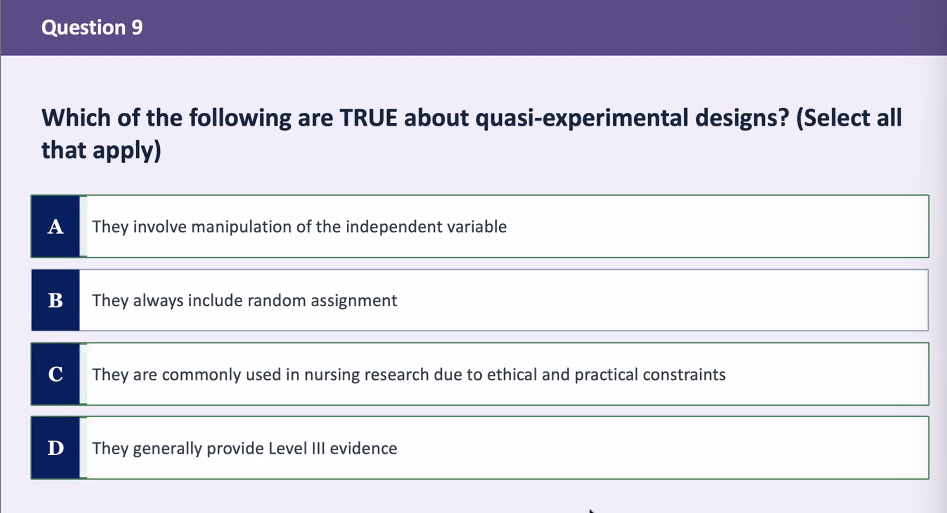
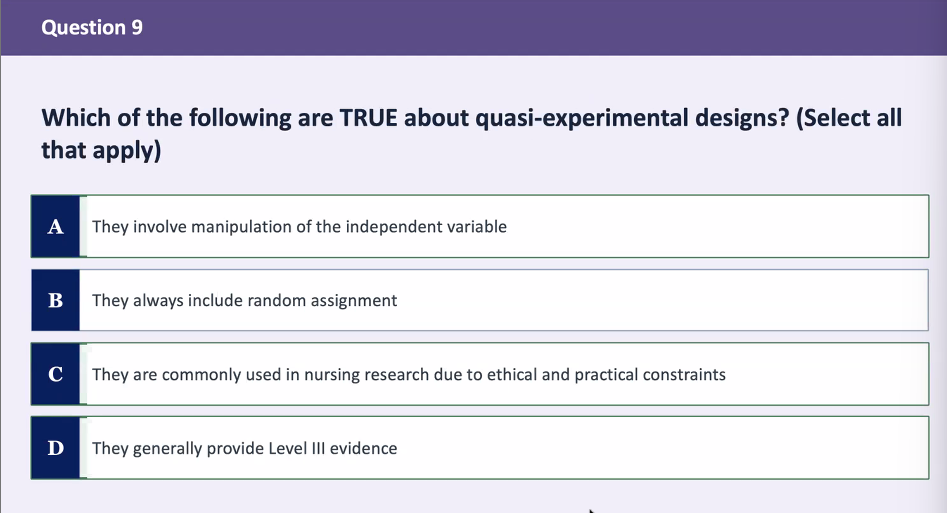
which of the following are true about quasi-experimental designs? (SATA)
A. they involve manipulation of the IV
C. they are commonly used in nursing research due to ethical and practical constraints
D. they generally provide Level III evidence
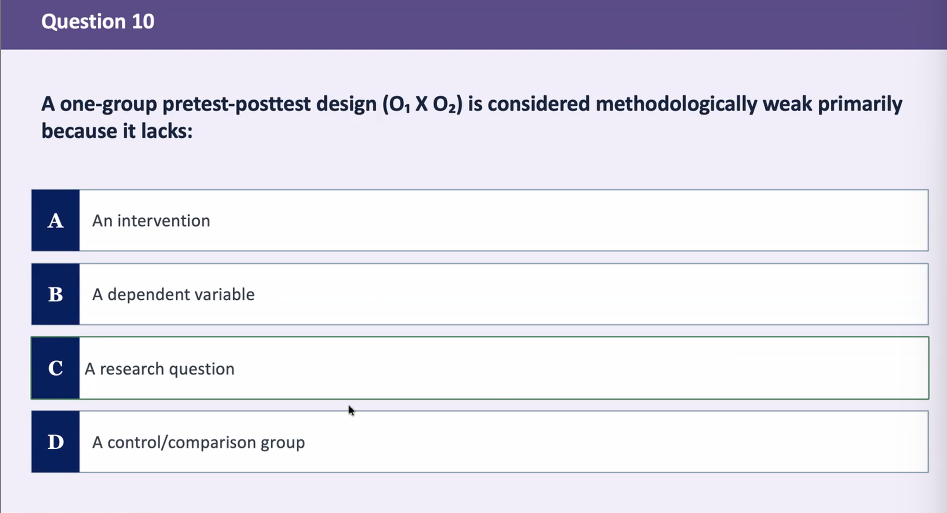
what does a one-group pretest-posttest design (O1 X O2) lack that makes it considered methodologically weak?
D. a control/comparison group