Concepts [Lecture 2]
 Call Kai
 Learn
Learn Practice Test
 Spaced Repetition
 Match
Match Flashcards
 Knowt Play
1/51

Earn XP
Description and Tags
Name | Mastery | Learn | Test | Matching | Spaced | Call with Kai |
|---|
No analytics yet
Send a link to your students to track their progress
52 Terms
Rocks are
Heterogenous at local and regional scale
Still forming today
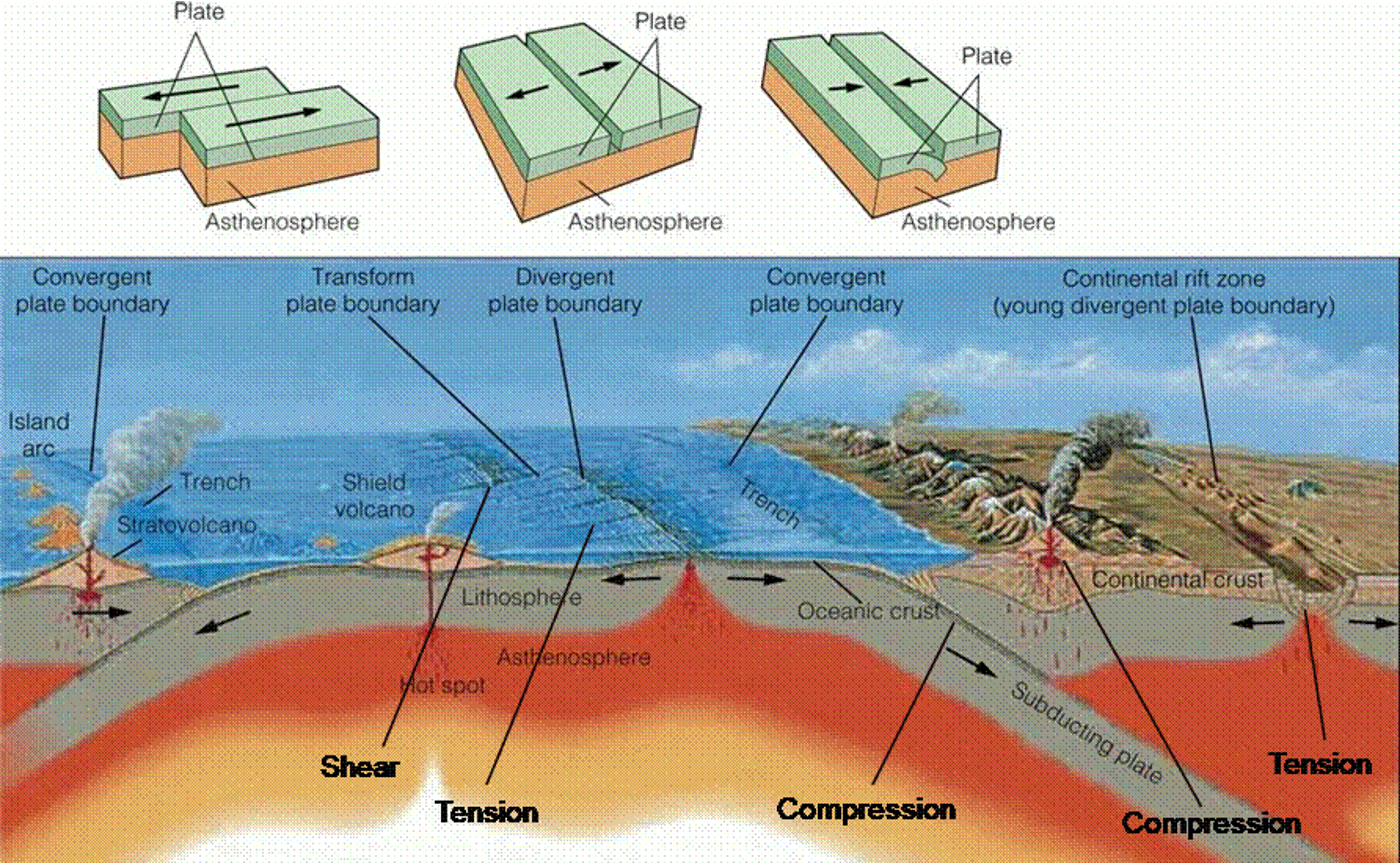
Tectonic plates
Active rock system
Mid Atlantic Ridge: Atlantic moves apart = new rocks
Ring of fire: rock subduction
Asthenosphere
hot, under high pressure but not yet melted
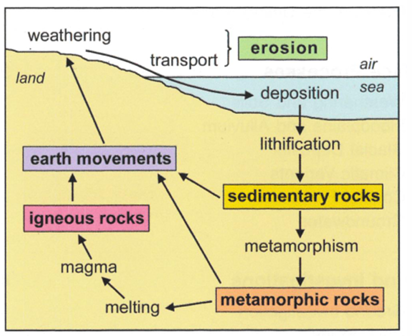
Rock cycle
Magma (molten rocks) under asthenosphere = liquid
⇒ Igneous rock
Extrusive = solidification at surface
Intrusive = cooling and crystallisation underground
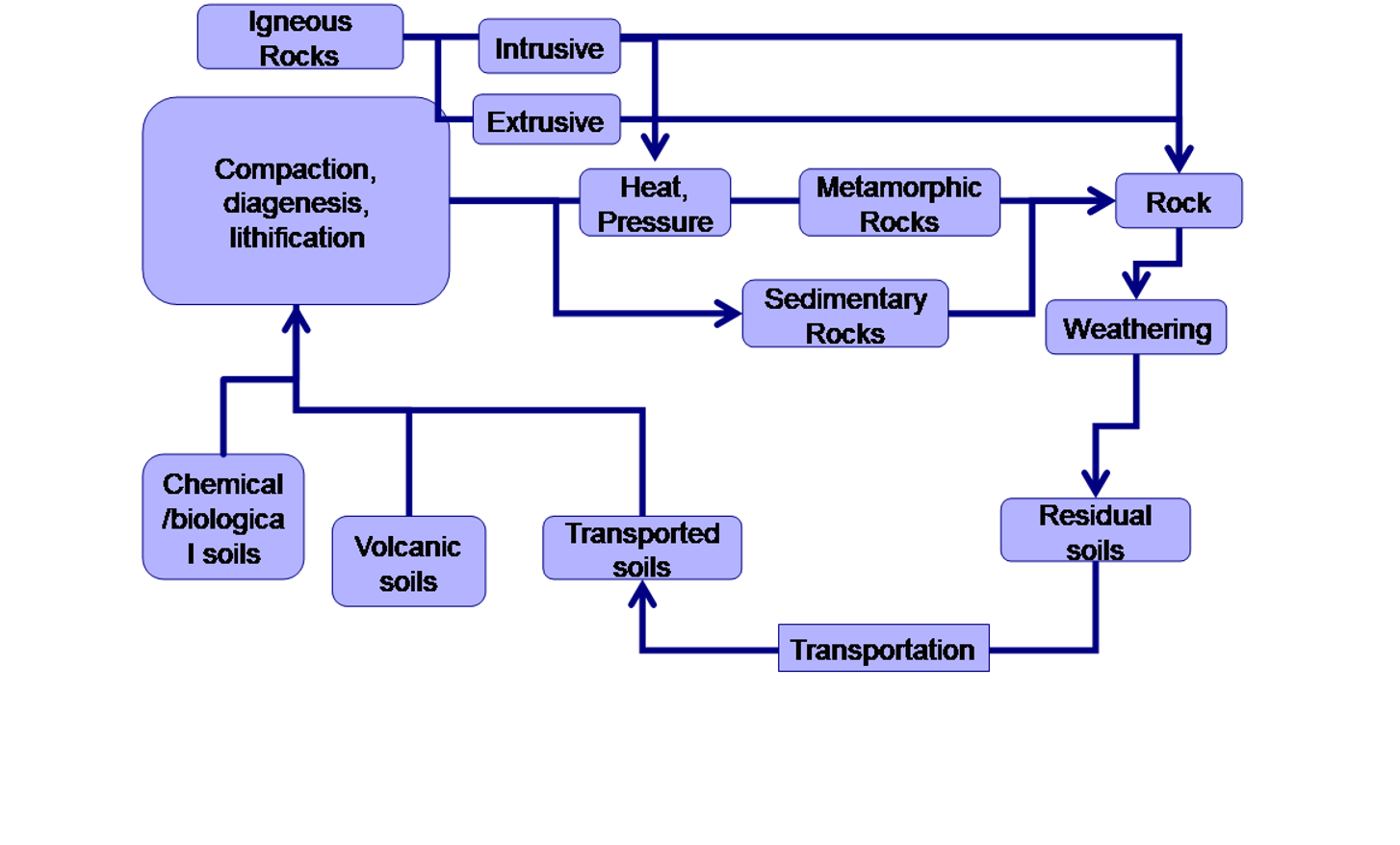
⇒ Soils
Come from weathering
Residual soils
Transported soils
⇒ Sediments
Weathering, erosion, transportation and deposition
⇒ Sedimentary rocks
Lithification = compacting and cementing ⇒ leads to development of tensile strength + frictional strength
Vertical cracks form due to overpressure of fluids once tensile strength is gained
⇒ Metamorphic rocks
Heat and pressure (metamorphism)
Transformation of existing rock, do not melt
Rock
any naturally occurring aggregate of one or more mineral or mineraloid matter
nature and properties of a rock are determined by the minerals in it & by the manner in which the minerals are arranged relative to each other
Igneous rock (origin, environment, texture, structure, strength)
Crystallized from molten magma
Underground, as lava flows
Massive structure = structureless
Uniform high strength
Sedimentary rock (origin, environment, texture, structure, strength)
Erosional debris on earth's surface
Deposition basins (mainly seas)
Mostly granular and cemented
Layered, bedded, bedding planes
Variable low strength, planar weakness
Igneous rock examples
Granite, granodiorite, basalt
Sedimentary rock examples
Sandstone, limestone, clay, chalk
Metamorphic rocks (origin, environment, texture, structure, strength)
Altered by heat and pressure
Mostly deep inside mountain chains
Mosaic of interlocking crystals
Crystal orientated due to pressure
High variability due to pressure
Detailed rock cycle
Rockhead
line between soil and rock (hard to place, more of a gradual transition)
UCS
unconfirmed compressive strength
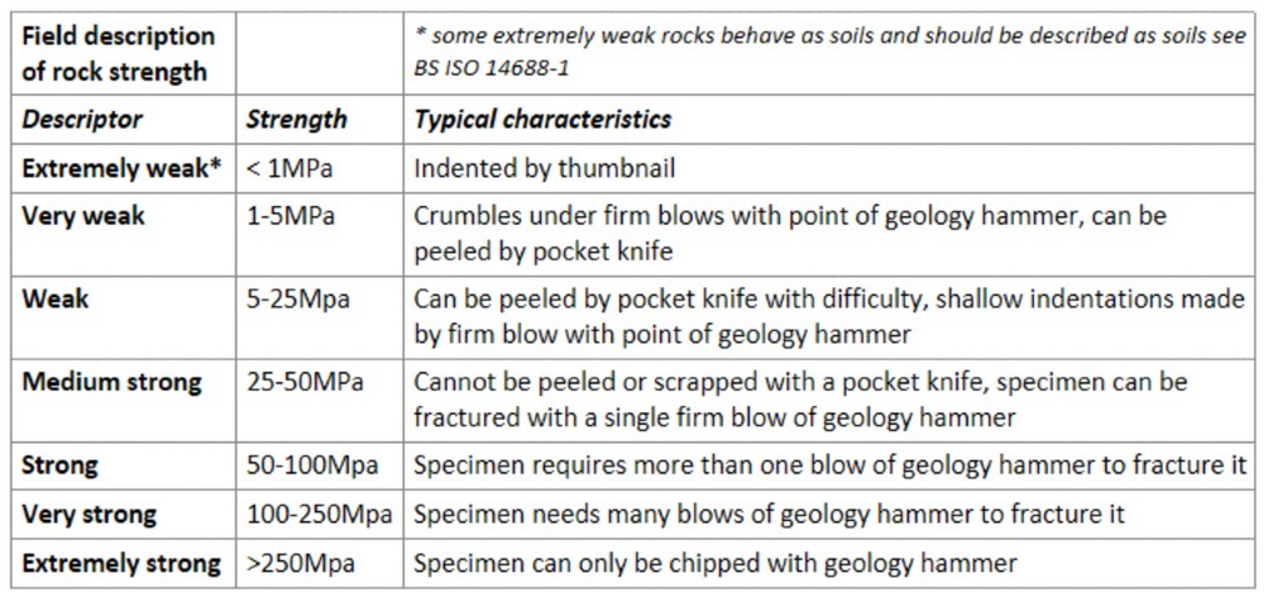
Rock compressive strength
> 0.6 MPa
Igneous rocks = strong
Chalk = weak
Soil shear strength
< 0.3 MPa or 300KPa
= weak
Fresh rock
UCS up for 250 MPa, not at earth surface
Slightly weathered
joints may be stained, looks fresh
several hammer blows to break sample
Moderately weathered
discoloured, weakened but still rock
needs hammer to break
Highly weathered
becoming soil like but doesn’t disintegrate in water
micro-cracks
broken by hand
Completely weathered
feldspar soft, grooved with pin and disintegrates in water
micro-cracks can be sealed with clay
Residual soil
original texture lost
most quartz is dissolved
typically red, clay rich
Rock tensile strength
weak
Soil & rock cementation
cementation from pore fluids and plastic migration from stresses grain contact
calcium carbonate cement or silicate cement (hardest)
bonding + cementation → tensile strength, cohesion & frictional strength
Today’s period
Interglacial
Cretaceous
Asteroid shot up sediments into atmosphere
Chalk formation (deposition in seas)
Deep weathering
happens during colder periods, ground freezes and breaks up rock
Mineral
naturally occurring inorganic substance which has a definite chemical composition and presents an ordered atomic arrangement
Mineral characteristics
Colour
Lustre = reflectance
Form = shape, grouping clustering
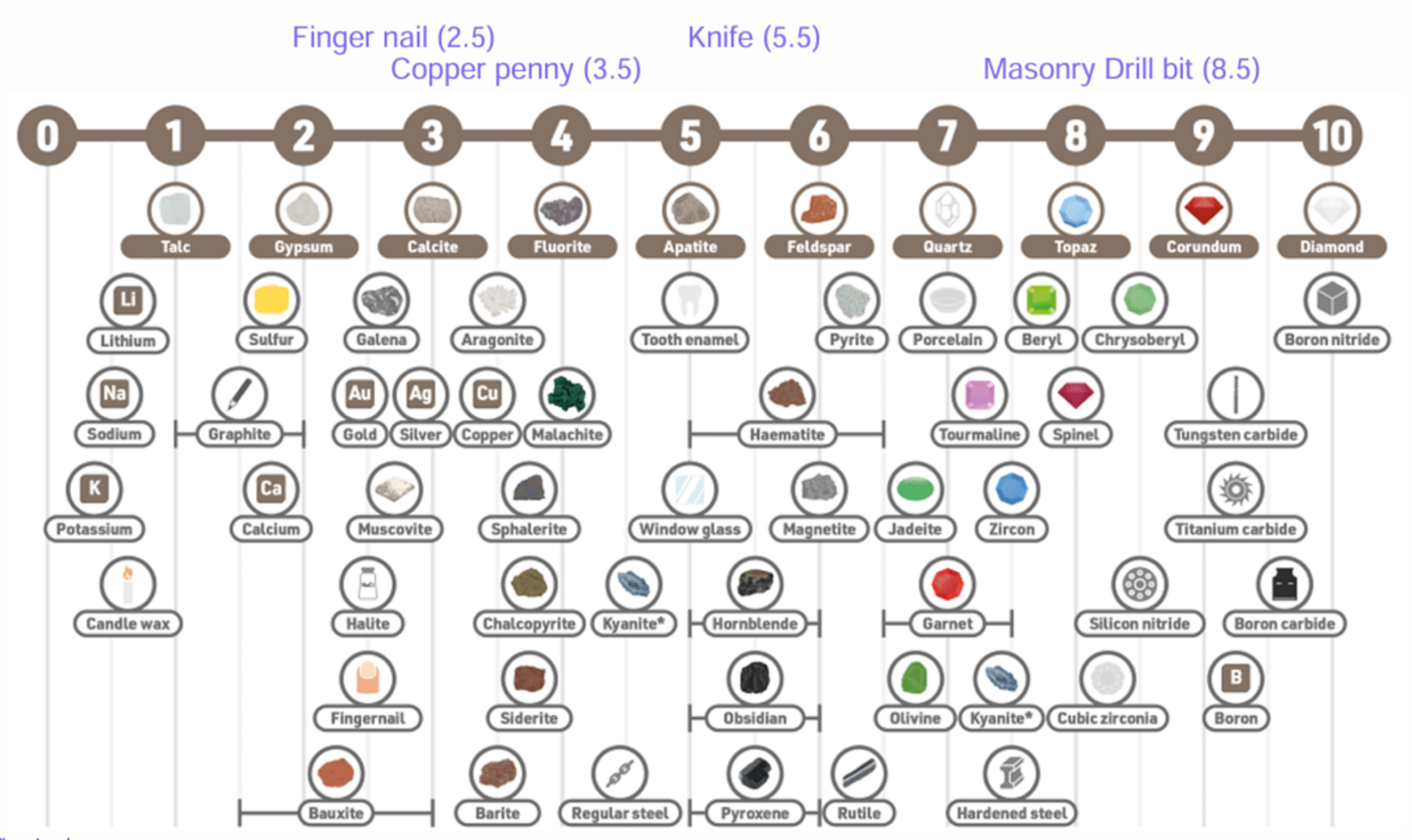
Hardness = resistance to abrasion
Cleavage = the way minerals break along planes of weakness, exhibiting smooth, flat surfaces.
Fracture = nature of broken surfaces, lack of cleavage
Tenacity = malleable vs brittle under sudden impact
Specific gravity
Metamorphic rock examples
Gneiss, schist, slate
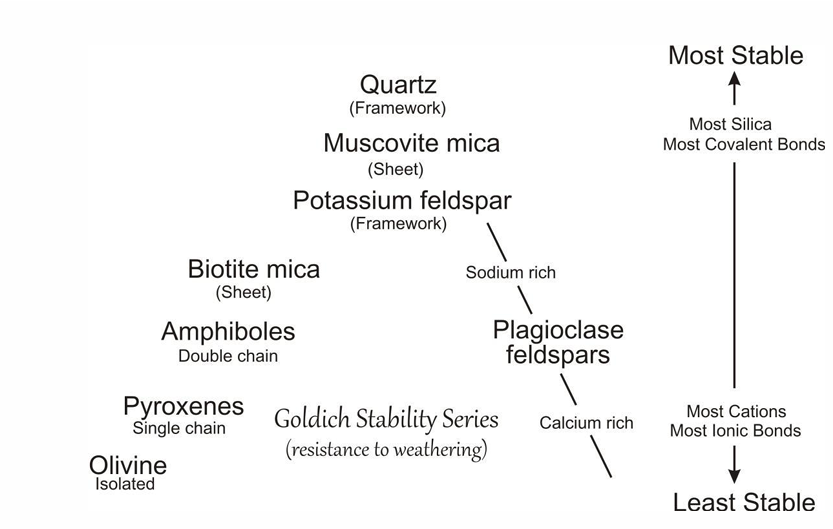
Rock forming minerals & susceptibility to weathering
Olivine - Very
Pyroxene - High
Amphibole - High
Mica - Medium/High
Feldspar - Medium/High
Silica - Low
Silicate structure
silicate minerals make up most rock forming minerals
SiO4
Non silicate minerals
Carbonates (chalk)
Oxides
Halides
Sulphides
Sulphates
Phosphates
Silicate structural linkages
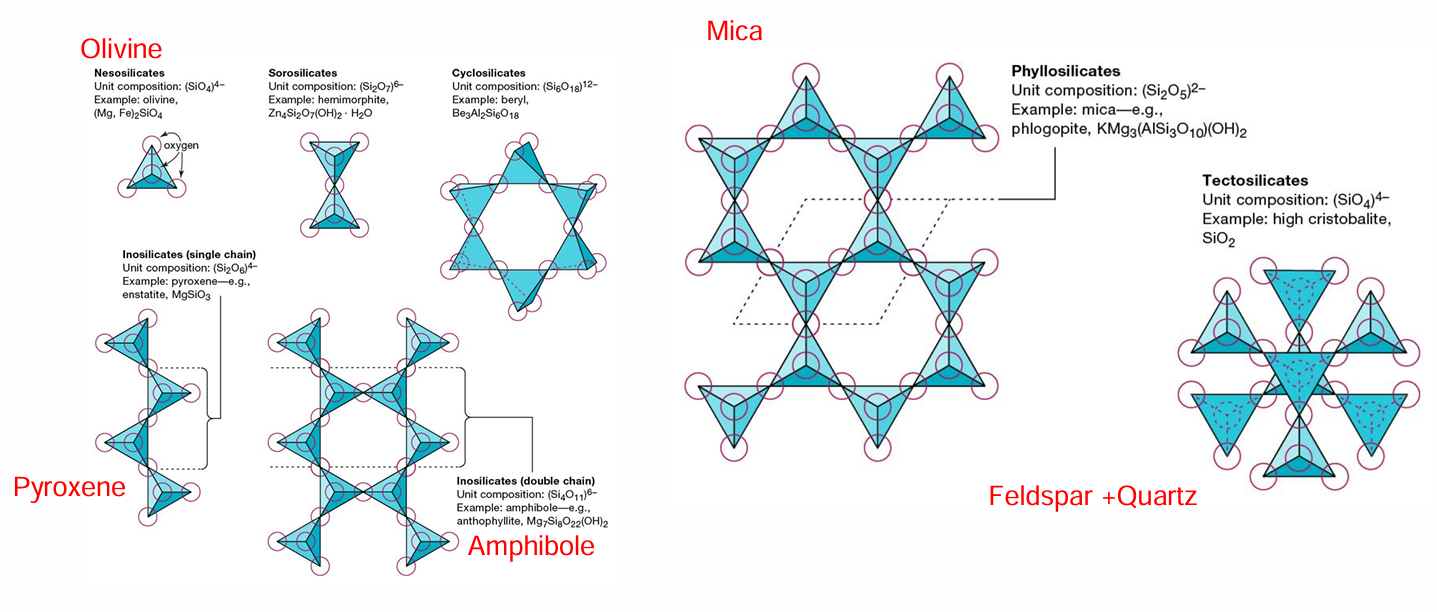
Slowly cooled rock linkages
crystalline (regular and repeating arrangement of atoms or molecules in a solid substance, forming a well-defined crystal lattice)
polycrystalline (structure lacks this regular arrangement, with atoms or molecules randomly distributed, resulting in a non-crystalline, often glassy appearance)
Quickly cooled rock linkages
Amorphous
Granite composition
Plagioclase K feldspars = white
Micca = black
Quartz = transparent
Hydrolisis
reaction between mineral and H+ and OH- of water
Orthoclase feldspar hydrolysis
kaoline produced
only happens with moving water

Forms of igneous rocks & magma formation
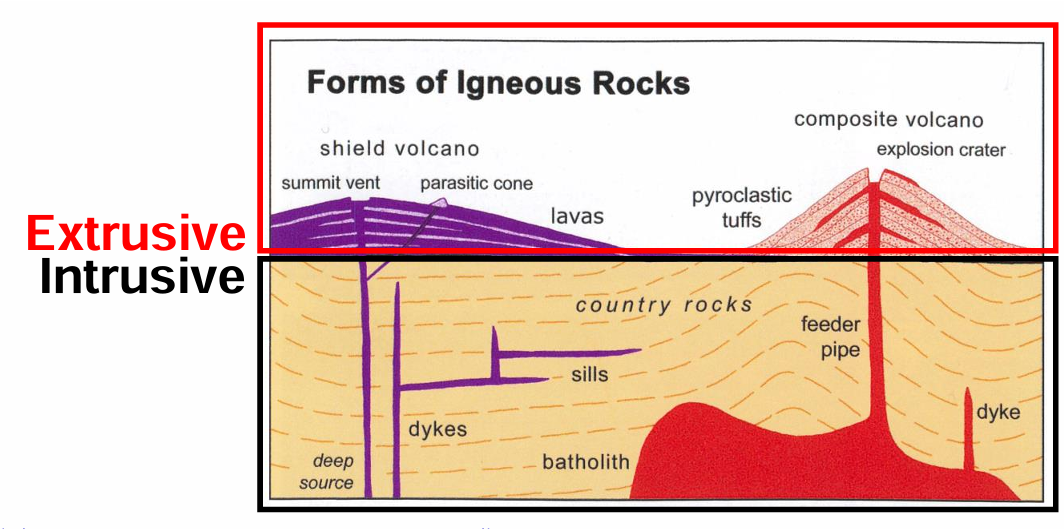
Magma formation and composition
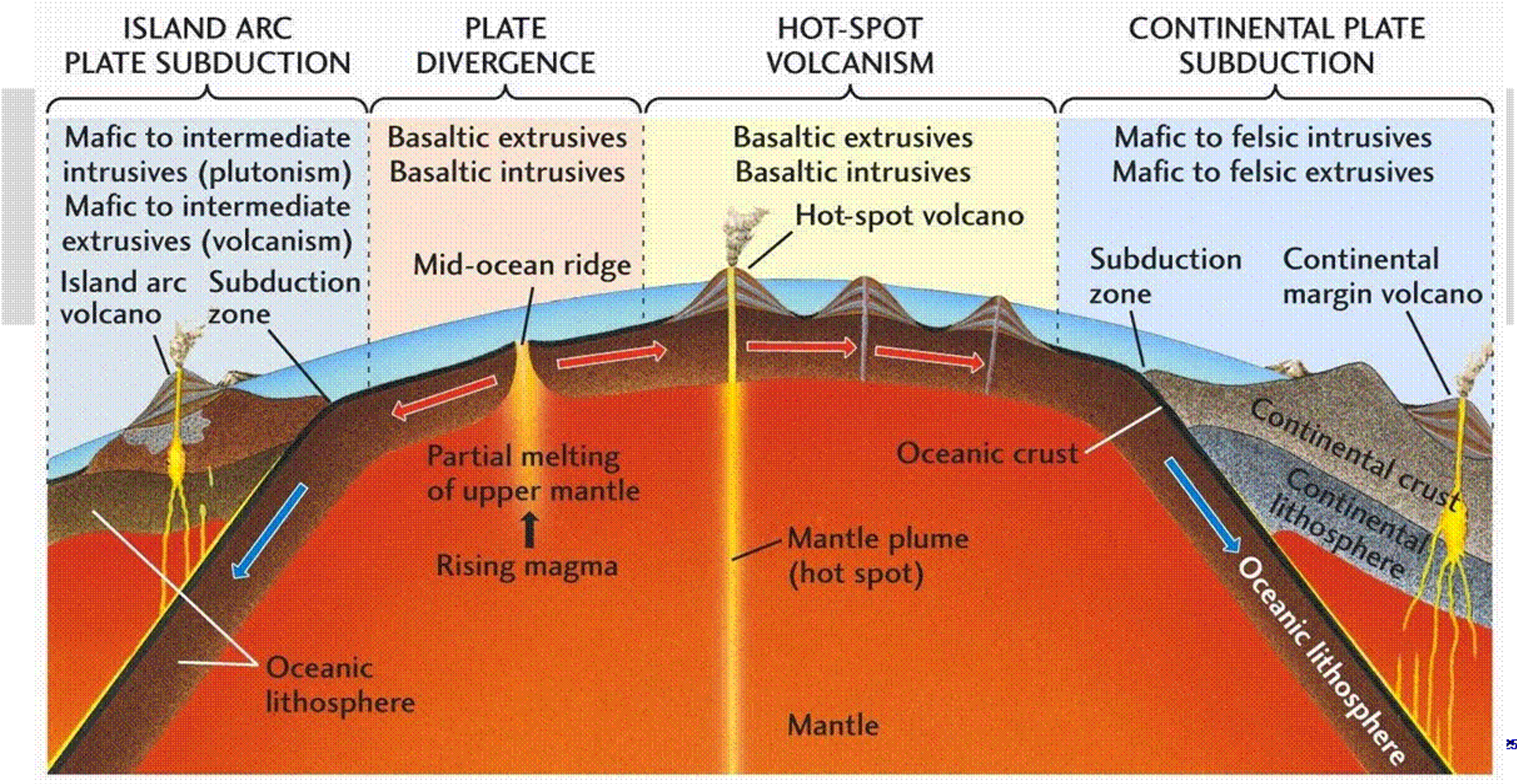
Volcanoes formation
Mafic to felsic classification
Felsic = high silicate %
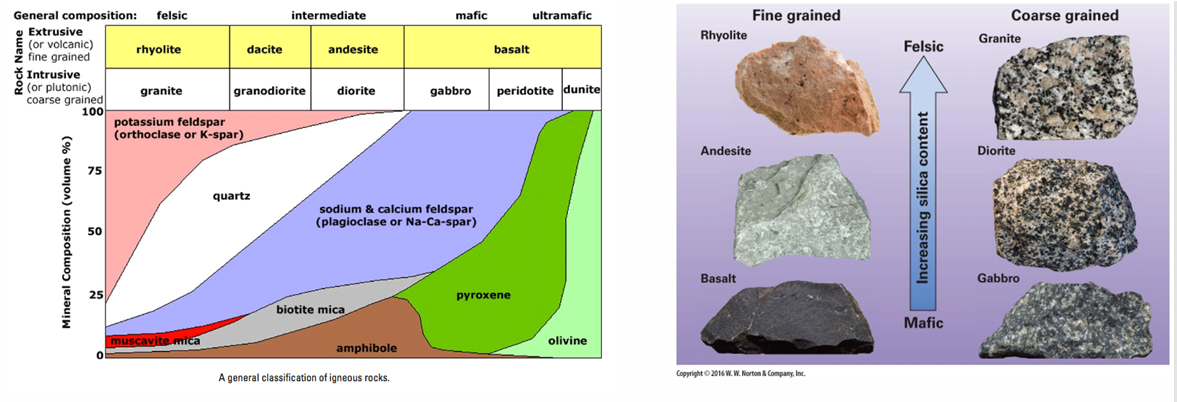
Intrusive rocks
slow cool down & compression → big crystals
Extrusive rocks
fissure eruptions → low viscosity, far flowing basaltic lava = fine grained
central eruptions (volcanoes) → ejection of lava, gases, ash, broken rock (explosive or effusive)
Texture / structure
Equigranular = minerals same size (intrusive)
Aphanitic = can't see crystals (extrusive)
Inequigranular = some crystals larger than others
Porphyritic = large crystals surrounded by much smaller ones
Shape
nice crystal shape = euhedral
other = anhedral
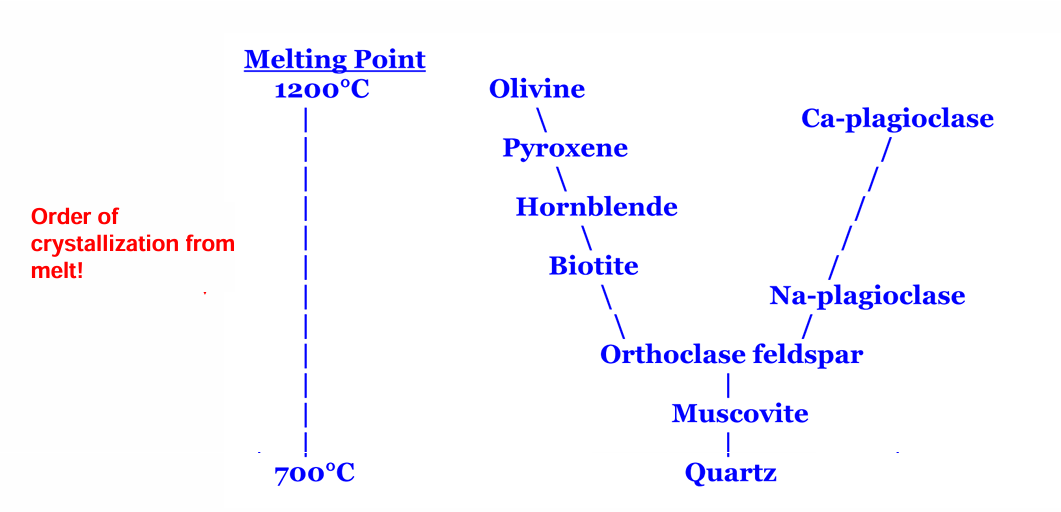
Bowen’s reaction series
Feldspar + mica cool first → biggest
Quartz = interstitial mineral → last mineral to harden, squeezes into spaces → smallest
Goldich’s dissolution series
Vesicular texture
fine-grained (basalt) + gas holes (from being shot out)
Glassy texture
obsidian = cooled quickly
Mica weathering
complex reaction where metal ions are removed from mica
→ results in soluble metal ions and clay minerals
Soil types
residual soils
transported soils
chemical & biological soils
volcanic soils