Cnidarians - Jellies and Such
 Call Kai
 Learn
Learn Practice Test
 Spaced Repetition
 Match
Match Flashcards
 Knowt Play
1/32

There's no tags or description
Looks like no tags are added yet.
Name | Mastery | Learn | Test | Matching | Spaced | Call with Kai | Chat |
|---|
No analytics yet
Send a link to your students to track their progress
33 Terms
Cnidarians include what animals?
Jellyfish, corals, anemones…
Cnidarians - number of tissues and names
2: epidermis, gastrodermis
Do cnidarians have one opening or two
One
What are the two different body plans of cnidarians?
Medusa and polyp
Cnidarians: freshwater or marine?
Mostly marine - 0.2% FW
Cnidarian symmetry type
Radial
Specialized stinging thread
Cnidae
Stinging cell that contains harpoon structure
Nematocysts
What do cnidarians eat?
eggs, larvae, small fish, inverts, plankton, other jellies
True Jellyfishes Class
Scyphozoa
Scyphozoa: ________ connects mouth to _________ canals
Manubrium, gastrovascular
Scyphozoa digestive system: Food particles captured by ____1____ on the ___2___, ingested at mouth. Transport via manubrium to ____3____, then distributed among four __4__ ___4___. Gastric filaments secrete ___5___, then partially digested stuff ____6____ intracellularly. Canals distribute nutrients and O2.
nematocysts
tentacles
“stomach”
gastric pouches
enzymes
phagocytosed
Scyphozoa “balance organs”
Statocysts
Scyphozoa light receptors
Ocelli
Scyphozoa: club shaped structure contains statocysts and ocelli on margins of bells
Rhopalia
Scyphozoa: Gonads develop in what
gastrodermal tissue
Describe the Scyphozoa life cycle
Gametes release, fertilization leads to planula larvae (non-feeding). Planula attaches to substrate - scyphistoma (polyp form). Mouth oriented up, starts feeding. Strobilation occurs: body column divides. Module breaks away called ephyra and starts swimming. Grows to an adult.
Box jellyfish class
Cubozoa
Cubozoa: ___ tentacles or ___ clusters of tentacles from ___ corners of bell; ___ rhopalia
4
Cubozoa: Difference in life cycle from Scyphozoa
Polyp doesn’t strobilate. Polyp buds off more polyps which produce a single medusa each.
True or false: Cubozoa have eyes
True - complex eyes that form images (general shapes)
Hydroids class
Hydrozoa
3 major orders of Hydrozoa
Hydroida, Siphonophora, Anthoatheca/Hydrocorallina
Hydrozoa: mostly marine, ____ is a freshwater species
Hydra
Hydrozoa: mostly _______ as adults
Medusoid
Hydrozoa: shelf of tissue that extends inward from the bell to the manubrium
Velum
Hydrozoa: _______ morph may be just a mass of ______ tissue
Medusa, gonadal
Hydrozoa order Siphonophora: Free floating Hydrozoan ______ in which ______ and ______ forms are present simultaneously
colonies, medusoid, polypoid
Well-known Siphonophora animal
Portuguese man-of-war
Hydrozoa Order Hydrocorallina: secrete what
calcium carbonate skeleton
True or false: Order Hydrocorallina are true corals
False, they are colonial hydroids
Name some husbandry considerations for Cnidarians
Adequate water flow, kriesels, remove waste, chiller, no air contact
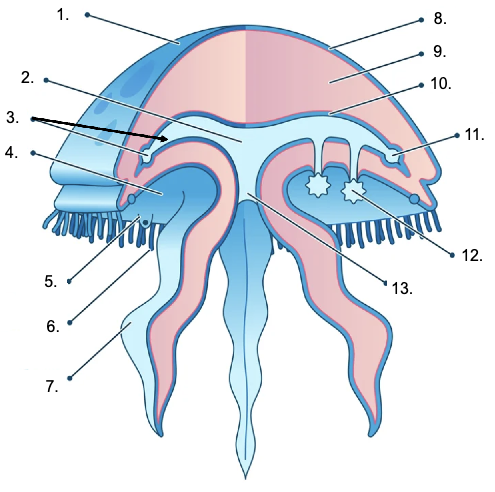
Exumbrella
Gastric cavity
Radial canal
Subumbrella
Rhopalium
Tentacle
Oral arm
Epidermis
Mesoglea
Gastrodermis
Circular canal
Gonad
Mouth