StemUp: AQA A level Biology 3.1.3 Lipids
 Call Kai
 Learn
Learn Practice Test
 Spaced Repetition
 Match
Match Flashcards
 Knowt Play
1/18

There's no tags or description
Looks like no tags are added yet.
Name | Mastery | Learn | Test | Matching | Spaced | Call with Kai | Chat |
|---|
No analytics yet
Send a link to your students to track their progress
19 Terms
What are the two types of lipids? (2)
- Triglycerides
- Phospholipids
Why are lipids not considered polymers? (1)
- They are not made from a small repeating unit (monomer)
- They are macromolecules (made of two or more different molecules)
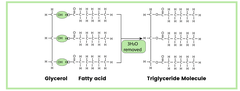
Describe how triglycerides are formed (3)
- 3 fatty acids combine to one glycerol molecule during a condensation reaction
- With the loss of three water molecules
- And the formation of an ester bond
Draw a diagram for the formation of a triglyceride (3)
What type of bond does a condensation reaction between glycerol and a fatty acid (RCOOH) form? (1)
Ester bond
What is the difference between a saturated and unsaturated molecule? (2)
- Saturated = no double bonds between the carbon atoms
- Unsaturated = contains one or more carbon to carbon double bond
Describe how a phospholipid is formed (3)
- One glycerol, two fatty acids and a phosphate group
- Joined together by an ester bond
- During a condensation reaction
Draw a diagram of a phospholipid molecule (1)
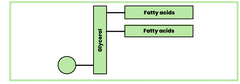
Describe the structure of a phospholipid molecule (2)
- Has a polar hydrophilic head containing the phosphate group
- Non-polar hydrophobic tail consisting of long fatty acid chains
What is the characteristic of the hydrophilic head of a phospholipid? (2)
- Polar
- So attracts water
What is the characteristic of the hydrophobic tail of a phospholipid? (2)
- Non-polar
- So repels water
How do phospholipid molecules arrange themselves in a bilayer? (3)
- Form a bilayer
- With the hydrophobic tails attracted to each other and away from water
- While the hydrophilic heads face outward towards the water
What is the function of the phospholipid bilayer in cell membranes? (1)
Enables lipid soluble molecules to pass quickly through cell membranes
Draw a phospholipid bilayer

What are two methods that you could use to carry out the hydrolysis of lipids? (2)
- Heat with acid or alkali
- Use lipase at its optimum temperature and pH
Describe the adaptations of triglycerides for their functions (6)
- Possess a high proportion of C-H bonds
- So will release twice as much energy as carbohydrates during aerobic respiration
- High ratio of hydrogen to oxygen atoms
- Which releases water when respired, important for organisms living in dry desserts
- Non-polar and therefore, insoluble
- Ideal as a storage compound as they are osmotically inactive
What are the similarities between triglycerides and phospholipids? (4)
- Both have glycerol backbone
- Both contain ester bonds
- Both contain the elements C, H, O.
- Both formed by condensation reactions
What are the differences between triglycerides and phospholipids? (3)
- Phospholipids contain two fatty acids whereas, triglycerides contain 3 fatty acids
- Phospholipids contain one phosphate group whereas, triglycerides do not contain a phosphate group
- Phospholipids have a hydrophilic head and a hydrophobic tail whereas, triglycerides are hydrophobic
Describe how you would carry out the test for the presence of lipids (3)
1. Small sample is dissolved in ethanol
2. Added to water in a different test tube and the contents are mixed
3. White emulsion indicates that lipids are present