8. Surgical Treatment of Glaucoma - Management of Glaucoma Summer 2026
 Call Kai
 Learn
Learn Practice Test
 Spaced Repetition
 Match
Match Flashcards
 Knowt Play
1/190

There's no tags or description
Looks like no tags are added yet.
Name | Mastery | Learn | Test | Matching | Spaced | Call with Kai | Chat |
|---|
No analytics yet
Send a link to your students to track their progress
191 Terms
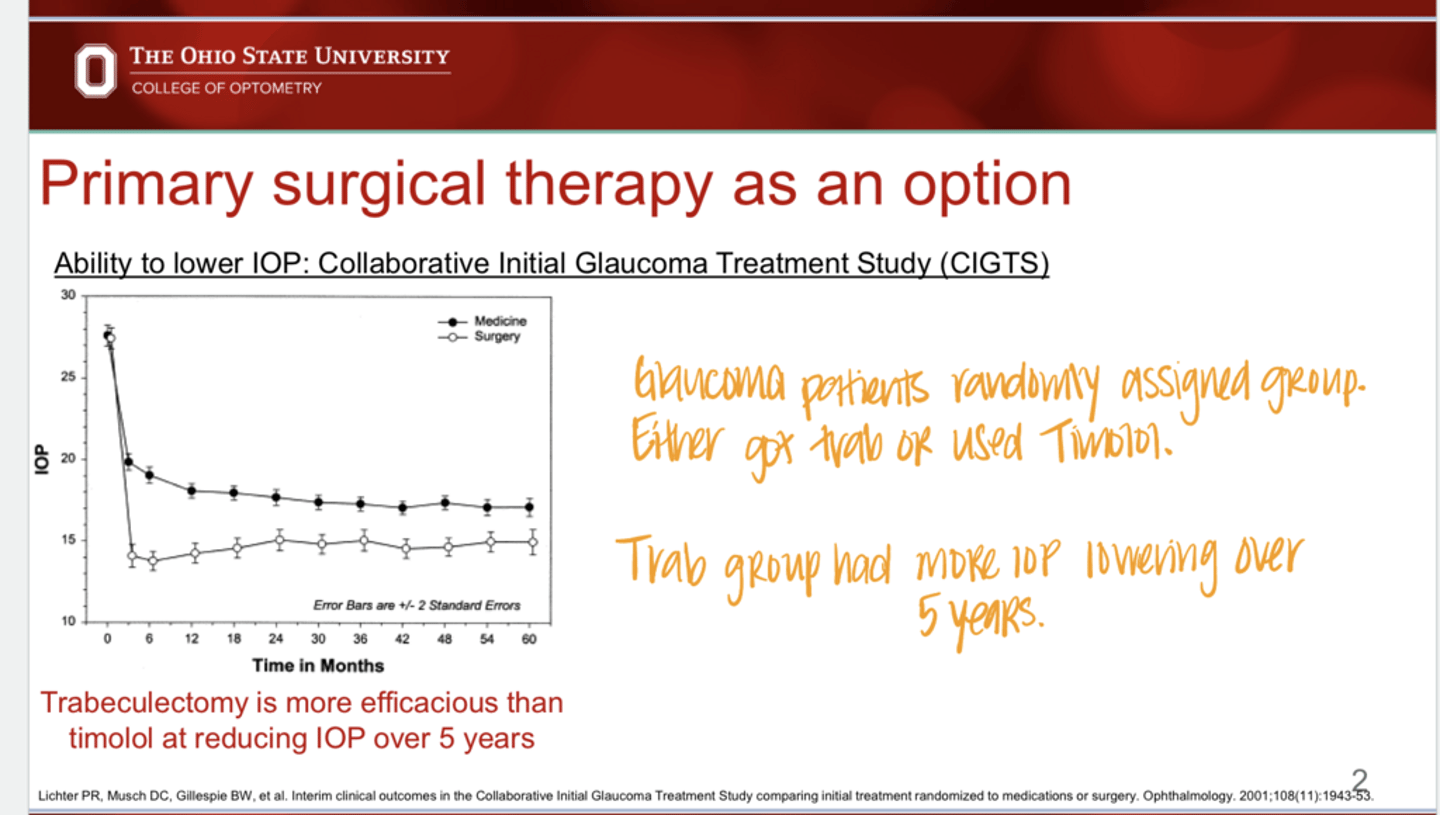
What was the result of the Collaborative Initial Glaucoma Treatment Study (CIGTS)?
Trabeculectomy is more efficacious than Timolol at reducing IOP over 5 years
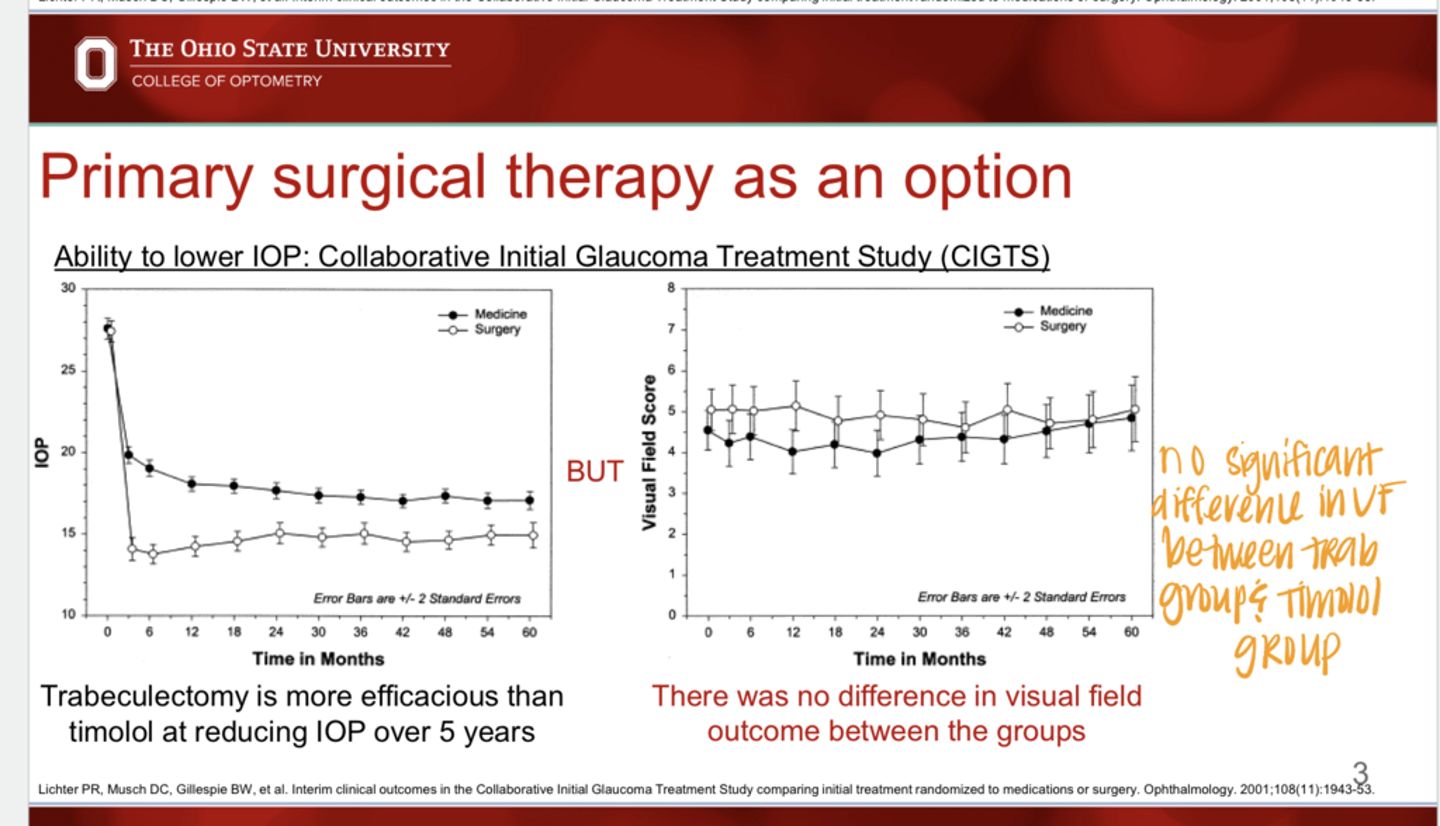
In the CIGTS, was there any difference in VF outcome over 5 years in either the Trabeculectomy or TImolol group?
There was no difference in visual field outcome between the 2 groups
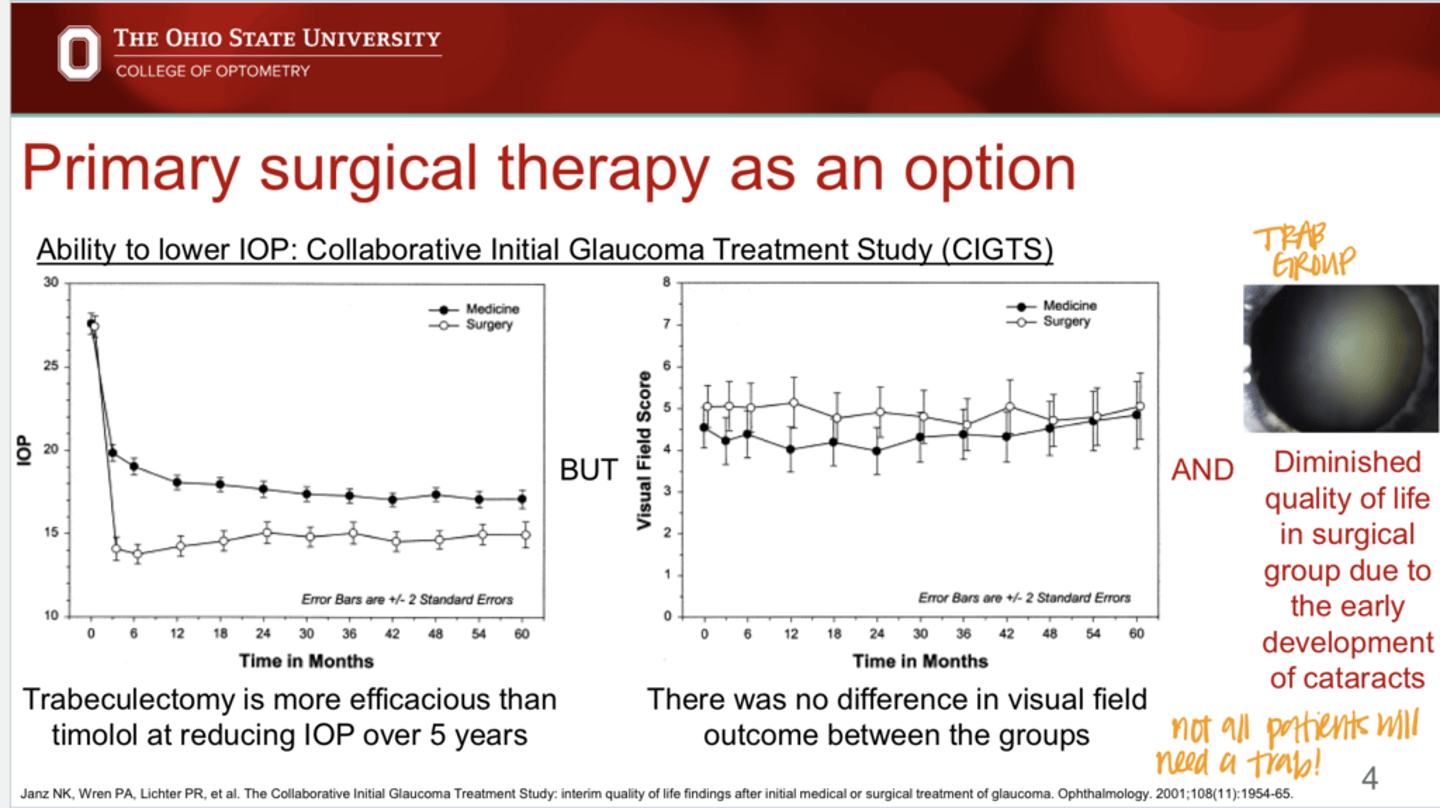
What was the downside to the trabeculectomy group in the CIGTS study?
Diminished quality of life in surgical group d/t early development of cataracts
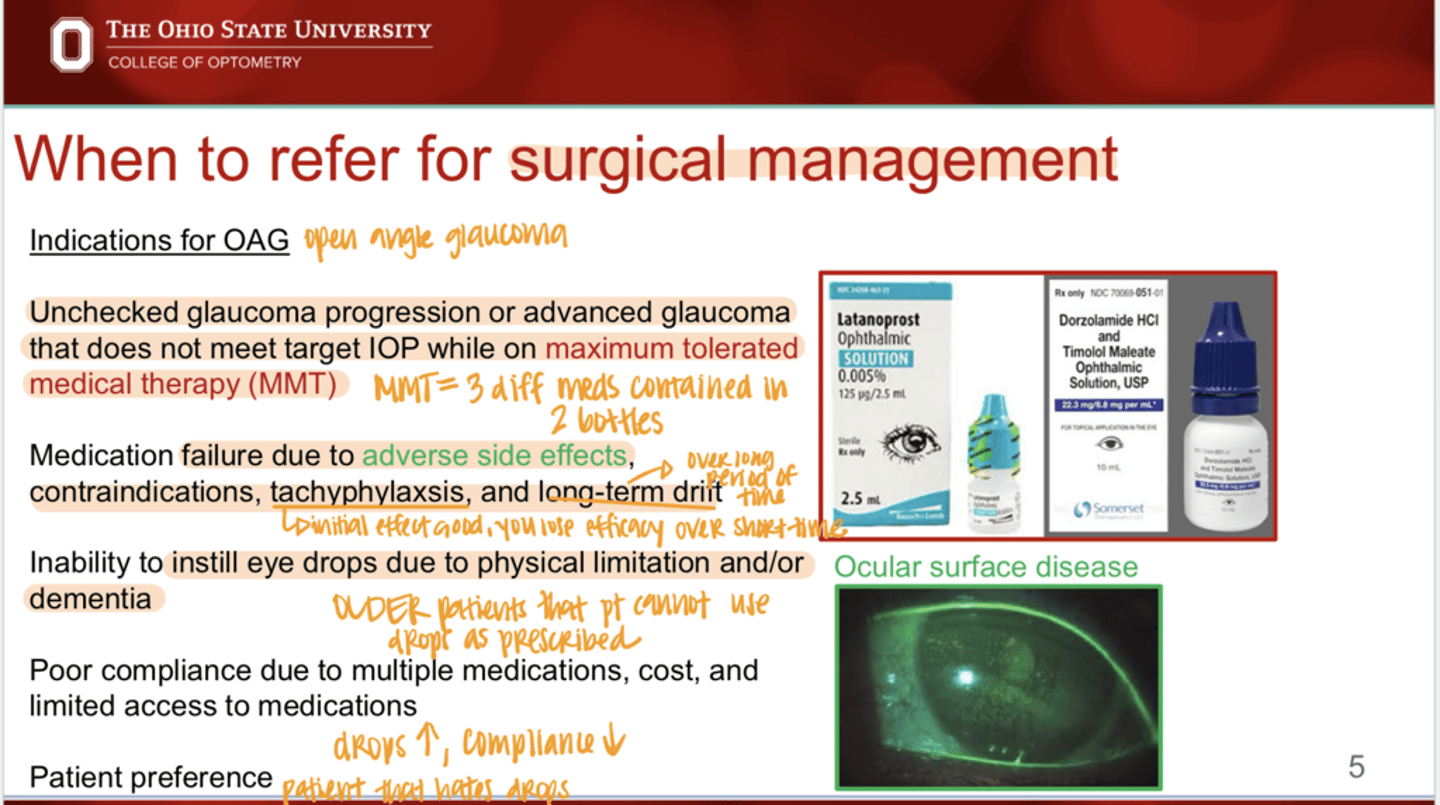
What are the indications for surgical management in OAG?
-Unchecked glaucoma progression or advanced glaucoma that does not meet target IOP while on maximum tolerated medical therapy (MMT)
-Medication failure d/t adverse side effects, contraindications, tachyphylaxis, and long-term drift
-Inability to instill eye drops d/t physical limitation and/or dementia
-Poor compliance d/t medical medication, cost, and limited access to medication
-Patient preference
What are the surgical options available for open angle glaucoma?
-Laser outflow
-Penetrating filter
-Minimally invasive glaucoma surgery (MIGS)
-Photocoagulation
-Drug-releasing implants
What are the surgical options available for narrow angle and angle closure?
-Peripheral iridotomy
-Peripheral iridectomy
-Peripheral iridoplasty
-Goniosynechialysis
What are the surgical options available for neovascular glaucoma?
PRP
What are the surgical options available for phacomorphic glaucoma?
cataract extraction
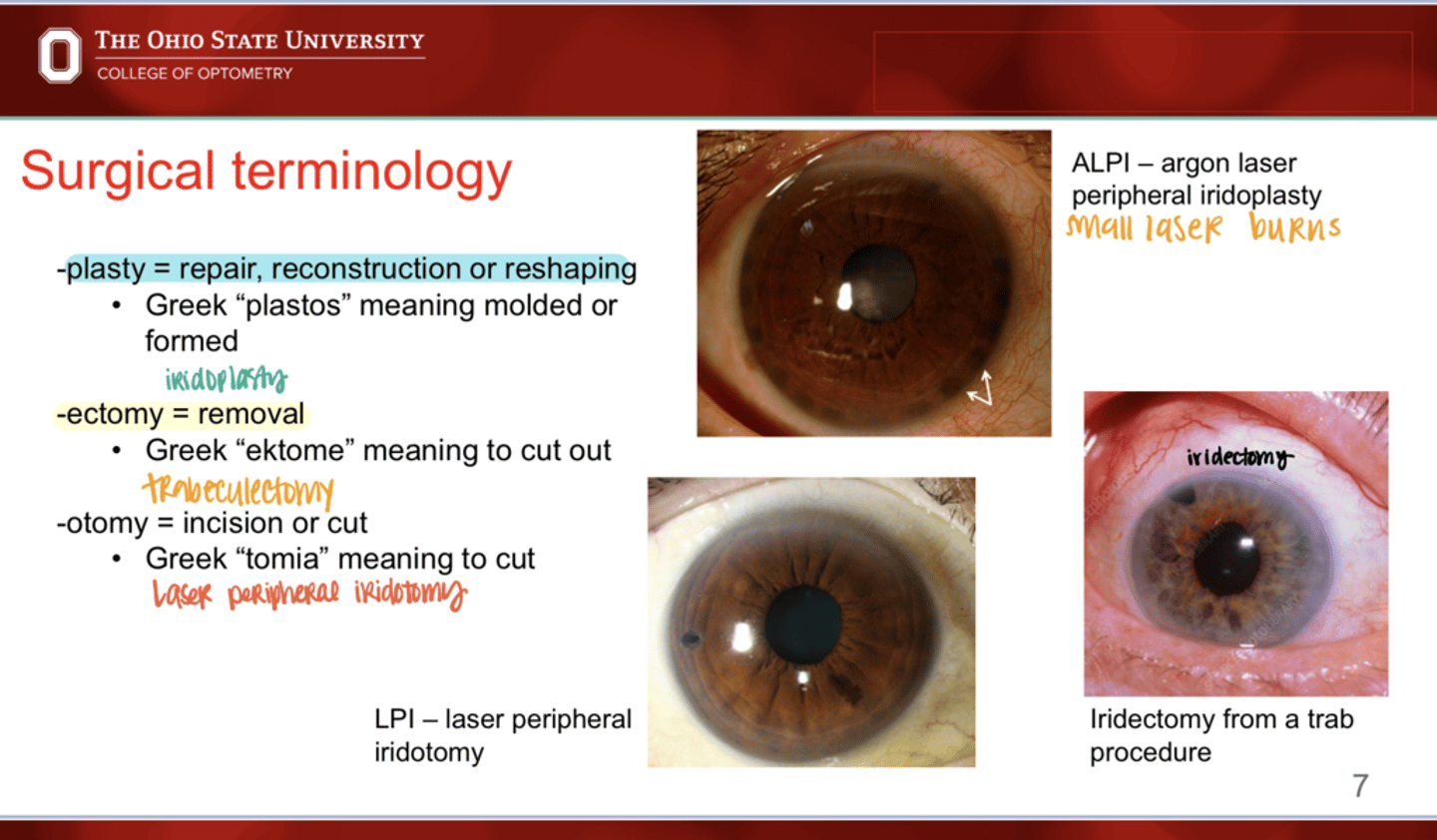
What is the meaning of -plasty?
repair, reconstruction or reshaping
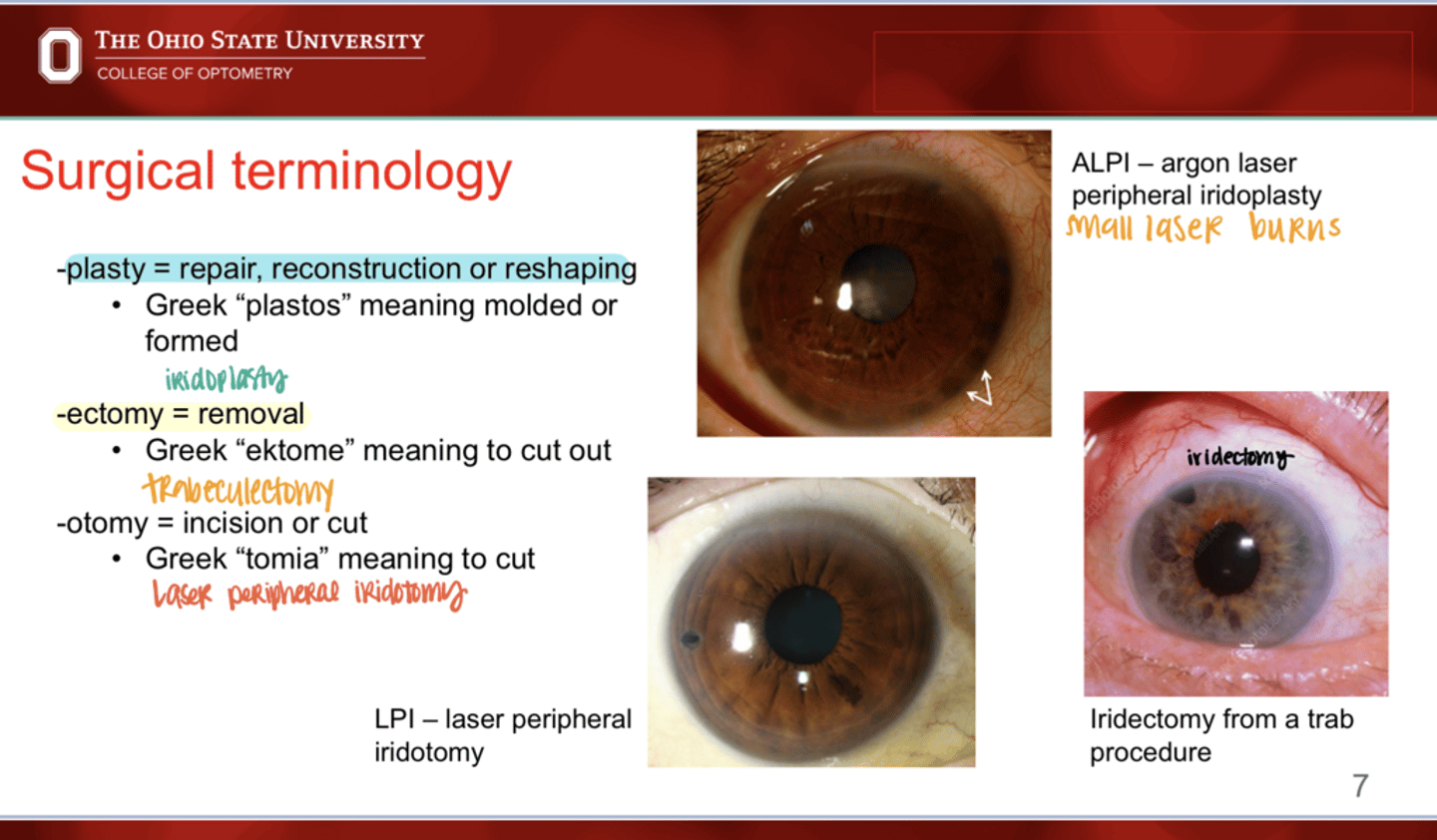
What is the meaning of -ectomy?
removal
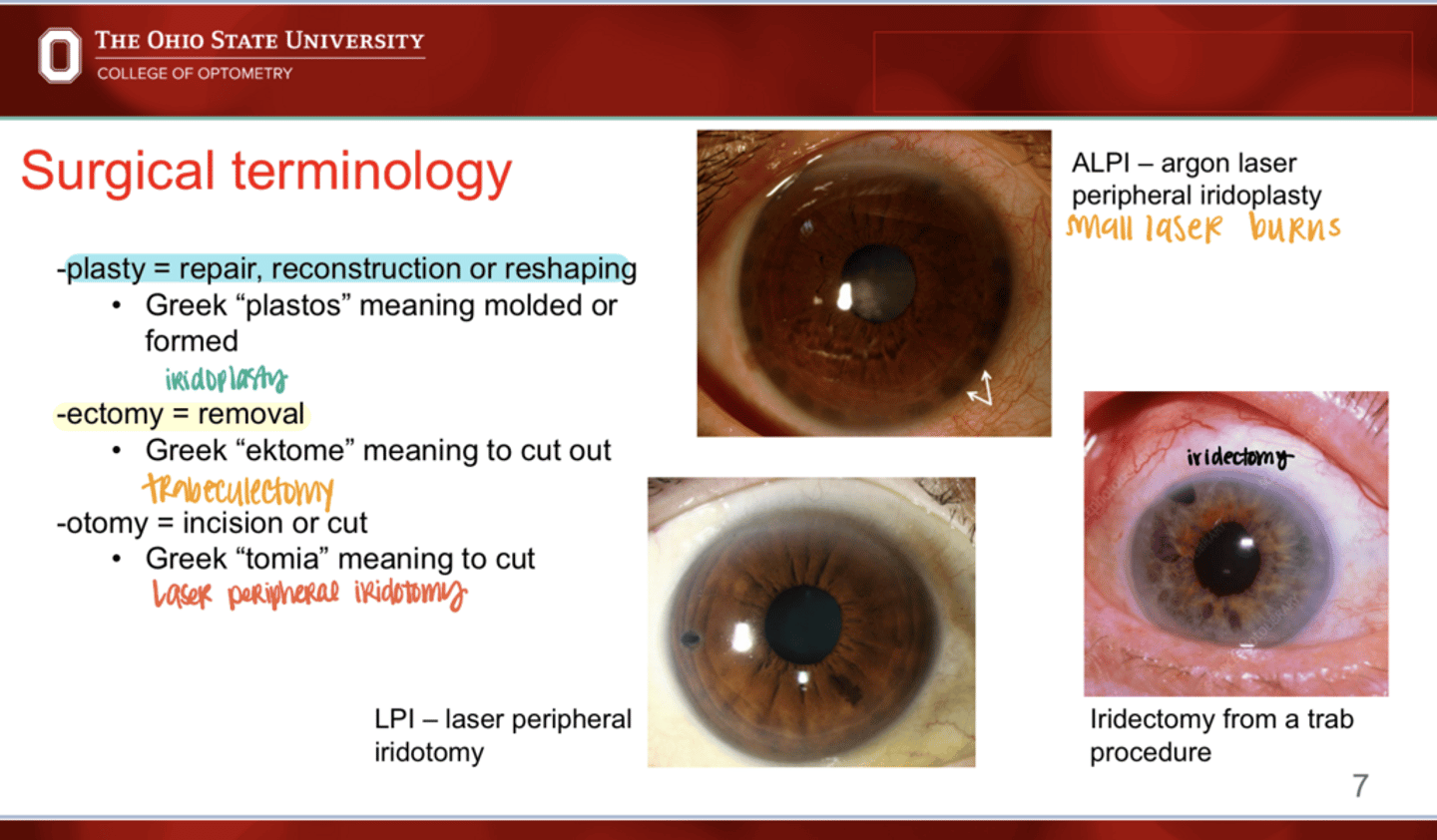
What is the meaning of -otomy?
incision or cut
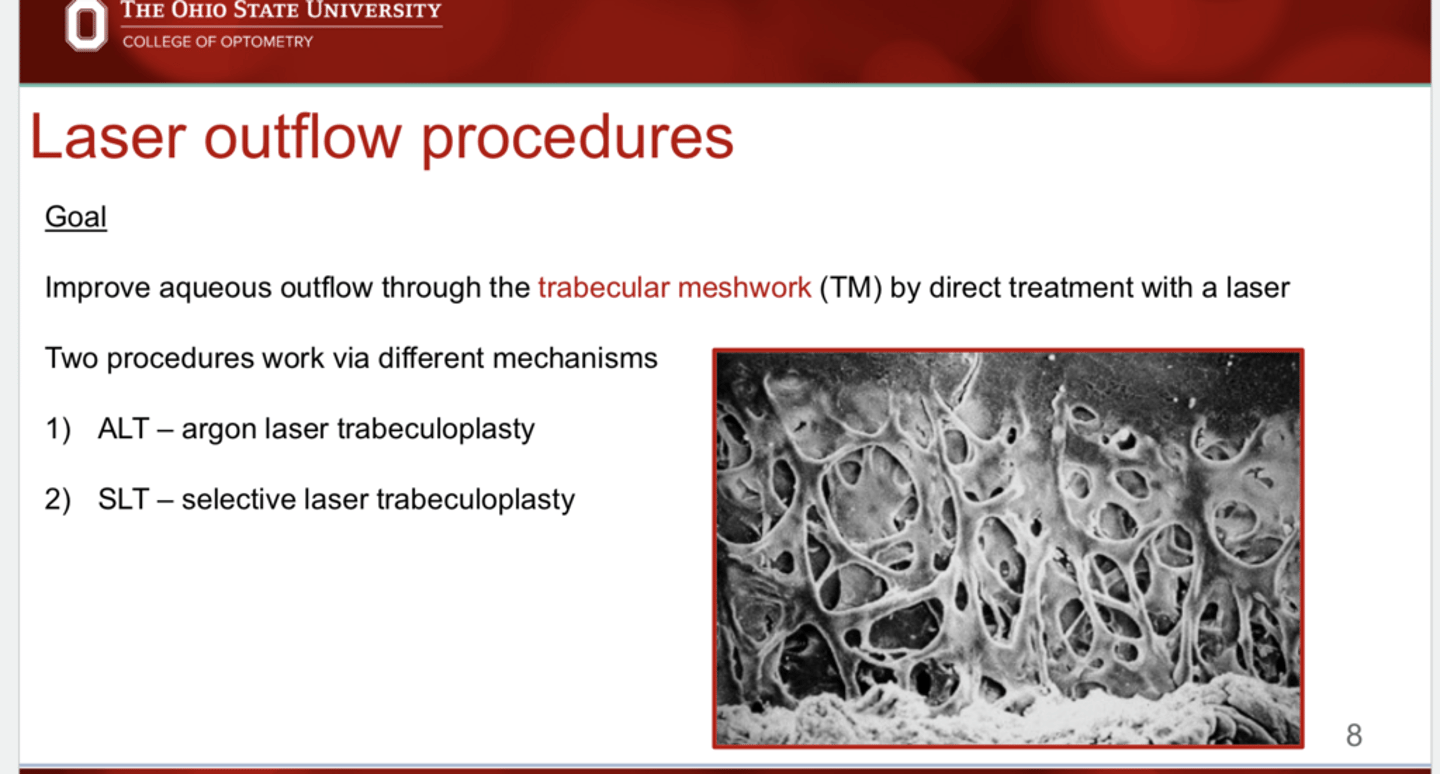
What is the goal of laser outflow procedures?
Improve aqueous outflow through the TM by direct treatment with a laser
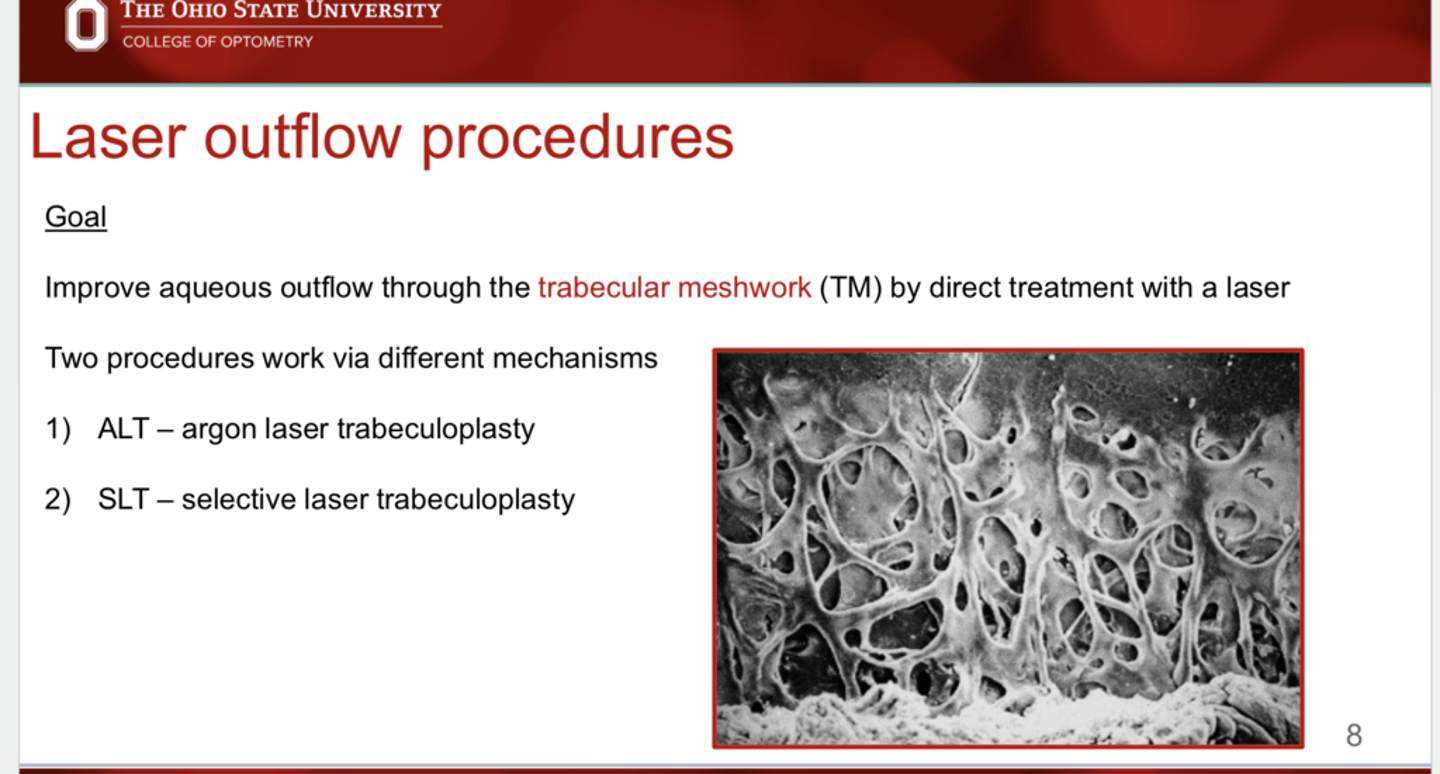
What are the 2 laser procedures that are discussed in this module?
-ALT
-SLT
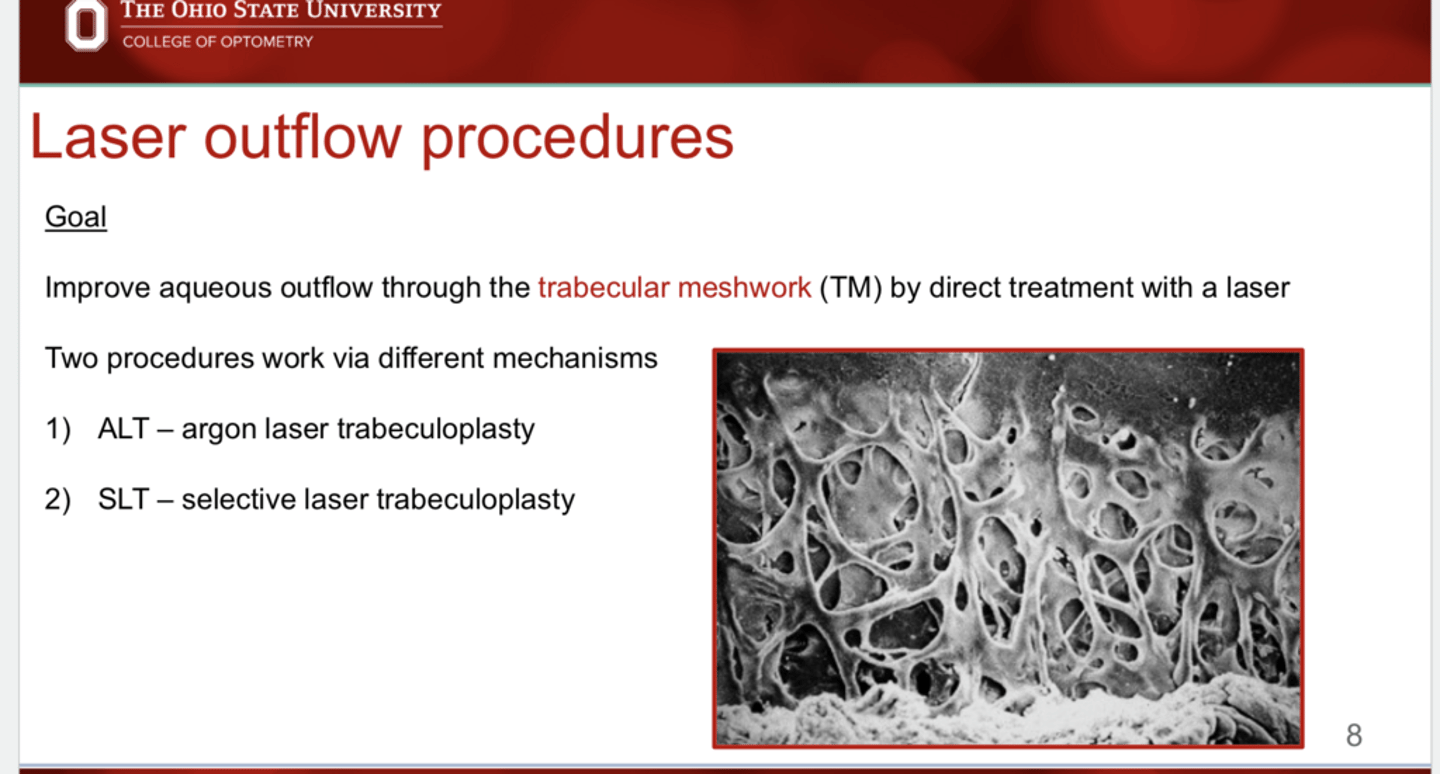
What does ALT stand for?
Argon Laser Trabeculoplasty
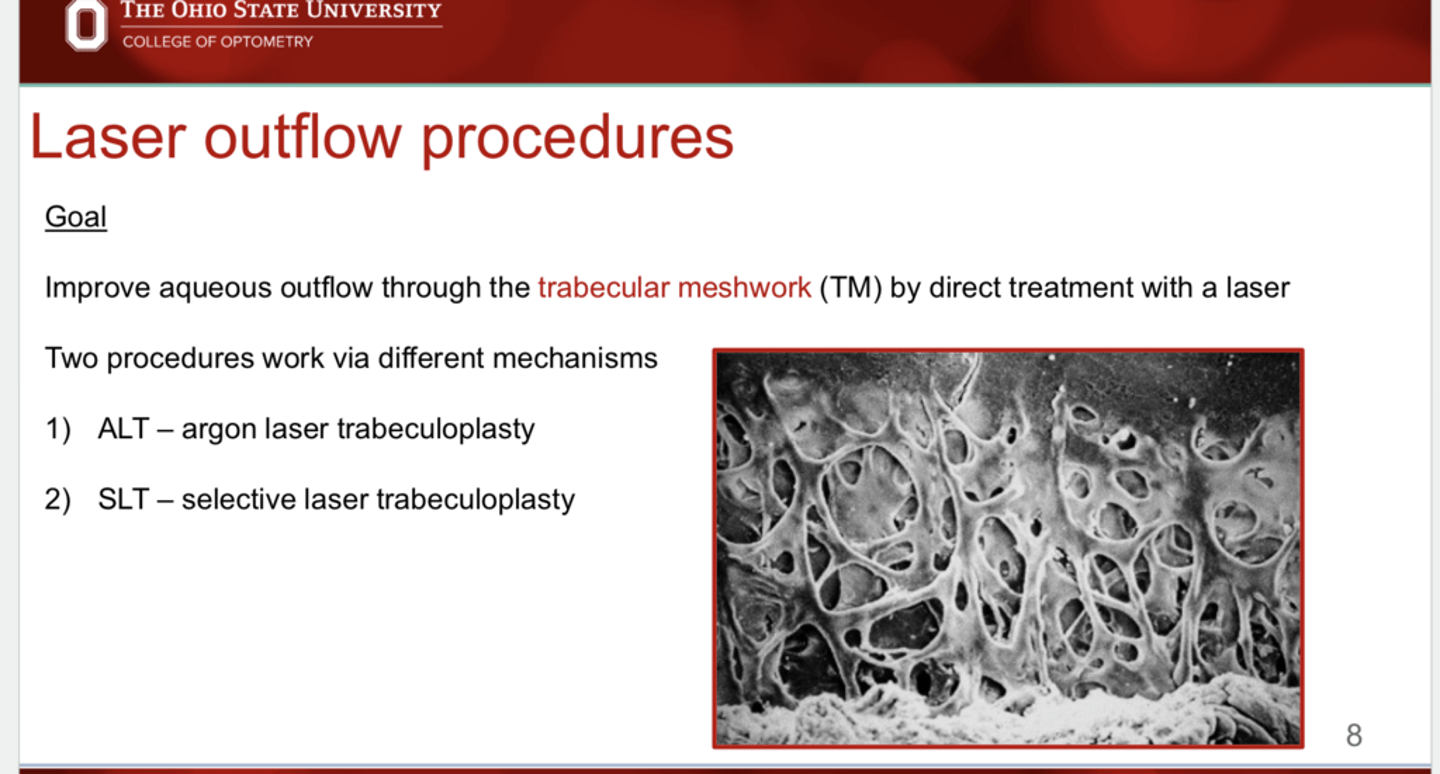
What does SLT stand for?
Selective laser trabeculoplasty
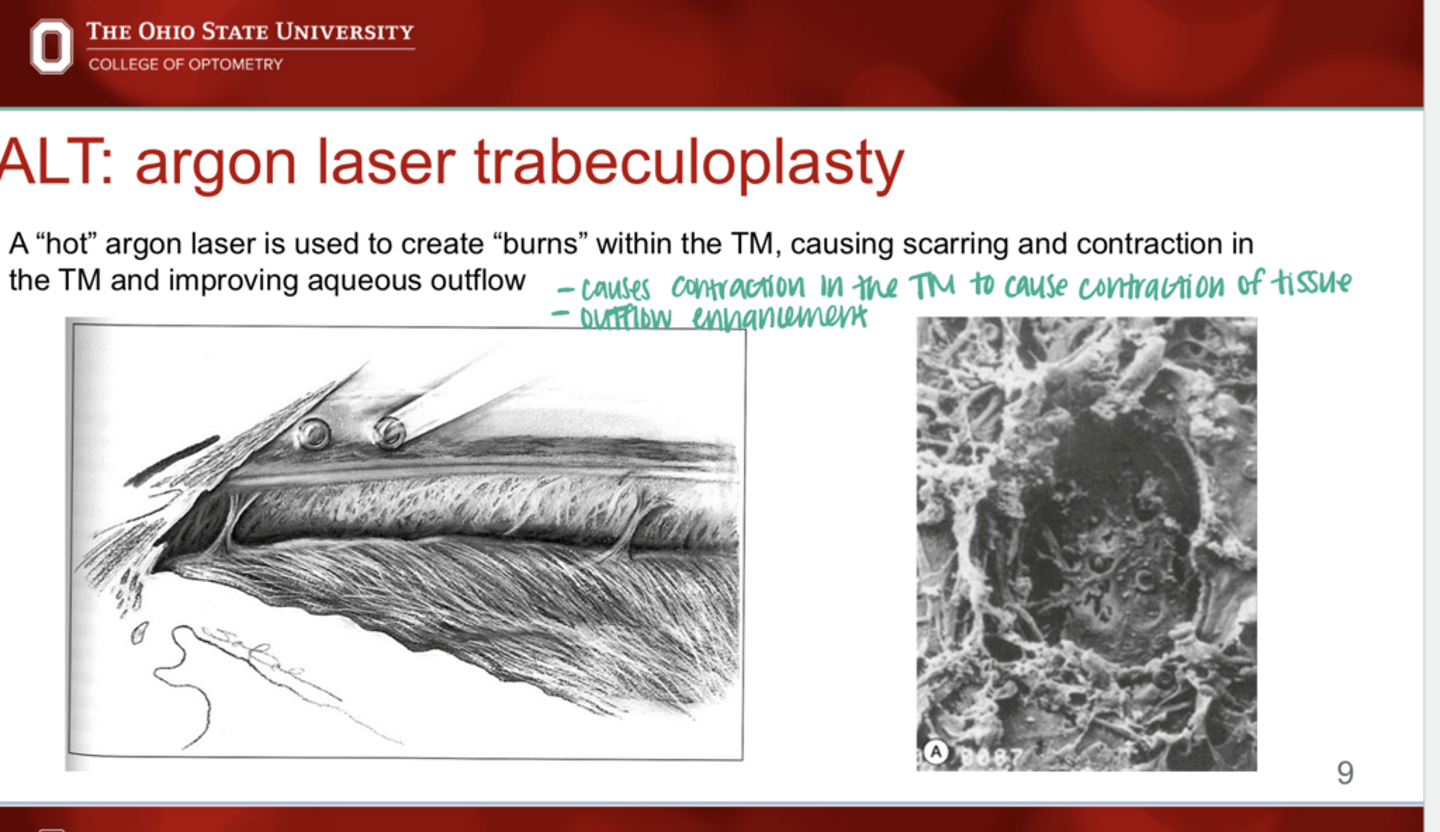
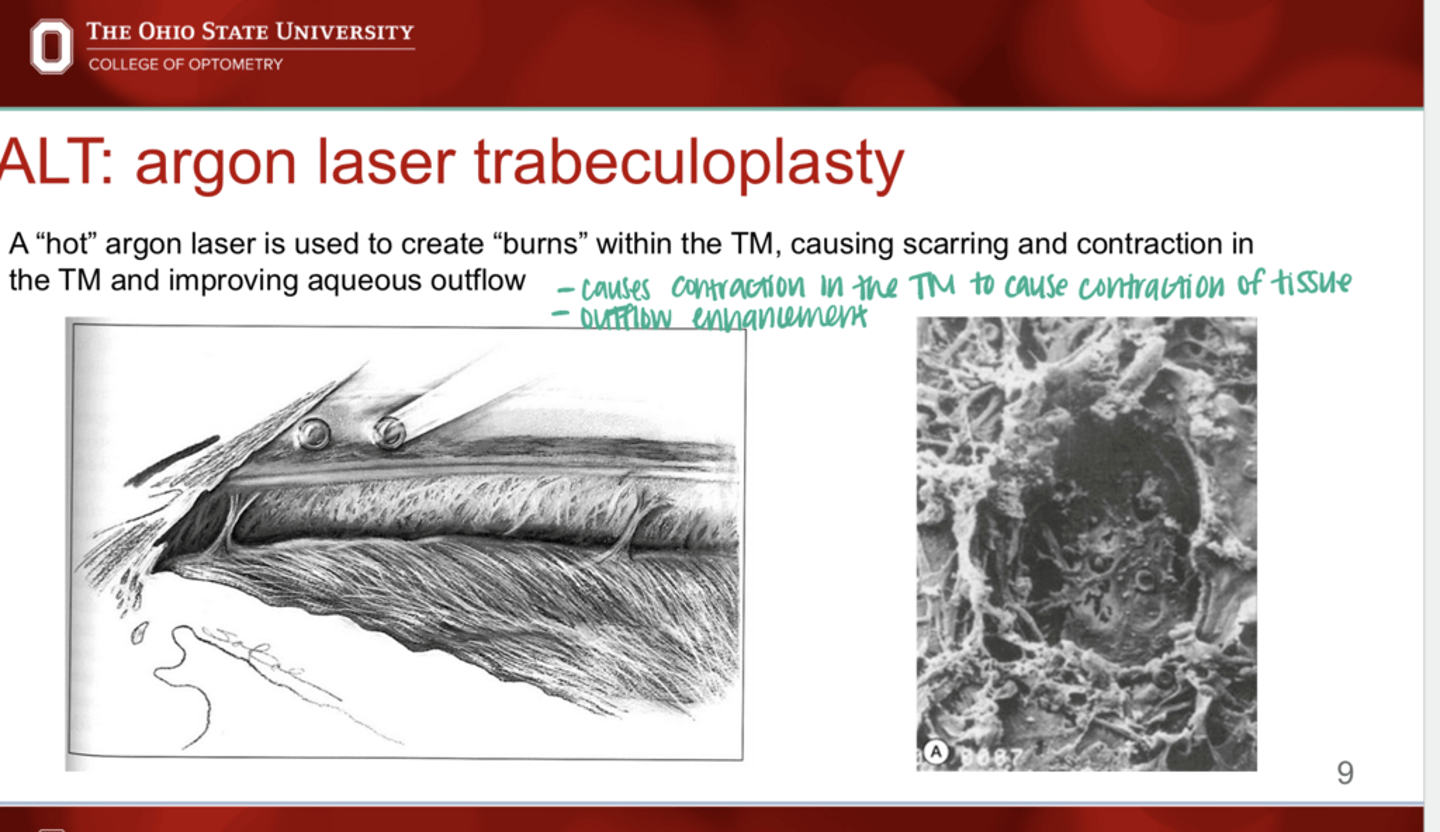
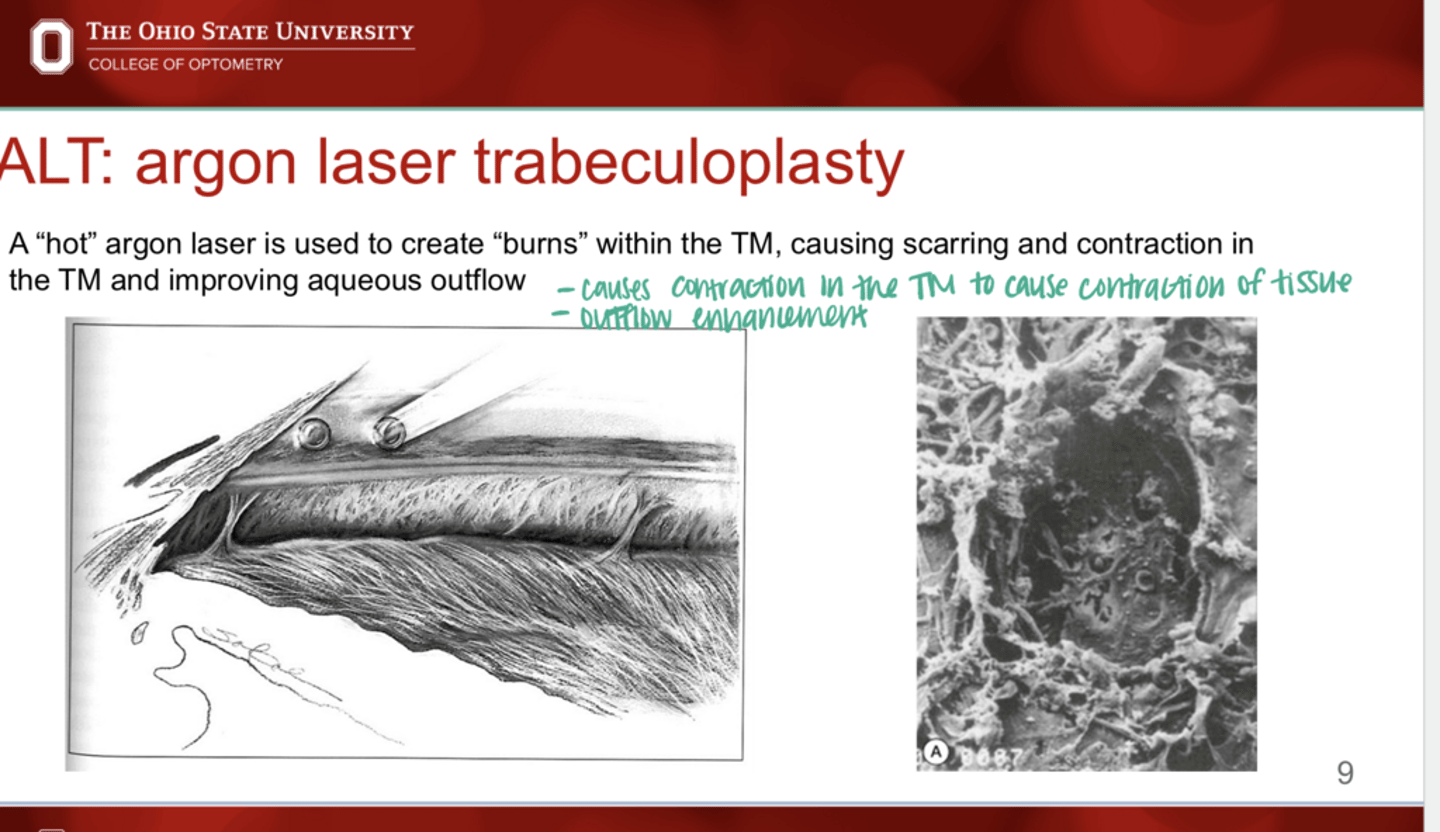
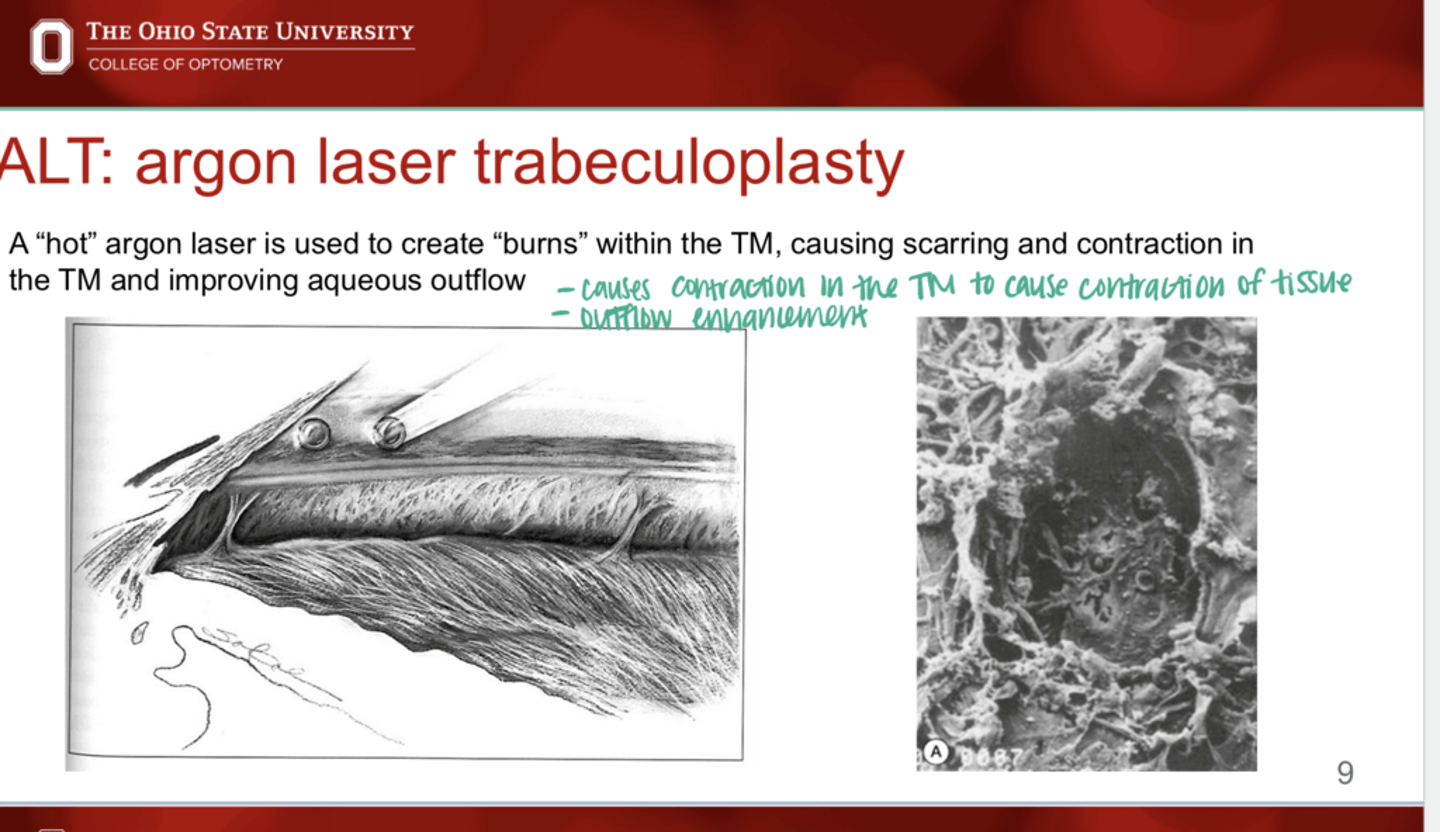
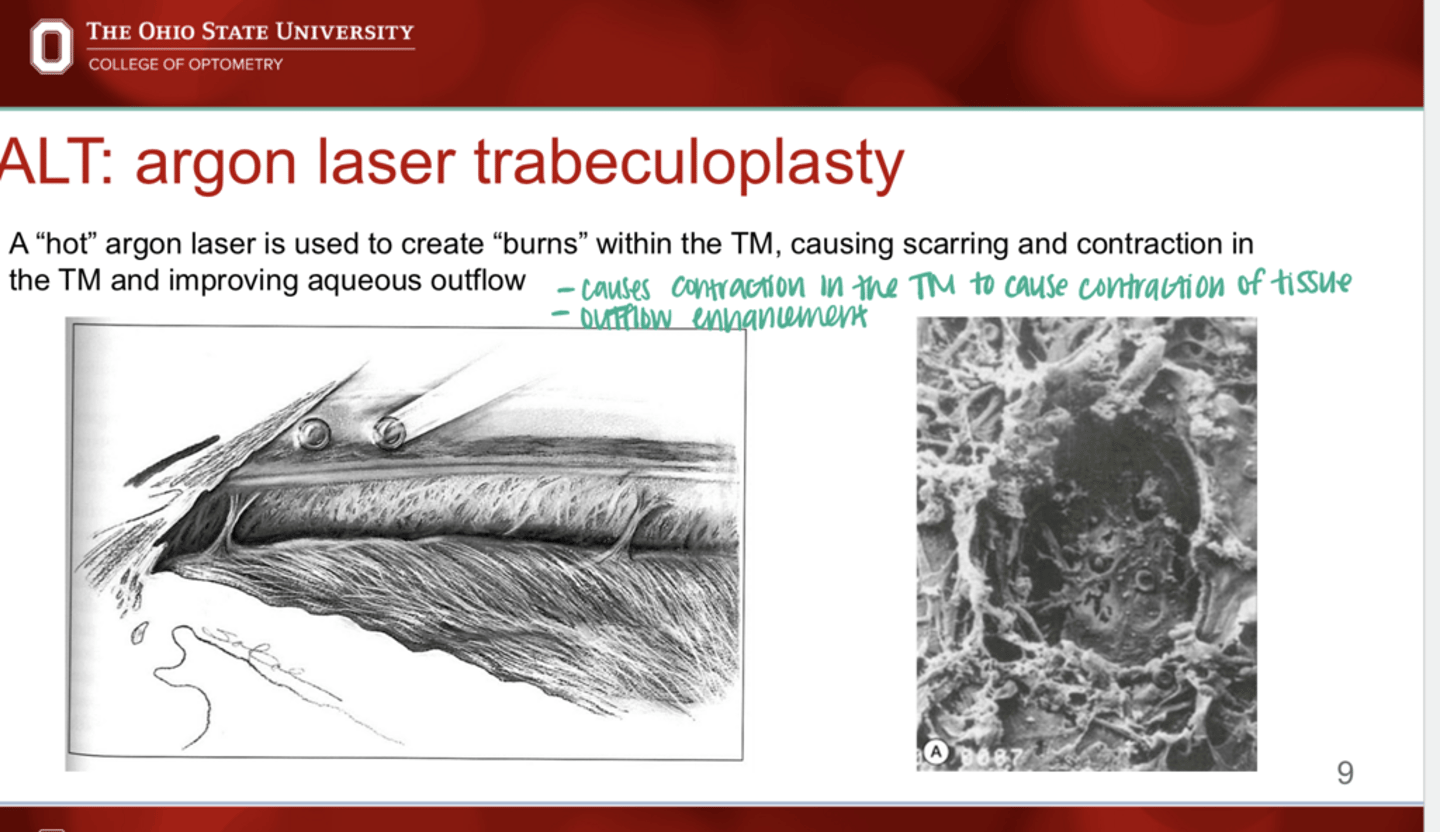
What is ALT (argon laser trabeculoplasty)?
A "hot" argon laser is used to create "burns" within the TM, causing scarring and contraction in the TM and improving aqueous outflow
What is the expected efficacy of ALT (argon laser trabeculoplasty)?
A typical patient will have approx 20% IOP reduction for 2 years
Is ALT typically done twice in the same eye? In the same spot?
ALT is often done twice on the same eye as 2 separate treatments of 180º to minimize the risk of IOP spikes (there will be too much inflammation if full 360º is treated all at once)
True or False:
ALT can be performed in the same 180º of the same eye twice and this is likely to be successful
False -- Laser treatment applied to a previously ALT-treated TM is likely to fail (75% failure rate)
Is SLT treatment on a previously ALT treated spot likely to be successful?
No -- this is likely to fail
What are the post-operative complications and considerations of ALT?
-transient IOP spikes
-persistent elevation of IOP
-iritis
-pain
-PAS
-ocular pain
-permanent damage to TM architecture may limit or prevent future MIGS procedures
Post-ALT, there is a ____% chance of a IOP spike >5mmHg
30
Post-ALT, there is a ____% chance of a IOP spike >10mmHg
12
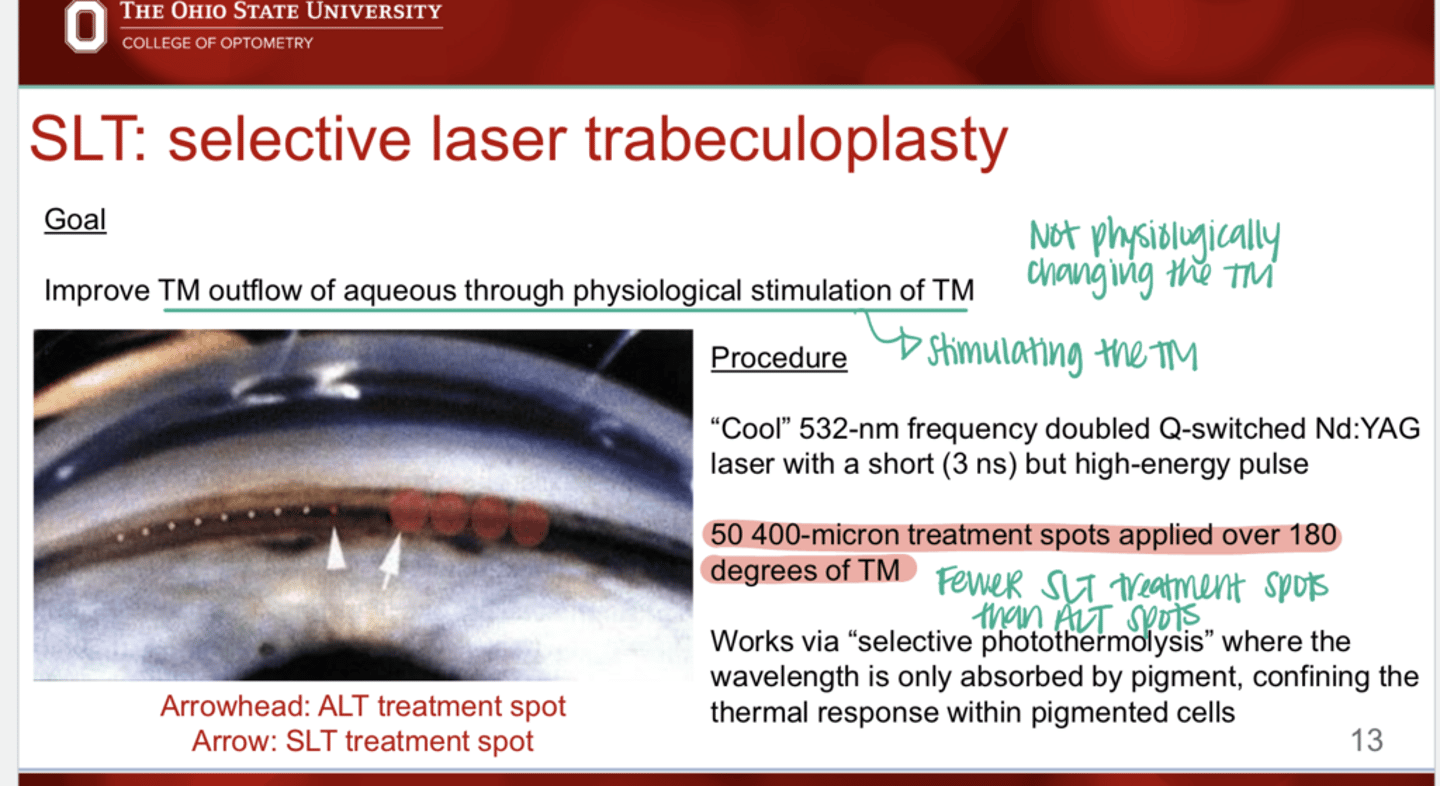
What is the goal of SLT (selective laser trabeculoplasty)?
Improve TM outflow of aqueous through physiological stimulation of the TM
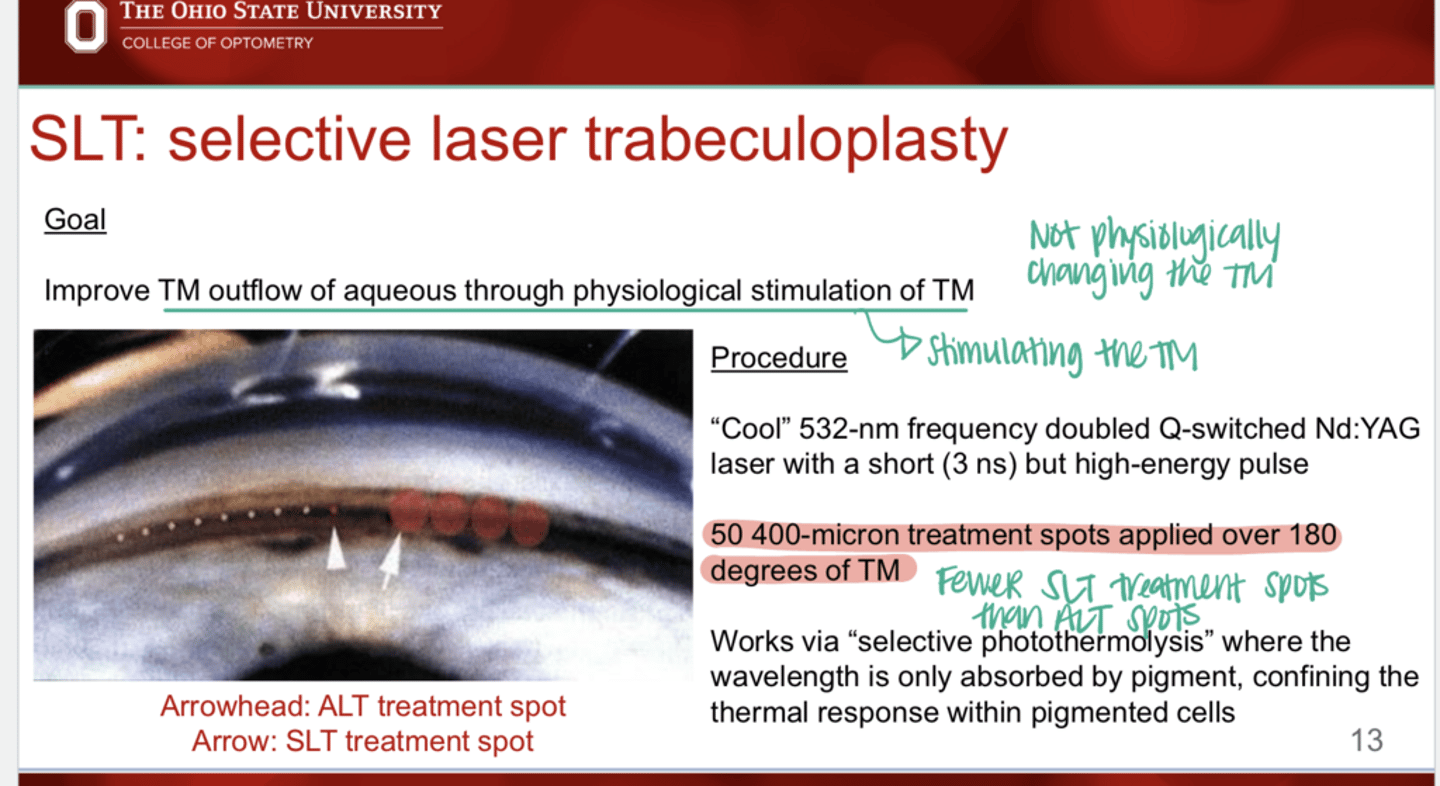
What is the "procedure" of SLT?
-"Cool" 532mm frequency doubled Q-switched Nd:YAG laser with a short (3ns) but high energy pulse
-Applied over 180 degrees of the TM in 50 spots
-Works via selective photothermolysis
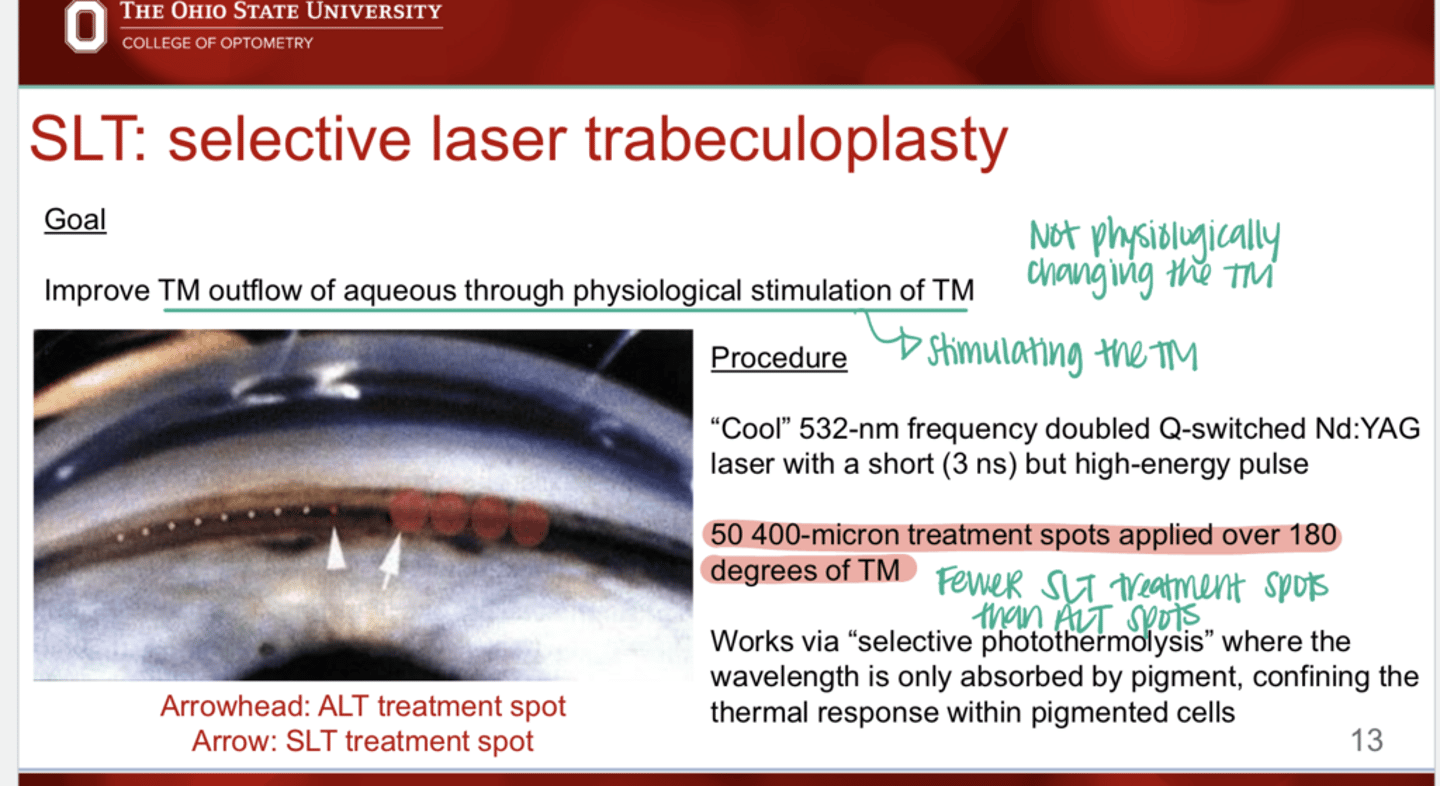
What is "selective photothermolysis"?
Wavelength is only absorbed by pigment, confining the thermal response within pigmented cells
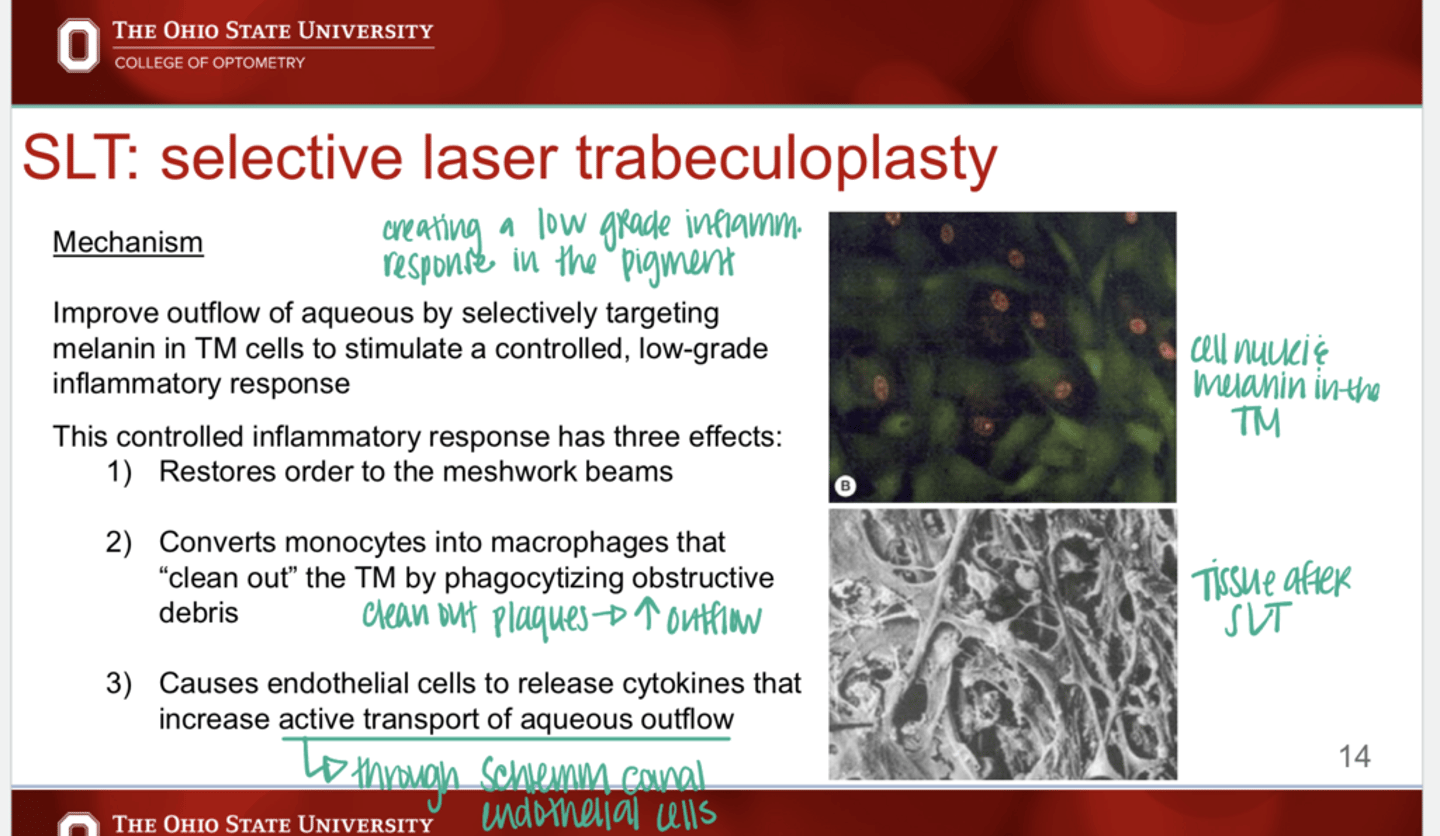
What is the mechanism of SLT?
Improve aqueous outflow by selectively targeting melanin in TM cells to stimulate a controlled, low-grade inflammatory response
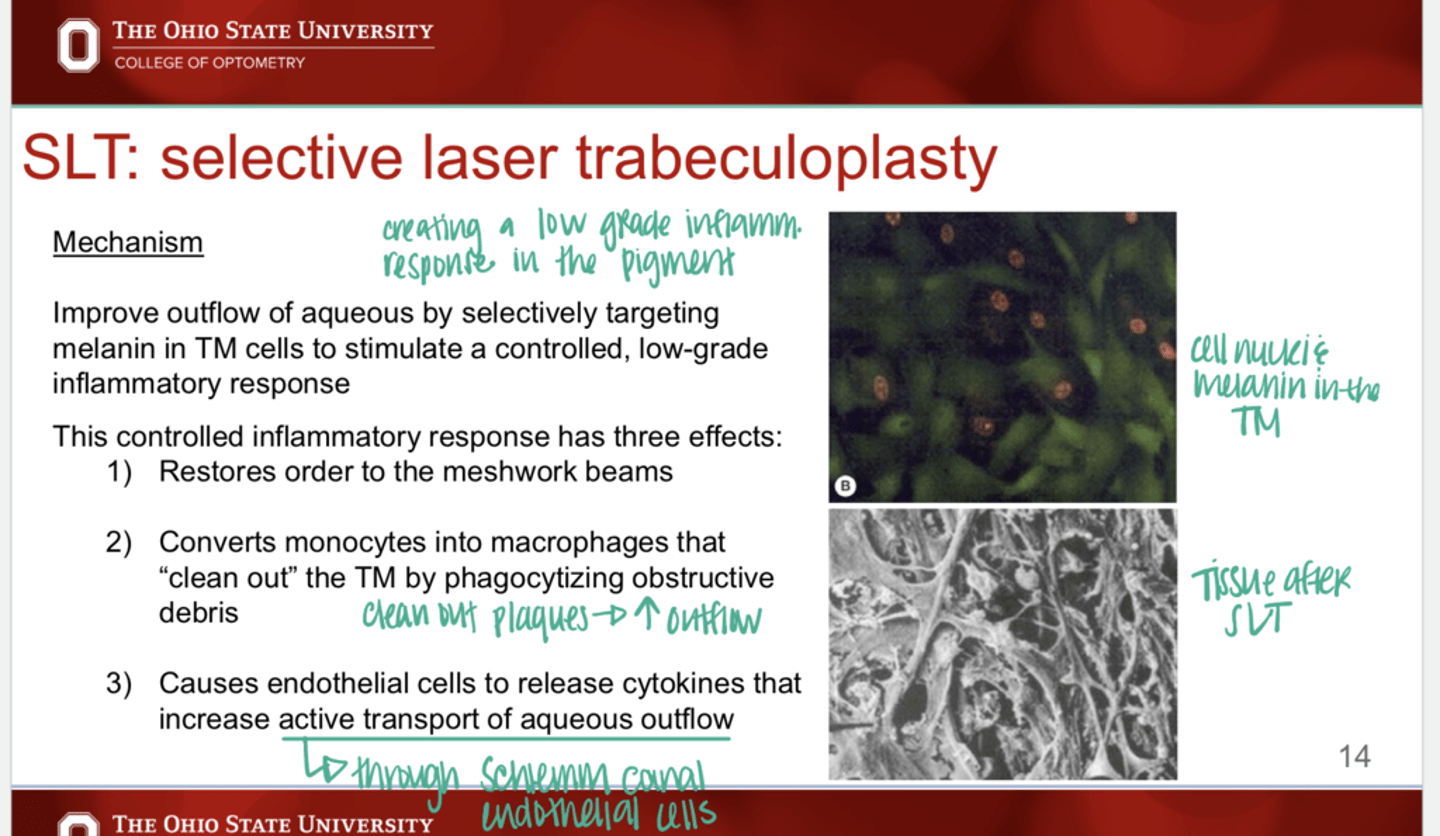
What are the 3 effects of the inflammatory response that is controlled by SLT?
-Restores order to the meshwork beams
-Converts monocytes into macrophages that "clean out" the TM by phagocytizing obstructive debris
-Causes endothelial cells to release cytokines that increase active transport of aq. outflow through Schlemms canal
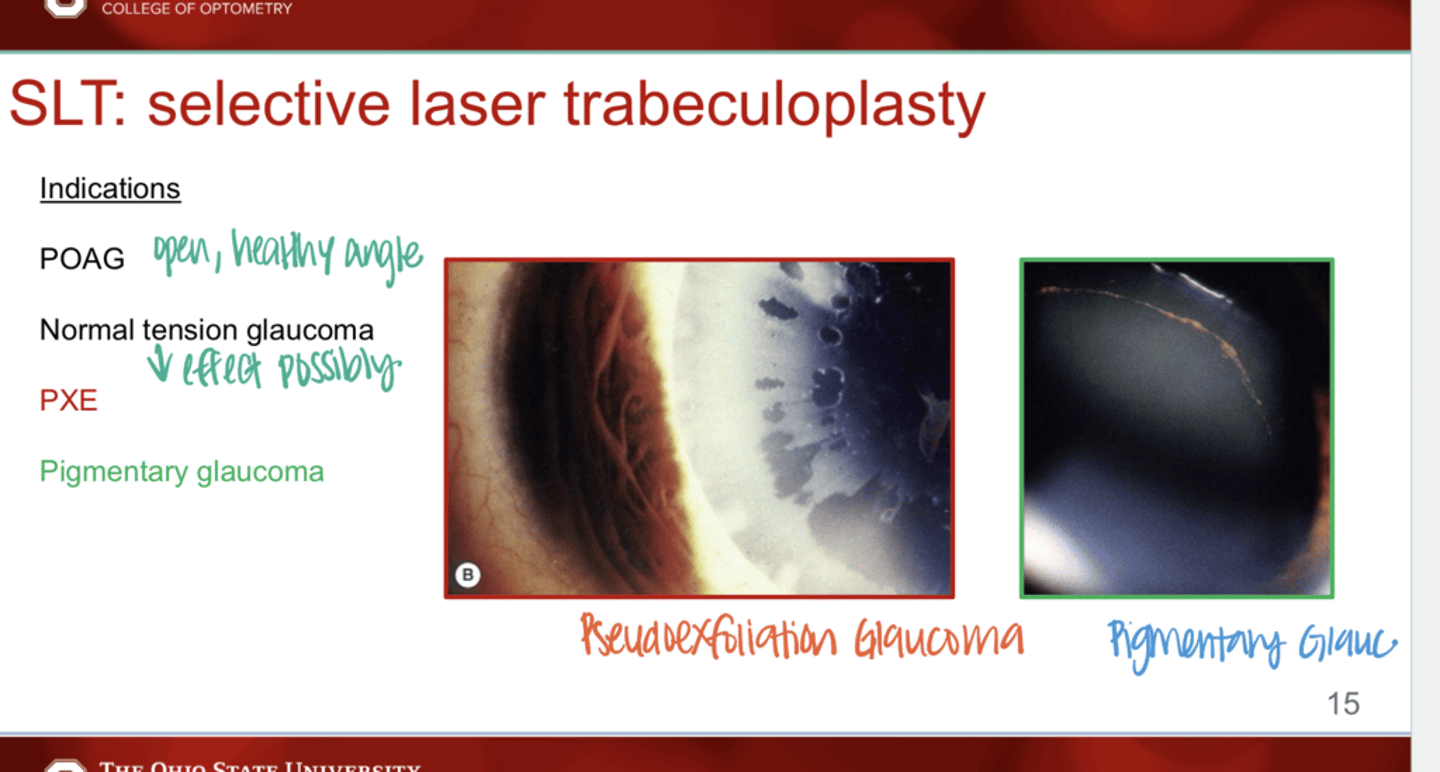
What are the indications for SLT?
POAG
Normal tension glaucoma
PXE
Pigmentary glaucoma
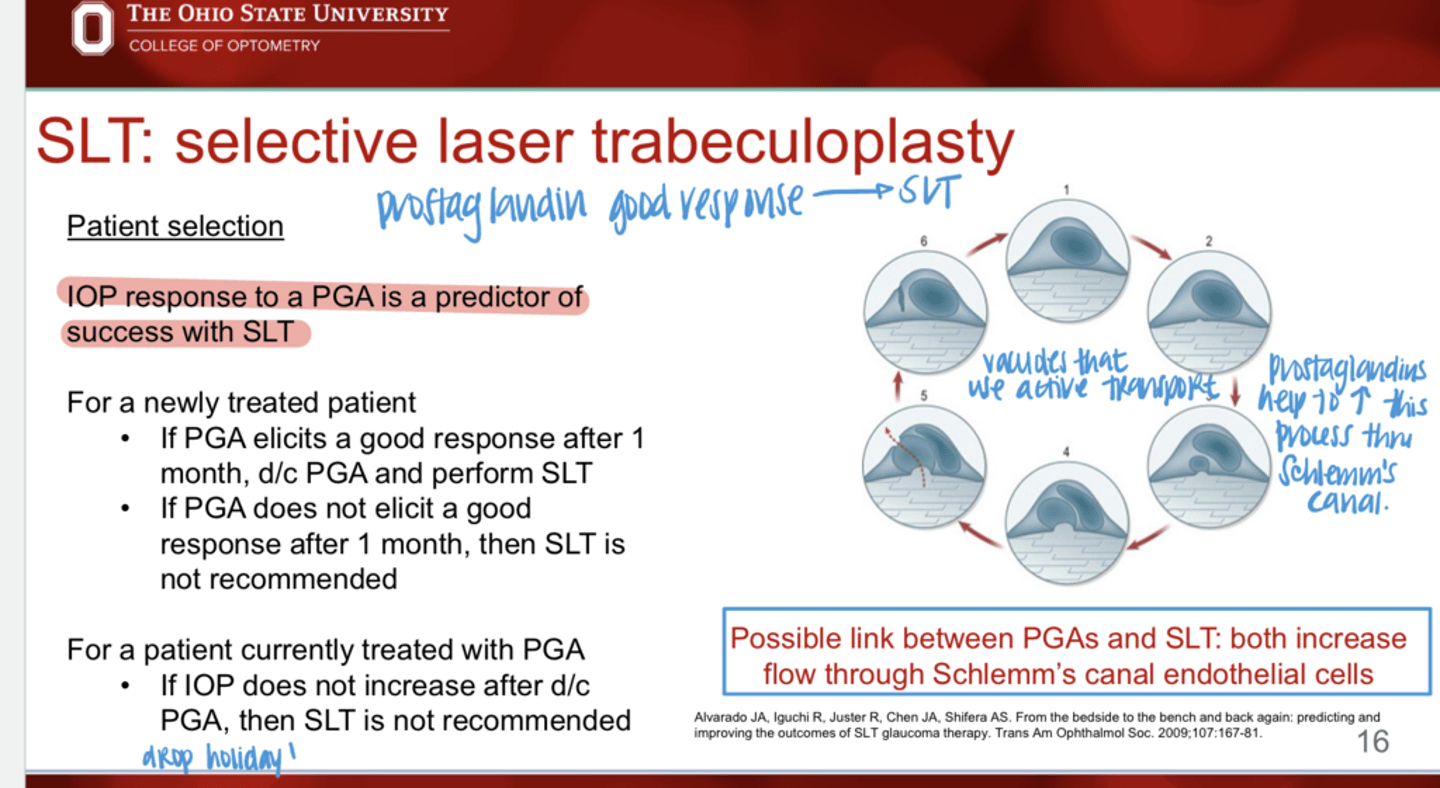
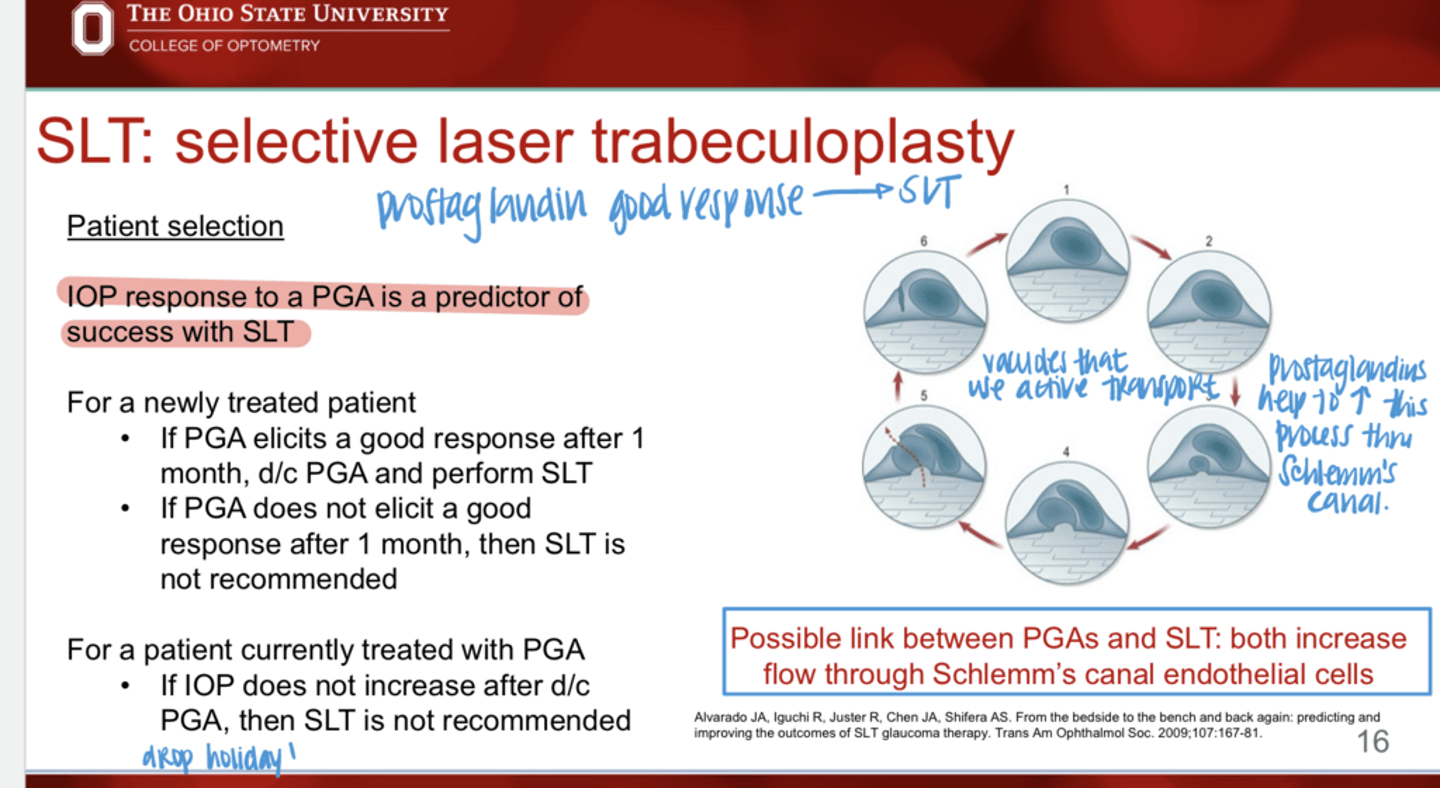
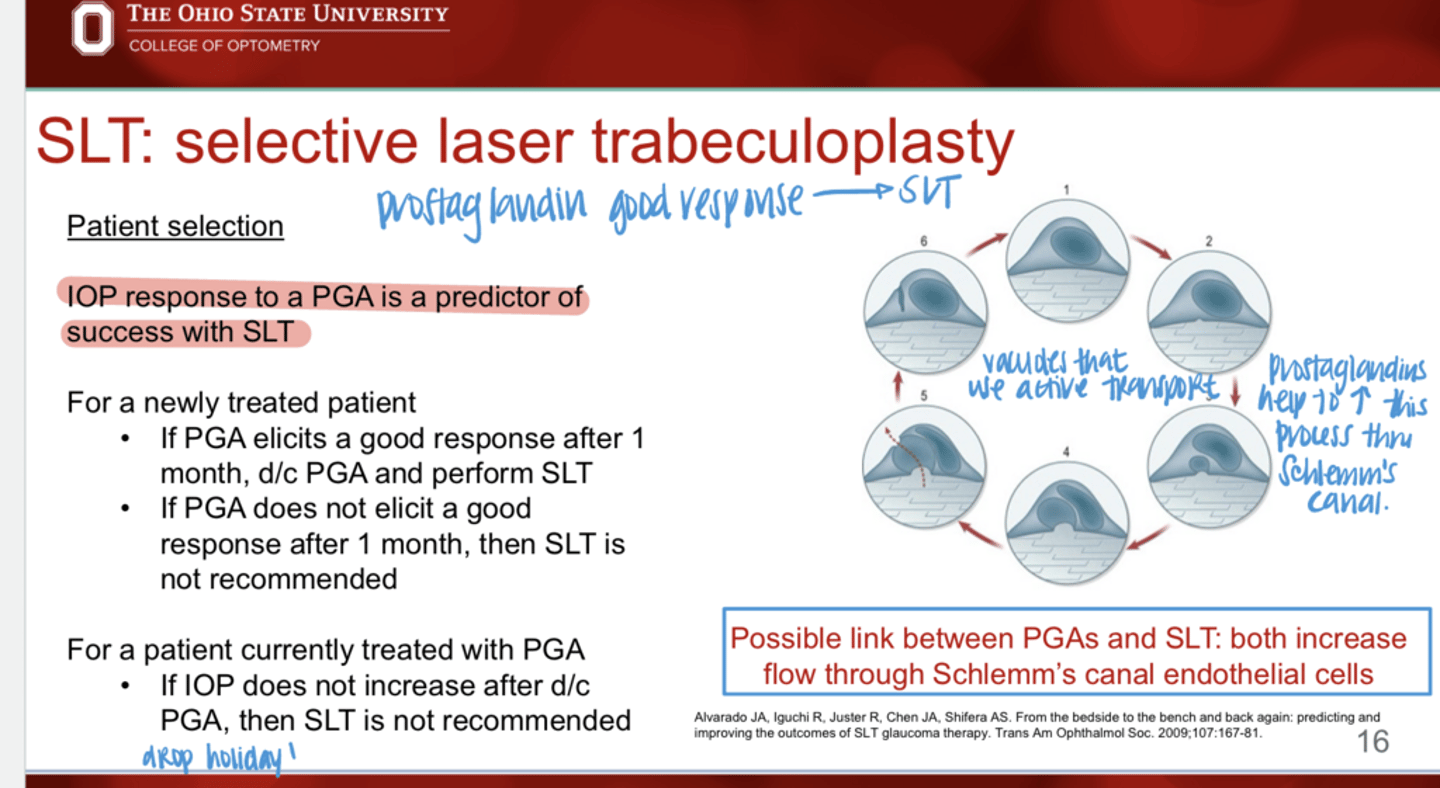
IOP response to a _____ is a predictor of success with SL
prostaglandin
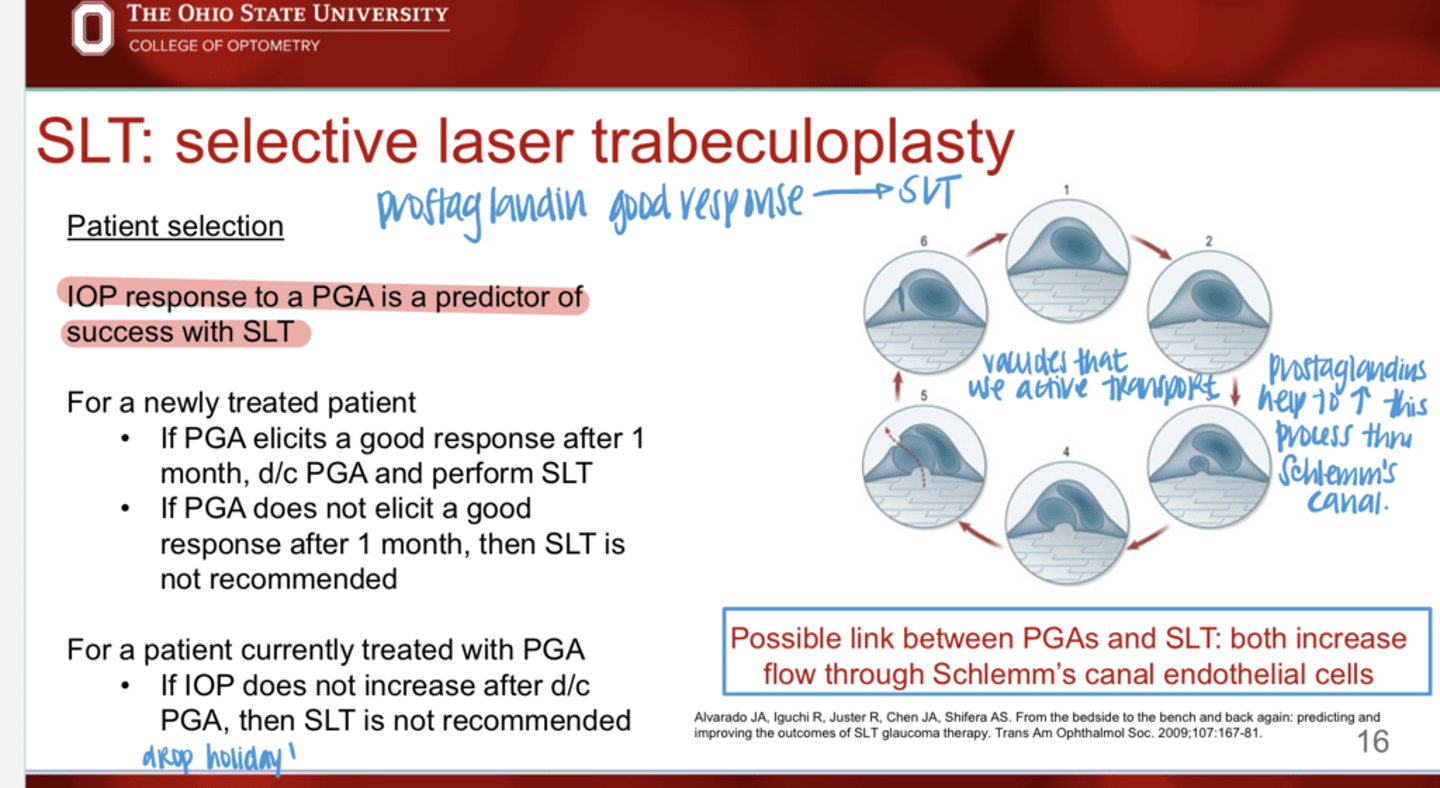
IN A NEWLY TREATED PATIENT,
If a prostaglandin elicits a good response after 1 month, what should you do regarding SLT?
discontinue PGA and perform SLT
IN A NEWLY TREATED PATIENT,
If a prostaglandin DOES NOT elicit a good response after 1 month, what should you do regarding SLT?
SLT is not recommended in this patient
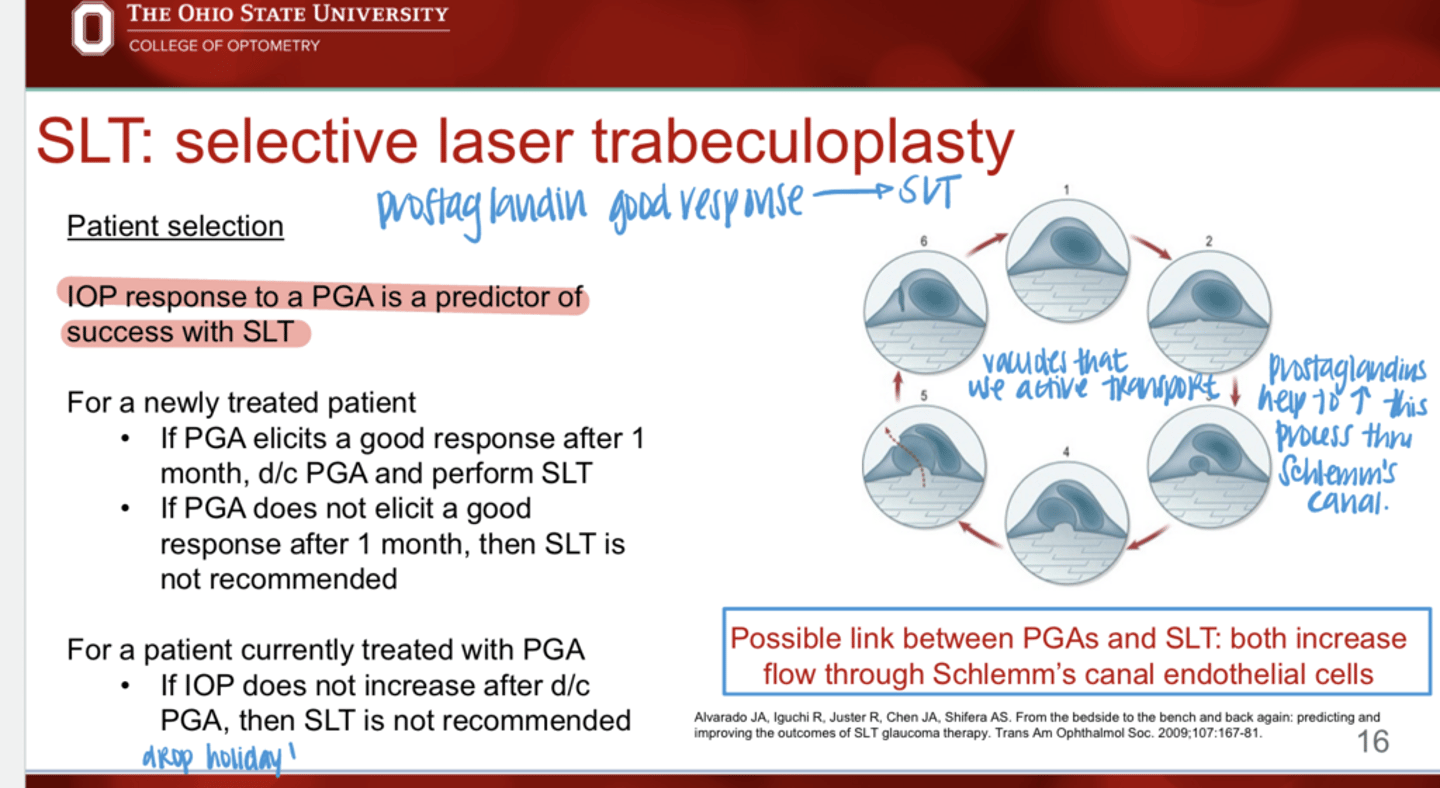
For a patient currently being treated with a PGA, how do you know if they will be a good candidate for SLT?
-Discontinue the prostaglandin
-If IOP does not increase after discontinuing, then SLT is not recommended.
REVIEW: Is there a possible link between PGAs and SLT?
Yes
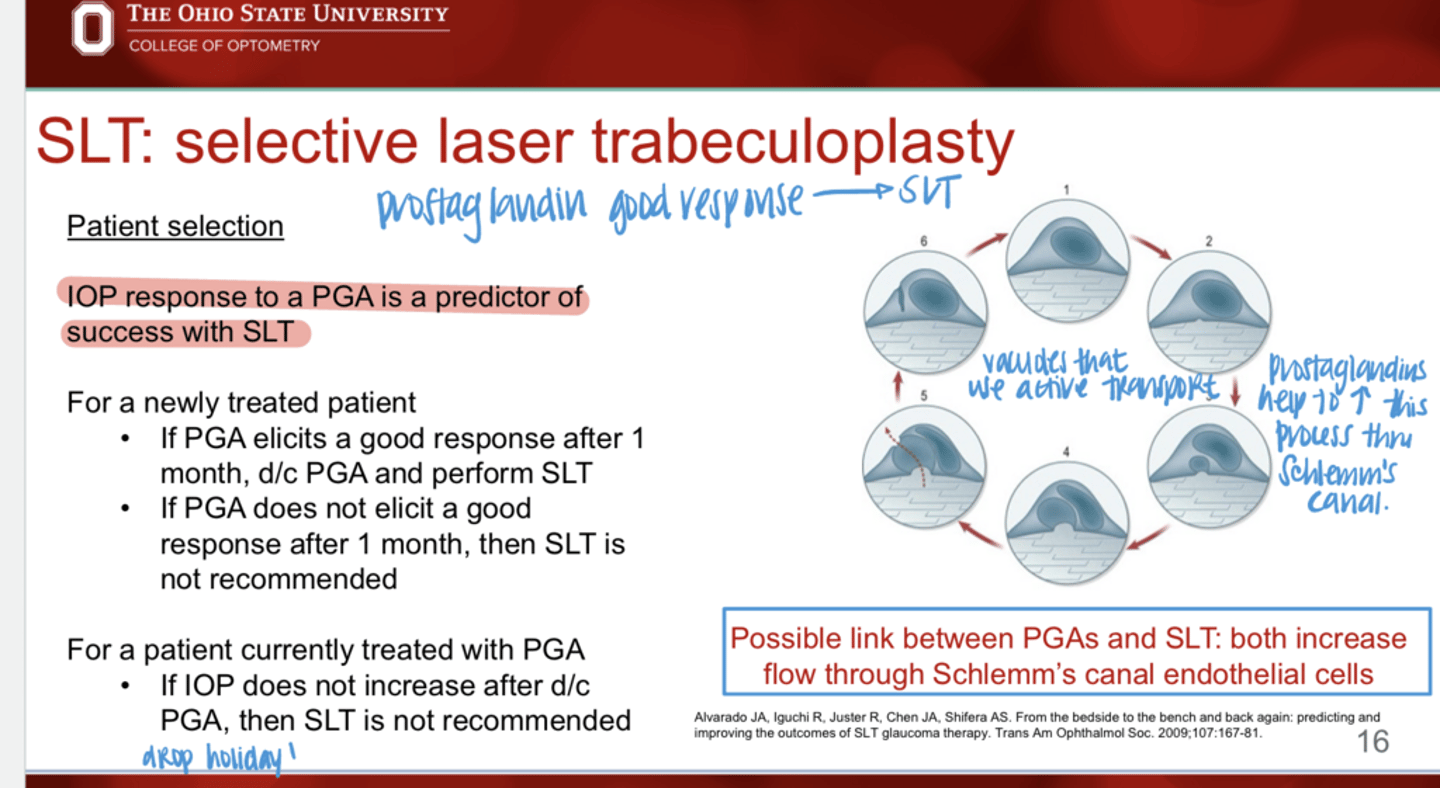
What is the link between PGAs and SLT?
both increase flow through Schlemm's canal endothelial cellsb
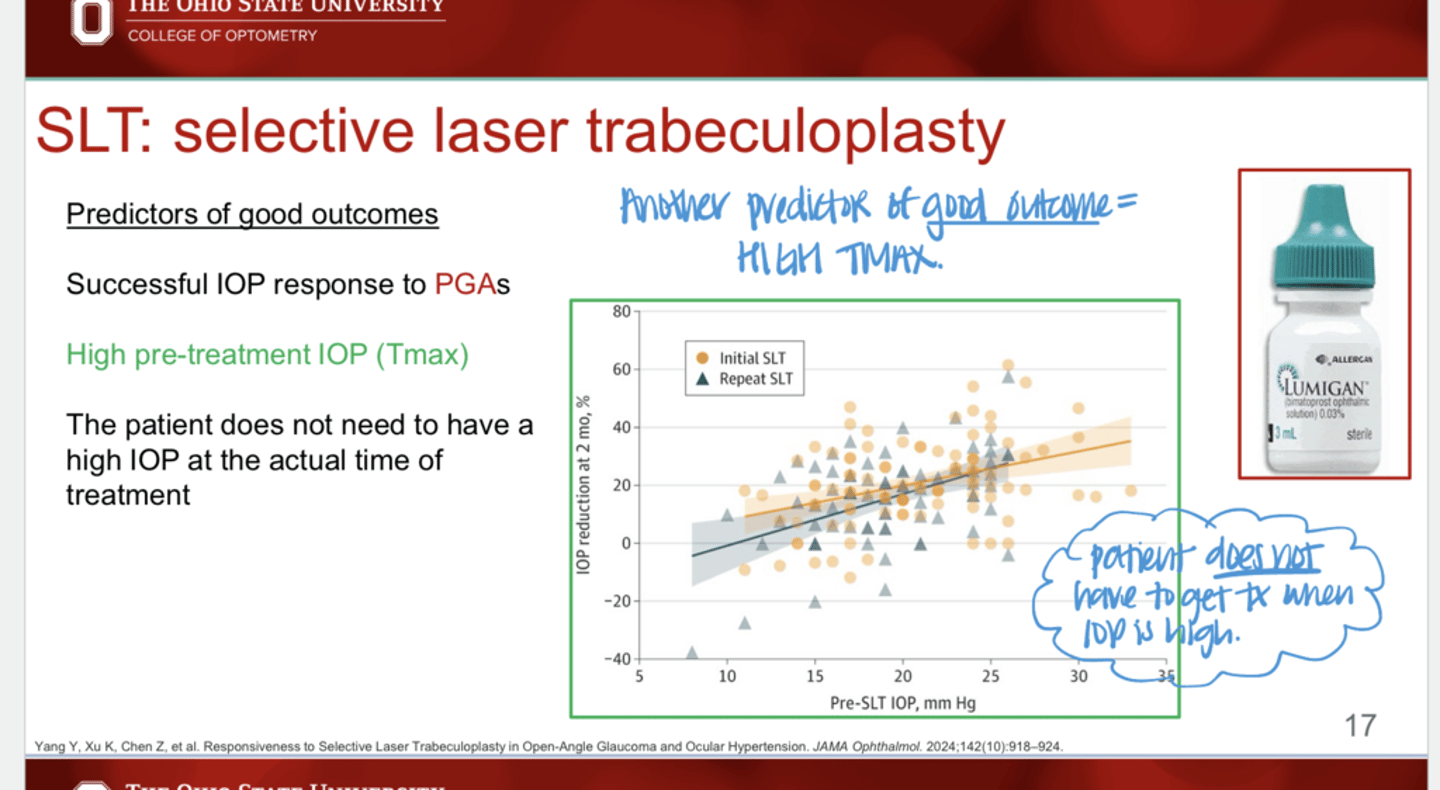
What are the predictors of good SLT outcomes?
-successful IOP response to PGAs
-High pre-treatment IOP
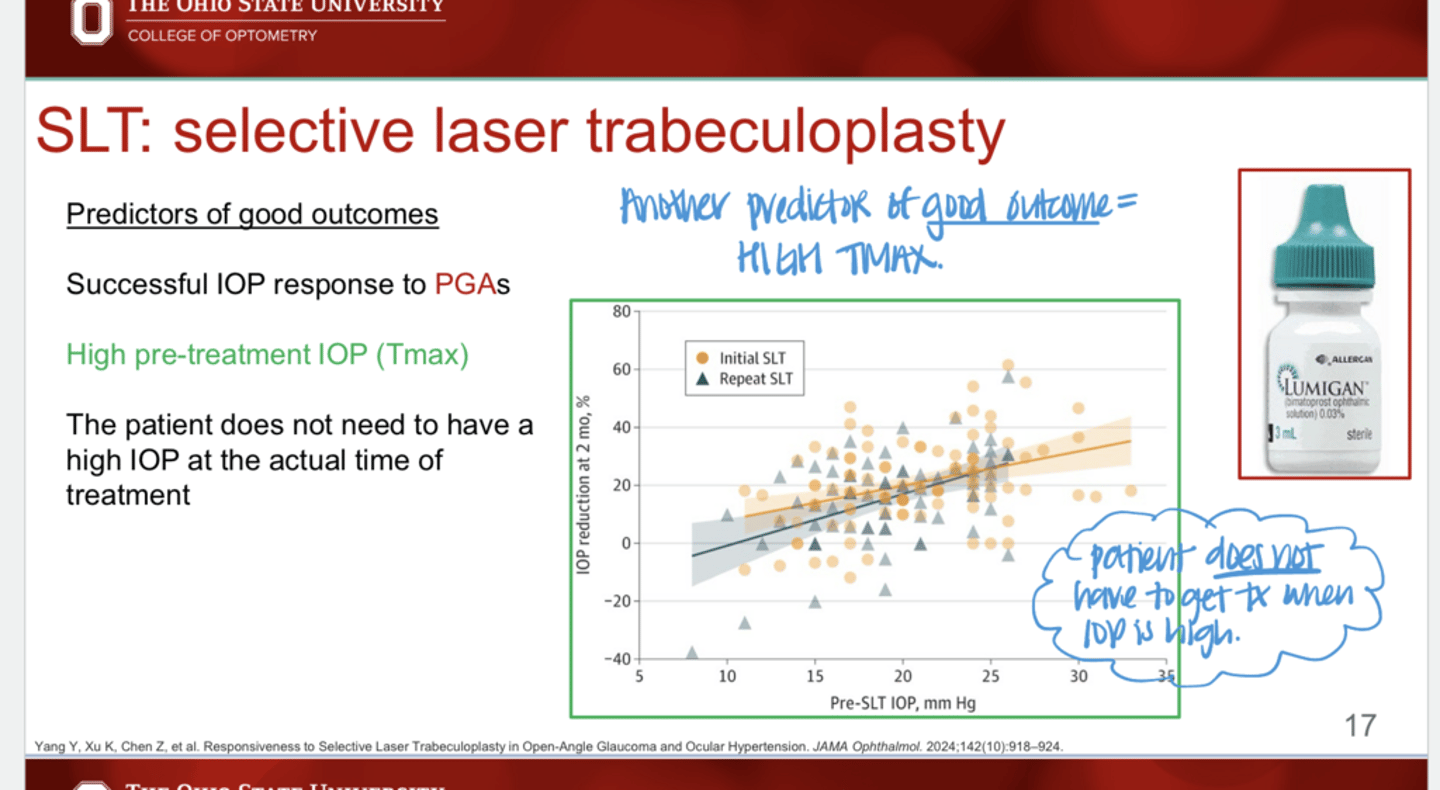
True or False:
The patient needs to have a high IOP AT THE TIME OF TREATMENT for SLT to be successful
False -- a higher pre-treatment Tmax is correlated to better outcome
Predictors of SLT Success
Low pre-treatment IOP
Poor outcome
Predictors of SLT Success
High pre-treatment IOP
Good outcome
Predictors of SLT Success
Successful IOP response to PGAs
Good outcome
Predictors of SLT Success
Use of post-operative steroids
Poor outocme
Predictors of SLT Success
Unsuccessful IOP response to PGAs
Poor outcome
Predictors of SLT Success
Lack of post-operative steroids needed
Good outcome
Predictors of SLT Success
Systemic immunosuppressive therapy
Poor outcome
Unlike ALT, IOP reduction after SLT is _______ successful in patients with high and low TM pigment concentration
equally
With SLT, patients with more pigmentation are at a (higher/lower) risk for side effects
higher
Is high pigmentation in the TM a contraindication of SLT use?
No
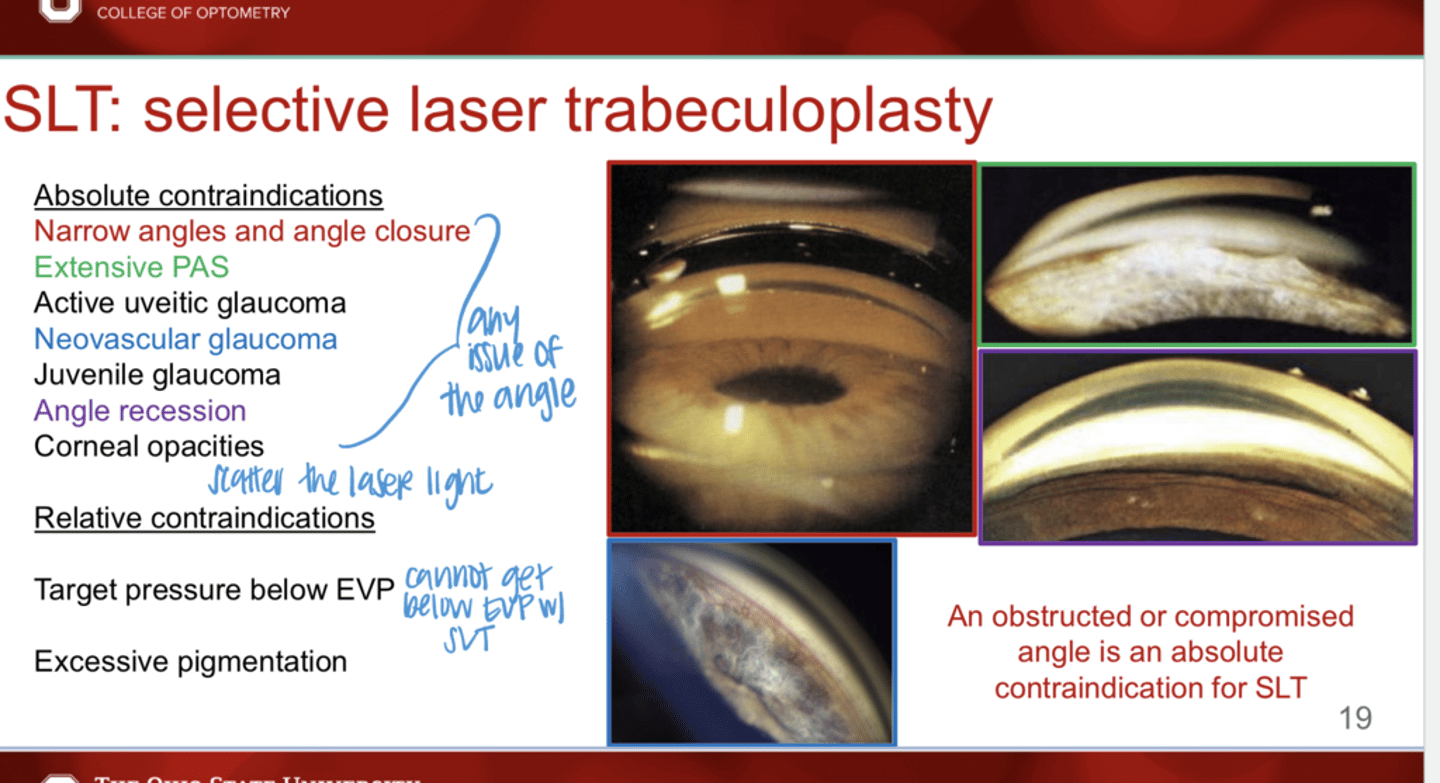
What are the absolute contraindications of SLT?
-narrow angles and angle closure
-extensive PAS
-active uveitic glaucoma
-neovascular glaucoma
-juvenile glaucoma
-angle recession
-corneal opacity
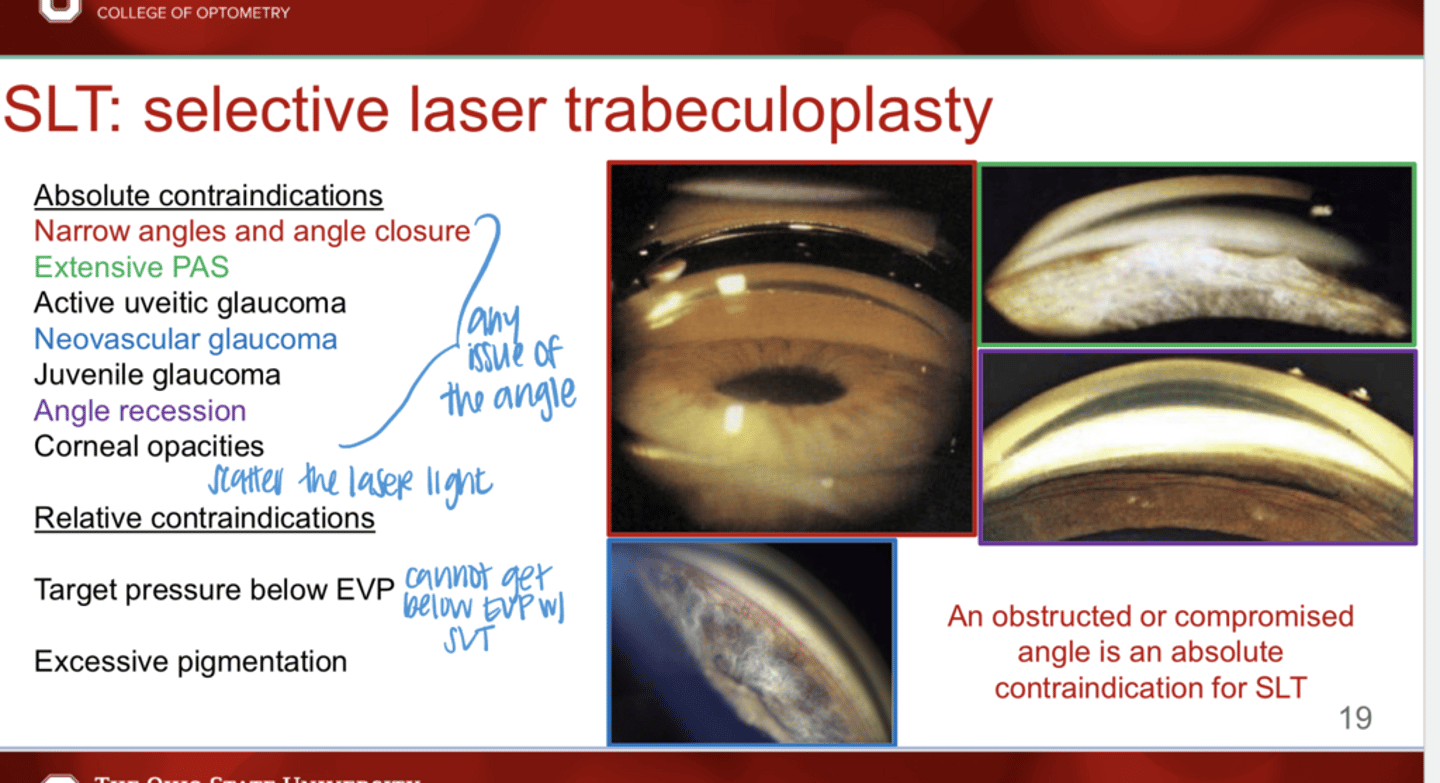
What are the RELATIVE contraindications of SLT?
-target pressure below EVP
-excessive pigmentation
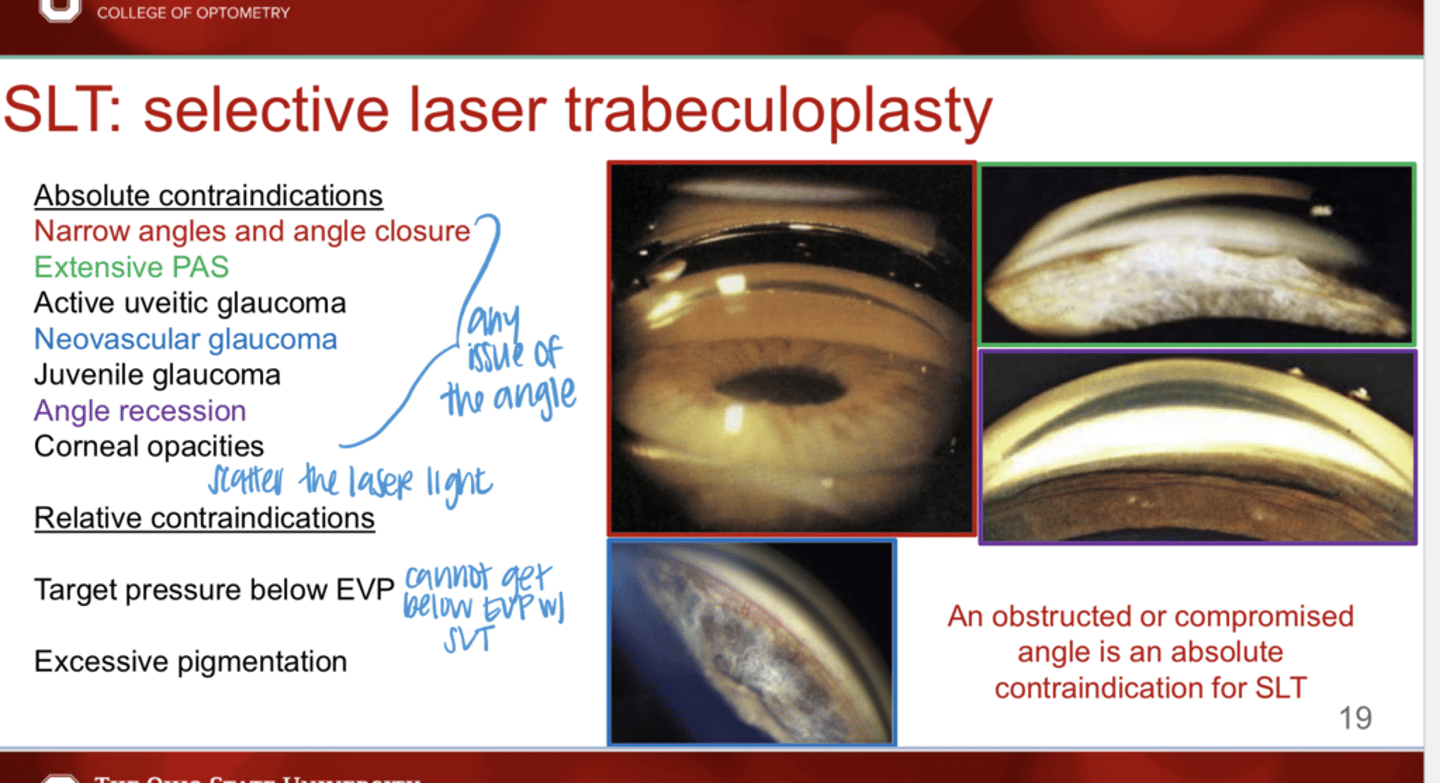
True or False:
An obstructed or compromised angle is an absolute contraindication to SLT
true
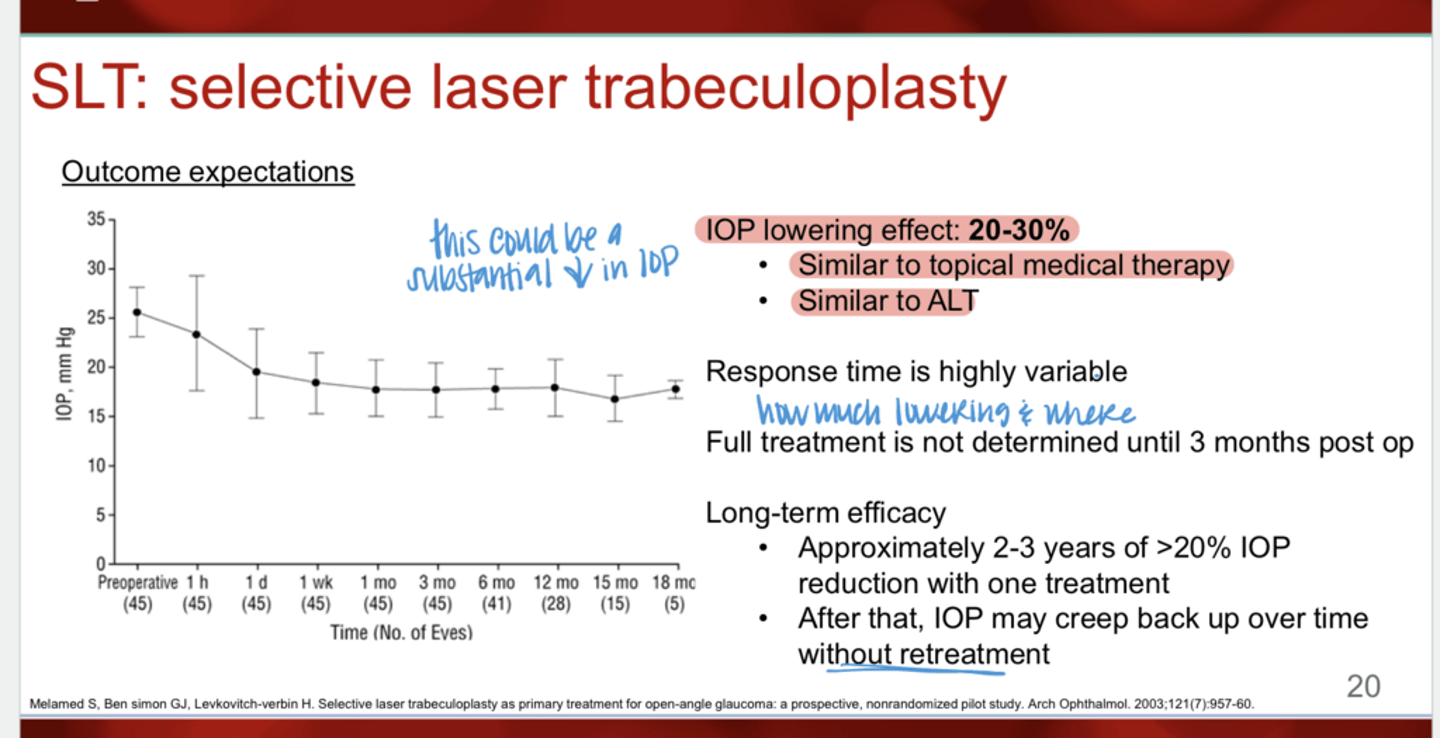
What is the expected IOP lowering effect of SLT?
20-30%
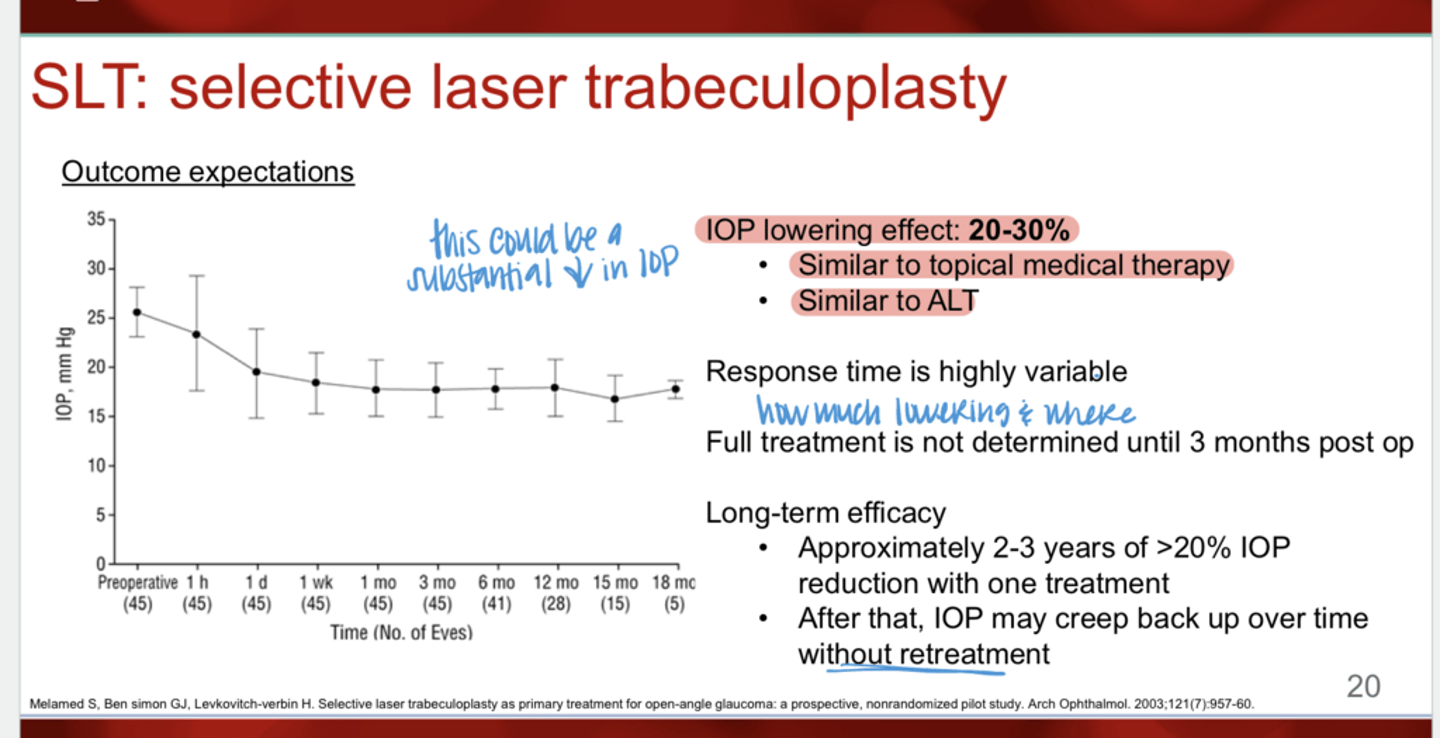
Expected IOP lowering of SLT is around 20-30%. This is similar to what?
-topical medical therapy
-ALT
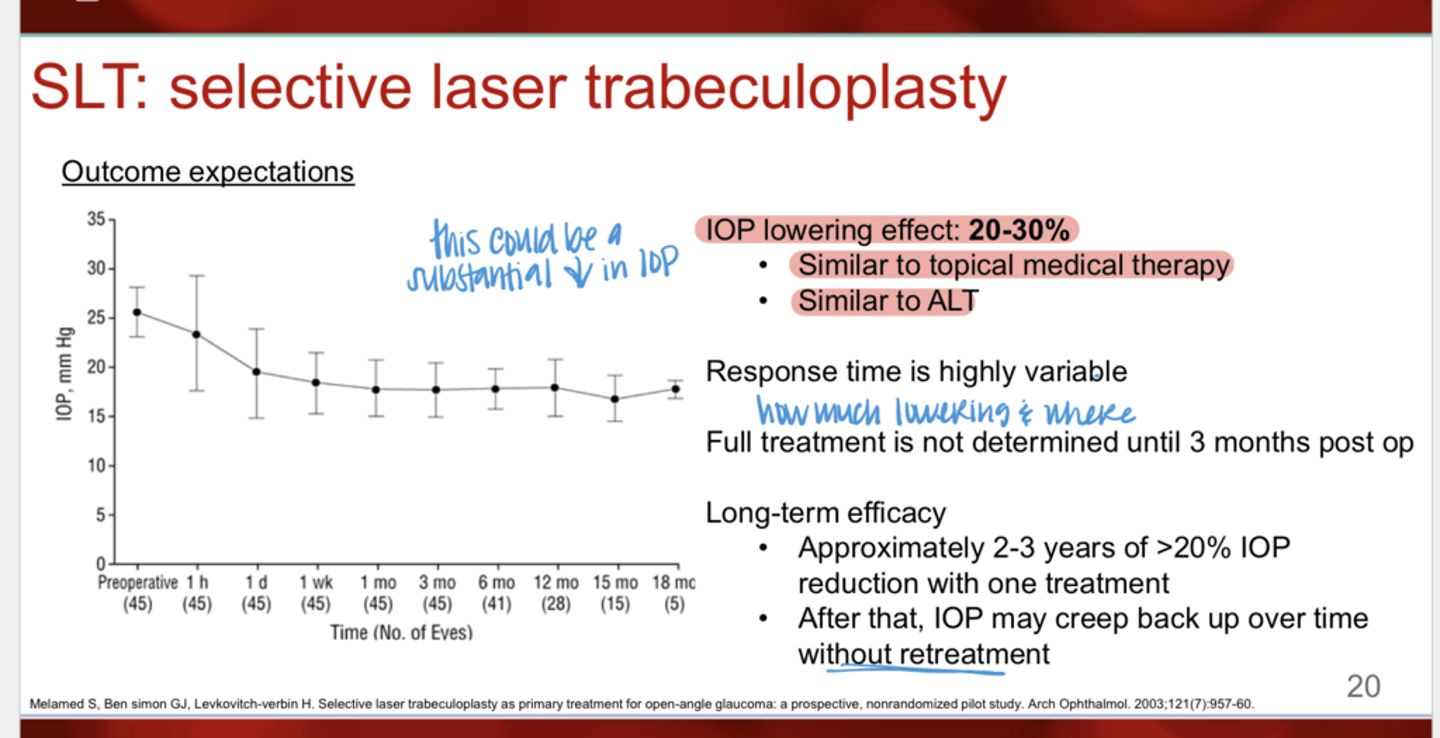
True or False:
The response time to SLT is highly variable depending on the patient
true
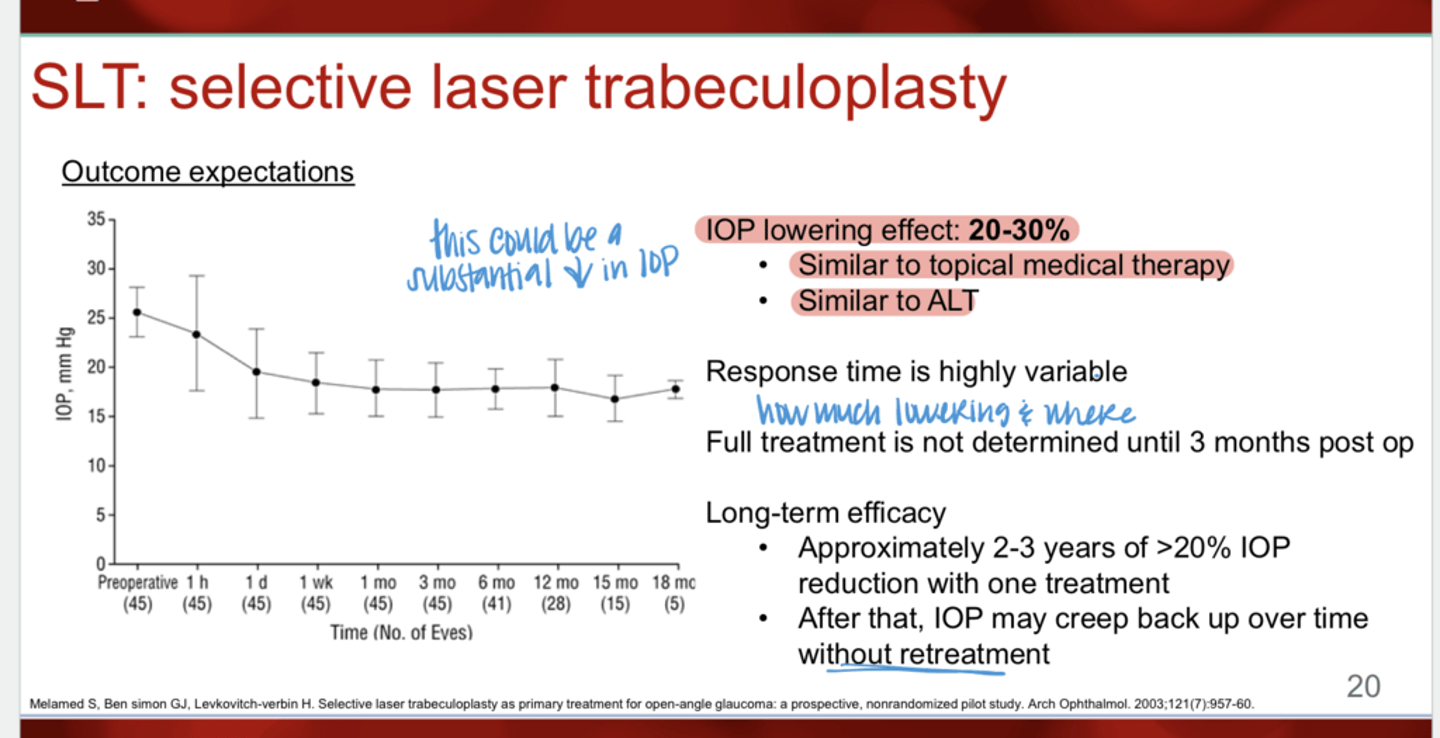
Full treatment potential of SLT is not determined until ______ months post op
3
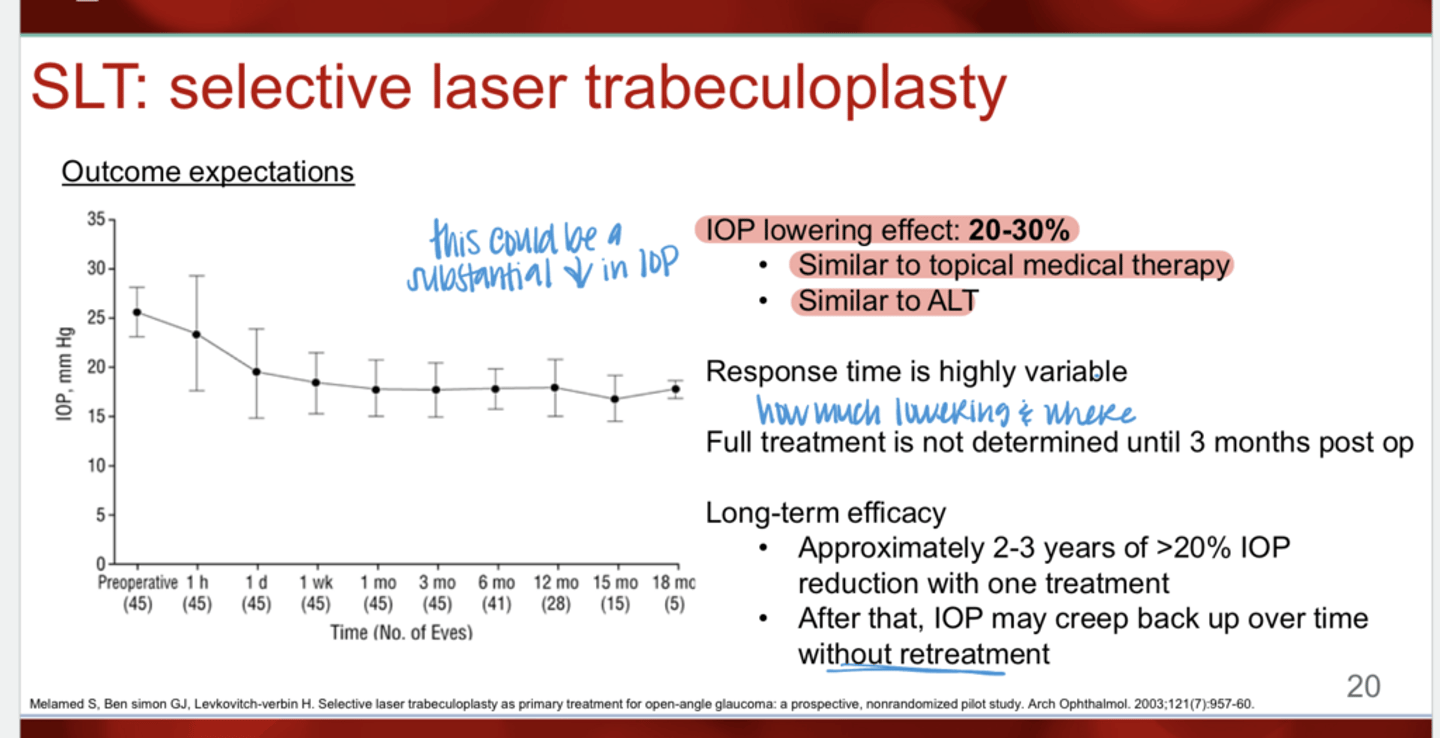
What is the long-term efficacy of SLT?
-Approx 2-3 years of >20% IOP reduction with one treatment
-After that, IOP may creep back up over time without treatment
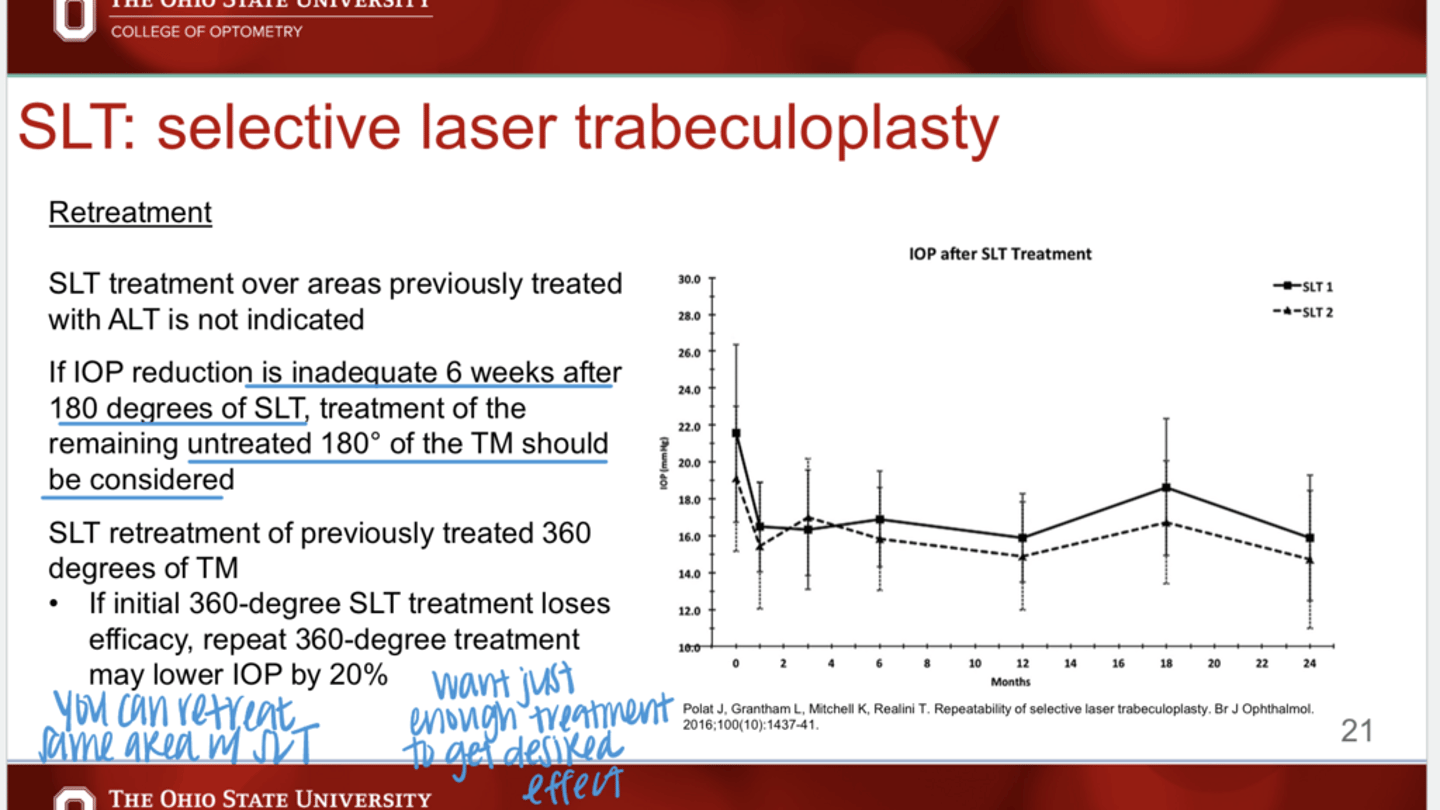
SLT treatment over areas previously treated with ALT (is/is not) indicated
is not
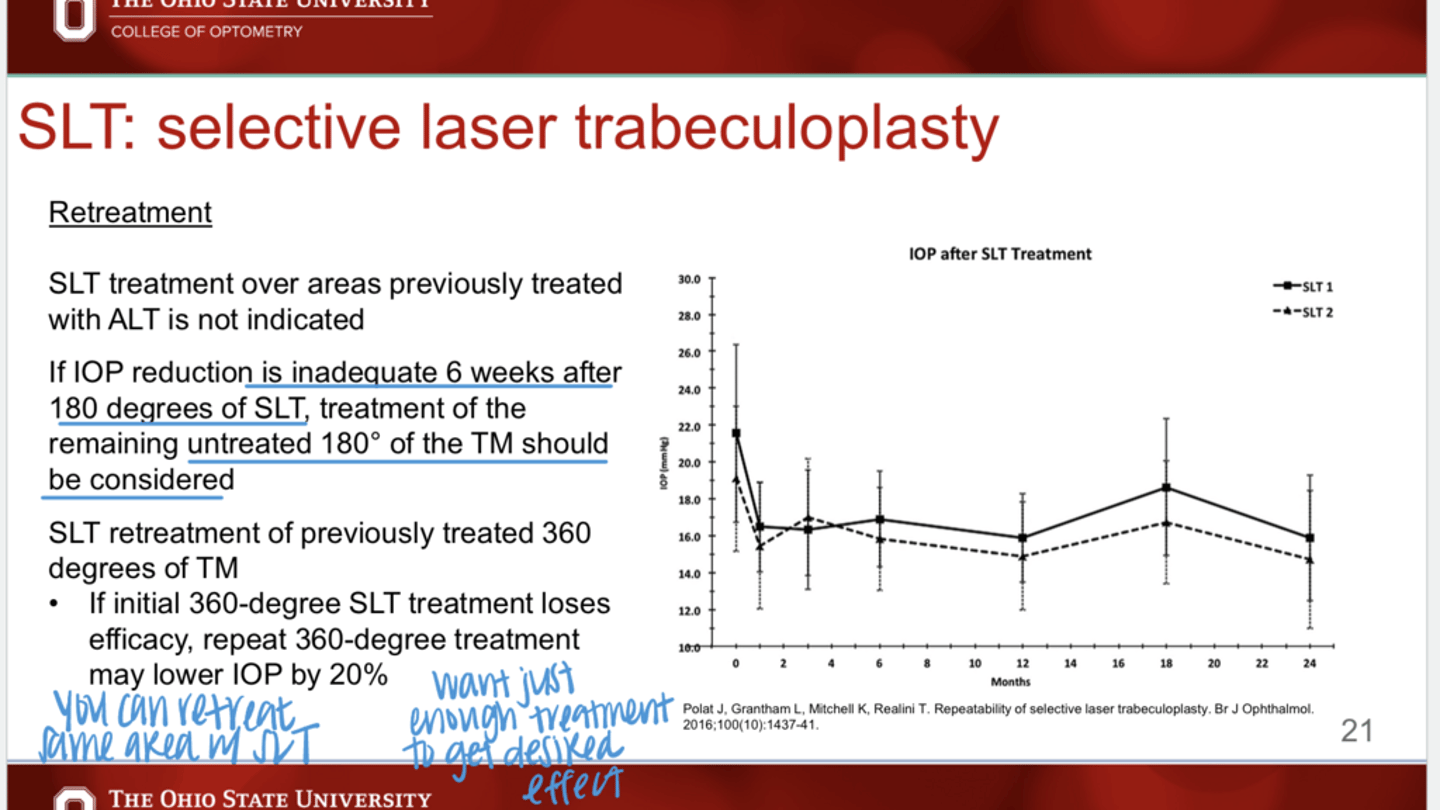
If IOP reduction is INADEQUATE 6 weeks after 180º treatment w/ SLT, what should happen next?
treatment of the remaining 180º of the TM should be considered
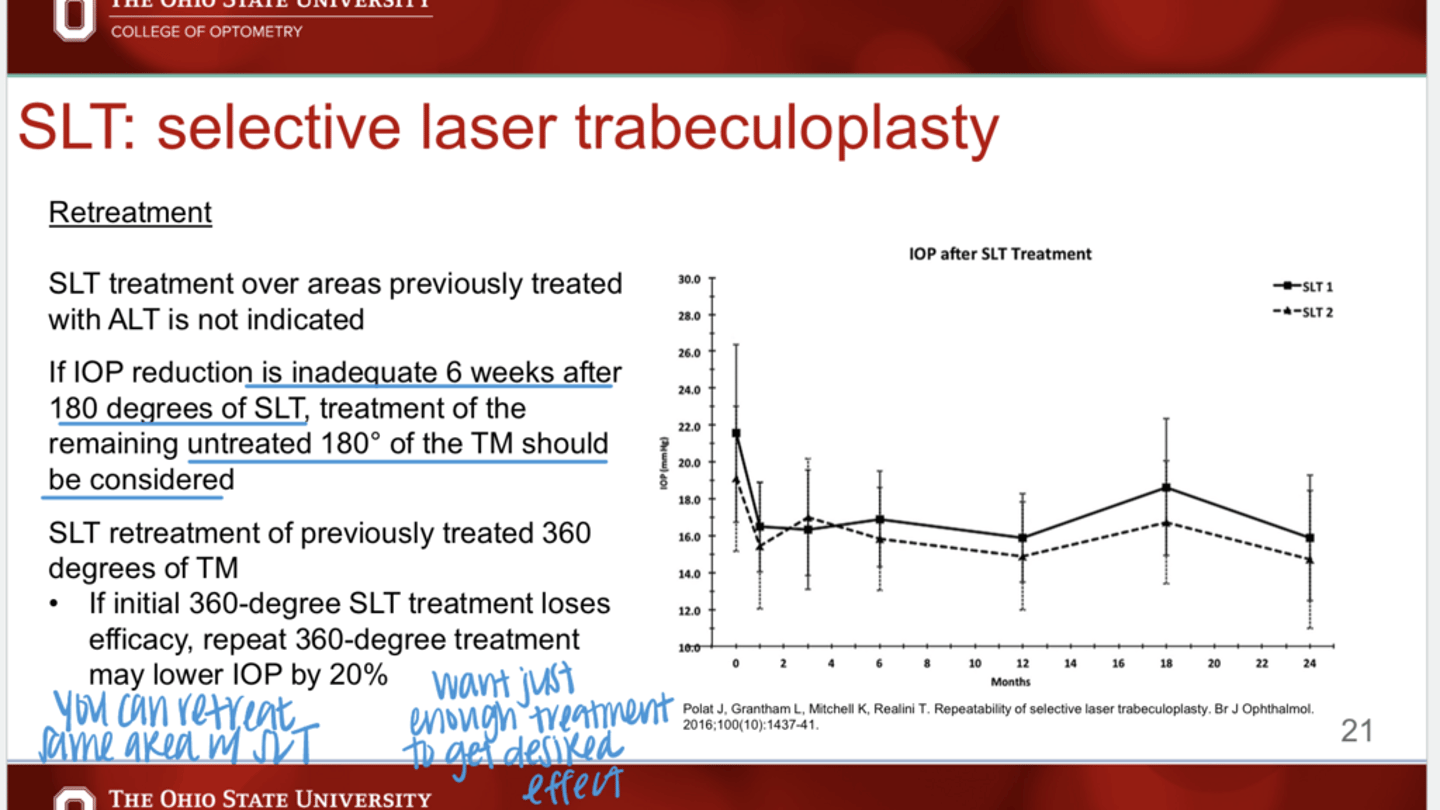
If initial 360º SLT treatment loses efficacy, what should happen next?
Repeat 360º treatment may lower IOP by 20% again. You can retreat the same area w/ SLT
What is the pre-treatment care of a patient with SLT?
-1 gtt Brimonidine or Apraconidine (a2 agonist) 30-60min before the procedure
-1gtt pilocarpine
Why are alpha agonists used for the pre-treatment care of SLT patients?
lower IOP, constrict conj BVs leading to less inflammation
What is the post-treatment care of a patient with SLT?
-1 gtt brimonidine or apraclonidine immediately after the procedure
-IOP checks
-Low energy pulse necessitates only topical NSAID if needed for comfort
-Steroids used only for pronounced initial uveitis that persists for 1 wk
When should IOP checks be scheduled after SLT?
-1-2 hours
-1-2 days if the IOP is high
-7-10 days
-4-6wks
-3 months
What are the complications of SLT?
-Uveitis
-Transient IOP spikes
-Intractable IOP spike
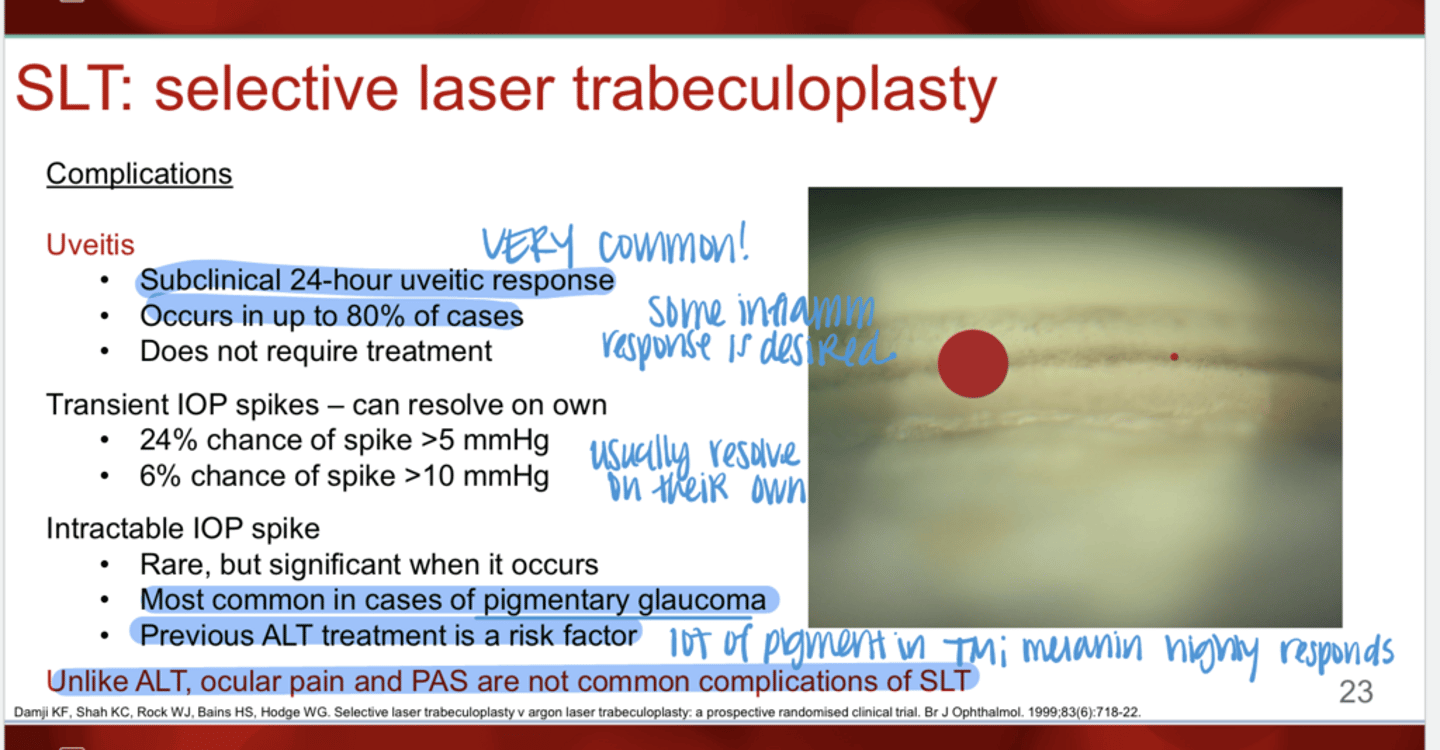
Is a subclinical 24-hr uveitic response common after SLT?
Yes -- occurs in 80% of cases
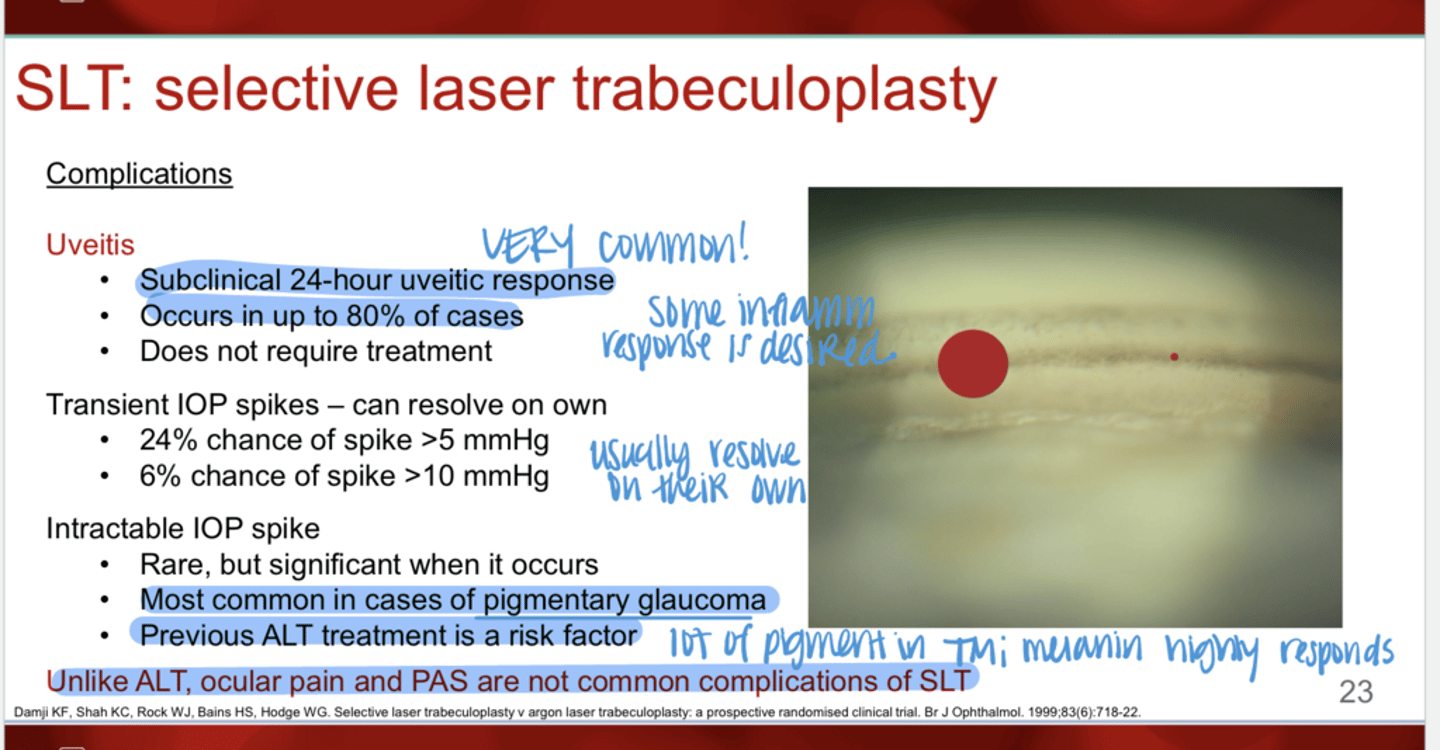
Does a subclinical 24-hr uveitic response after SLT require treatment?
No
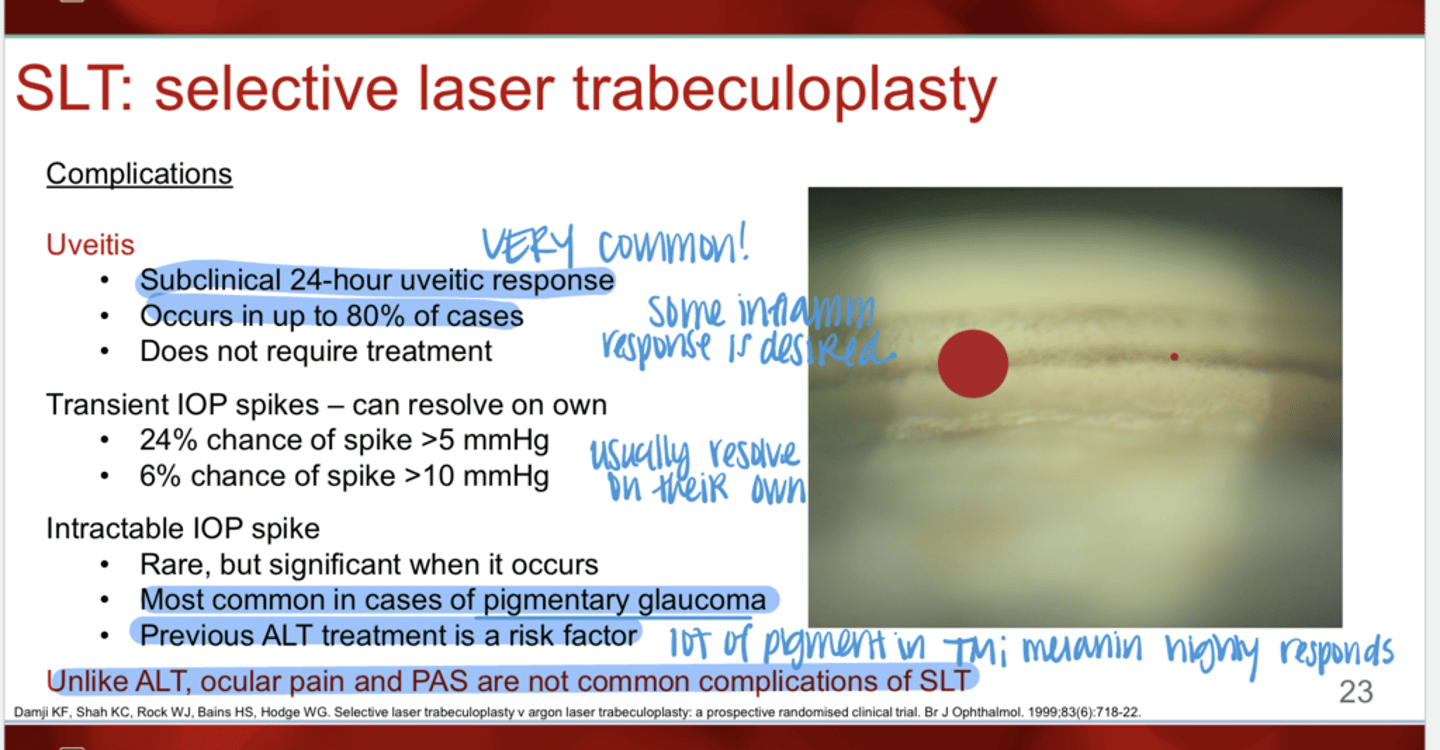
Can transient IOP spikes after SLT resolve on their own?
Yes
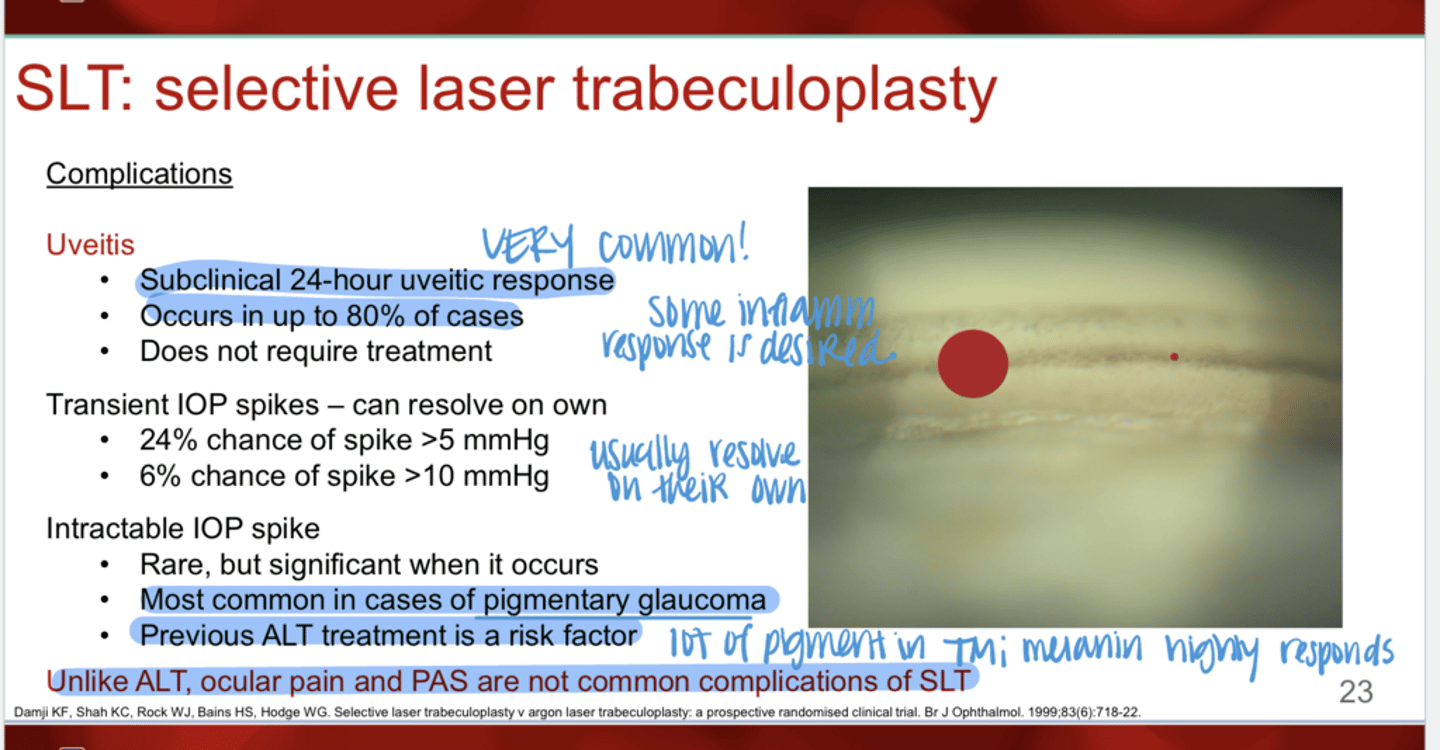
There is a _____% chance of a IOP spike >5mmHg after SLT
24
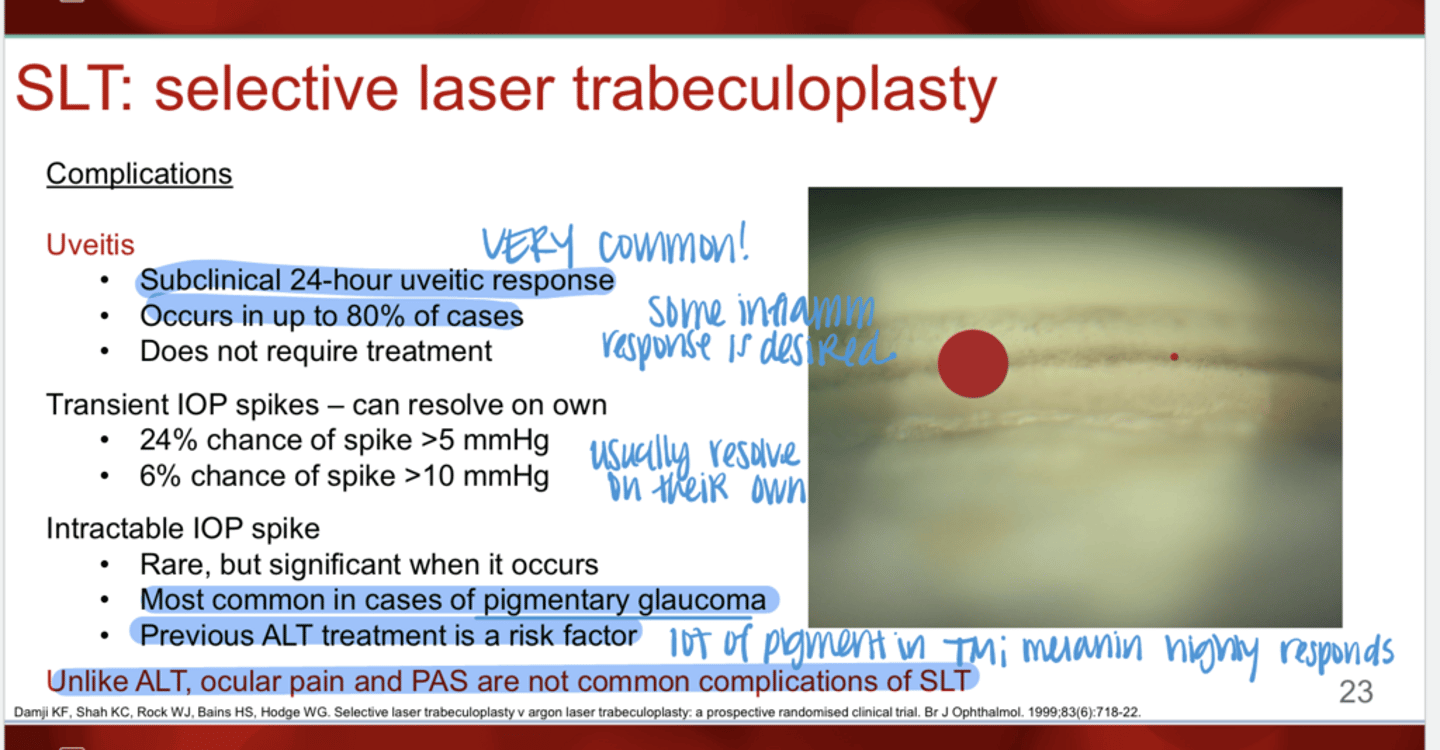
There is a _____% chance of a IOP spike >10mmHg after SLT
6
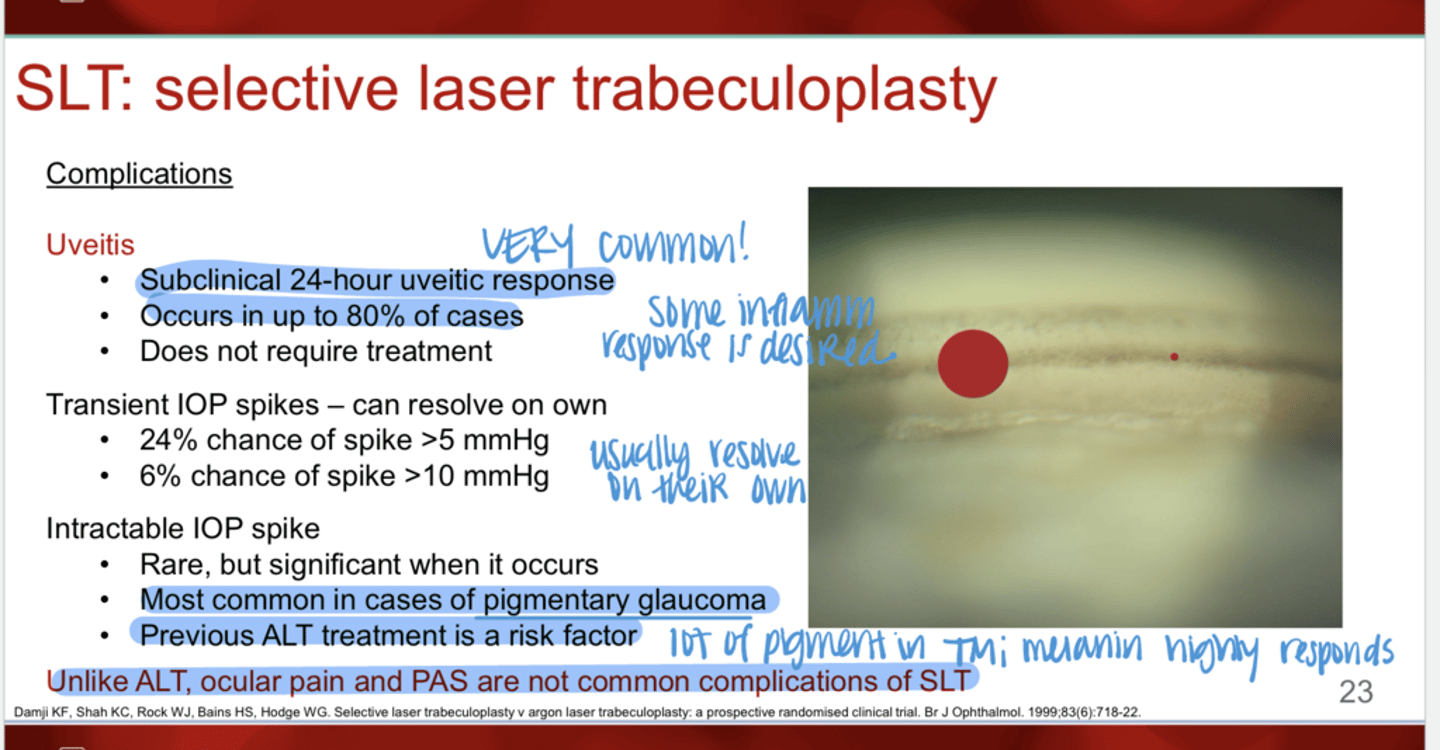
What is the likelihood of a intractable IOP spike after SLT?
rare, but significant
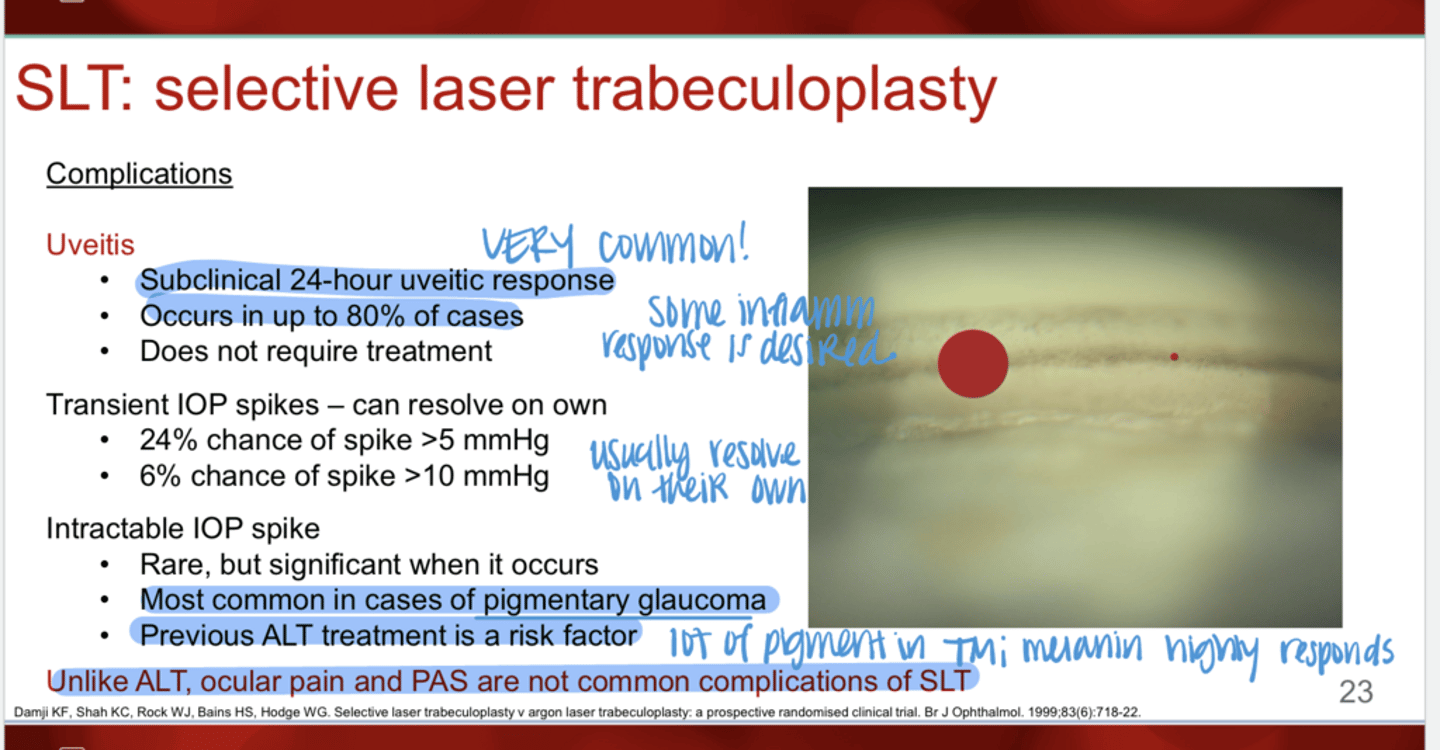
Intractable IOP spike after SLT is most common in cases of ______ glaucoma
pigmentary
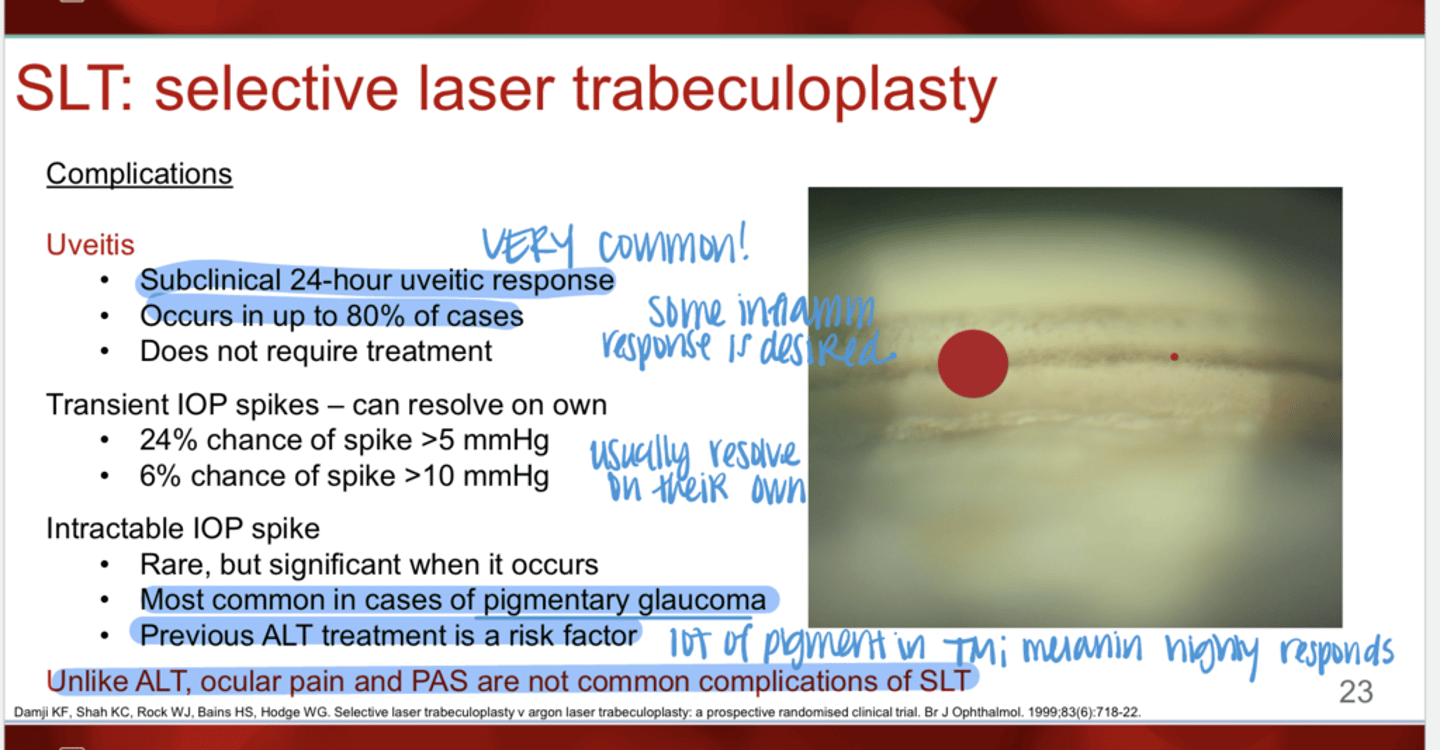
What is a risk factor for intractable IOP spike?
previous ALT treatment
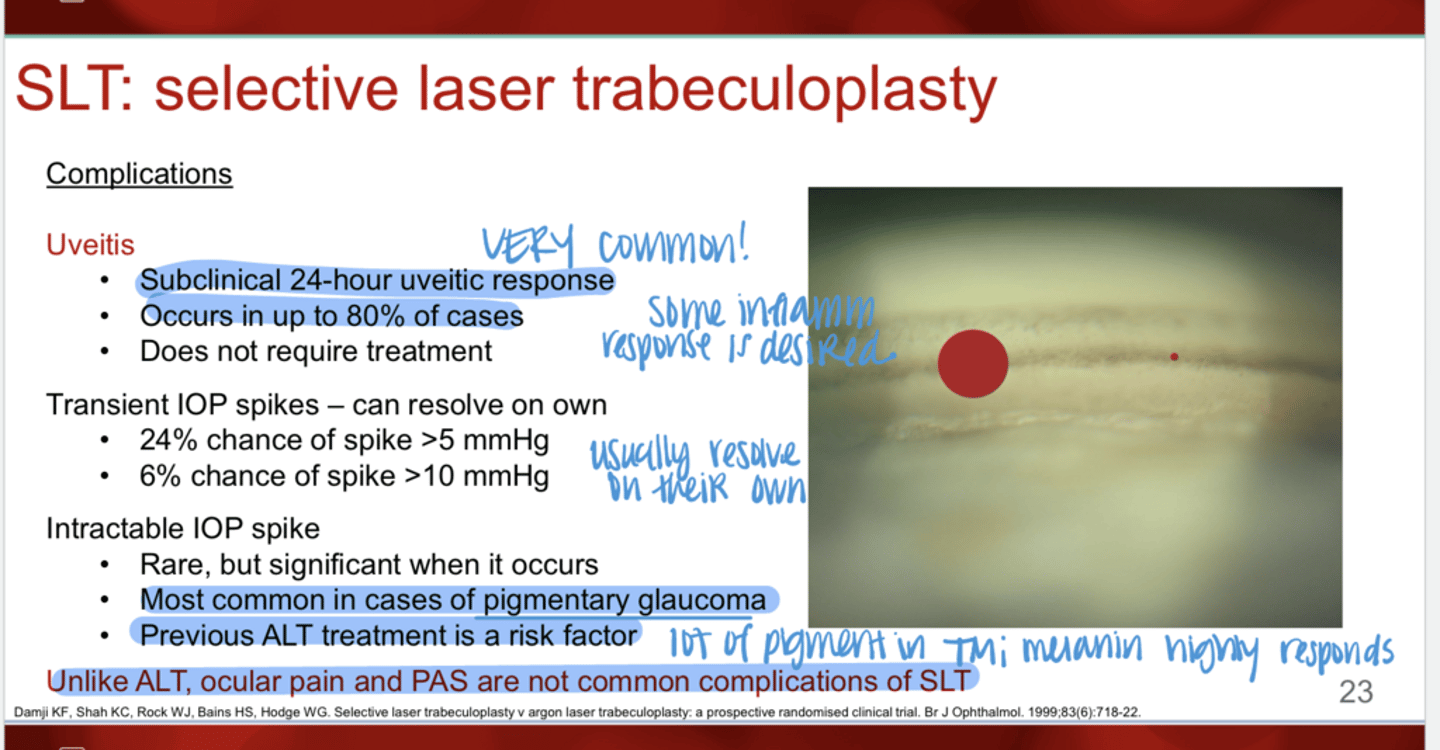
Unlike ALT, are ocular pain and PAS common after SLT?
No
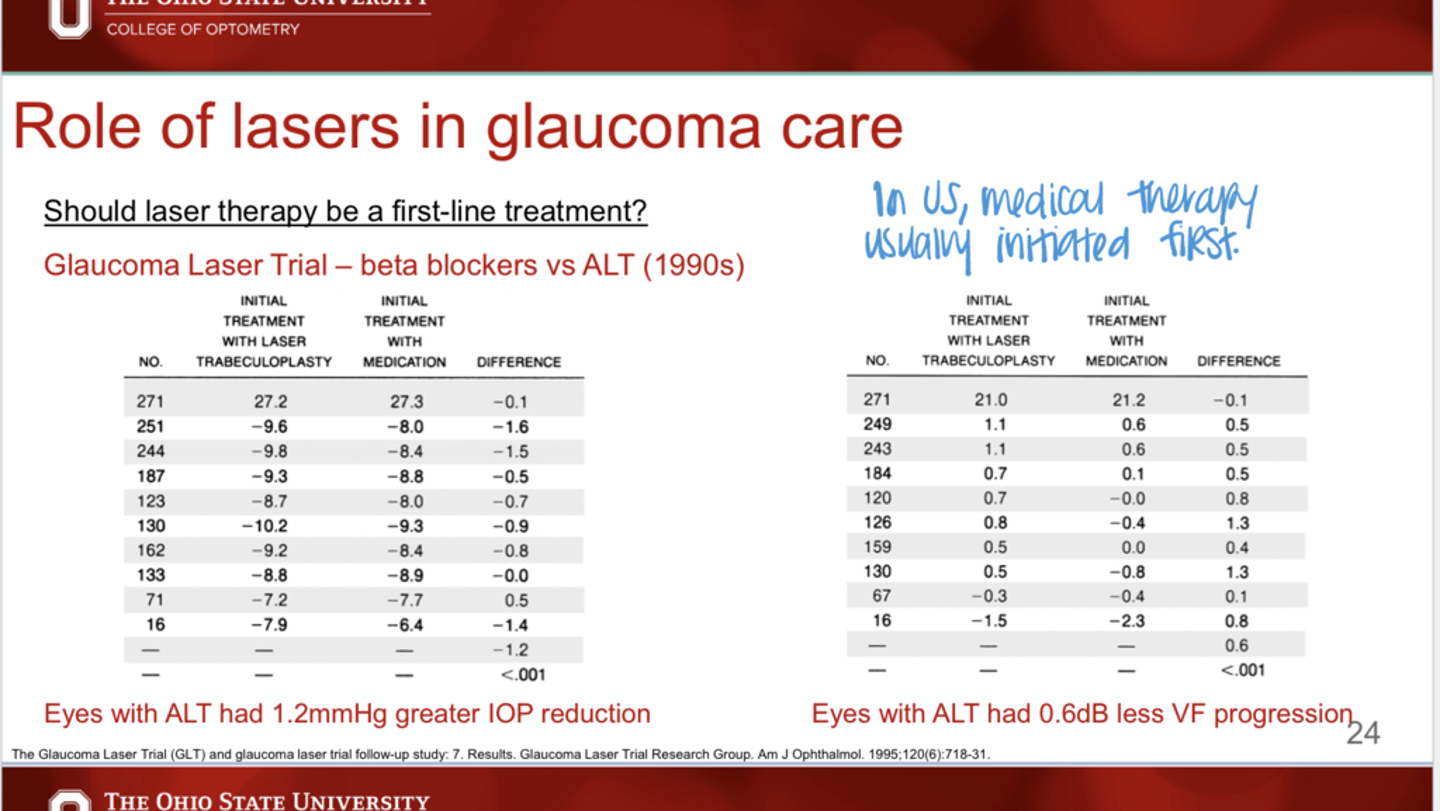
What were the results of the Glaucoma Laser Trial (B blocker v ALT)?
-Eyes with ALT had 1.2mmHg greater IOP reduction in the Glaucoma Laser Trial (Beta blockers vs ALT)
-Eyes with ALT had 0.6dB less Vf progression
What were the results of trial comparing SLT vs PGAs as first line treatment?
-Both had average IOP reduction of 27% at 1 year
-SLT is good at reducing diurnal curve
-No statistical difference when compared to Xalatan over 6 months post-treatment
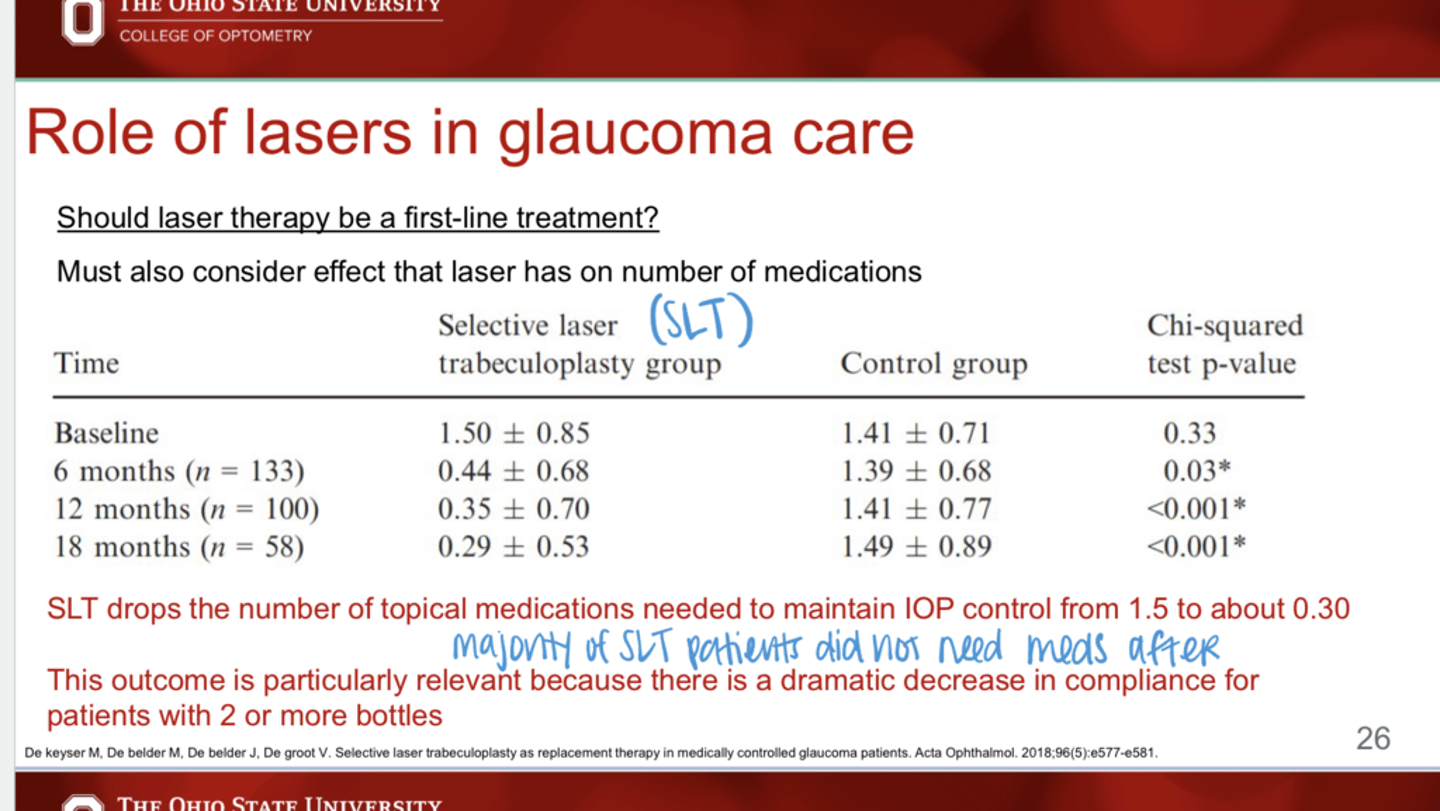
SLT drops the number of topical medications needed to maintain IOP control from ____ to _____
1.5 to 0.3
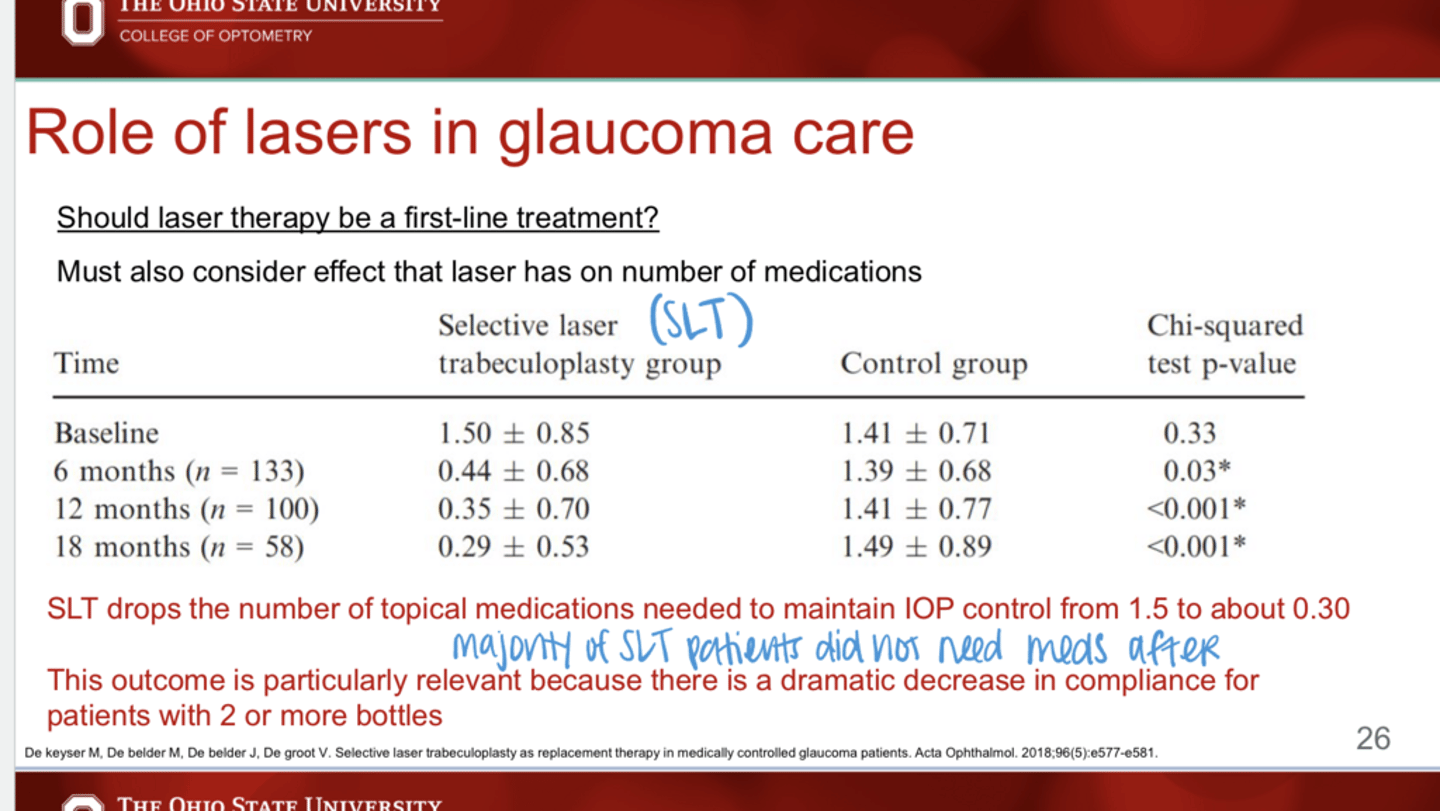
Why is the drop in # of drops from 1.5 to 0.3 post SLT important?
This outcome is particularly relevant because there is a dramatic decrease in compliance for patients with 2 or more bottles
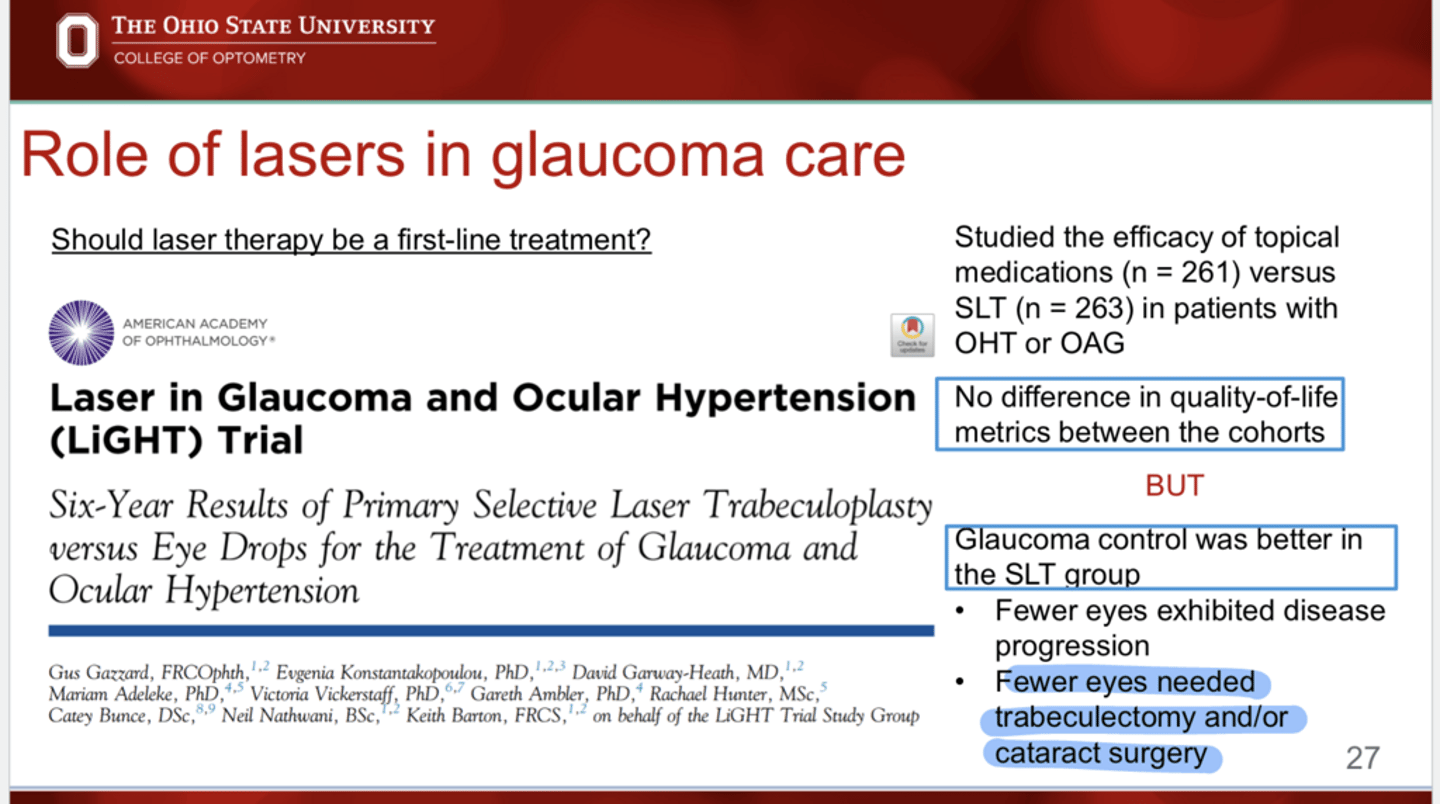
What is the outcome of the Laser in Glaucoma and Ocular Hypertension (Light) Trial?
-Studied the efficacy of topical medications versus SLT in patients with OHT or OAG
-No difference in quality of life metrics between cohorts
-Glaucoma control was better in the SLT group
-Fewer eyes exhibited disease progression after SLT
-Fewer eyes needed trabeculectomy and/or cataract sx after SLT
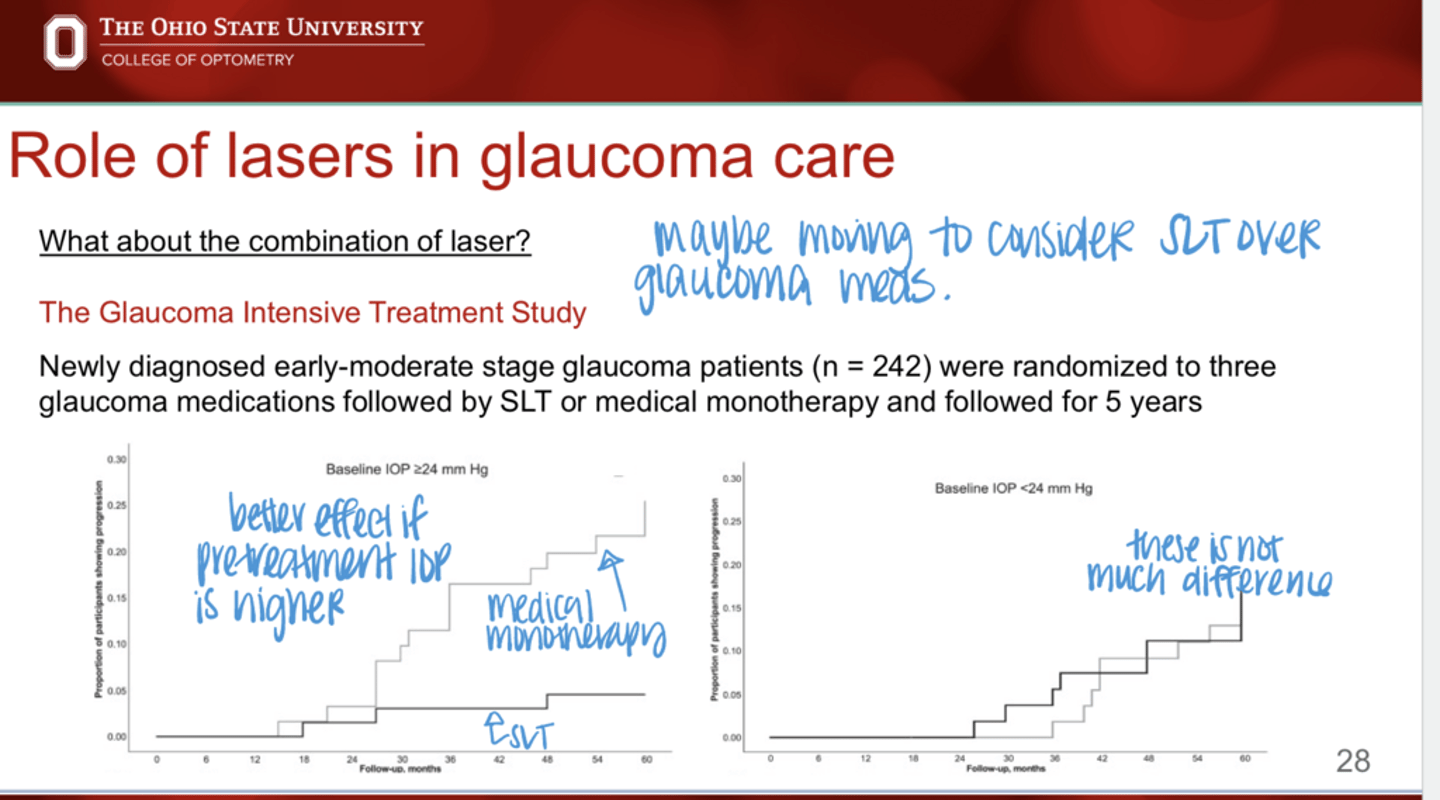
What were the results of the Glaucoma Intensive Treatment Study?
-Newly diagnosed early-moderate stage glaucoma patients were randomized to three glaucoma medications followed by SLT or medical monotherapy and followed for 5 years
-Patient will have better effect with SLT vs Medical monotherapy if pre-treatment IOP is higher
-No difference in SLT vs Medical monotherapy if pre-treatment IOP is lower (<24mmHg)
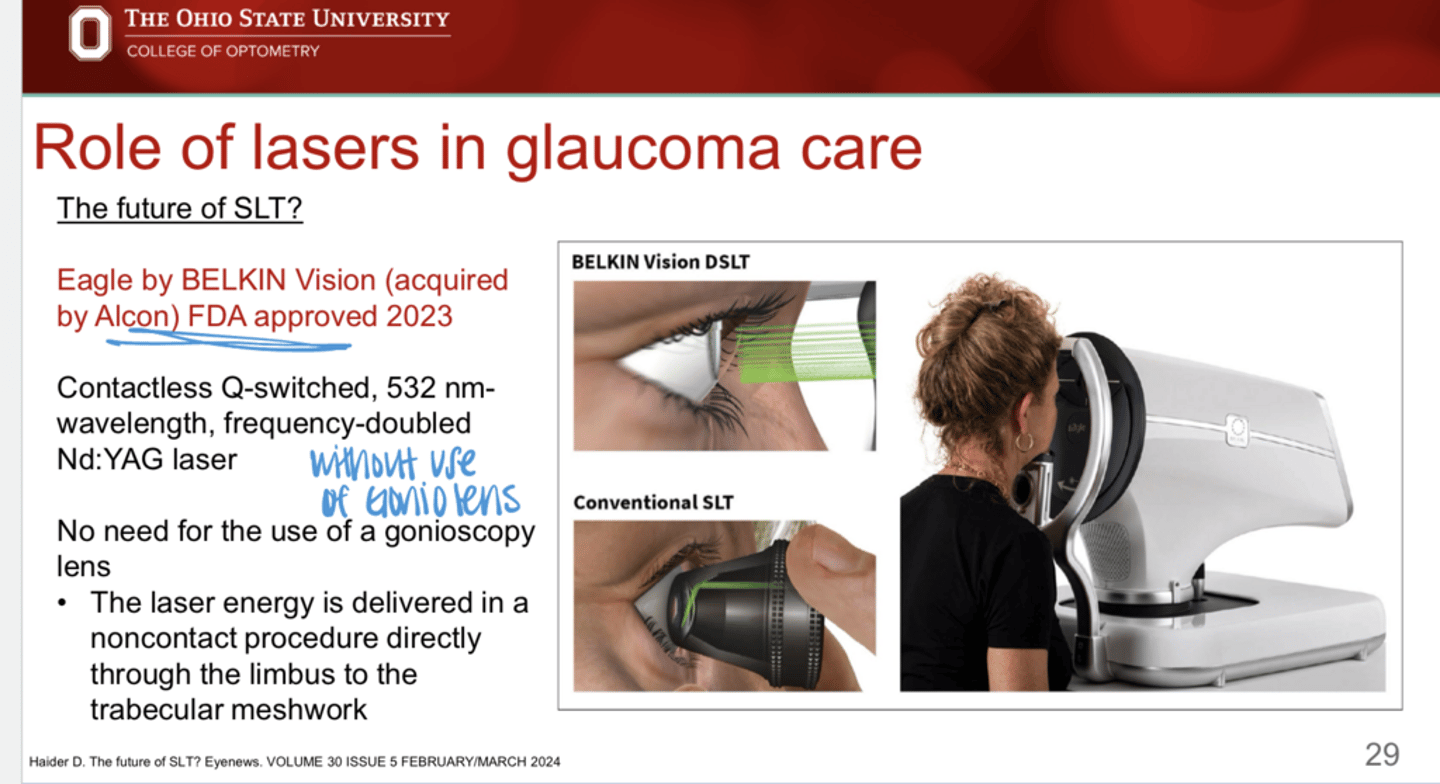
What is Eagle by BELKIN Vision that was approved by the FDA in 2023?
Contactless Q-switched, 532nm wavelength, frequency doubled Nd:YAG laser
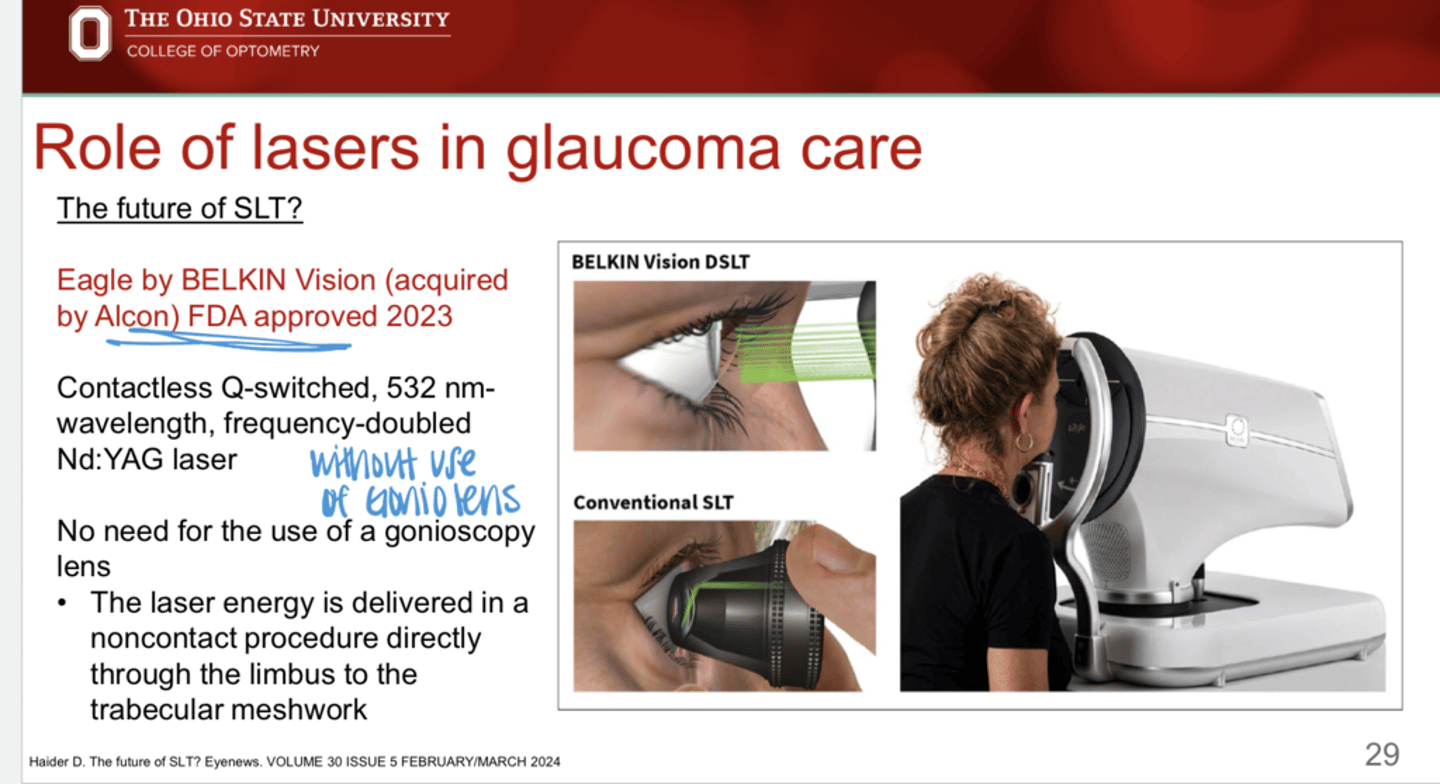
Do you need to use a gonioscopy lens with Eagle by BELKIN Vision?
No
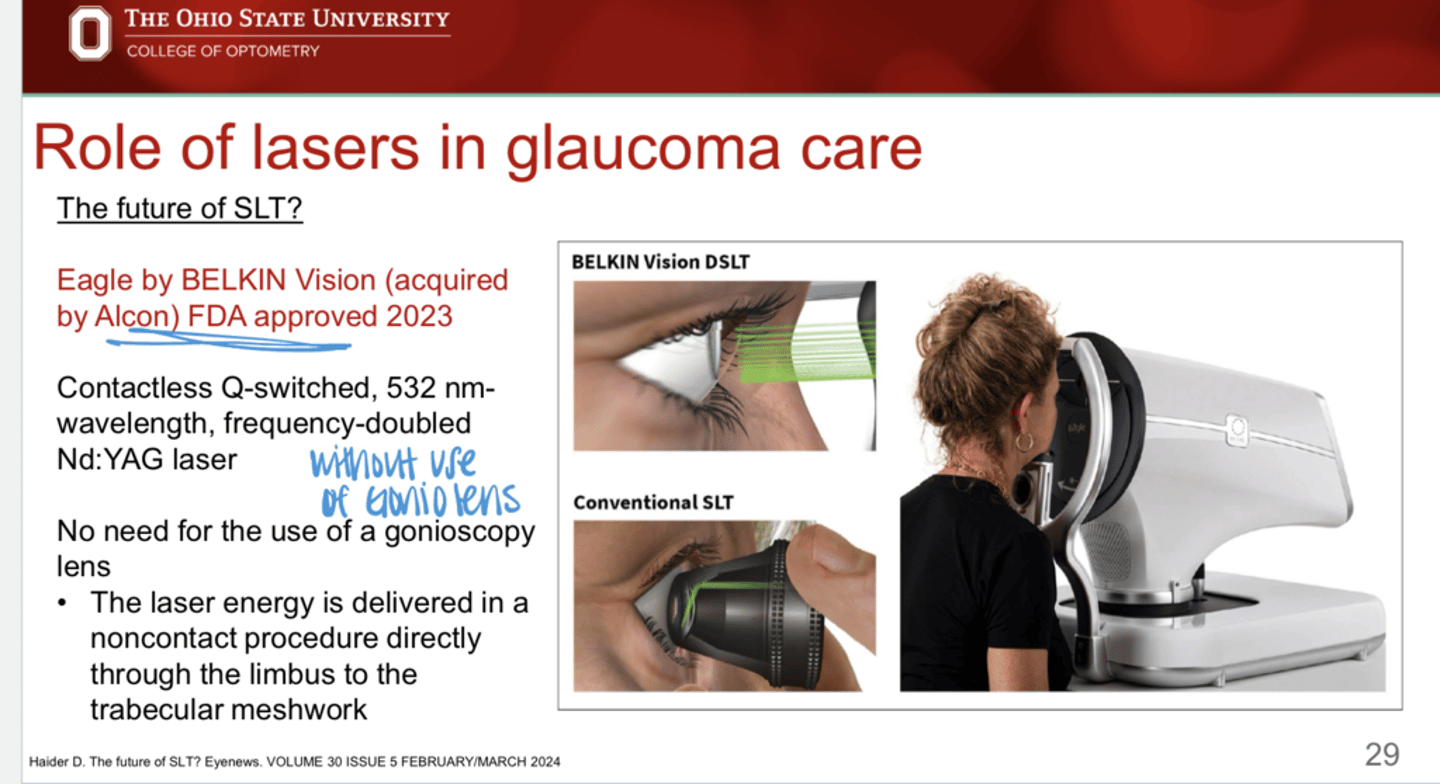
How is laser energy delivered with Eagle by BELKIN Vision?
The laser energy is delivered in a non-contact procedure directly through the limbus to the TM
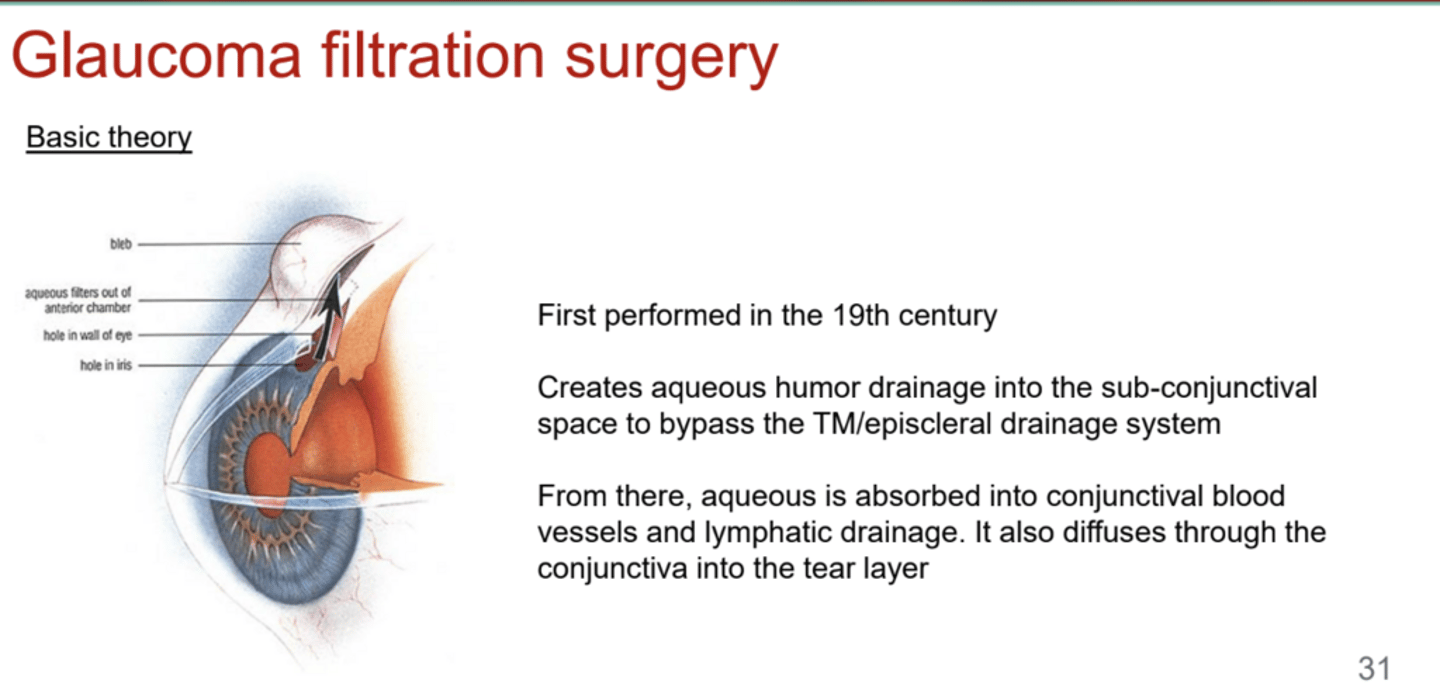
When was glaucoma filtration surgery 1st performed?
In the 19th century
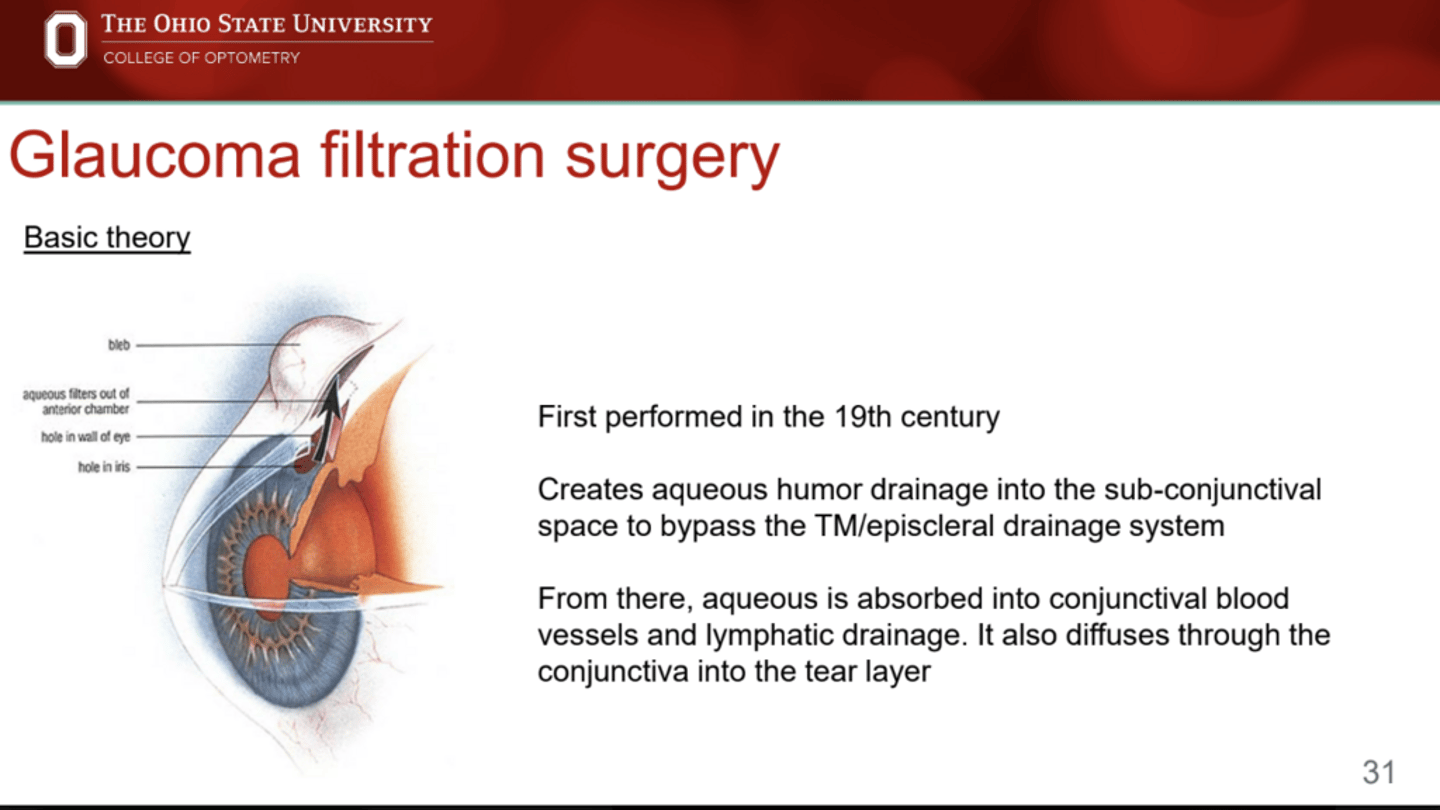
What is the function of glaucoma filtration surgery?
creates aqueous humor drainage into the sub-conj space to bypass the TM/episcleral drainage system
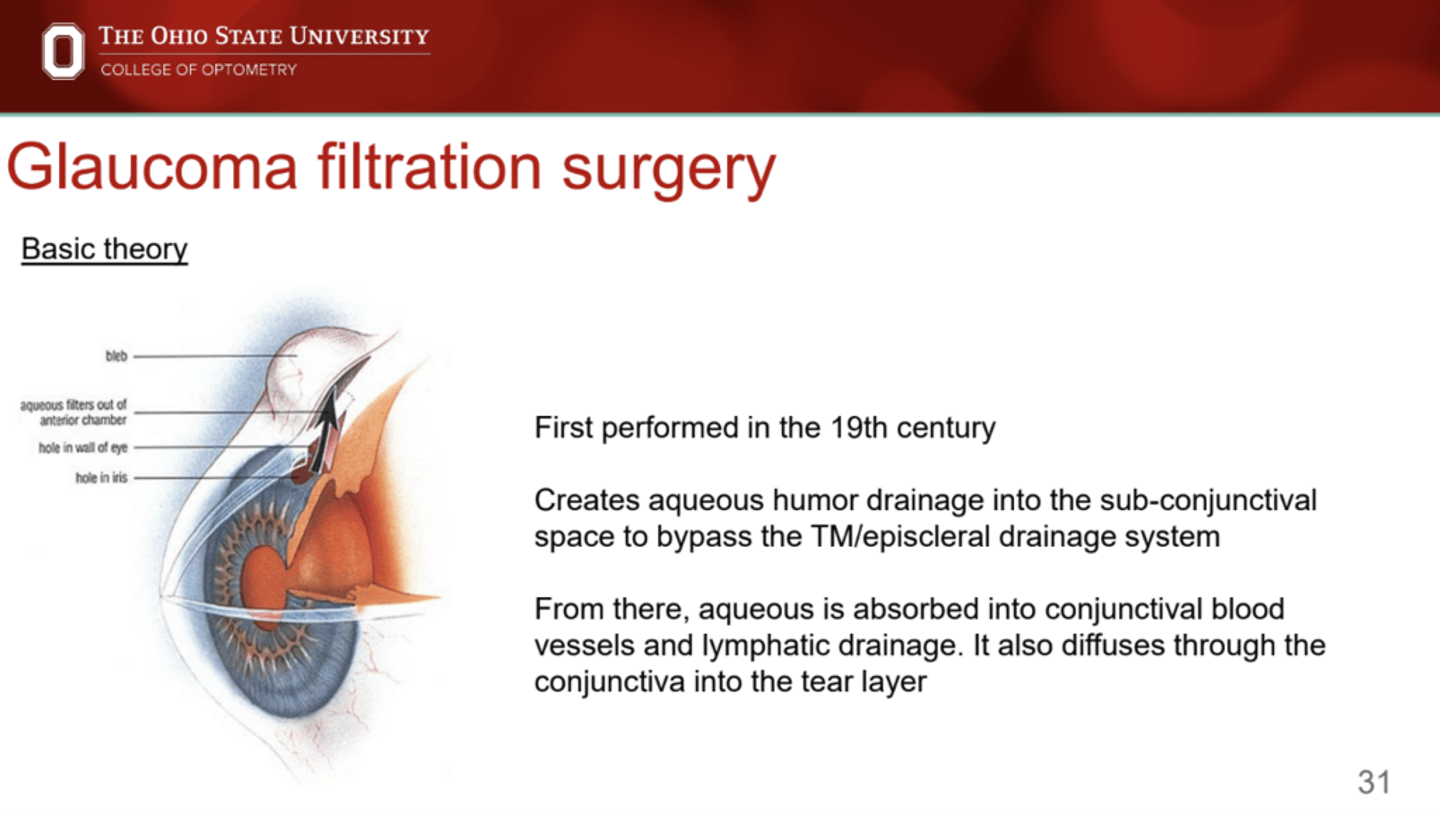
With glaucoma filtration surgery, aqueous bypasses the TM/episcleral drainage system. From there, where does aqueous go?
-Aqueous is absorbed into conj blood vessels and lymphatic drainage
-It will diffuse through the conj into the tear layer
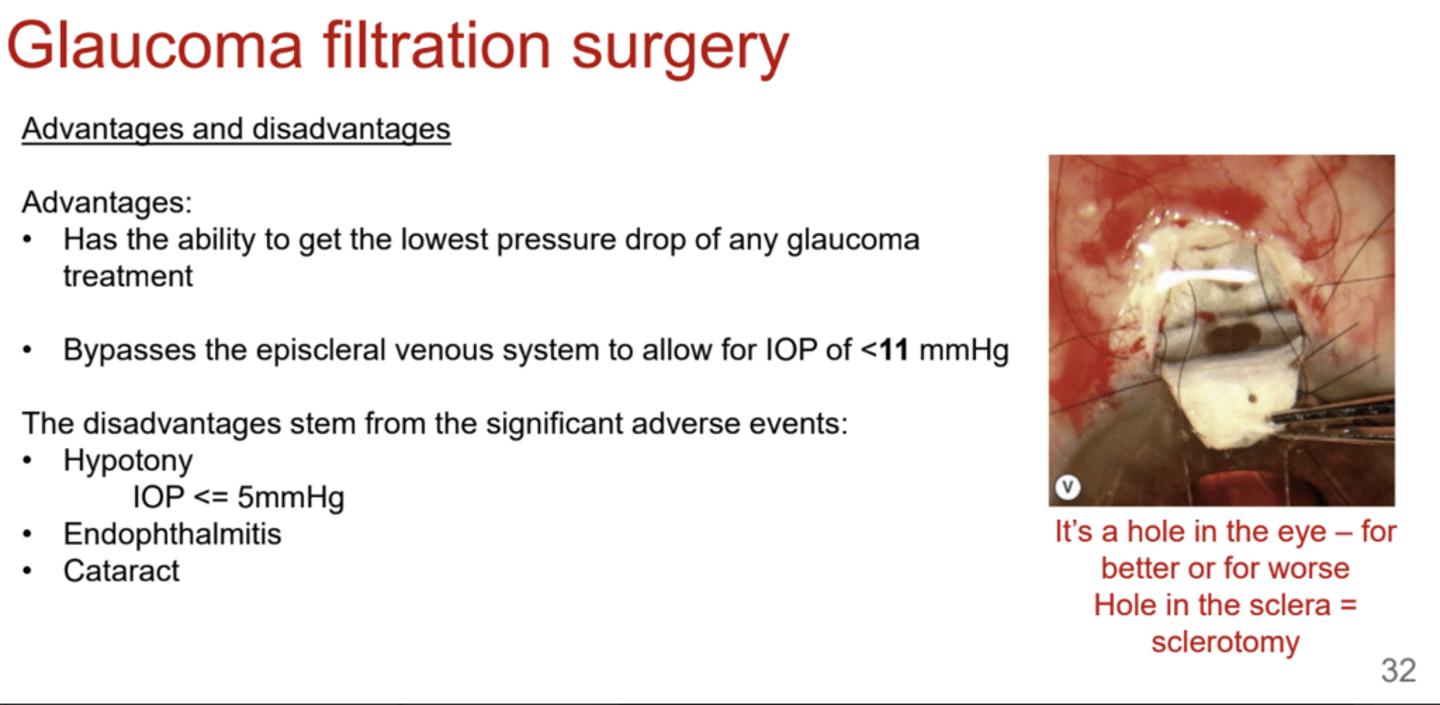
What are the advantages of glaucoma filtration surgery?
-Has the ability to get the lowest pressure drop of any glaucoma treatment
-Bypasses the episcleral venous system to allow for IOP of <11mHg
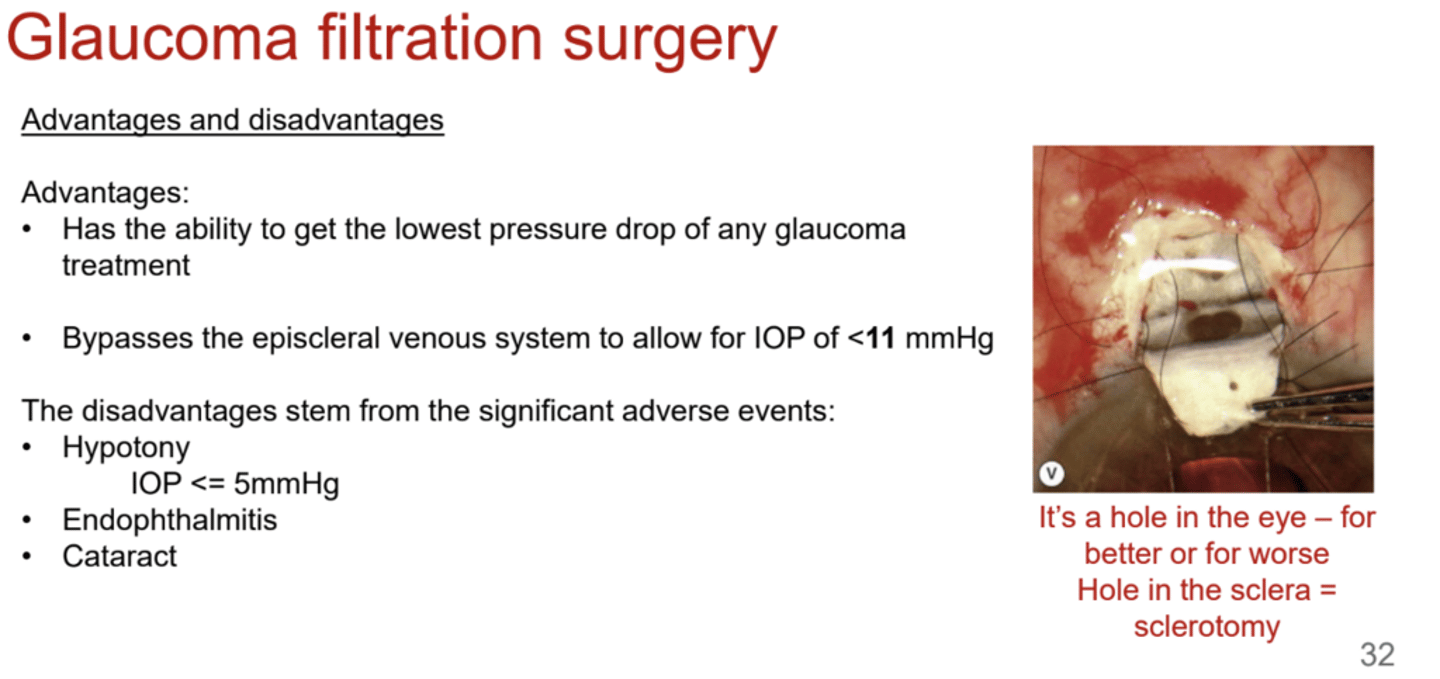
What are the disadvantages of glaucoma filtration surgery?
-Hypotony possible
-Endophthalmitis
-Cataract
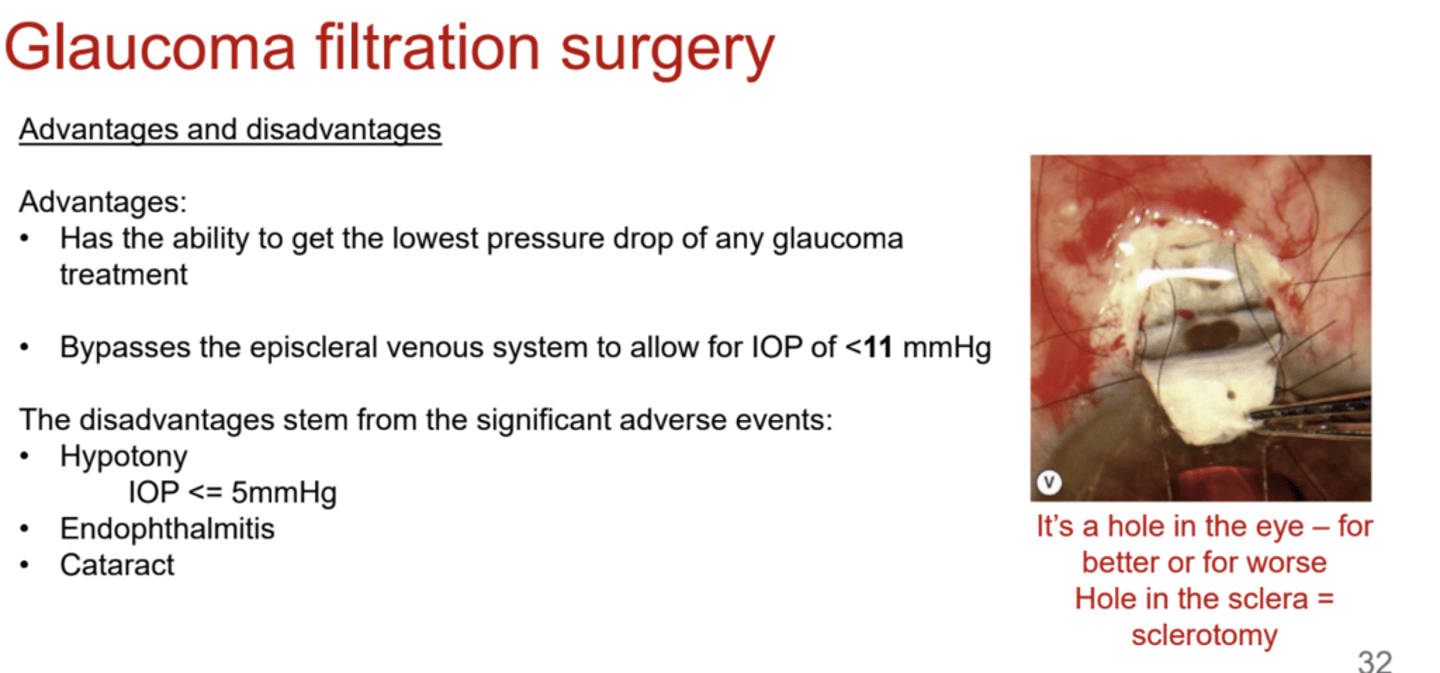
What does IOP have to be to be characterized as hypotony?
<5mmHg
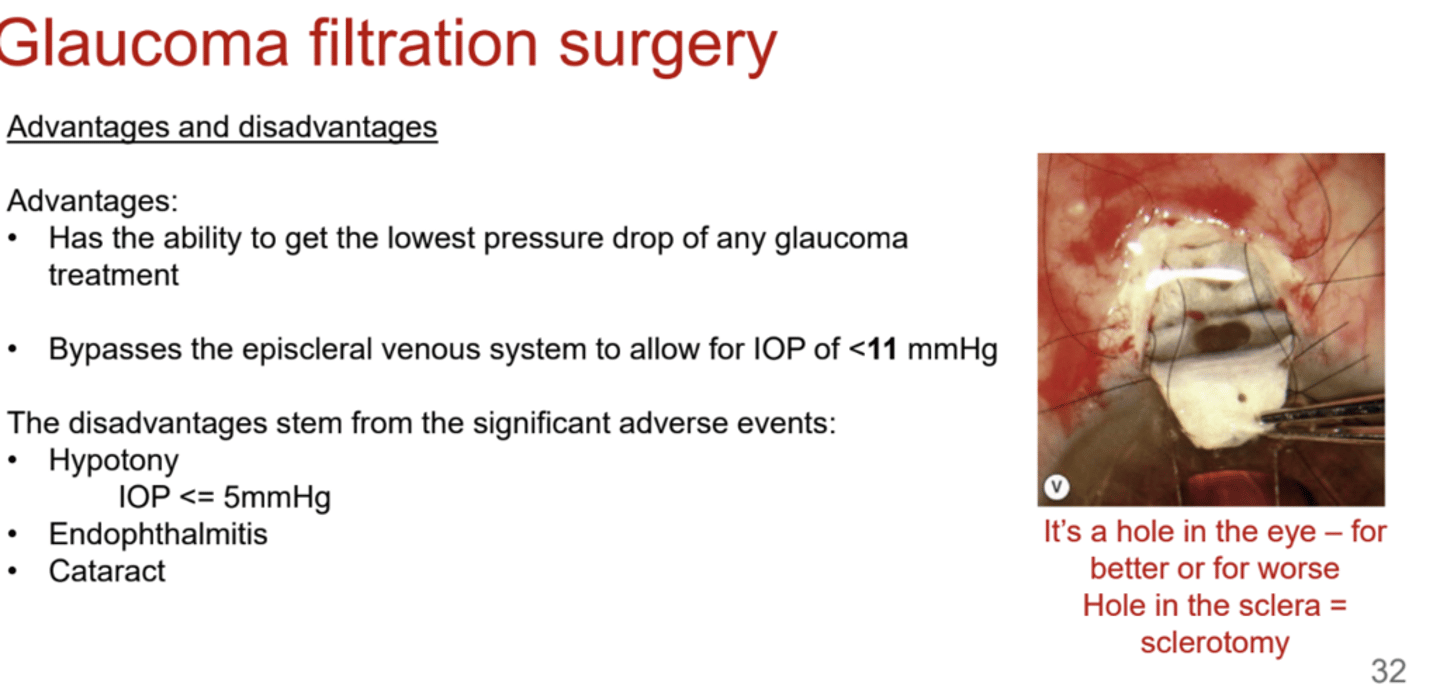
Without glaucoma bypass surgery, what is the floor for how low IOP can be dropped?
EVP
Glaucoma filtration surgery is a route for _____ into the eye. This can cause endophthalmitis
microbes
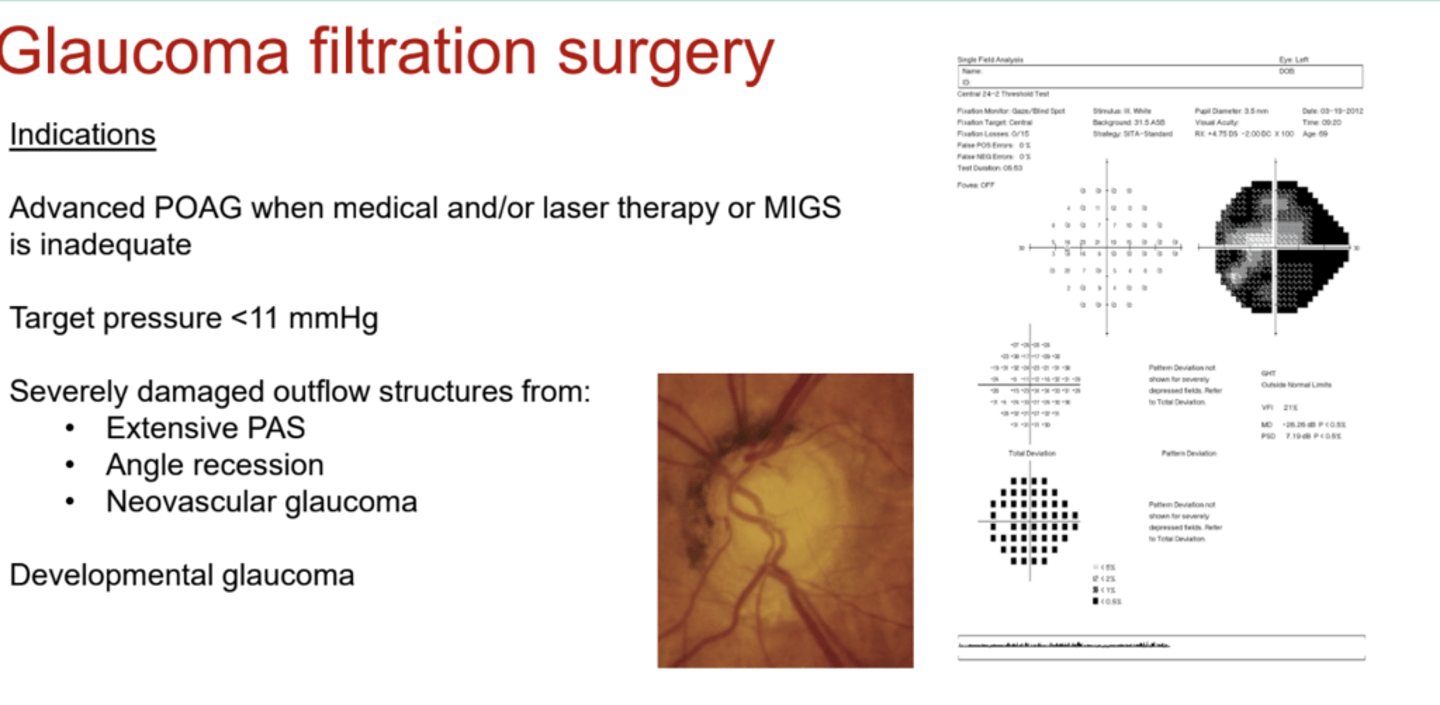
What are the indications for a glaucoma filtration surgery?
-Advanced POAG when medical and/or laser therapy or MIGS is inadequate
-When target pressure is <11mHg
-Severely damaged outflow structures
-Developmental glaucoma
Why is glaucoma surgery indicated if target IOP is <11mmHg?
This is EVP. You cannot drop IOP below this w/o a filtration surgery.
Outflow structures can be severely damaged from what? These are reasons why a glaucoma filtration surgery may be indicated.
-extensive PAS
-angle recession
-neovascular glaucoma
Basic Procedure of a Trabeculectomy
What is the first step in this procedure?
Incision through conj and Tenon's capsule
Basic Procedure of a Trabeculectomy
After incision through the conj and Tenon's capsule, what is the next step in this procedure?
Formation of conj pocket and treatment with MMC
Basic Procedure of a Trabeculectomy
What is the function of MMC?
prevents scarring -- which is the #1 cause of trabeculectomy failure
Basic Procedure of a Trabeculectomy
After formation of the conj pocket and treatment with MMC, what is the next step in this procedure?
Creation of the scleral flap
Basic Procedure of a Trabeculectomy
After creation of the scleral flap, what is the next step to this procedure?
Entry into the A.C. via a sclerostomy
Basic Procedure of a Trabeculectomy
After the sclerostomy, what happens next in this procedure?
Iriodectomy
Basic Procedure of a Trabeculectomy
After the iridectomy, what is the next step in this procedure?
Secure scleral flap with a suture
Basic Procedure of a Trabeculectomy
After securing the scleral flap with a suture, what is the next step in this procedure?
Suture conj and check for a Siedel sign