Sequencers and DAWs (and midi)
 Studied by 0 people
 Call with Kai
 Learn
Learn Practice Test
 Spaced Repetition
 Match
Match Flashcards
 Knowt Play
1/25

There's no tags or description
Looks like no tags are added yet.
Name | Mastery | Learn | Test | Matching | Spaced | Call with Kai |
|---|
No study sessions yet.
26 Terms
What does DAW stand for?
Digital audio workstation.
SEQUENCING: what is step sequencing?
The notes are entered into a sequencer’s memory one at a time onto a grid.
Step sequencers were built into a number to of popular analogue synths during the 1970s - regular musical loops became a feature of synth pop.
How did early analogue synthesisers work?
They sent a CV/gate signals to trigger notes on a synthesiser.
In order to do this, a voltage was sent from the sequencer to control the opening and closing of gates to play notes on a synthesiser module.
How did digital sequencing work?
Invented in the 1970s, digital analogue synthesisers used voltage control but with computer memory.
Digital sequencers also were built in to samplers and synthesisers in the 80s - eg ‘Rio’ - Duran Duran.
When was MIDI introduced?
1983.
What was the impact of MIDI?
It became the common language used by electronic musical instruments to communicate with eachother.
It was successful in music studios as it was easier to programme a sequence on the computer and send it through the MIDI ports to control a synth, sampler or drum machine.
What does a MIDI message consist of?
A status byte - tells us the type of MIDI message - and one or two data bytes - provide more information about the parameters associated with it.
What binary values can a bit have?
Either 0 or 1.
How many bits is a byte?
8 bits.
Therefore the binary number for each byte is 8 digits long.
What do we call the largest bit and the smallest bit?
The largest bit (furthest to the left) - the most significant bit (MSB).
The smallest bit (furthest to the right) - the least significant bit (LSB).
What are note messages and controller messages examples of?
MIDI messages - digital instructions sent between electronic musical instruments, computers, and other devices to communicate musical information like notes, velocity, and control changes
What’s the status byte and data bytes of a note midi message?
Status byte - Note on/Channel
Data Byte 1 - Note number
Data Byte 2 - Velocity value.
What’s the status byte and data bytes of a controller midi message?
Status byte - Control change/channel
Data byte 1 - Controller number
Data byte 2 - Controller value
How are midi messages transmitted to different pieces of equipment?
Using a specific order of bytes.
Example of a midi message.
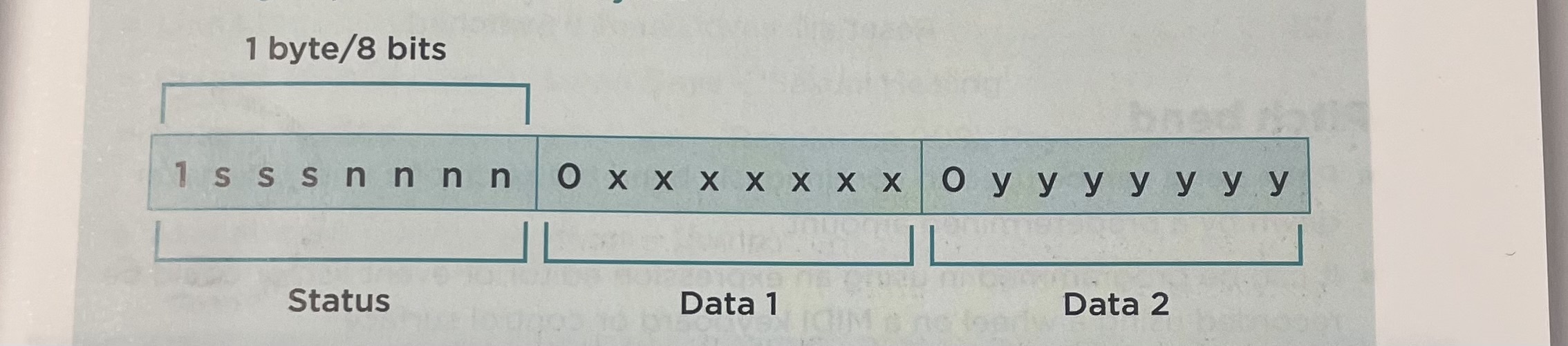
What do status bytes always begin with, and what do data bytes always begin with (as seen in example)
Status bytes always begin with 1.
Data bytes always begin with 0.
How is velocity data transmitted in a midi message?
As part of the second data byte in a note.
What type of system is binary?
A base 2 system.
What’s the number of possible values in binary code?
The number of possible values is given by 2 to the power of 8 (given by calculation 2 to the power of x). So
the possible values of 8 bits is 256.
Why can we only use 7 bits to represent velocity?
As the first bit is used to distinguish between a status and data byte.
So how many possible values are there for a note’s velocity?
2 to the power of 7 = 128.
Therefore there are 128 possible values for a note’s velocity: 0-127
What are some examples of other MIDI messages?
Aftertouch, pitch bend, program changes
What are midi controllers?
Hardware that transmits MIDI data to MIDI enabled devices.
These are normally connected to a computer or synthesiser.
What are the two types of controllers?
Switched and continuous.
What are some examples of controller names?
Modulation
Volume
Pan
Expression
Sustain
Portamento
Each controller has a a value between 0 and 127.
What is pitch bend?