week 39 - care for the elderly woman
0.0(0)
Studied by 0 people Call Kai
 Learn
Learn Practice Test
 Spaced Repetition
 Match
Match Flashcards
 Knowt Play
Card Sorting
1/7

There's no tags or description
Looks like no tags are added yet.
Last updated 4:05 PM on 7/8/26
Name | Mastery | Learn | Test | Matching | Spaced | Call with Kai | Chat |
|---|
No analytics yet
Send a link to your students to track their progress
8 Terms
1
New cards
statement: older women have a longer lifetime than men, but are also burdened by chronic diseases and functional impairment for longer, and have a higher frailty level than men when they are at the same age
flip
flip
This increase in chronic disease burden often results in polypharmacy, and in having treatment prescribed by several medical specialists at the same time
2
New cards
postmenopausal women experience…
loss of bone mineral density, decreased muscle strength, weight gain and changes in body composition, with an increase in body fat content, increased cardiovascular risk, and a slow deterioration in cognitive function
early menopause is associated with an even higher cardiovascular and cerebrovascular risk, but the causality is still uncertain
early menopause is associated with an even higher cardiovascular and cerebrovascular risk, but the causality is still uncertain
3
New cards
physiology of ageing
* due to limited reserve and recovery capacity of the cells and organs as well as accumulation of damage due to ageing
* most important molecular and cellular ageing mechanisms:
1. oxidative stress
bruh… do we need to know the chemistry behind it?
* antioxidants reduce the negative effects of oxidative stress (namely radicals, i think?)
2. maillard reaction with production of glycosylation products (eg. AGEs) → protein glycation
3. protein aggregation (particularly amyloidosis which occurs in multiple organs)
4. inflammation
5. mechanical damage/wear and tear (particularly in joints)
6. protein glycation
7. mutations and methylation of DNA (eg. due to UV)
8. accumulation of residues (eg. lipofuscin) in ageing cells (= senescent cells)
* lipofuscin is visible in the ‘liver spots’ on the skin and the yellowing of subcutaneous fat and other organs of older poeple
* through the excretion of inflammatory mediators, these senescent cells give rise to a local inflammatory reaction, possibly dying off as a result of the disruption in their biochemical composition due to the reaction or apoptosis
* cells that rarely, if ever, divide are the most vulnerable to the physiology of ageing (eg. brain cells)
* both the total life expectancy at advanced age and the life expectancy in good and poor health are heavily dependent upon social-economic class, education, vulnerability and disease burden
* life expectancy of an 80 y/o woman with high education is 15 but 5 in low education, primarily due to lifestyle differences
* *In outlining the scenarios for diagnosis and treatment, this life expectancy and the ‘time needed for benefit’ – the time needed in order to experience benefit from a treatment (e.g. 3–5 years for osteoporosis treatment) – are combined with the ‘time needed to harm’ (the time that is likely to elapse before encountering the disadvantages of a treatment) to arrive at a framework for individualized decision-making*
* disposable soma theory, antagonistic pleiotropy\*\*\*\*\*\*\*
* most important molecular and cellular ageing mechanisms:
1. oxidative stress
bruh… do we need to know the chemistry behind it?
* antioxidants reduce the negative effects of oxidative stress (namely radicals, i think?)
2. maillard reaction with production of glycosylation products (eg. AGEs) → protein glycation
3. protein aggregation (particularly amyloidosis which occurs in multiple organs)
4. inflammation
5. mechanical damage/wear and tear (particularly in joints)
6. protein glycation
7. mutations and methylation of DNA (eg. due to UV)
8. accumulation of residues (eg. lipofuscin) in ageing cells (= senescent cells)
* lipofuscin is visible in the ‘liver spots’ on the skin and the yellowing of subcutaneous fat and other organs of older poeple
* through the excretion of inflammatory mediators, these senescent cells give rise to a local inflammatory reaction, possibly dying off as a result of the disruption in their biochemical composition due to the reaction or apoptosis
* cells that rarely, if ever, divide are the most vulnerable to the physiology of ageing (eg. brain cells)
* both the total life expectancy at advanced age and the life expectancy in good and poor health are heavily dependent upon social-economic class, education, vulnerability and disease burden
* life expectancy of an 80 y/o woman with high education is 15 but 5 in low education, primarily due to lifestyle differences
* *In outlining the scenarios for diagnosis and treatment, this life expectancy and the ‘time needed for benefit’ – the time needed in order to experience benefit from a treatment (e.g. 3–5 years for osteoporosis treatment) – are combined with the ‘time needed to harm’ (the time that is likely to elapse before encountering the disadvantages of a treatment) to arrive at a framework for individualized decision-making*
* disposable soma theory, antagonistic pleiotropy\*\*\*\*\*\*\*
4
New cards
health is…
a state of complete physical, mental and social well-being, and not merely the absence of disease or defect
5
New cards
frailty
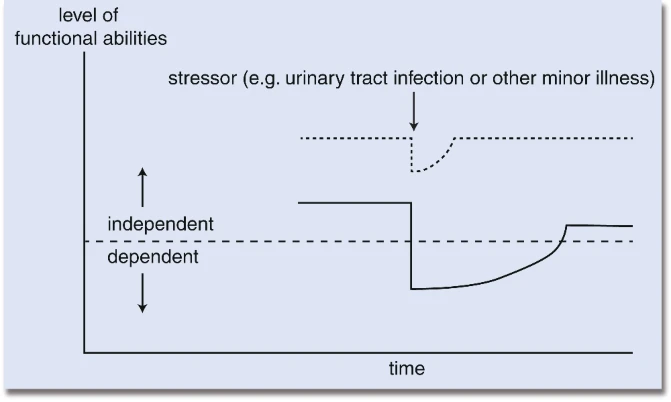
* develops as a consequence of age-related decline in many physiological systems, collectively resulting in vulnerability to sudden changes in health status triggered by minor stressor events
* can be seen as a reduced ability to maintain functional equilibrium
* !! under the influence of a stressor, therefore, frailty may lead to disability or, in the case of urinary tract infections, to delirium, which is otherwise only a minor stressor
* frailty assessment?
* in frail older patients, geriatric syndromes are highly prevalent
* eg. impaired mobility, falls, incontinence, depression, acute confusion state and dizziness
* a geriatric syndrome is one in which one or more of these symptoms are due to the presence of ==__several disorders__== at the same time
* for example, dizziness occurs due to impaired proprioceptive sensory function, loss of muscle power, drug-related adverse effects, orthostatic hypotension and benign paroxysmal positional vertigo-based dizziness
* so geriatric syndrome is a multi factorial aetiology, it occurs mainly with frailty, it serves as a prognostic marker for increased risk of complications/side effects and higher mortality
* the current quality standard for identifying geriatric syndromes is the CGA → comprises a geriatric, neurological, internal medicine, psychiatric and orthopaedic physical examination, in order to detect all potential problems in frail elderly patients
* can be seen as a reduced ability to maintain functional equilibrium
* !! under the influence of a stressor, therefore, frailty may lead to disability or, in the case of urinary tract infections, to delirium, which is otherwise only a minor stressor
* frailty assessment?
* in frail older patients, geriatric syndromes are highly prevalent
* eg. impaired mobility, falls, incontinence, depression, acute confusion state and dizziness
* a geriatric syndrome is one in which one or more of these symptoms are due to the presence of ==__several disorders__== at the same time
* for example, dizziness occurs due to impaired proprioceptive sensory function, loss of muscle power, drug-related adverse effects, orthostatic hypotension and benign paroxysmal positional vertigo-based dizziness
* so geriatric syndrome is a multi factorial aetiology, it occurs mainly with frailty, it serves as a prognostic marker for increased risk of complications/side effects and higher mortality
* the current quality standard for identifying geriatric syndromes is the CGA → comprises a geriatric, neurological, internal medicine, psychiatric and orthopaedic physical examination, in order to detect all potential problems in frail elderly patients
6
New cards
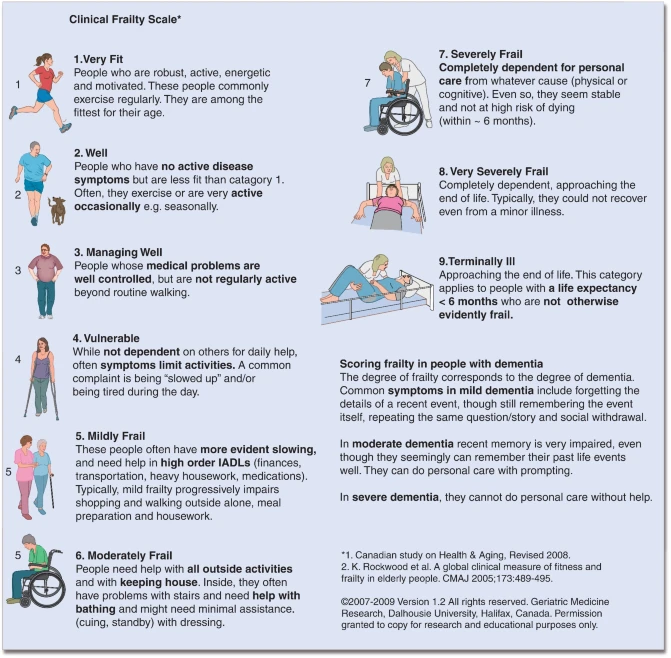
clinical frailty scale
7
New cards
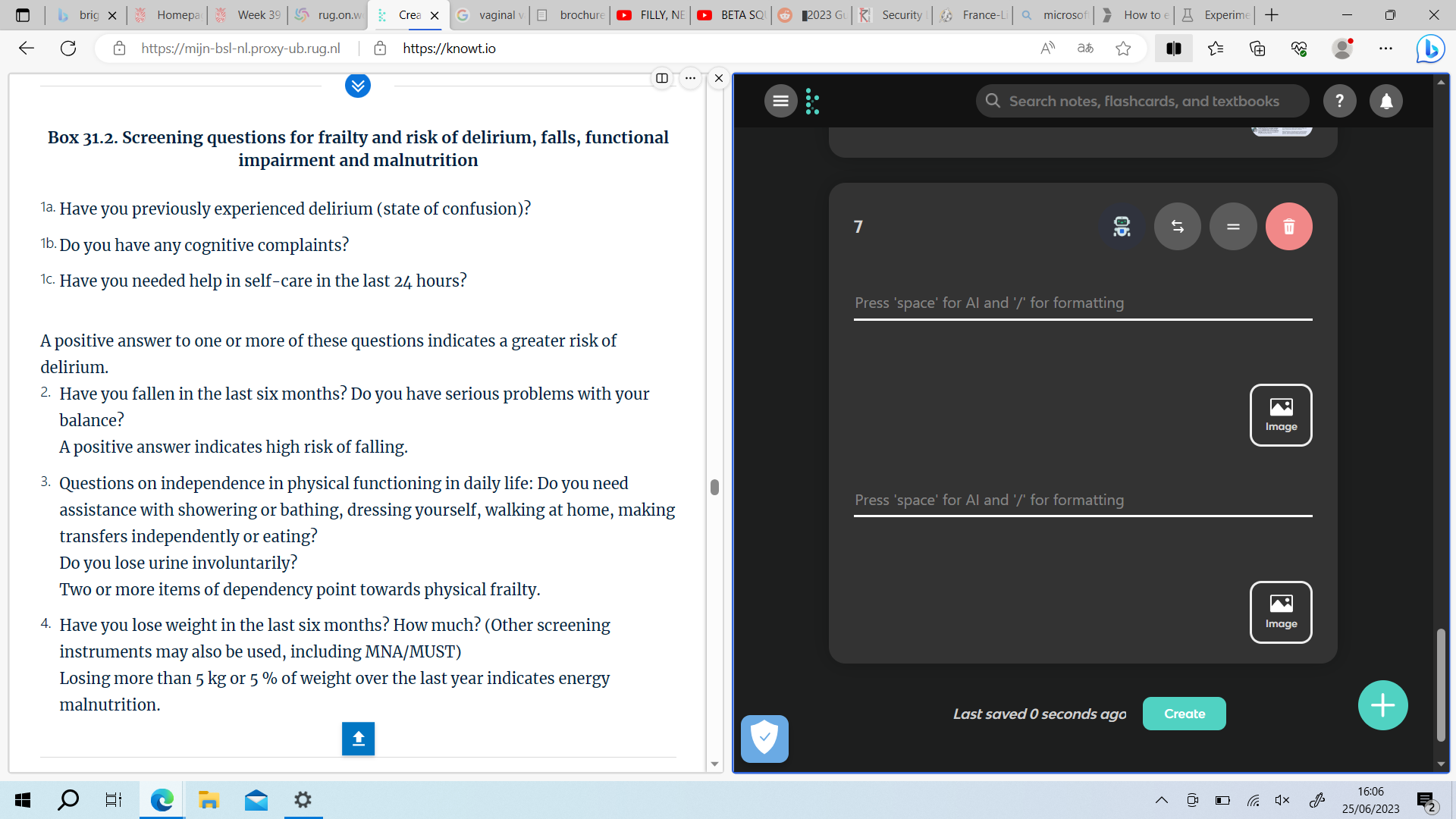
Screening questions for frailty and risk of delirium, falls, functional impairment and malnutrition
A positive score on one or more of these four items indicates frailty, which means that it would be best to involve a geriatric team if the patient is hospitalized
8
New cards
this chapter had so much bullshit i almost jumped out a window, go over it, or dont, wont make a difference