BIO 207 Exam 3
 View linked note
 Call Kai
 Learn
Learn Practice Test
 Spaced Repetition
 Match
Match Flashcards
 Knowt Play
1/196

There's no tags or description
Looks like no tags are added yet.
Name | Mastery | Learn | Test | Matching | Spaced | Call with Kai |
|---|
No analytics yet
Send a link to your students to track their progress
197 Terms
Skin & Mucosal System Defenses
tight junctions in epithelial tissue, mucus
Diet and drugs
Can alter normal flora
Antimicrobial secretions
lysozyme, defensin proteins, blood proteins, fatty acids
bacteria, saliva, tears
Lysozyme and other enzymes kill ___ in ____ and _____
insert, membranes
Defensin proteins ______ in microbial ________
sequester
Blood proteins _______ nutrients
lower
Fatty acids on skin ____ pH
cilia/mucus movement and urine flushing
Physical removal (general defense)
closed
Blood is a ______ loop powered by the heart
drainage system
Lymph is a _________ returning tissue fluid to blood
one-way, chest
______ valves keep lymph moving to ______
Extravasation
white blood cells move in and out of lymph
thymus, bone marrow, develop
The ______ and ______ are primary organs/tissues, where lymphocytes ______
spleen, lymph nodes, tonsils, adenoids, appendix, collect
The ______, ______, ________, ________, ______ are secondary organs/tissues, where lymphocytes ______
SALT, MALT, GALT
skin, mucus, gut-associated lymphoid tissue
M cells
monitor flora
skin, tonsils, adenoids, intestines
Organs/tissues with M cells
Erythrocytes, enucleated
______ are red blood cells. They are not a part of the immune system. They are _______ and carry oxygen
Platelets
involved in clotting
Leukocytes
White blood cells
Monocytes, dendritic cells, macrophages- phagocytic, antigen-presenting cells (APCs)
Types of white blood cells (there are 4 listed)
engulf, display, peptides
White blood cells _____ foreign cells, viruses, proteins
Break these down & ______ foreign ______ on their surface
Monocytes
WBC that circulate blood
Dendritic cells and macrophages
WBC that attach to different tissues
neutrophils, eosinophils, basophils
types of polymorphonuclear leukocytes (PMNs or granulocytes, in blood)
phagocytic, migrate
neutrophils are _______ cells that ______ to the site of infection
Neutrophil Extracellular Trap (NET)
used by neutrophils to kill cells
Eosinophils
anti-protozoan secretions
Basophils
inflammation mediator
Mast cells
mediate inflammation throughout body, not in blood
Lymphocytes, cancerous, spleen, T, B
_______ are natural killer cells- kill infected or ______ cells
mostly in ____ and lymph nodes
includes ___ cells and ____ cells
T cells
central to adaptive immunity
B cells
part of adaptive immunity, produce antibodies
Plasma proteins, fibrinogen, sequestration
________ are soluble in fluid portion of blood
Consist of: ______ for clotting and antibodies
Iron ______ and other antibacterial proteins
Inflammatory response
a non-specific response to wounds and infection
macrophages, cytokines,
Inflammatory response process:
Resident _______ engulf pathogens and release ______ (chemical alarm signals)
Vasoactive factors and [blank #2] help deliver additional phagocytes
Some [blank #2] initiate healing as pathogens are destroyed
![<p><strong>Inflammatory response process:</strong></p><p>Resident _______ engulf pathogens and release ______ (chemical alarm signals)</p><p>Vasoactive factors and [blank #2] help deliver additional phagocytes</p><p>Some [blank #2] initiate healing as pathogens are destroyed</p>](https://knowt-user-attachments.s3.amazonaws.com/a2d03201-d549-45d0-b6c4-0f8d5a7ab3d8.png)
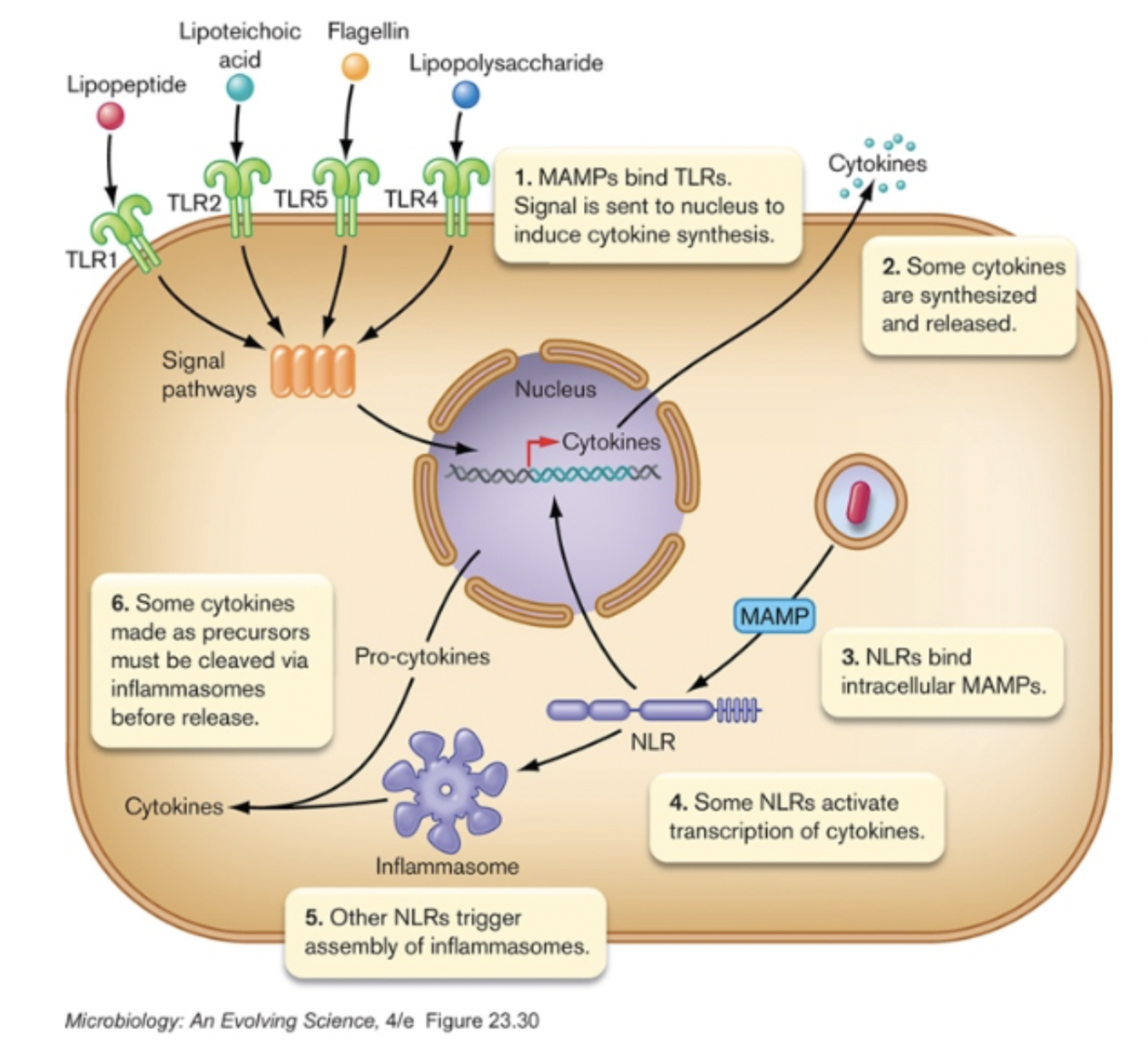
signals, toll, nod, transcription, cytokines
Detection:
Triggered by unique _____ of invader (MAMPs, microbe-associated molecular patterns)
bind to ____-like receptors (in membrane) or _____-like receptors (in cytoplasm)
cause _____ and release of _____
platelets, contain
Clotting factors released by _____ and attempt to ______ infection
phagocyte, self-antigen, leukocytes, cytokines
Phagocytosis:
_______ (macrophage) engulfs microbe
invader is recognized because it does not have ________ (CD47)
microbe is killed/digested in phagolysozome
peptides from invader may be displayed on phagocyte surface
peptide release can stimulate/attract other ________
macrophages also release (and are activated by) ________
capsule
Some pathogens can avoid being engulfed because of _____
increase, opsonization
Antibodies can ______ phagocytosis (________)
antigen presentation
displaying of peptides from invader on phagocyte surface
Extravasation
brings neutrophils from nearby capillaries
endothelial, selectins, integrin, bradykinin, histamines, vasodilation, permeability, edema, prostaglandin
Extravasation:
Cytokines cause local _____ cells to make _____
[blank #2]/_____/ICAM-1 retain passing neutrophils from circulating blood
_____ from damaged host cells loosens connections between [blank #1] cells
allows neutrophils to squeeze out
triggers mast cells to release ________
causes ______ (blood volume increases), bringing more cells
vessel wall _______ increases, leading to ______ (fluid buildup)
triggers _____ release —> pain
blood, temperature, isolate
Benefits of inflammation:
increased ______ volume brings in more antimicrobial agents
increased ______ makes phagocytes more efficient, may inhibit bacteria
clot may ______ area of infection
nutrients, bacterial, blood vessels, host
Downside of inflammation:
may release ______ & promote ______ growth
microbe can gain access to further tissue via ________
high fever can harm ______
chronic inflammation damages host tissue
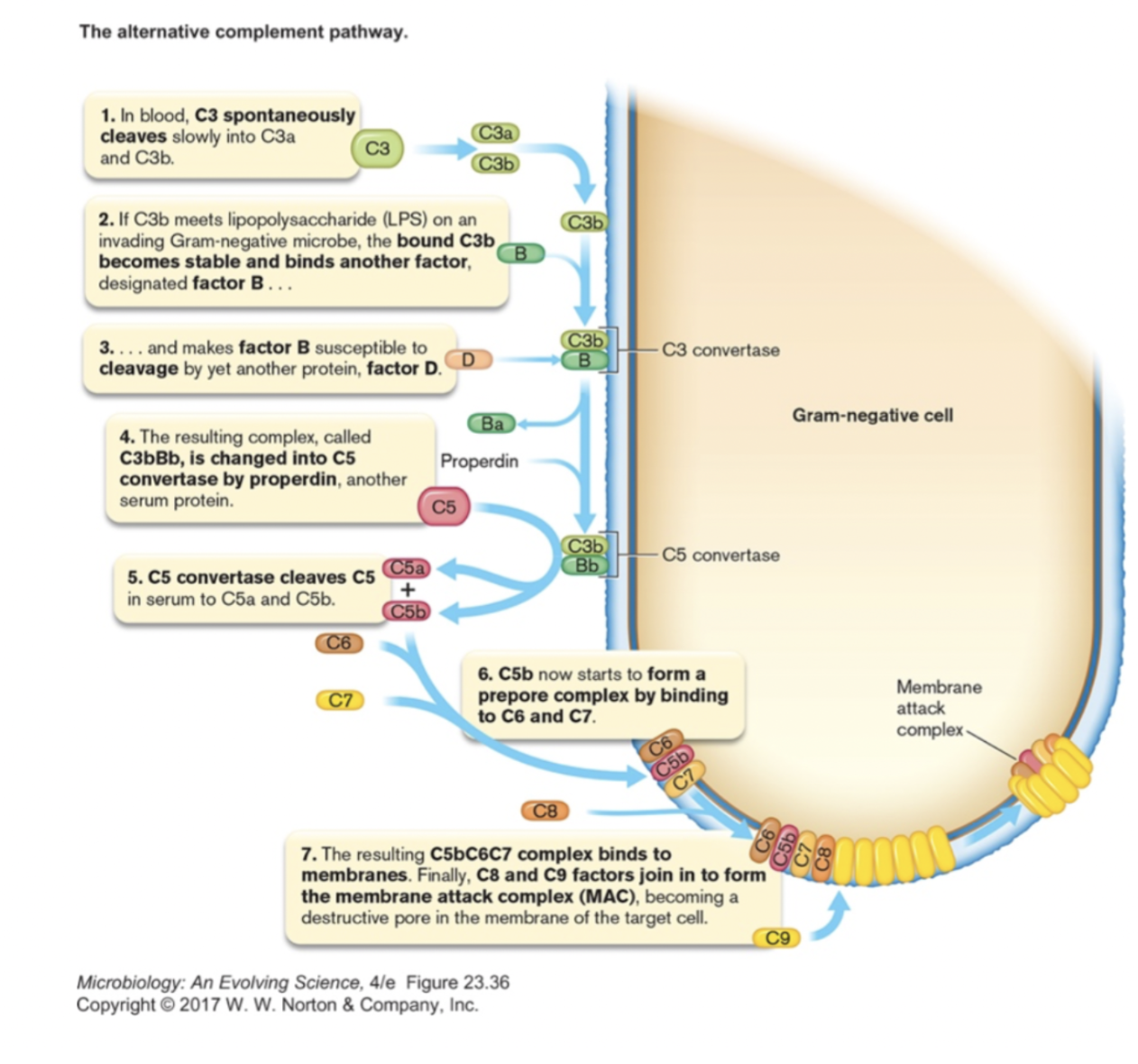
serum, antibodies, cascade, active, inactive
Complement system:
_____ proteins that can work with or independent of ______ to kill bacteria (cytoplasm leaks out and proton gradient cannot be maintained)
______ of protein interactions leads to pores forming in bacterial membrane
Presence of bacteria converts these proteins into their _____ form (exist in blood as _____)
Activated by binding to bacterial cells (LPS) directly or by antibodies sticking to complement cells
Antibodies
secreted proteins that bind antigen
light, heavy, constant (C), variable (V), antigen
Antibody structure:
four polypeptide chains, 2 ____ & 2 ____, held together by disulfide bonds
each chain has ______ and _____ regions
on a given antibody, all binding domains bind the same _____
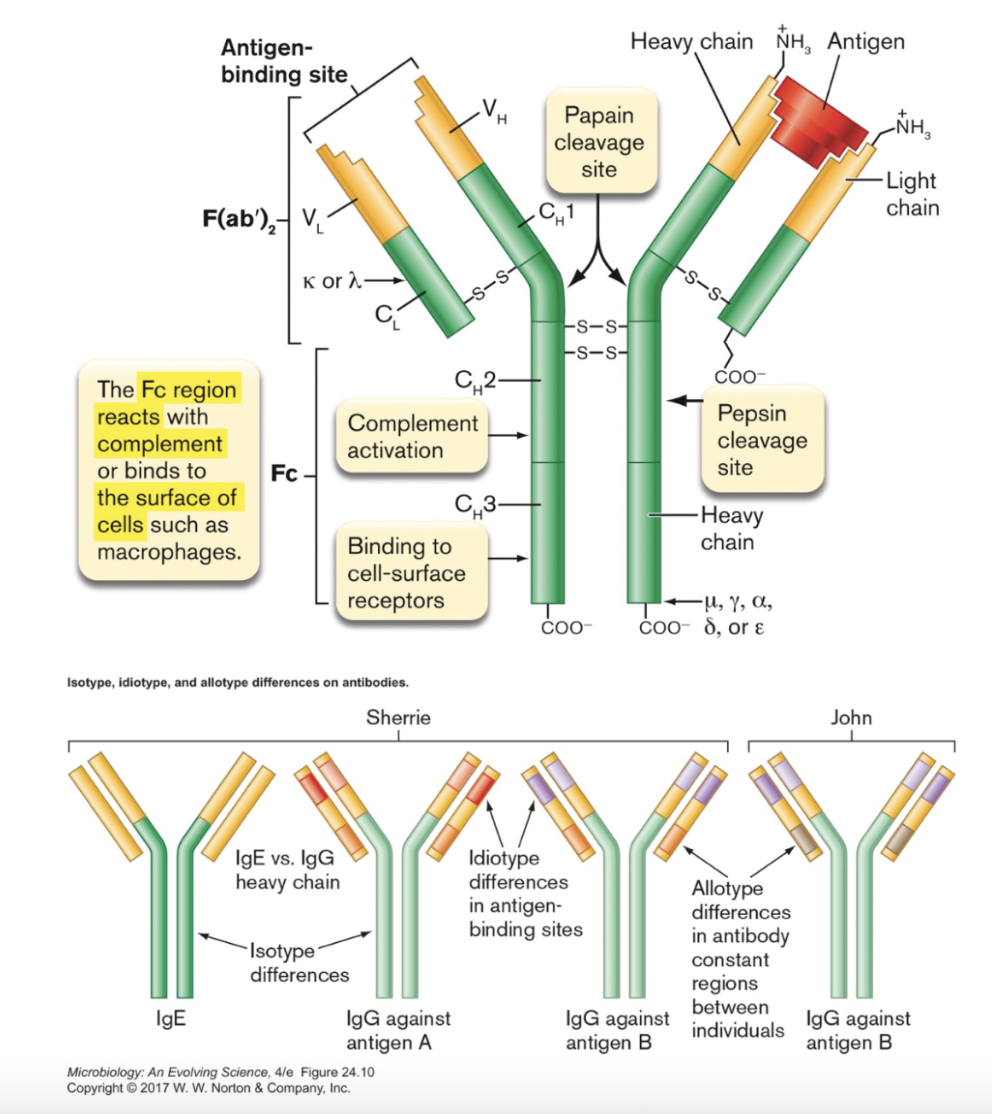
C regions
the same for that individual/chain (allotype) and class (isotype)
V regions
unique to each antibody (idiotype)
antigen binding domains
formed by V regions of 1 H and 1 L chain
antigen
whatever antibody binds to, usually protein (carbohydrate, lipid, DNA)
epitope
the specific part of the antigen being bound
bivalent, blood serum
IgG:
_____ antibody (will bind 2 of the exact same antigen)
found in _______
classic Y-shape
longer, first, bind, presentation
IgM:
five antibody proteins held together
_____ constant domain
generally the ____ Ig made in immune response
IgM monomers in B cell membrane ____ antigen, help bring it in for _______
body secretions
IgA:
two antibodies held together
common in __________ (tears, breast milk, mucus, etc.)
longer, mast, allergic
IgE:
______ constant domain (has CH4)
binds to ____ cells
important in _____ reactions
IgD
helps antigen bind to B cells
Major Histocompatibility Complex (MHC) proteins
exist in plasma membrane of host cells
unique to individual, help determine "self" (HLA type)
two types, both will bind and display antigens
nucleated, alerts, infected cell
MHC I cells:
present in all _____ cells in the body
_____ immune system that the cell is infected
tells immune system to kill _________
takes proteins in the cell and puts them on the surface (holds them there)
B, APCs, activate
MHC II cells:
unique to ___ cells and _____
tells other immune cells that [blank #2] has found a foreign antigen
tells immune system that it found something and to _____ against it
T cell receptor (TCR)
structurally similar to MHC but only found on T-cells
each type will bind only one antigen (with limited cross-reactivity to others)
variable region is different in each cell, ensuring a range of binding specificities
B cell receptor (BCR)
classic antibody sitting in membrane of a B cell
antibodies are secreted by activated B cells
has extra domain in tail to insert into membrane
antigen presentation
I- viruses, cancer; II- proc. antigen
N/A
N/A
N/A
Macrophages dendritic cells receptor interactions:
cell function:
MHC displays:
receptor:
co-receptor:
binds to:
activate other immune cells
I- viruses, cancer
TCR
CD4
MHC II/antigen
helper T cells (T H) receptor interactions:
cell function:
MHC displays:
receptor:
co-receptor:
binds to:
kill infected host cells
I- viruses, cancer
TCR
CD8
MHC I/antigen
Cytotoxic T cells (T C) receptor interactions:
cell function:
MHC displays:
receptor:
co-receptor:
binds to:
antibody production
I- viruses, cancer; II- proc. antigen
BCR
N/A
intact antigen
B cells receptor interactions:
cell function:
MHC displays:
receptor:
co-receptor:
binds to:
N/A
I- viruses, cancer
N/A
N/A
N/A
Body cells receptor interactions:
cell function:
MHC displays:
receptor:
co-receptor:
binds to:
internal, MHC I
All cells display _______ antigens in ______
foreign, T C
if antigens are ______ (viral or cancerous) → activate ______ (cell-mediated immunity)
external, MHC II
only "true" APCs (dendritic cells, macrophages, B cells) process ______ antigens
take in, break down, and display antigens on surface of APC in ______
size, complexity, dosage
Immunogenicity of antigen depends on:
exceeding minimum ____ (5-100 a.a.?)
molecular _______ (proteins > carbohydrates > lipids & nucleic acids)
form (soluble or insoluble)
_____ (not too high, not too low)
route of introduction (injection better than ingestion)
self/non-self (self should not provoke immune response)
antigenic determinant
response is only to small part of immunogen (4-6 a.a.)
called ________ or epitope
a single protein has hundreds of potential epitopes
T-helper cells, T-cytotoxic cells, and B-cells
3 types of cells activated by antigen-presenting cells (APCs)
MHC II, proliferating, differentiating
T-helper cell (TH0) activation:
Signal 1.) TCR fits this particular antigen held in an _____
Signal 2.) TCR CD28 binds to APC’s B7 (serves as confirmation signal)
Signal 3.) Once it is activated, it will start ________ and ___________ (going from TH0 to a different type of TH) and move out into the body looking for infected cells
Cell-Mediated Immunity
effective against virally infected cells or cancerous host cells
operates via activated cytotoxic T-cells (TC)
MHC I, cytokines, T-helper
Cytotoxic T-cell (TC) activation:
Signal 1.) TCR fits this particular antigen held in an _____
Signal 2.) TCR CD28 binds to APC’s B7 (serves as confirmation signal)
Signal 3.) _______ release by an activated ______ cell
activated TC kills infected host cells
capping, free-floating, T-helper cells, plasma
B-cell activation:
can be activated in two ways
______
antigen binds to more than one BCR on its surface
they start clustering together
binding lots of antigen on their surface
change from ______ to clusters is the signal that causes it to activate
interaction with _________
BCR detects something in macrophage’s MHC II that matches the T-cell receptor
confirmatory signal
causes B-cells to differentiate into ______ cells (secrete antibodies) and memory cells
antibody/receptor diversity, clonal, deletion
What the immune system can do:
respond to anything, even if never encountered before (__________)
strengthen its response upon encountering something (______ proliferation and memory)
discriminate between self and non-self (clonal _______)
TCR and CD8
how does TC cell bind to virally infected cell to kill it?
TH2 cell
induces differentiation of B-cell
Virus/toxin neutralization
bind to viral surface or toxin
prevent intended interaction of virus or toxin with host
clump, precipitate
Agglutination/Precipitation:
_____ antigens together
will ______ soluble antigen and agglutinate (clump) cells
allows rapid detection of some infectious agents
cleavage, inflammation, positive
Activate complement system of proteins:
antibody bound to bacterial cell surface triggers binding/_______ of complement proteins
cleaved complement proteins cause _______
other fragments of complement proteins insert into membrane
pores form, cell dies
doesn't work for Gram ________
Opsonization
antibodies and complement on cell surface "flag" cell for phagocytosis
works for all bacteria
can also clump cells or toxin molecules leading to easier phagocytosis
DNA segments
Antibody diversity is created by uniquely splicing ___________ in each B cell
(even more variation because of imprecise joining of segments + high mutation rate during B cell proliferation)
Natural active immunity
disease exposure
infection leads to immune response, boost in memory cells (takes weeks)
second exposure results in stronger, faster response
Artificial active immunity
vaccination
vaccination leads to immune response (takes weeks)
whole organism- killed or attenuated
subunit- natural, modified or recombinant
hapten + carrier molecule- when antigen is too small on its own
second exposure (or booster) results in stronger, faster response
Natural passive immunity
maternal immunity
antibodies are received from mother through placenta, breast milk (instant protection)
no host immune response, no boost for later exposure
Artificial passive immunity
antitoxins
injection of antibodies from another individual or animal (instant protection)
used against toxins
no host immune response, no boost for later exposure
Allergies
an overreaction of the immune system
Autoimmune diseases
the immune system attacks self-antigens
Superantigens
can activate T cells indiscriminately and destabilize the system
deleted
During embryonic/neonatal development, B & T cells that bind antigen (presumed to be self) are _______
bone marrow, thymus
B cells mature in _______
T cells mature in _______
MHC, antigen
if maturing cell does not react with _____, it dies
if maturing cell does react with ______, it dies
macrophages, dendritic cells, and TH cells (immune system cells)
HIV attacks CD4+ cells, which include: ________, ________, ________
Without [blank #3], cannot amplify TC cells or B-cells and entire immune response collapses
detection, identification
Quick _______ and _______ of pathogens is critical to effective treatment
site, contamination, normal flora, oxygen
Proper sampling & handling of samples:
must take sample from ____ of infection
may be swab, blood, fluid or stool collection
include precautions to prevent ________
must not contaminate with _________ (if possible)
must be mindful of _______ tolerance of suspected pathogens