Hydrology, Meteorology, and Geology Revision Vocabulary
 Call Kai
 Learn
Learn Practice Test
 Spaced Repetition
 Match
Match Flashcards
 Knowt Play
1/58

Earn XP
Description and Tags
Vocabulary practice flashcards covering atmospheric dynamics, radiation balance, hydrology, catchment processes, and geological principles based on lecture notes.
Name | Mastery | Learn | Test | Matching | Spaced | Call with Kai | Chat |
|---|
No analytics yet
Send a link to your students to track their progress
59 Terms
Weather
Short-term atmospheric conditions over hours, days, or weeks, including specific events like thunderstorms, cold fronts, or tropical cyclones.
Climate
The average atmospheric conditions and their variability over long periods, typically several decades, at a specific location.
Aerosols
Tiny liquid or solid particles suspended in the atmosphere, such as dust, sea salt, and soot.
Troposphere
The lowermost layer of Earth's atmosphere where most weather events occur.
Coriolis Effect
The apparent deflection of moving objects caused by Earth's rotation, turning moving air and water to the right in the Northern Hemisphere and to the left in the Southern Hemisphere.

Conditionally Unstable Atmosphere
An atmospheric condition where a rising air parcel is stable when unsaturated below the condensation level, but becomes positively buoyant and unstable once saturated above it.
Humidity
A general term for the quantity of water vapour content present in the air.
Vapour Pressure (e)
The partial pressure exerted by water vapour in the atmosphere.
Relative Humidity (e/esat)
The ratio of the actual partial pressure of water vapour (e) to the saturation vapour pressure (esat) at a given temperature.
Dew-point Temperature (Tdew)
The temperature to which air must be cooled at constant pressure to become fully saturated with water vapour.
Dry Adiabatic Lapse Rate
The cooling rate of unsaturated air as it rises and expands without exchanging heat, approximately equal to 9.8∘Ckm−1.
Saturated Adiabatic Lapse Rate
The reduced cooling rate (typically 4–7∘Ckm−1) of rising saturated air, where latent heat released by condensation partially offsets expansion cooling.
Adiabatic Process
A thermodynamic process in which a parcel of air undergoes temperature changes due to expansion or compression without exchanging heat energy with its surroundings.
Albedo
The fraction or percentage of incoming shortwave solar radiation reflected by a surface rather than absorbed.
Stefan-Boltzmann Law
A fundamental physical law predicting that the total energy radiated per unit area of a body is proportional to the fourth power of its absolute temperature (E=σT4).
Greenhouse Effect
The mechanism whereby atmospheric greenhouse gases absorb outgoing thermal longwave radiation from Earth's surface and re-radiate a portion back down, warming the lower atmosphere.
Catchment
An area of land bounded by topographic divides in which all incoming precipitation and surface runoff drain toward a single common outlet point.
Porosity
The ratio of the volume of pore spaces in a soil or rock sample to its total bulk volume.
Field Capacity
The soil moisture content retained in a soil profile after excess gravity water has drained away.
Wilting Point (θwp)
The minimal soil moisture level below which plants can no longer extract water from the soil, causing permanent wilting.
Potential Evapotranspiration (PET)
The maximum rate of evapotranspiration possible under given atmospheric and energy conditions when soil water supply is unlimited.
Actual Evapotranspiration (AET)
The actual rate of water vaporized and transpired from a landscape, constrained by both available solar energy and soil moisture supply.
Baseflow
The sustained, slow-moving portion of streamflow derived from groundwater discharge into a stream channel between rainfall events.
Mineral
Solid, naturally occurring, inorganic, ordered crystalline structure, defined chemical composition.
Silicon-Oxygen Tetrahedron
The fundamental structural building block (SiO44−) of all silicate minerals, consisting of a central silicon atom bonded to four surrounding oxygen atoms.
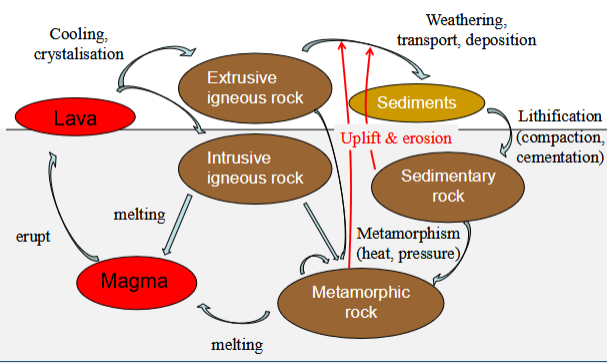
Draw out the Rock Cycle
A continuous geological process model illustrating how igneous, sedimentary, and metamorphic rocks are formed, broken down, transformed, and recycled over time.
Magmatic Differentiation
The process during magma cooling where early-formed mineral crystals separate from the melt, changing the remaining chemical composition of the magma.
Metamorphism
The solid-state transformation of a pre-existing rock into a new rock type through high heat, intense pressure, and chemically active fluids without melting completely.
Aerosols
Tiny liquid or solid particles suspended in the atmosphere, such as dust, sea salt, and soot.
Darcy's Law
A physical relationship stating that fluid flow rate through a porous medium is directly proportional to hydraulic conductivity and the hydraulic gradient (Q=−KAdldh).
Infiltration Excess Runoff
Overland surface flow generated when the rainfall intensity exceeds the infiltration capacity of the soil.
Saturation Excess Runoff
Overland surface flow generated when precipitation falls onto soil that is already fully saturated to the ground surface.
Isostasy
The gravitational equilibrium between Earth's lithosphere and asthenosphere, causing crustal blocks to float at elevations proportional to their thickness and density.
Lithification
The set of processes (compaction and cementation) that converts loose, unconsolidated sediment into solid sedimentary rock.
Difference between a dam and a reservoir
A dam is the physical barrier structure holding back water, whereas a reservoir is the body of water or artificial lake that accumulates behind the barrier.
Four most common gases in Earth's atmosphere
Nitrogen (78%), Oxygen (21%), Argon (0.93%), and Carbon dioxide (0.04%).
Density comparison between warm air and cool air at a given pressure
Warm air is less dense than cool air because heating causes air to expand, spreading the same mass over a larger volume.
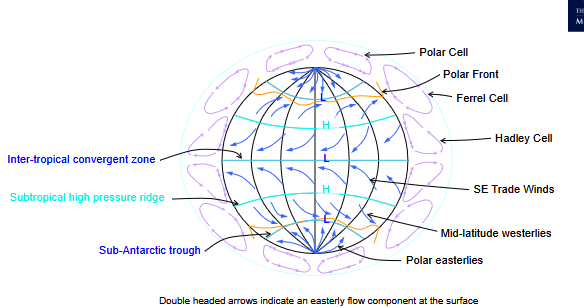
Three meridional circulation cells in each hemisphere
Hadley Cell (0∘–30∘), Ferrel Cell (30∘–60∘), and Polar Cell (60∘–90∘).
Distinction between precipitation mechanisms in warm clouds (T>0∘C) and cold clouds (T<0∘C)
Warm clouds produce rain via collision and coalescence of liquid droplets. Cold clouds feature coexisting ice crystals and supercooled water, where ice crystals grow rapidly at the expense of water droplets to form snowflakes.
Four primary atmospheric uplift processes
Convection (surface heating), Convergence (colliding air masses), Frontal lifting (warm air forced over cold air), and Orographic lifting (air forced over topography).
Radiative property difference between a black body and a grey body
A black body absorbs all incident radiation and emits maximum possible energy at all wavelengths; a grey body reflects some incident radiation and emits less efficiently than a black body.
Key features of solar passive building design
Uses orientation (e.g., north-facing windows in Southern Hemisphere), shading/eaves, thermal mass, and insulation to admit low winter sun for heating while blocking high summer sun to maintain cooling.
Difference between the natural greenhouse effect and the enhanced greenhouse effect
The natural effect keeps Earth ∼33∘C warmer than baseline via naturally occurring gases; the enhanced effect is additional warming driven by anthropogenic greenhouse gas emissions.
Distinction between baseflow and event runoff in streamflow
Baseflow is sustained, slow groundwater discharge between storms; event runoff (quickflow) is the rapid rise in streamflow generated directly by surface and shallow subsurface pathways during rainfall.
Four principal structural layers of Earth
Rigid crust (oceanic and continental), solid plastic mantle, liquid iron-nickel outer core, and solid iron-nickel inner core.
Elastic rebound mechanism for earthquake generation
Tectonic stress gradually accumulates along a locked fault until it exceeds friction, causing the rock to snap back elastically and release stored energy as seismic waves.
Three main types of geological faults
Normal faults (extensional dip-slip), Reverse/Thrust faults (compressional dip-slip), and Strike-slip faults (horizontal shearing).
Three types of tectonic plate margins
Divergent (pulling apart/new crust), Convergent (colliding/subduction), and Transform (sliding horizontally).
Eight primary rock-forming minerals
Quartz, Feldspar, Mica, Amphibole, Pyroxene, Olivine, Calcite, and Clay minerals.
Difference between mineral cleavage and mineral fracture
Cleavage is breaking along smooth, parallel structural planes of weak atomic bonds; fracture is an irregular break independent of internal atomic planes.
Relationship between magma cooling rate and mineral crystal size
Slow cooling deep underground forms large, coarse-grained crystals (e.g., granite); rapid cooling at or near the surface forms fine-grained or glassy textures (e.g., basalt, obsidian).
Bowens-Reaction series
Four main compositional categories of igneous rocks ordered by decreasing silica content
Felsic (high silica, light color, lower density), Intermediate, Mafic (high Fe/Mg, dark color, dense), and Ultramafic (lowest silica, highest density).
Compaction and cementation in sedimentary rock formation
Compaction reduces pore space in fine sediments under overburden pressure; cementation precipitates binding minerals (calcite, silica, iron oxide) in coarse sediment pores.
Distinction between regional metamorphism and contact metamorphism
Regional metamorphism occurs over vast areas due to high pressure and temperature during mountain building; contact metamorphism is localized heating adjacent to an intruding magma body.
Distinction between foliated and non-foliated metamorphic textures
Foliated texture shows parallel mineral alignment or banding from directed differential pressure (e.g., slate, schist, gneiss); non-foliated texture shows random mineral orientation from uniform pressure (e.g., marble, quartzite).
Draw out the atmosphere circulation and explain why the circulation forms this way?
Circulation is form this way due to the uneven distribution of radiation from the sun (equator gets more radiation) and the Coriolis effect (Earth’s rotation affecting objects movement)
Agents of Erosion
Water, Wind, Ice, and Gravity
Formulas to Know:
1 ML
Depth
Runoff coefficent
Soil Storage final
Psoil
AET
Total Runoff
Total Runoff Volume
1ML = 1000m3
Depth = Volume/Area **Use if for avg. annual runoff
Runoff coefficent = runoff depth/precipation depth
C = Q/P
Soil Storage final **based off of water balance equation
Sfinal=Sinital + Psoil - AET - Baseflow
Psoil = P . (1-% of saturated soil)
AET = P - avg. annual runoff depth **this one is not given
Total Runoff = surface runoff + baseflow
Total Runoff Volume = total runoff . catchment area
Convert total runoff into volume using catchment area **translate to the same units
Draw the catchment water cycle
